Singapore Cloud VPN Market Size & Growth Rate (2026-2032)
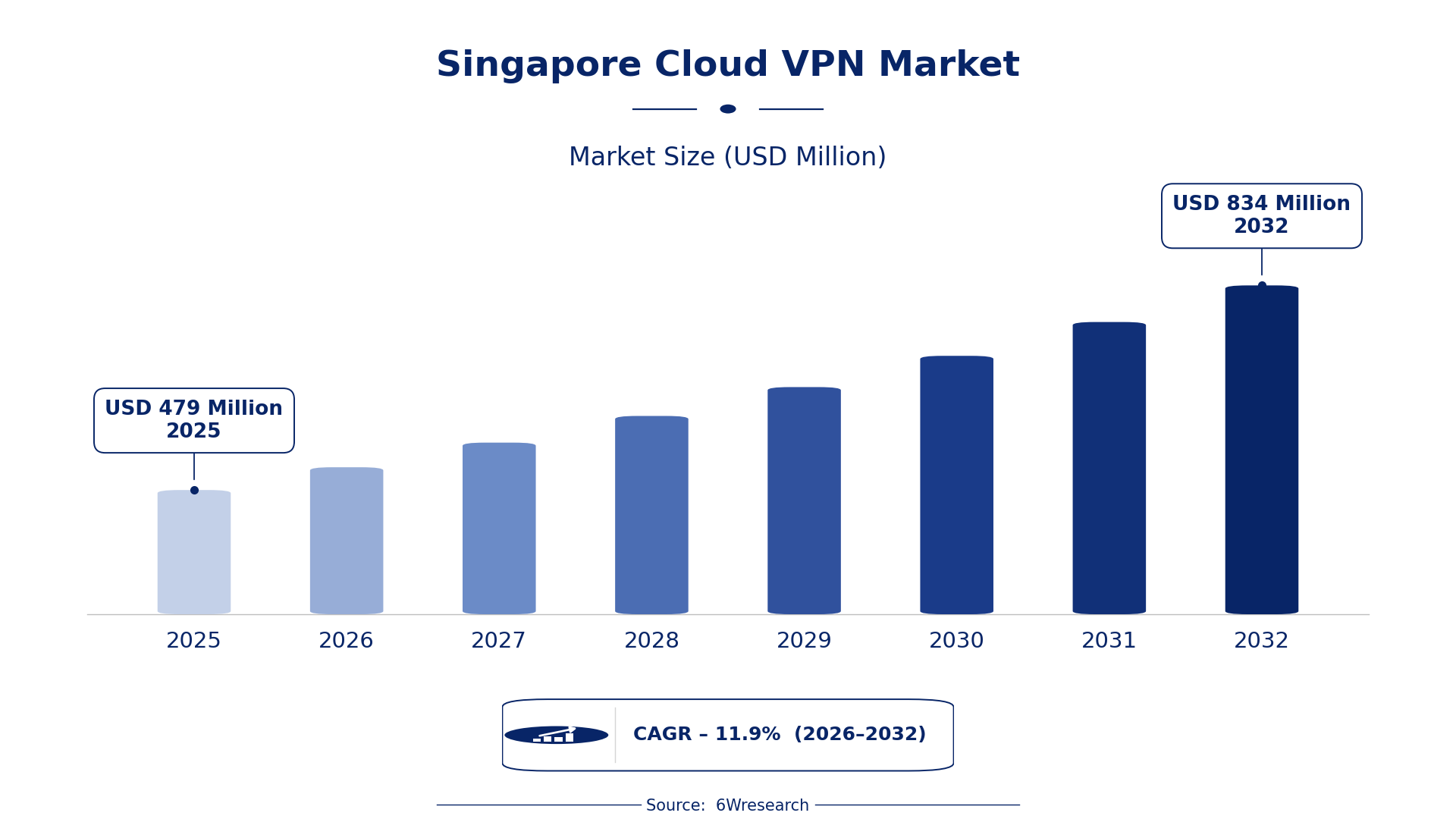
The Singapore Cloud VPN Market was estimated at USD 479 Million in 2025 and is projected to reach USD 834 Million by 2032, growing at a CAGR of 11.9% from 2026 to 2032.
Singapore Cloud VPN Market Synopsis
Singapore's Cloud VPN market is witnessing rapid growth, largely fueled by the shift towards remote work. As organizations embrace flexible working arrangements, the need for secure, scalable network solutions has intensified. The cloud VPN technology is emerging as a key enabler, providing businesses with efficient access to company resources while ensuring data privacy.
Organizations are increasingly adopting cloud-based applications, which necessitate reliable VPN solutions. Cloud VPNs are attractive due to their ease of scalability and lower operational costs, making them a preferred choice for businesses in Singapore. As the digital landscape continues to evolve, these solutions are set to become indispensable for secure connectivity.
Singapore Cloud VPN Market Year-wise Growth Rate and Key Drivers
This graph illustrates the annual growth rates of the Singapore Cloud VPN Market from 2021 to 2032, highlighting a steady upward trajectory and projected expansion over the forecast period.
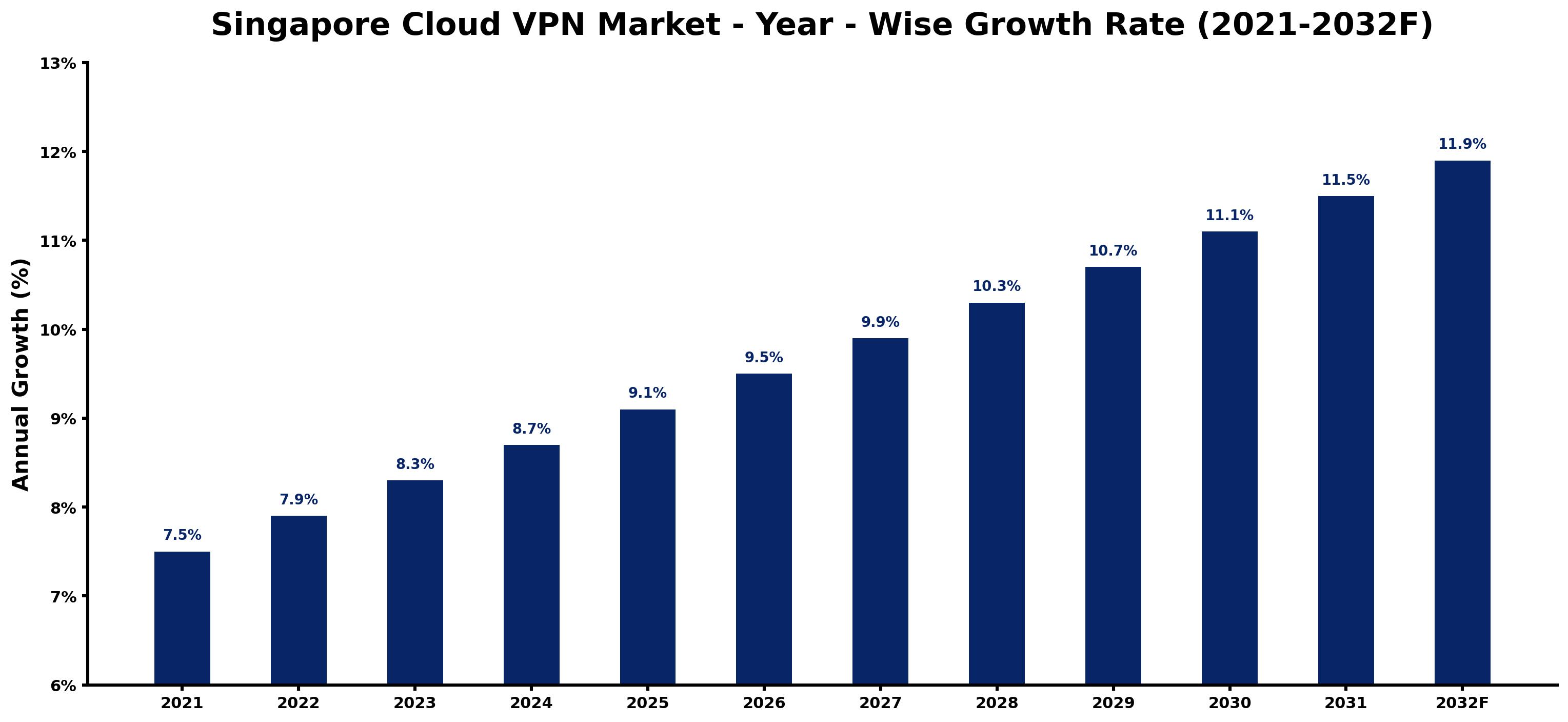
The table below presents the year‑wise growth rates along with the key drivers influencing the market
| Year | Growth Rate | Major Drivers |
| 2021 | 7.5% | Regulatory push for enhanced cybersecurity compliance by IMDA. |
| 2022 | 7.9% | Increased remote work driving demand for secure connectivity. |
| 2023 | 8.3% | Government initiatives supporting digital transformation in enterprises. |
| 2024 | 8.7% | Growing awareness of data privacy regulations among SMEs. |
| 2025 | 9.1% | Surge in adoption of multi-cloud strategies by local businesses. |
| 2026 | 9.5% | Enhanced network infrastructure boosting user access and speed. |
| 2027 | 9.9% | Rise in cybersecurity threats increasing VPN necessity. |
| 2028 | 10.3% | Emergence of 5G expanding mobile cloud services usage. |
| 2029 | 10.7% | Support for fintech innovations requiring secure data channels. |
| 2030 | 11.1% | Local demand for telehealth services driving VPN uptake. |
| 2031 | 11.5% | Government grants incentivizing digital security investments. |
| 2032 | 11.9% | Strategic partnerships enhancing VPN offerings in regional markets. |
Note: Market size estimations and growth projections presented in this report are based on 6Wresearch's proprietary forecasting methodology, utilizing the latest available industry data, government publications, and primary research inputs.
Singapore Cloud VPN Market Key Takeaways
Below are some of the specific key takeaways from the market, including:
- The market is driven by a growing demand for remote work solutions that prioritize security.
- Organizations are increasingly investing in cloud VPNs to enhance their operational efficiency.
- Data privacy and compliance challenges remain critical considerations for cloud VPN providers.
- Innovations in cloud VPN technology are emerging in response to evolving business needs.
- The COVID-19 pandemic has significantly accelerated the adoption of cloud VPN solutions.
Evaluation of Restraints in Singapore Cloud VPN Market
Despite its growth potential, the Singapore Cloud VPN market faces notable restraints. Data security and compliance are paramount concerns; organizations must implement strong encryption measures to safeguard sensitive information. Additionally, the pressure to comply with stringent data protection regulations can hinder the rapid deployment of cloud VPN services. As businesses wrestle with these challenges, the necessity for balancing convenience with security becomes even more pronounced.
Singapore Cloud VPN Market Trends
Emerging trends in the Singapore Cloud VPN market highlight a shift towards more sophisticated security protocols. Companies are seeking solutions that offer not just basic functionality but advanced features like multi-factor authentication and enhanced data encryption. As hybrid work models become standard, the demand for VPN services that can support a diverse range of devices and locations is on the rise.
Furthermore, integration with Artificial Intelligence and machine learning is beginning to shape the development of next-generation cloud VPN solutions. These technologies aim to enhance performance, automate threat detection, and streamline user experiences. Businesses are recognizing the value of such innovations, which position cloud VPNs as essential tools in today’s digital economy.
Singapore Cloud VPN Market Opportunities
The market is rife with opportunities as organizations navigate the complexities of digital transformation. Demand for customized cloud VPN solutions tailored to specific industry needs is growing, particularly in sectors such as finance and healthcare, where data protection is critical. Additionally, small and medium-sized enterprises (SMEs) are increasingly recognizing the importance of secure remote access, opening avenues for service providers to capture this demographic.
There’s also potential for cloud VPN providers to explore partnerships with cybersecurity firms, which can enhance their offerings with integrated security features. As businesses prioritize cybersecurity, robust cloud VPN solutions equipped with advanced security functionalities will likely stand out in a crowded market.
Government Initiatives in the Singapore Cloud VPN Market
Government policies in Singapore are increasingly influencing the Cloud VPN market, with a focus on strengthening digital infrastructure and ensuring data privacy. The regulatory environment is designed to promote secure online transactions and protect sensitive information, which aligns closely with the needs of the Cloud VPN market. Government initiatives seek to foster a trusted digital ecosystem, critical for businesses leveraging cloud technologies.
- A national digital infrastructure upgrade programme launched in early 2023 aims to enhance connectivity across sectors, including public and private enterprises.
- The Personal Data Protection Commission is currently updating its guidelines to address emerging cybersecurity threats, enhancing compliance frameworks for cloud services.
- In 2025, the government plans to introduce a regulatory framework mandating stronger encryption standards for all cloud-based services, directly impacting the Cloud VPN market.
- A public-private partnership initiative is underway, expected to focus on expanding digital security education and resources for SMEs by mid-2026.
Future Insights of the Singapore Cloud VPN Market
Looking ahead to 2026-2032, the Singapore Cloud VPN market is set for substantial growth driven by ongoing shifts towards remote work and digitalization. As organizations increasingly prioritize secure access to applications and data, demand for versatile cloud VPN solutions will likely rise. Furthermore, advancements in encryption technologies and user-friendly features will create a more competitive environment, compelling providers to innovate continuously.
Singapore Cloud VPN Market Latest Developments
In the past year, the Singapore Cloud VPN market has experienced various developments that reflect the increasing emphasis on security and usability. Major technology vendors are actively enhancing their services to better meet the needs of businesses adapting to hybrid work models. Enhanced focus on user experience and security features is transforming how cloud VPN solutions are deployed across industries.
- A leading regional operator rolled out an upgraded cloud VPN service in Q2 2023, incorporating advanced threat detection and response capabilities.
- A partnership between a major technology vendor and a cybersecurity firm began in early 2023, focusing on integrating AI-driven security features into cloud VPN offerings.
- A technology vendor announced plans for an upcoming service expansion in the second half of 2024, targeting SMEs with tailored cloud VPN solutions.
- A cloud VPN platform is currently undergoing a service enhancement that started in late 2023, aimed at improving scalability and performance for enterprise clients.
Singapore Cloud VPN Market - Key Attractiveness of the Report
- 10 Years of Market Numbers
- Historical Data Starting from 2022 to 2025
- Base Year: 2025
- Forecast Data until 2032
- Key Performance Indicators Impacting the Market
- Major Upcoming Developments and Projects
Key Highlights of the Report:
- Singapore Cloud VPN Market Outlook
- Market Size of Singapore Cloud VPN Market, 2025
- Forecast of Singapore Cloud VPN Market, 2032
- Historical Data and Forecast of Singapore Cloud VPN Revenues & Volume for the Period 2022-2032F
- Singapore Cloud VPN Market Trend Evolution
- Singapore Cloud VPN Market Drivers and Challenges
- Singapore Cloud VPN Price Trends
- Singapore Cloud VPN Porter's Five Forces
- Singapore Cloud VPN Industry Life Cycle
- Historical Data and Forecast of Singapore Cloud VPN Market Revenues & Volume By Component for the Period 2022-2032F
- Historical Data and Forecast of Singapore Cloud VPN Market Revenues & Volume By Software for the Period 2022-2032F
- Historical Data and Forecast of Singapore Cloud VPN Market Revenues & Volume By Services for the Period 2022-2032F
- Historical Data and Forecast of Singapore Cloud VPN Market Revenues & Volume By Connectivity Type for the Period 2022-2032F
- Historical Data and Forecast of Singapore Cloud VPN Market Revenues & Volume By Site-to-Site for the Period 2022-2032F
- Historical Data and Forecast of Singapore Cloud VPN Market Revenues & Volume By Remote Access for the Period 2022-2032F
- Historical Data and Forecast of Singapore Cloud VPN Market Revenues & Volume By Organization Size for the Period 2022-2032F
- Historical Data and Forecast of Singapore Cloud VPN Market Revenues & Volume By Large Enterprises for the Period 2022-2032F
- Historical Data and Forecast of Singapore Cloud VPN Market Revenues & Volume By SMEs for the Period 2022-2032F
- Historical Data and Forecast of Singapore Cloud VPN Market Revenues & Volume By End User for the Period 2022-2032F
- Historical Data and Forecast of Singapore Cloud VPN Market Revenues & Volume By Service Providers for the Period 2022-2032F
- Historical Data and Forecast of Singapore Cloud VPN Market Revenues & Volume By Verticals for the Period 2022-2032F
- Singapore Cloud VPN Import Export Trade Statistics
- Market Opportunity Assessment By Component
- Market Opportunity Assessment By Connectivity Type
- Market Opportunity Assessment By Organization Size
- Market Opportunity Assessment By End User
- Singapore Cloud VPN Top Companies Market Share
- Singapore Cloud VPN Competitive Benchmarking By Technical and Operational Parameters
- Singapore Cloud VPN Company Profiles
- Singapore Cloud VPN Key Strategic Recommendations






































