Singapore Coaxial Cables Market Summary
The singapore coaxial cables market was estimated at USD 203 Million in 2025 and is projected to reach USD 275 Million by 2032, growing at a CAGR of 5.4% from 2026 to 2032.
Singapore Coaxial Cables Market Year-wise Growth Rate and Key Drivers
This graph highlights how the Singapore Coaxial Cables Market has steadily grown over the past five years, supported by major growth factors.
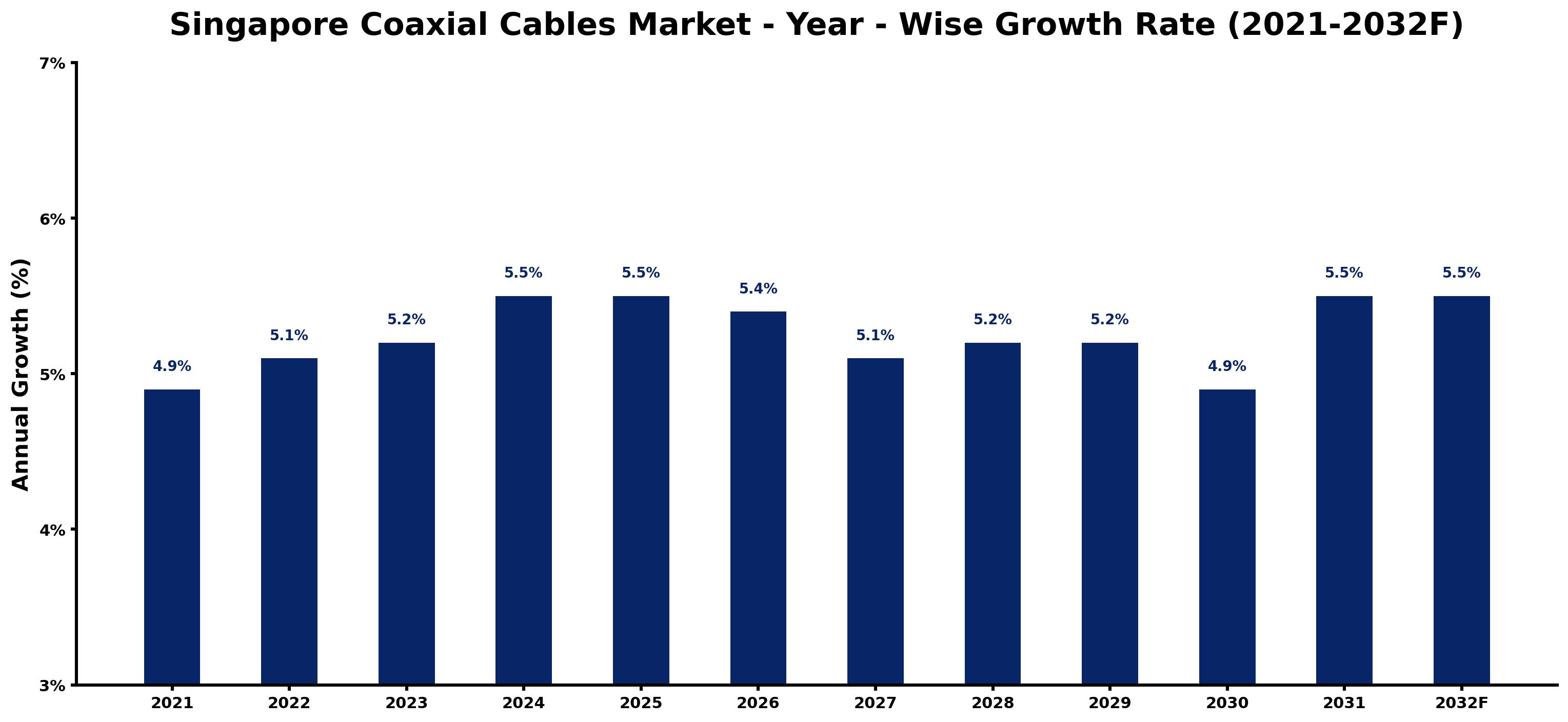
The table below presents the year wise growth rates along with the key drivers influencing the market
| Year | Growth Rate | Major Drivers |
| 2021 | 4.9% | Post-lockdown retail projects spurred infrastructure investments in telecommunications cabling systems. |
| 2022 | 5.1% | Legacy copper grid failures prompted shifts toward more reliable coaxial cable solutions. |
| 2023 | 5.2% | Enterprise budgets prioritizing digital transformation increased demand for high-performance cables. |
| 2024 | 5.5% | The integration of smart technologies in buildings created new opportunities for coaxial installation. |
| 2025 | 5.5% | Emerging 5G networks necessitated enhanced connectivity solutions, benefiting coaxial cable producers. |
| 2026 | 5.4% | Local manufacturers ramped up production to meet the needs of expanding tech sectors. |
| 2027 | 5.1% | Innovative coaxial designs improved signal quality, attracting interest from industry players. |
| 2028 | 5.2% | International trade agreements enabled easier access to advanced cable technologies in Singapore. |
| 2029 | 5.2% | Sustainability trends influenced materials used in coaxial production, appealing to eco-conscious buyers. |
| 2030 | 4.9% | Collaboration between tech firms and local manufacturers accelerated development of customized solutions. |
| 2031 | 5.5% | Increased urbanization led to higher demand for reliable telecommunications infrastructure investments. |
| 2032 | 5.5% | Ongoing research in materials science promised enhancements in coaxial cable performance and durability. |
Note - Market size estimations and growth projections presented in this report are based on 6Wresearch's advanced forecasting approach, validated with industry datasets as of June 2026.
Singapore Coaxial Cables Market Synopsis
The Singapore Coaxial Cables Market is projected to reach 5.4% and witness significant growth during the forecast period (2026-2032). As businesses in various sectors such as banking, manufacturing, hospitality, and healthcare increasingly digitalize their operations, the demand for reliable and fast data connections continues to surge. This trend is supported by government initiatives aimed at enhancing internet infrastructure, which is expected to further bolster the market for coaxial cables in Singapore.
Singapore Coaxial Cables Market Growth Drivers
The drive for growth in the Singapore Coaxial Cables Market is attributed to several critical factors shaping the technology landscape:
- The automotive industry's rapid shift towards advanced infotainment systems necessitates high-speed data transfer, thereby increasing the demand for coaxial cables. Their low signal loss and broad frequency capabilities make them ideal for integration in vehicles.
- Telecommunications is undergoing significant transformation with the rollout of 5G networks. The demand for coaxial cables is escalating as these networks require enhanced bandwidth and more reliable connections to function effectively.
- Growth in smart city initiatives in Singapore is leading to a higher requirement for infrastructure that supports better connectivity, which directly increases the dependence on coaxial cable technologies.
- The rise of IoT applications across various domains fuels the need for robust communication systems. Coaxial cables play a vital role in ensuring seamless connectivity between devices, thereby supporting the growth of smart solutions.
- As cloud computing gains traction, data centers demand enhanced connectivity solutions. The versatility of coaxial cables in transmitting high-speed data efficiently positions them favorably in this scenario.
Singapore Coaxial Cables Market Challenges and Restraints
Despite the favorable growth outlook, the Singapore Coaxial Cables Market faces several challenges that may impede progress:
- High production and material costs of coaxial cables can deter small businesses and startups from adopting these technologies due to budget constraints, potentially limiting their market penetration.
- The complexity of installation and integration of coaxial cables into existing systems may require specialized skills, resulting in additional expenses and longer deployment timelines.
- Market fluctuations in the cost of raw materials can impact pricing stability, which may lead to unpredictable market conditions and affect demand patterns.
- As technology evolves rapidly, there is a risk that current coaxial cable products could become obsolete, prompting manufacturers to invest in continuous innovation to stay relevant.
- The global supply chain disruptions caused by events such as the Covid-19 pandemic have highlighted vulnerabilities, particularly in procurement, which can lead to delays in production and delivery timelines.
Singapore Coaxial Cables Market Government Investment and Initiatives
The Singapore government has been proactive in fostering a conducive environment for the growth of the coaxial cables market through various initiatives:
- The government has allocated substantial funds to enhance national broadband infrastructure, which is critical for supporting high-speed internet connections and will increase the consumption of coaxial cables.
- Initiatives aimed at developing smart cities include investments in digital infrastructure, which emphasizes the necessity for reliable connectivity solutions such as those provided by coaxial cables.
- Training and development programs are being established to ensure that the workforce is equipped with the necessary skills to support advanced telecommunications infrastructure, leading to increased utilization of coaxial technology.
- Public-private partnerships are being encouraged to foster technological advancements and investments in research and development, thus benefiting the coaxial cables sector.
- Regulatory frameworks are being updated to promote innovation and ease of doing business, ultimately creating a more favorable market for coaxial cable products.
Singapore Coaxial Cables Market Latest Developments (May 2025 - June 2026)
The period spanning from May 2025 to June 2026 has seen several notable developments in the Singapore Coaxial Cables Market:
- Innovation in coaxial cable manufacturing processes has been a focal point, with advancements leading to enhanced performance characteristics and cost efficiencies.
- Growing collaborations between technology firms and telecommunications providers have resulted in the introduction of next-generation coaxial solutions tailored for high-speed internet applications.
- Market participants have begun to place greater emphasis on sustainable manufacturing practices, aligning with global trends towards environmentally friendly technologies.
- There has been an escalating focus on the integration of coaxial cables in the deployment of next-gen smart home devices, aligning with the country's digital transformation goals.
- Regulatory changes have facilitated improved market access for new entrants, stimulating competition and innovation within the coaxial cables sector.
Singapore Coaxial Cables Market - Key Attractiveness of the Report
- 10 Years of Market Numbers
- Historical Data Starting from 2022 to 2025
- Base Year: 2025
- Forecast Data until 2032
- Key Performance Indicators Impacting the Market
- Major Upcoming Developments and Projects
Key Highlights of the Report:
- Singapore Coaxial Cables Market Outlook
- Market Size of Singapore Coaxial Cables Market, 2025
- Forecast of Singapore Coaxial Cables Market, 2032F
- Historical Data and Forecast of Singapore Coaxial Cables Revenues & Volume for the Period 2022-2032F
- Singapore Coaxial Cables Market Trend Evolution
- Singapore Coaxial Cables Market Drivers and Challenges
- Singapore Coaxial Cables Price Trends
- Singapore Coaxial Cables Porter's Five Forces
- Singapore Coaxial Cables Industry Life Cycle
- Historical Data and Forecast of Singapore Coaxial Cables Market Revenues & Volume By Types for the Period 2022-2032F
- Historical Data and Forecast of Singapore Coaxial Cables Market Revenues & Volume By Hard-line Cable for the Period 2022-2032F
- Historical Data and Forecast of Singapore Coaxial Cables Market Revenues & Volume By Triaxial Cable for the Period 2022-2032F
- Historical Data and Forecast of Singapore Coaxial Cables Market Revenues & Volume By Twin Axial Cable for the Period 2022-2032F
- Historical Data and Forecast of Singapore Coaxial Cables Market Revenues & Volume By Applications for the Period 2022-2032F
- Historical Data and Forecast of Singapore Coaxial Cables Market Revenues & Volume By Internet Data Transfer for the Period 2022-2032F
- Historical Data and Forecast of Singapore Coaxial Cables Market Revenues & Volume By Video Distribution for the Period 2022-2032F
- Historical Data and Forecast of Singapore Coaxial Cables Market Revenues & Volume By Radio Distribution Frequency Transfer for the Period 2022-2032F
- Historical Data and Forecast of Singapore Coaxial Cables Market Revenues & Volume By Others for the Period 2022-2032F
- Historical Data and Forecast of Singapore Coaxial Cables Market Revenues & Volume By End-users for the Period 2022-2032F
- Historical Data and Forecast of Singapore Coaxial Cables Market Revenues & Volume By Cable Television Industry for the Period 2022-2032F
- Historical Data and Forecast of Singapore Coaxial Cables Market Revenues & Volume By Military and Aerospace for the Period 2022-2032F
- Historical Data and Forecast of Singapore Coaxial Cables Market Revenues & Volume By Internet Service Providers for the Period 2022-2032F
- Historical Data and Forecast of Singapore Coaxial Cables Market Revenues & Volume By Telephone Network Operators for the Period 2022-2032F
- Historical Data and Forecast of Singapore Coaxial Cables Market Revenues & Volume By Communication Equipment Manufactures for the Period 2022-2032F
- Singapore Coaxial Cables Import Export Trade Statistics
- Market Opportunity Assessment By Types
- Market Opportunity Assessment By Applications
- Market Opportunity Assessment By End-users
- Singapore Coaxial Cables Top Companies Market Share
- Singapore Coaxial Cables Competitive Benchmarking By Technical and Operational Parameters
- Singapore Coaxial Cables Company Profiles
- Singapore Coaxial Cables Key Strategic Recommendations






































