Singapore Cognitive Radio Market Size & Growth Rate (2026-2032)
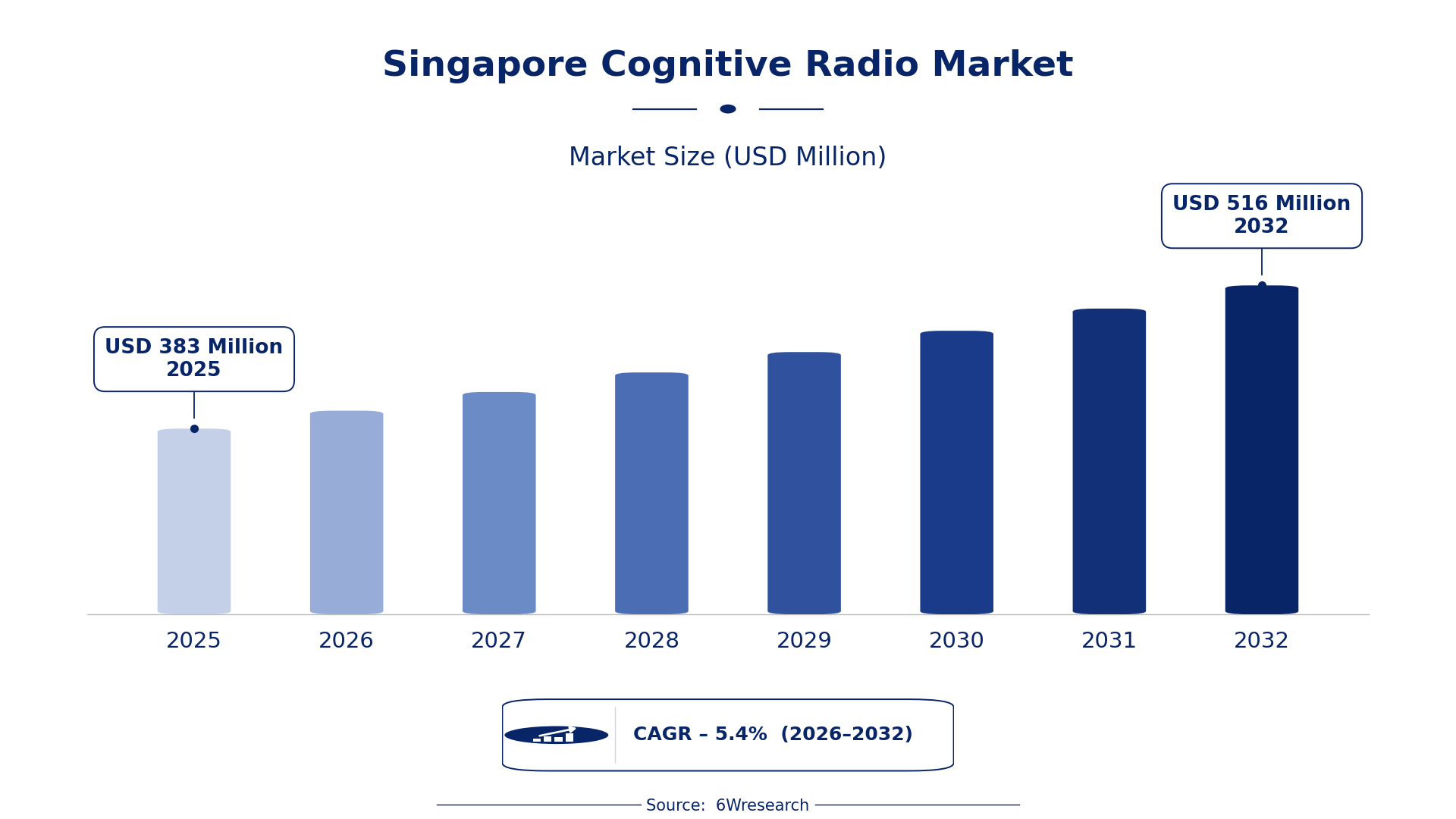
The Singapore Cognitive Radio Market was estimated at USD 383 Million in 2025 and is projected to reach USD 516 Million by 2032, growing at a CAGR of 5.4% from 2026 to 2032.
Singapore Cognitive Radio Market Synopsis
The pressing demand for enhanced spectrum efficiency is the strongest force shaping the Singapore Cognitive Radio Market. With urban congestion leading to intense competition for available frequencies, cognitive radio technology provides a practical solution for optimizing spectrum use.
Additionally, government initiatives aimed at promoting advanced communication technologies are fueling market growth. The commitment to establishing a robust 5G infrastructure is particularly noteworthy, as it drives investment in cognitive radio systems that can adapt dynamically to network needs.
Singapore Cognitive Radio Market Year-wise Growth Rate and Key Drivers
This graph illustrates the annual growth rates of the Singapore Cognitive Radio Market from 2021 to 2032, highlighting a steady upward trajectory and projected expansion over the forecast period.
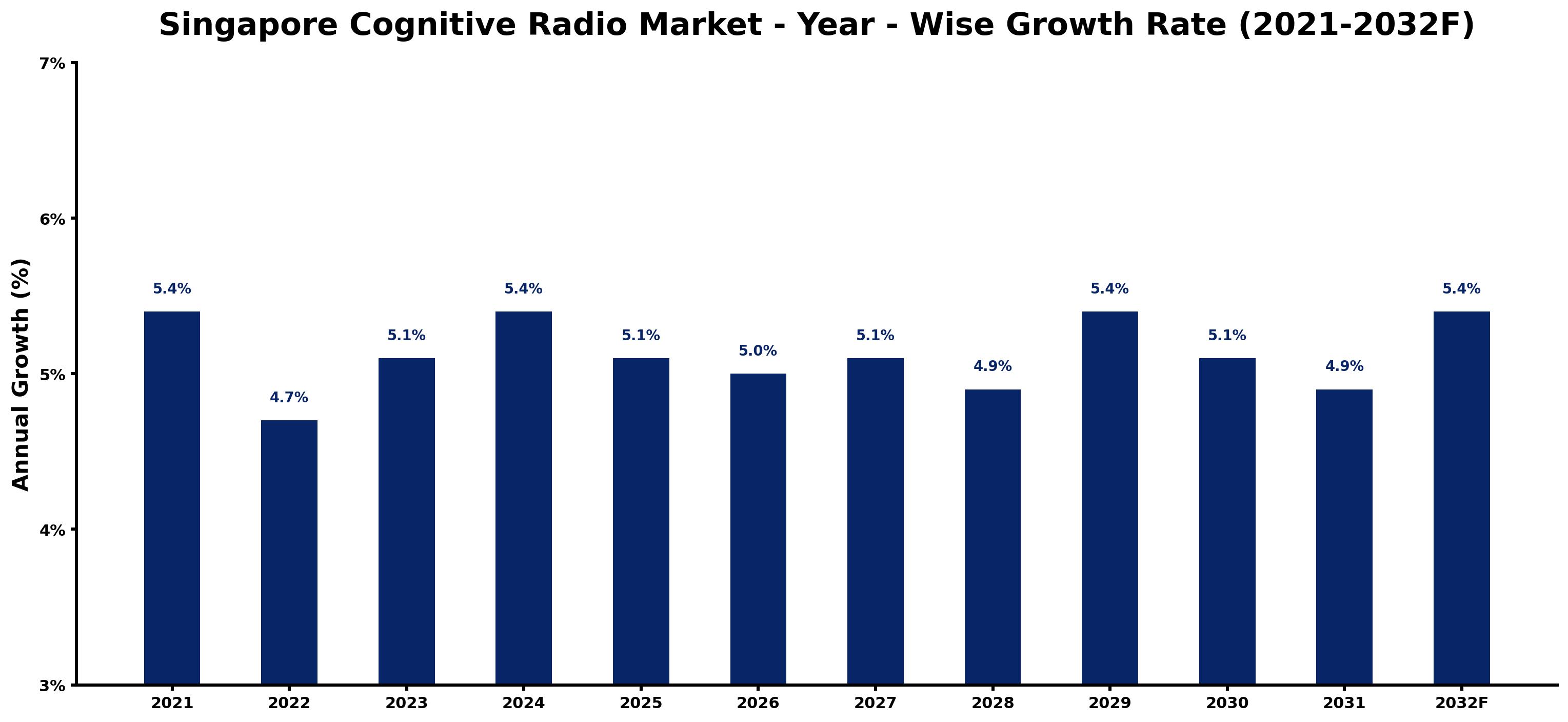
The table below presents the year‑wise growth rates along with the key drivers influencing the market
| Year | Growth Rate | Major Drivers |
| 2021 | 5.4% | Government initiatives promoting smart nation technology integration. |
| 2022 | 4.7% | Increased demand for spectrum-efficient communication solutions. |
| 2023 | 5.1% | Growing adoption of IoT applications requiring dynamic spectrum access. |
| 2024 | 5.4% | Investments in telecommunications infrastructure by Info-Comm Media Development Authority. |
| 2025 | 5.1% | Rise in localized emergency communication system improvements. |
| 2026 | 5.0% | Enhanced regulatory support for cognitive radio innovations. |
| 2027 | 5.1% | Development of urban tech initiatives fostering intelligent connectivity. |
| 2028 | 4.9% | Increasing collaboration with tech startups advancing radio technology. |
| 2029 | 5.4% | Government funding boosting research in wireless communication. |
| 2030 | 5.1% | Surge in demand for adaptive traffic management solutions. |
| 2031 | 4.9% | Strong growth in public safety communication upgrades. |
| 2032 | 5.4% | Focus on smart city projects enhancing connectivity frameworks. |
Note: Market size estimations and growth projections presented in this report are based on 6Wresearch's proprietary forecasting methodology, utilizing the latest available industry data, government publications, and primary research inputs.
Singapore Cognitive Radio Market Key Takeaways
Below are some of the specific key takeaways from the market, including:
- The market is experiencing significant growth due to increasing wireless communication demands.
- Government policies favoring innovation and spectrum management are pivotal for market expansion.
- Cognitive radio technology is becoming essential for sectors like telecommunication and public safety.
- Investment in cognitive solutions is prioritized as organizations seek cost-effective options amidst economic uncertainties.
- Security and regulatory compliance remain critical challenges for cognitive radio adoption.
Evaluation of Restraints in Singapore Cognitive Radio Market
Despite its potential, the Singapore Cognitive Radio Market faces significant constraints that hinder its growth trajectory. Regulatory compliance is a considerable challenge, as cognitive radio systems must navigate complex spectrum management frameworks while ensuring minimal interference with licensed users. Furthermore, security issues surrounding data privacy and integrity in cognitive networks cannot be overlooked, as these factors play a crucial role in user trust and technology adoption. Addressing these challenges will be essential for unlocking the full capabilities of cognitive radio technology.
Singapore Cognitive Radio Market Trends
The trend towards 5G deployment is reshaping demand in the Singapore Cognitive Radio Market. As operators roll out next-generation networks, there is a growing focus on cognitive radio solutions that facilitate dynamic spectrum access and improve spectral efficiency. This trend is further compounded by advancements in artificial intelligence and machine learning technologies, which are enhancing the capabilities of cognitive radios in managing spectrum intelligently. The demand for real-time data analytics and optimization tools is also on the rise, reflecting the critical need for adaptive communication solutions.
Singapore Cognitive Radio Market Opportunities
Significant growth opportunities lie in sectors that require efficient spectrum management, such as telecommunication, public safety, and IoT applications. As the demand for seamless connectivity increases, organizations are more inclined to invest in cognitive radio technologies that optimize spectrum usage. The push towards urban smart solutions offers another avenue for investment, as cities seek to integrate intelligent systems for better resource management. Firms focusing on innovative, cost-effective cognitive radio solutions stand to gain considerable market share in the coming years.
Government Initiatives in the Singapore Cognitive Radio Market
The Singapore government plays a crucial role in shaping the Cognitive Radio Market through targeted policies and initiatives that encourage innovation and adoption. By focusing on advanced communication technologies, the government aims to enhance national connectivity while promoting spectrum efficiency. This regulatory support is crucial as it aligns with global trends towards more flexible and adaptive wireless communication systems.
- A recently completed initiative in 2025 involved updating spectrum management policies to facilitate dynamic spectrum access for cognitive radio technologies.
- A current program is underway to integrate cognitive radio solutions in public safety communications, aiming to enhance emergency response capabilities.
- Planned for 2026, a new regulatory framework is expected to establish guidelines for the deployment of cognitive radio technologies in urban settings.
- The government has launched a public-private partnership focused on advancing research and development in cognitive radio applications, expected to commence in late 2025.
- In 2024, a national digital infrastructure upgrade was initiated, focusing on enhancing connectivity and integrating cognitive radio systems across various sectors.
Future Insights of the Singapore Cognitive Radio Market
Looking ahead to 2026-2032, the Singapore Cognitive Radio Market is set to experience robust growth, driven by the continued demand for enhanced wireless connectivity and spectrum efficiency. As cognitive radio technology matures, we can expect to see broader adoption across diverse sectors, particularly with the integration of smart city initiatives. Furthermore, ongoing advancements in AI and machine learning will further optimize cognitive radio functions, ensuring that these systems can meet the dynamic needs of modern communication networks.
Singapore Cognitive Radio Market Latest Developments
Recent months have seen a flurry of activity within the Singapore Cognitive Radio Market, emphasizing innovation and technological advancement. Key players are increasingly focusing on developing solutions that enhance spectrum efficiency and cater to the unique demands of urban environments. This momentum reflects a broader commitment to addressing the communication challenges faced in densely populated regions.
- A major technology vendor launched a new cognitive radio platform in early 2025, aimed at enhancing dynamic spectrum management capabilities.
- In mid-2025, a regional operator initiated a project to integrate cognitive radio technologies into its existing 4G infrastructure, which remains underway.
- Currently, a collaborative research effort is ongoing between technology providers and academic institutions to explore innovative applications of cognitive radio, expected to yield results by late 2025.
- A rollout of a cognitive radio-based communication system for public safety is planned for early 2026, focusing on improving emergency response times.
- In 2024, significant upgrades were made to cognitive radio technologies aimed at optimizing spectrum use in rural areas, with implementation already reported.
Singapore Cognitive Radio Market - Key Attractiveness of the Report
- 10 Years of Market Numbers
- Historical Data Starting from 2022 to 2025
- Base Year: 2025
- Forecast Data until 2032
- Key Performance Indicators Impacting the Market
- Major Upcoming Developments and Projects
Key Highlights of the Report:
- Singapore Cognitive Radio Market Outlook
- Market Size of Singapore Cognitive Radio Market, 2025
- Forecast of Singapore Cognitive Radio Market, 2032
- Historical Data and Forecast of Singapore Cognitive Radio Revenues & Volume for the Period 2022-2032F
- Singapore Cognitive Radio Market Trend Evolution
- Singapore Cognitive Radio Market Drivers and Challenges
- Singapore Cognitive Radio Price Trends
- Singapore Cognitive Radio Porter's Five Forces
- Singapore Cognitive Radio Industry Life Cycle
- Historical Data and Forecast of Singapore Cognitive Radio Market Revenues & Volume By Component for the Period 2022-2032F
- Historical Data and Forecast of Singapore Cognitive Radio Market Revenues & Volume By Software Tools for the Period 2022-2032F
- Historical Data and Forecast of Singapore Cognitive Radio Market Revenues & Volume By Hardware for the Period 2022-2032F
- Historical Data and Forecast of Singapore Cognitive Radio Market Revenues & Volume By Services for the Period 2022-2032F
- Historical Data and Forecast of Singapore Cognitive Radio Market Revenues & Volume By Application for the Period 2022-2032F
- Historical Data and Forecast of Singapore Cognitive Radio Market Revenues & Volume By Spectrum Sensing for the Period 2022-2032F
- Historical Data and Forecast of Singapore Cognitive Radio Market Revenues & Volume By Spectrum Analysis for the Period 2022-2032F
- Historical Data and Forecast of Singapore Cognitive Radio Market Revenues & Volume By Spectrum Allocation for the Period 2022-2032F
- Historical Data and Forecast of Singapore Cognitive Radio Market Revenues & Volume By Location Tracking for the Period 2022-2032F
- Historical Data and Forecast of Singapore Cognitive Radio Market Revenues & Volume By Cognitive Routing for the Period 2022-2032F
- Historical Data and Forecast of Singapore Cognitive Radio Market Revenues & Volume By End-User for the Period 2022-2032F
- Historical Data and Forecast of Singapore Cognitive Radio Market Revenues & Volume By Government and Defense for the Period 2022-2032F
- Historical Data and Forecast of Singapore Cognitive Radio Market Revenues & Volume By Telecommunication for the Period 2022-2032F
- Historical Data and Forecast of Singapore Cognitive Radio Market Revenues & Volume By Transportation for the Period 2022-2032F
- Historical Data and Forecast of Singapore Cognitive Radio Market Revenues & Volume By Others (Energy and Utilities, and Healthcare) for the Period 2022-2032F
- Singapore Cognitive Radio Import Export Trade Statistics
- Market Opportunity Assessment By Component
- Market Opportunity Assessment By Application
- Market Opportunity Assessment By End-User
- Singapore Cognitive Radio Top Companies Market Share
- Singapore Cognitive Radio Competitive Benchmarking By Technical and Operational Parameters
- Singapore Cognitive Radio Company Profiles
- Singapore Cognitive Radio Key Strategic Recommendations






































