Singapore Community Cloud Market Size & Growth Rate (2026-2032)
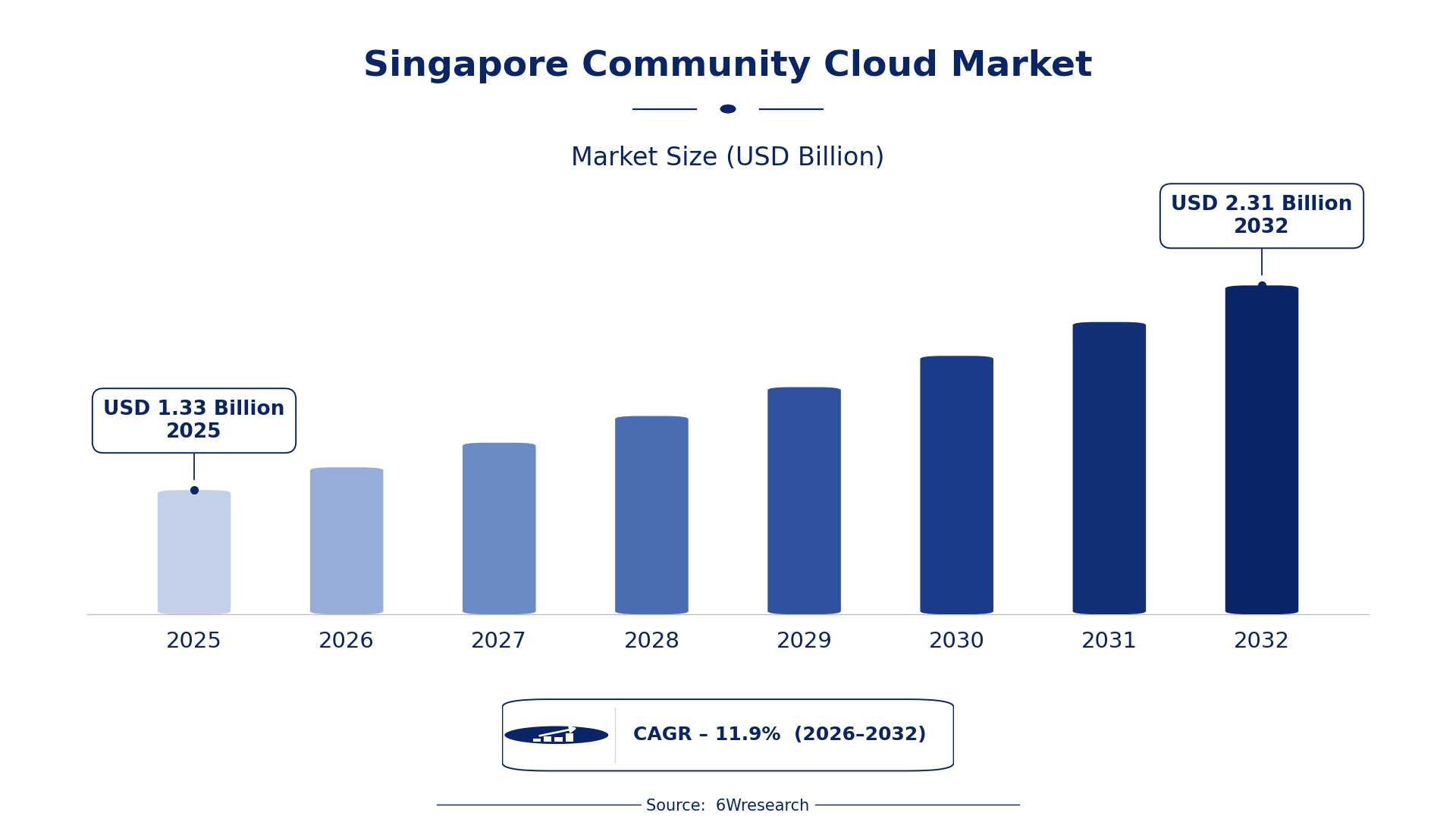
The Singapore Community Cloud Market was estimated at USD 1326 Million in 2025 and is projected to reach USD 2310 Million by 2032, growing at a CAGR of 11.9% from 2026 to 2032.
Singapore Community Cloud Market Synopsis
Organizations in Singapore are increasingly recognizing the advantages of community clouds, which provide tailored solutions to meet the unique demands of specific industries. This trend is particularly strong in sectors like healthcare and finance, where regulatory compliance and data security are paramount.
With a focus on shared infrastructure, community clouds facilitate collaboration among organizations facing similar challenges. This shared approach not only reduces costs but also enhances innovation, as businesses can leverage collective resources for industry-specific advancements.
Singapore Community Cloud Market Year-wise Growth Rate and Key Drivers
This graph illustrates the annual growth rates of the Singapore Community Cloud Market from 2021 to 2032, highlighting a steady upward trajectory and projected expansion over the forecast period.
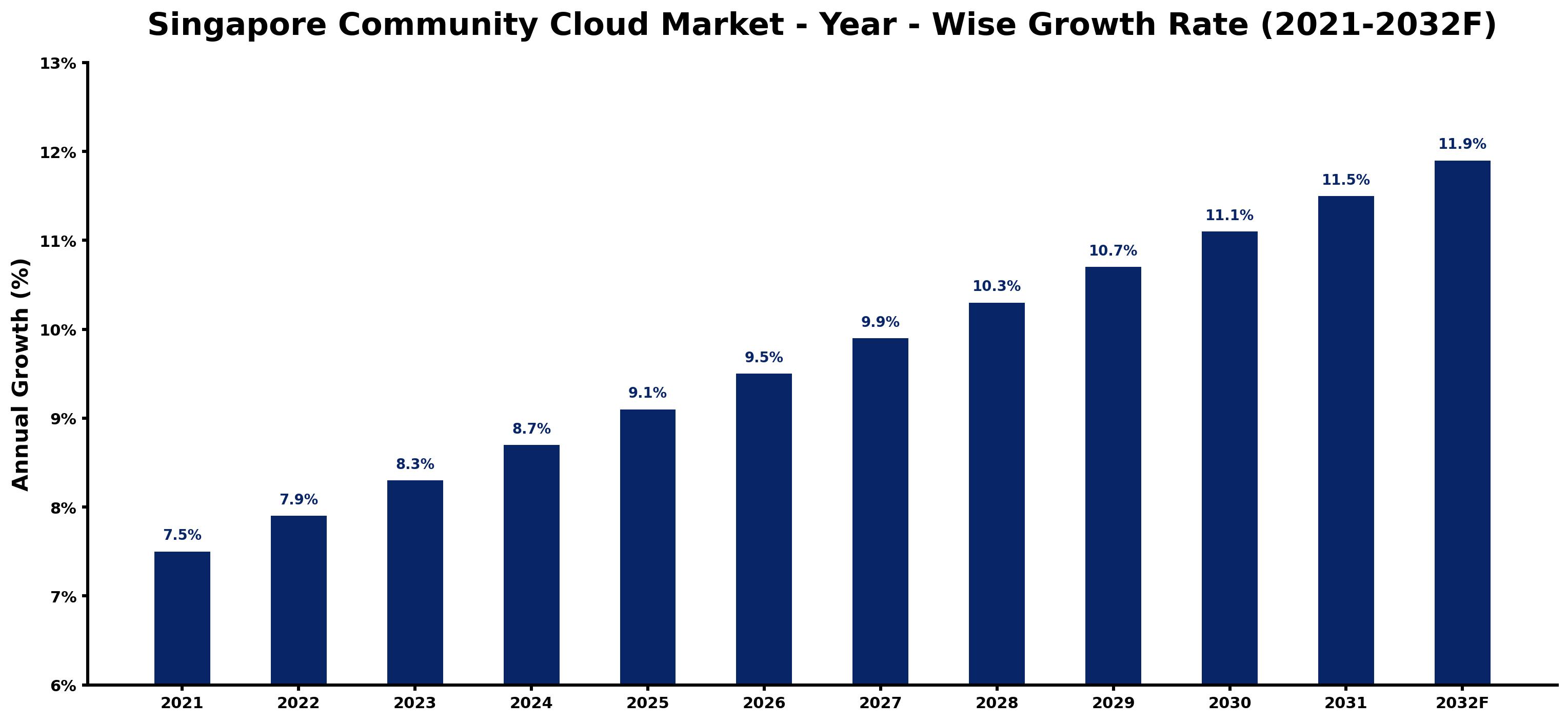
The table below presents the year‑wise growth rates along with the key drivers influencing the market
| Year | Growth Rate | Major Drivers |
| 2021 | 7.5% | Rise of smart nation initiatives enhancing cloud services adoption. |
| 2022 | 7.9% | Partnership with Infocomm Media Development Authority for innovation. |
| 2023 | 8.3% | Increased focus on cybersecurity regulations boosting cloud usage. |
| 2024 | 8.7% | Growing local startup ecosystem adopting community cloud solutions. |
| 2025 | 9.1% | National AI strategy driving cloud demand in public sector. |
| 2026 | 9.5% | Emergence of green data centers aligned with sustainability goals. |
| 2027 | 9.9% | Widespread cloud usage in healthcare for patient data management. |
| 2028 | 10.3% | Government policies promoting tech integration in urban planning. |
| 2029 | 10.7% | Boost in e-commerce requiring scalable cloud infrastructure. |
| 2030 | 11.1% | Investment in 5G technology enhancing cloud connectivity. |
| 2031 | 11.5% | Rise in remote work models driving collaborative cloud tools. |
| 2032 | 11.9% | Public sector cloud adoption for efficient citizen services. |
Note: Market size estimations and growth projections presented in this report are based on 6Wresearch's proprietary forecasting methodology, utilizing the latest available industry data, government publications, and primary research inputs.
Singapore Community Cloud Market Key Takeaways
Below are some of the specific key takeaways from the market, including:
- The community cloud model addresses specific industry needs, particularly in healthcare and finance.
- Data security and regulatory compliance are driving demand for community cloud solutions.
- Customization challenges exist, as providers must balance tailored services with standardization.
- The COVID-19 pandemic underscored the importance of collaborative cloud solutions.
- Government initiatives are actively shaping the community cloud environment in Singapore.
Evaluation of Restraints in Singapore Community Cloud Market
The Singapore Community Cloud Market faces notable constraints that could impede its growth. One significant issue is the complexity of customization; as community clouds cater to specific industries, tailoring solutions without losing the benefits of standardization proves challenging. on top of that, data privacy concerns are heightened when multiple organizations share a cloud environment. This necessitates a delicate balance between facilitating collaboration and ensuring stringent data protection measures. Regulatory compliance also adds layers of complexity, demanding that cloud providers stay abreast of evolving legal frameworks while meeting the diverse needs of their users.
Singapore Community Cloud Market Trends
Several trends are currently shaping the Singapore Community Cloud Market. One key trend is the growing emphasis on data sovereignty, pushing organizations to adopt local solutions that comply with national regulations. Additionally, increased investments in AI and machine learning technologies are enhancing the capabilities of community cloud offerings, allowing for smarter data management and analysis. Collaborative projects among industry players are also on the rise, as businesses seek to pool resources for innovation and efficiency.
Singapore Community Cloud Market Opportunities
The market presents several growth opportunities, particularly for providers willing to innovate. There’s a clear demand for solutions that address industry-specific challenges, especially in sectors like education and healthcare, where secure data sharing is crucial. Public-private partnerships could further enhance infrastructure, providing the support needed to scale community cloud services. As organizations prioritize digital transformation, aligning cloud solutions with strategic business objectives will also open new avenues for investment.
Government Initiatives in the Singapore Community Cloud Market
The Singapore government is actively influencing the community cloud market through various initiatives aimed at enhancing digital infrastructure and promoting compliance. With a focus on building a secure and collaborative digital environment, these initiatives reflect the government's commitment to fostering innovation while ensuring data protection.
- A regulatory framework introduced in 2025 to enhance data protection and compliance for cloud services.
- A national digital infrastructure upgrade programme currently underway, aimed at improving connectivity and access to cloud services.
- Ongoing support for public-private partnerships focused on developing industry-specific cloud solutions.
- A planned initiative expected to launch in 2026, promoting AI integration within community cloud platforms.
Future Insights of the Singapore Community Cloud Market
Looking ahead to 2026-2032, the Singapore Community Cloud Market is expected to evolve significantly. As organizations increasingly prioritize data security and regulatory compliance, community clouds will likely become integral to their operational strategies. The focus on industry-specific solutions will drive innovation, while government support will enhance the infrastructure necessary for robust cloud services. Anticipated advancements in technology will further reshape the landscape, fostering collaboration and enabling organizations to leverage shared resources effectively.
Singapore Community Cloud Market Latest Developments
Recent developments in the Singapore Community Cloud Market indicate a strong momentum towards enhanced collaboration and innovation. Over the past year, several initiatives and partnerships have emerged, reflecting the market's adaptability and growth potential.
- A major technology vendor launched a new community cloud platform in early 2025, designed specifically for the healthcare sector.
- An ongoing initiative began in mid-2025 to integrate advanced data analytics capabilities within community cloud services.
- A partnership between public agencies and private firms is expected to roll out in late 2026, focusing on educational cloud solutions.
- A regulatory compliance workshop series started in early 2025 to assist organizations in navigating new data protection laws.
Singapore Community Cloud Market - Key Attractiveness of the Report
- 10 Years of Market Numbers
- Historical Data Starting from 2022 to 2025
- Base Year: 2025
- Forecast Data until 2032
- Key Performance Indicators Impacting the Market
- Major Upcoming Developments and Projects
Key Highlights of the Report:
- Singapore Community Cloud Market Outlook
- Market Size of Singapore Community Cloud Market, 2025
- Forecast of Singapore Community Cloud Market, 2032
- Historical Data and Forecast of Singapore Community Cloud Revenues & Volume for the Period 2022-2032F
- Singapore Community Cloud Market Trend Evolution
- Singapore Community Cloud Market Drivers and Challenges
- Singapore Community Cloud Price Trends
- Singapore Community Cloud Porter's Five Forces
- Singapore Community Cloud Industry Life Cycle
- Historical Data and Forecast of Singapore Community Cloud Market Revenues & Volume By Components for the Period 2022-2032F
- Historical Data and Forecast of Singapore Community Cloud Market Revenues & Volume By Server for the Period 2022-2032F
- Historical Data and Forecast of Singapore Community Cloud Market Revenues & Volume By Storage Devices for the Period 2022-2032F
- Historical Data and Forecast of Singapore Community Cloud Market Revenues & Volume By Network Equipments for the Period 2022-2032F
- Historical Data and Forecast of Singapore Community Cloud Market Revenues & Volume By Verticals for the Period 2022-2032F
- Historical Data and Forecast of Singapore Community Cloud Market Revenues & Volume By Healthcare for the Period 2022-2032F
- Historical Data and Forecast of Singapore Community Cloud Market Revenues & Volume By Finance for the Period 2022-2032F
- Historical Data and Forecast of Singapore Community Cloud Market Revenues & Volume By Government for the Period 2022-2032F
- Historical Data and Forecast of Singapore Community Cloud Market Revenues & Volume By Transport and Logistics for the Period 2022-2032F
- Historical Data and Forecast of Singapore Community Cloud Market Revenues & Volume By Gaming for the Period 2022-2032F
- Historical Data and Forecast of Singapore Community Cloud Market Revenues & Volume By Education for the Period 2022-2032F
- Singapore Community Cloud Import Export Trade Statistics
- Market Opportunity Assessment By Components
- Market Opportunity Assessment By Verticals
- Singapore Community Cloud Top Companies Market Share
- Singapore Community Cloud Competitive Benchmarking By Technical and Operational Parameters
- Singapore Community Cloud Company Profiles
- Singapore Community Cloud Key Strategic Recommendations






































