Singapore Composable Infrastructure Market Size & Growth Rate (2026-2032)
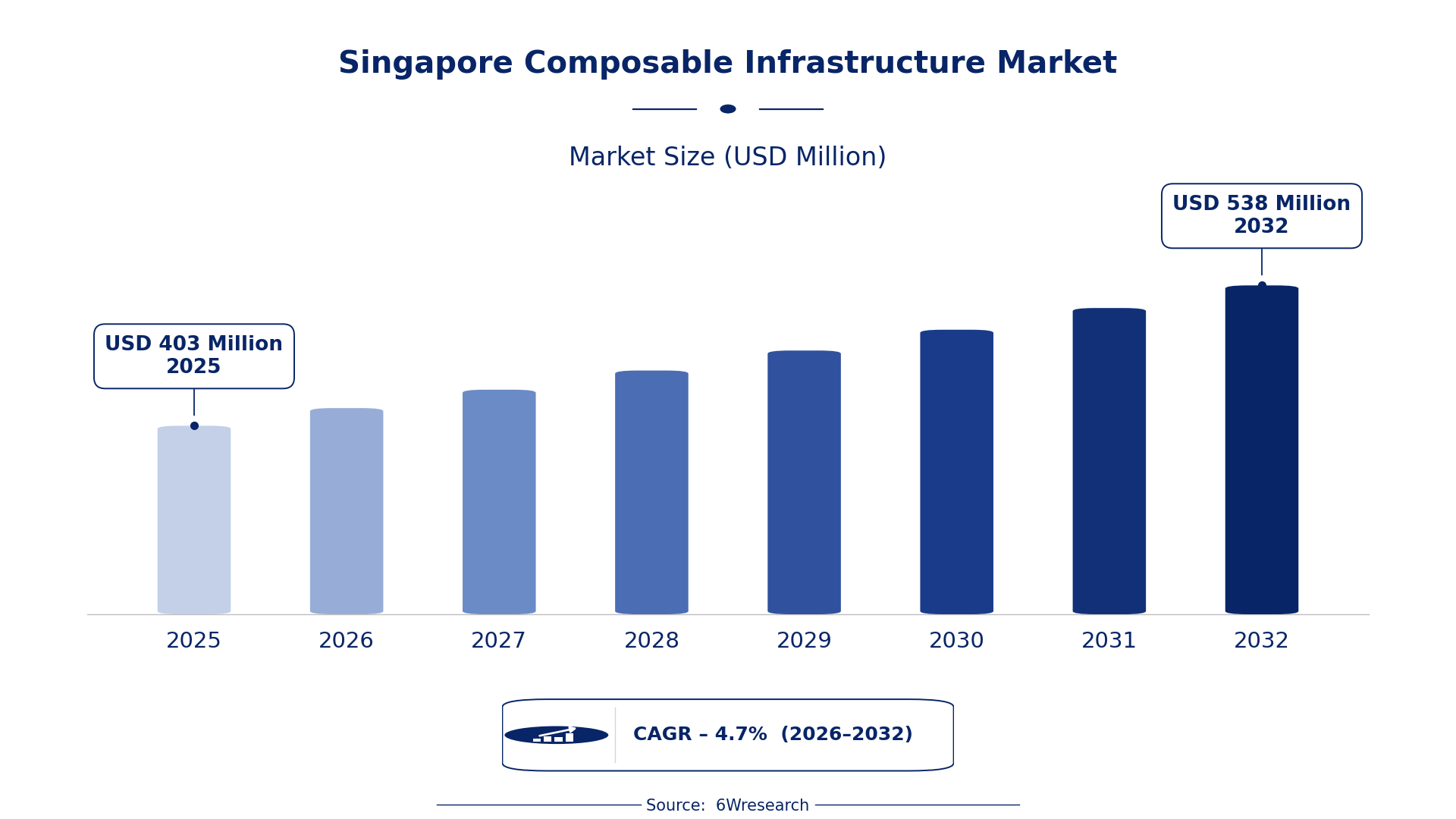
The Singapore Composable Infrastructure Market was estimated at USD 403 Million in 2025 and is projected to reach USD 538 Million by 2032, growing at a CAGR of 4.7% from 2026 to 2032.
Singapore Composable Infrastructure Market Synopsis
The Singapore Composable Infrastructure Market is experiencing a notable transformation as organizations prioritize agility in their IT frameworks. This shift is driven by the need for rapid responsiveness to evolving business demands, particularly within key sectors such as finance, healthcare, and technology. Companies are increasingly adopting solutions that enable dynamic resource allocation and operational efficiency.
As firms in Singapore strive for competitive advantage, composable infrastructure stands out as a strategic choice. The integration of hardware and software innovations fosters a more adaptable IT ecosystem, allowing businesses to optimize resource utilization while minimizing operational complexities.
Singapore Composable Infrastructure Market Year-wise Growth Rate and Key Drivers
This graph illustrates the annual growth rates of the Singapore Composable Infrastructure Market from 2021 to 2032, highlighting a steady upward trajectory and projected expansion over the forecast period.
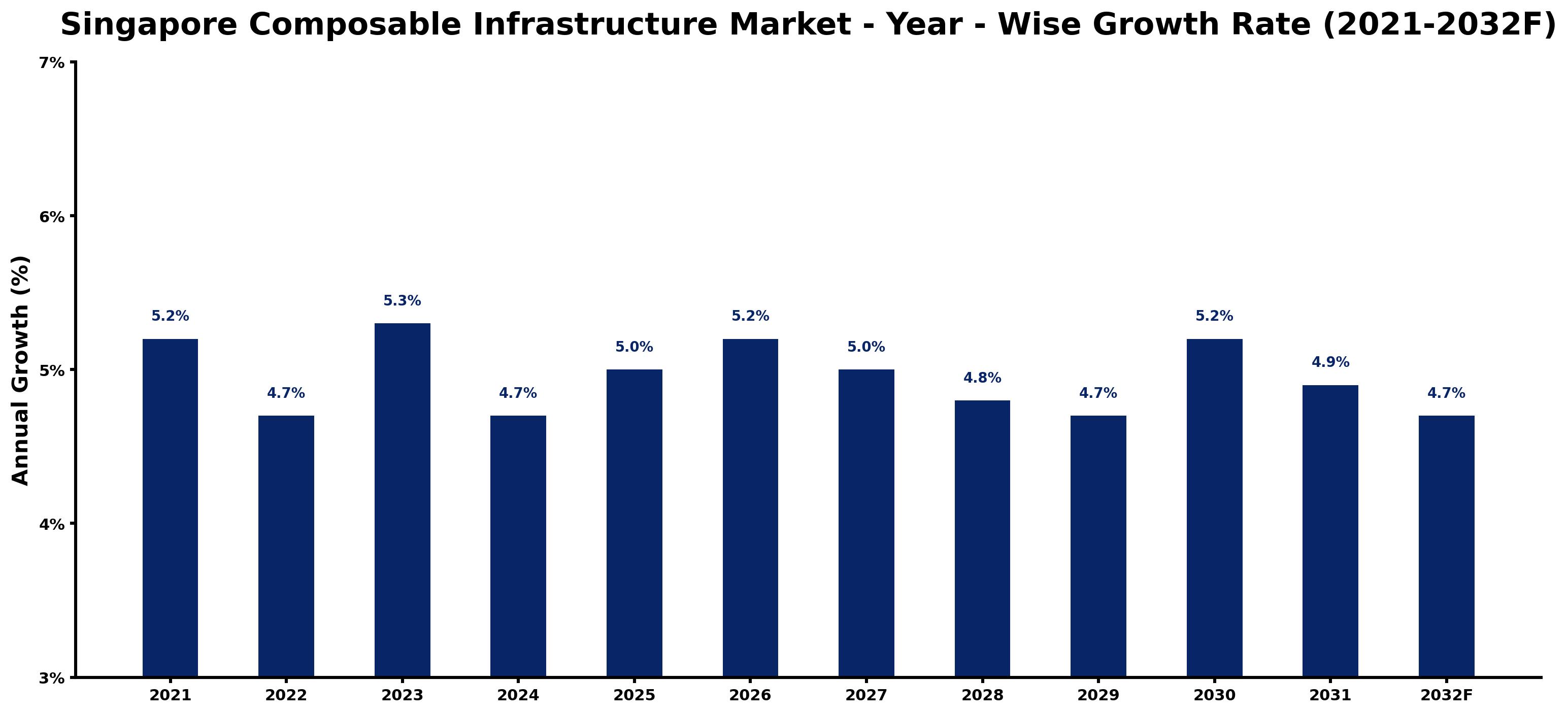
The table below presents the year‑wise growth rates along with the key drivers influencing the market
| Year | Growth Rate | Major Drivers |
| 2021 | 5.2% | Government's Smart Nation initiative enhancing digital infrastructure. |
| 2022 | 4.7% | Growing adoption of hybrid cloud solutions among enterprises. |
| 2023 | 5.3% | Rise of edge computing solutions in urban environments. |
| 2024 | 4.7% | Increased investments in AI-driven IT management tools. |
| 2025 | 5.0% | Digital transformation in banking drives composable infrastructure adoption. |
| 2026 | 5.2% | Focus on sustainability boosts green IT infrastructure initiatives. |
| 2027 | 5.0% | Growing cybersecurity regulations strengthen infrastructure demands. |
| 2028 | 4.8% | Local enterprises migrating to microservices architecture rapidly. |
| 2029 | 4.7% | Emerging fintech solutions require flexible IT resource allocation. |
| 2030 | 5.2% | Enhanced government funding for tech innovation accelerates growth. |
| 2031 | 4.9% | Rising e-commerce demand intensifies infrastructure scalability needs. |
| 2032 | 4.7% | Continued IoT deployment propelling composable solutions necessity. |
Note: Market size estimations and growth projections presented in this report are based on 6Wresearch's proprietary forecasting methodology, utilizing the latest available industry data, government publications, and primary research inputs.
Singapore Composable Infrastructure Market Key Takeaways
Below are some of the specific key takeaways from the market, including:
- The market is expected to see a steady growth trajectory, with a projected size of USD 538 Million by 2032.
- Key sectors driving demand include finance, healthcare, and technology.
- Innovation in software-defined capabilities is critical for enhancing resource management.
- Companies are increasingly focused on achieving interoperability with existing systems.
- The COVID-19 pandemic has accelerated the shift towards composable infrastructure solutions.
Evaluation of Restraints in Singapore Composable Infrastructure Market
Despite the positive momentum, the Singapore Composable Infrastructure Market grapples with certain restraints that may hinder its growth. Organizations face challenges in ensuring optimal resource allocation and achieving true interoperability with existing infrastructures. The complexities involved in transitioning to composable models often deter businesses from fully embracing this approach. on top of that, maintaining security and compliance in dynamic environments remains a pressing concern that requires robust solutions and strategic planning.
Singapore Composable Infrastructure Market Trends
A key trend shaping the Singapore Composable Infrastructure Market is the growing emphasis on hybrid and multi-cloud strategies. Organizations are increasingly adopting these frameworks to enhance flexibility and scalability. Another significant trend is the rise of automation tools that streamline resource management, allowing for real-time adjustments based on workload demands. The focus on sustainability is also gaining traction, as businesses seek energy-efficient solutions that align with their corporate responsibility goals.
Singapore Composable Infrastructure Market Opportunities
Opportunities abound for growth in the Singapore Composable Infrastructure Market. The increasing demand for cloud-native applications presents avenues for vendors to innovate and offer tailored solutions. on top of that, as organizations continue to modernize their IT environments, partnerships and collaborations among technology providers can lead to enhanced service offerings. The ongoing push towards digital transformation across various industries also creates a fertile ground for investments in composable infrastructure.
Government Initiatives in the Singapore Composable Infrastructure Market
Government policy is playing a crucial role in shaping the Singapore Composable Infrastructure Market. With a strong focus on digital transformation and infrastructure modernization, the government is actively promoting initiatives that encourage the adoption of advanced technologies. As Singapore aims to position itself as a global technology hub, public-sector priorities are increasingly aligned with fostering innovation and enhancing IT capabilities within enterprises.
- A national digital infrastructure upgrade programme now in its rollout phase aims to enhance connectivity across various sectors.
- The Smart Nation initiative is currently underway, focusing on integrating smart technologies into urban infrastructure and services.
- A regulatory framework introduced in 2025 mandates improved data security standards for IT solutions.
- Planned public-private partnerships are expected to expand access to advanced computing resources by 2028.
- Ongoing funding programmes aim to support companies in adopting cutting-edge composable infrastructure solutions.
Future Insights of the Singapore Composable Infrastructure Market
Looking ahead, the Singapore Composable Infrastructure Market is set to evolve significantly. By 2032, organizations will increasingly rely on composable solutions to navigate the complexities of digital transformation. The demand for real-time resource management and adaptability will drive further innovations in this space. As businesses continue to embrace hybrid cloud environments, composable infrastructure will emerge as a cornerstone for achieving efficiency and scalability.
Singapore Composable Infrastructure Market Latest Developments
Recent activity in the Singapore Composable Infrastructure Market indicates a robust environment for innovation and growth. Over the past year, companies have been actively launching new solutions and enhancing existing offerings to better meet the needs of enterprises. The emphasis has been on developing more agile systems that facilitate resource allocation and integration.
- A major technology vendor launched a new composable infrastructure solution in early 2025, aimed at enhancing data center efficiency.
- An initiative that began in mid-2025 is currently underway to improve interoperability standards across various IT platforms.
- A partnership between regional operators was established in Q3 2025 to develop advanced security features for composable environments.
- Upcoming plans include the rollout of a service upgrade expected to begin in late 2026, focusing on automation capabilities.
- Several companies are exploring collaborations to create a shared composable infrastructure resource hub, with discussions ongoing as of early 2025.
Singapore Composable Infrastructure Market - Key Attractiveness of the Report
- 10 Years of Market Numbers
- Historical Data Starting from 2022 to 2025
- Base Year: 2025
- Forecast Data until 2032
- Key Performance Indicators Impacting the Market
- Major Upcoming Developments and Projects
Key Highlights of the Report:
- Singapore Composable Infrastructure Market Outlook
- Market Size of Singapore Composable Infrastructure Market, 2025
- Forecast of Singapore Composable Infrastructure Market, 2032
- Historical Data and Forecast of Singapore Composable Infrastructure Revenues & Volume for the Period 2022-2032F
- Singapore Composable Infrastructure Market Trend Evolution
- Singapore Composable Infrastructure Market Drivers and Challenges
- Singapore Composable Infrastructure Price Trends
- Singapore Composable Infrastructure Porter's Five Forces
- Singapore Composable Infrastructure Industry Life Cycle
- Historical Data and Forecast of Singapore Composable Infrastructure Market Revenues & Volume By Type for the Period 2022-2032F
- Historical Data and Forecast of Singapore Composable Infrastructure Market Revenues & Volume By Software for the Period 2022-2032F
- Historical Data and Forecast of Singapore Composable Infrastructure Market Revenues & Volume By Hardware for the Period 2022-2032F
- Historical Data and Forecast of Singapore Composable Infrastructure Market Revenues & Volume By for the Period 2022-2032F
- Historical Data and Forecast of Singapore Composable Infrastructure Market Revenues & Volume By RoW for the Period 2022-2032F
- Historical Data and Forecast of Singapore Composable Infrastructure Market Revenues & Volume By Vertical for the Period 2022-2032F
- Historical Data and Forecast of Singapore Composable Infrastructure Market Revenues & Volume By BFSI for the Period 2022-2032F
- Historical Data and Forecast of Singapore Composable Infrastructure Market Revenues & Volume By Healthcare for the Period 2022-2032F
- Historical Data and Forecast of Singapore Composable Infrastructure Market Revenues & Volume By IT for the Period 2022-2032F
- Historical Data and Forecast of Singapore Composable Infrastructure Market Revenues & Volume By Telecom for the Period 2022-2032F
- Historical Data and Forecast of Singapore Composable Infrastructure Market Revenues & Volume By Government for the Period 2022-2032F
- Historical Data and Forecast of Singapore Composable Infrastructure Market Revenues & Volume By Manufacturing for the Period 2022-2032F
- Singapore Composable Infrastructure Import Export Trade Statistics
- Market Opportunity Assessment By Type
- Market Opportunity Assessment By
- Market Opportunity Assessment By Vertical
- Singapore Composable Infrastructure Top Companies Market Share
- Singapore Composable Infrastructure Competitive Benchmarking By Technical and Operational Parameters
- Singapore Composable Infrastructure Company Profiles
- Singapore Composable Infrastructure Key Strategic Recommendations






































