Singapore Concrete Aggregate Market: Import Trend Analysis
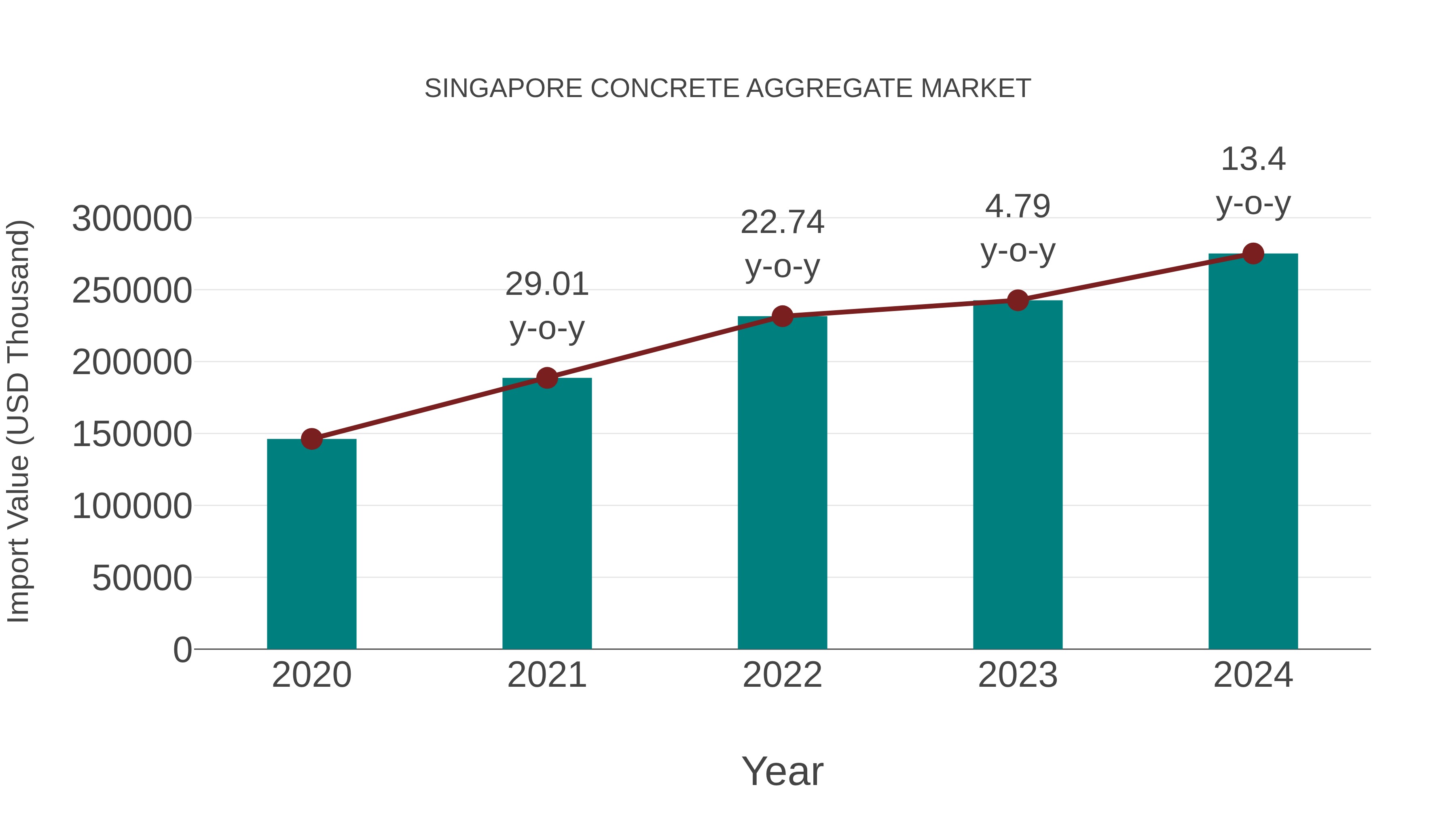
In the Singapore concrete aggregate market, the import trend displayed a notable growth rate of 13.4% from 2023 to 2024, with a compound annual growth rate (CAGR) of 17.12% over the period 2020-2024. This significant uptick in import momentum can be attributed to a steady demand shift towards higher quality construction materials, reflecting the market`s resilience and stability.
Singapore Concrete Aggregate Market Synopsis
The Singapore concrete aggregate market is a crucial segment within the construction and infrastructure sector. Concrete aggregates are essential components in the production of concrete, which is widely used in construction projects. The market includes suppliers of various types of aggregates, such as sand, gravel, and crushed stone, to meet the construction industry`s demand for high-quality materials.
Drivers of the Market
The demand for concrete aggregates in Singapore is fueled by the robust construction and infrastructure development activities in the region. The government`s commitment to urban development projects, such as housing and transportation, drives the need for high-quality concrete. Additionally, the renovation and maintenance of existing structures contribute to the growing demand for concrete aggregates. As Singapore continues to invest in its infrastructure, the concrete aggregate market is expected to thrive.
Challenges of the Market
The concrete aggregate market in Singapore faces challenges related to sustainable sourcing and environmental impact. Sourcing high-quality aggregates while minimizing the ecological footprint can be challenging. Furthermore, regulations on mining and quarrying can lead to supply chain disruptions. The industry must navigate a delicate balance between construction demand and environmental preservation.
COVID-19 Impact on the Market
The COVID-19 pandemic had varying effects on the Singapore concrete aggregate market. Initially, construction projects were put on hold or delayed due to lockdowns and supply chain disruptions. However, as economic recovery efforts began, there was a resurgence in construction and infrastructure projects, leading to increased demand for concrete aggregates. Market players had to adapt to changing project timelines and health and safety protocols.
Key Players in the Market
In the Singapore Concrete Aggregate market, prominent players include LafargeHolcim, CEMEX, and Boral Limited. These companies are key suppliers of high-quality aggregates used in the construction industry.
Key Highlights of the Report:
- Singapore Concrete Aggregate Market Outlook
- Market Size of Singapore Concrete Aggregate Market, 2025
- Forecast of Singapore Concrete Aggregate Market, 2032
- Historical Data and Forecast of Singapore Concrete Aggregate Revenues & Volume for the Period 2022-2032F
- Singapore Concrete Aggregate Market Trend Evolution
- Singapore Concrete Aggregate Market Drivers and Challenges
- Singapore Concrete Aggregate Price Trends
- Singapore Concrete Aggregate Porter's Five Forces
- Singapore Concrete Aggregate Industry Life Cycle
- Historical Data and Forecast of Singapore Concrete Aggregate Market Revenues & Volume By Production for the Period 2022-2032F
- Historical Data and Forecast of Singapore Concrete Aggregate Market Revenues & Volume By Natural for the Period 2022-2032F
- Historical Data and Forecast of Singapore Concrete Aggregate Market Revenues & Volume By Artificial for the Period 2022-2032F
- Historical Data and Forecast of Singapore Concrete Aggregate Market Revenues & Volume By Processed for the Period 2022-2032F
- Historical Data and Forecast of Singapore Concrete Aggregate Market Revenues & Volume By Glass Ceramics for the Period 2022-2032F
- Historical Data and Forecast of Singapore Concrete Aggregate Market Revenues & Volume By Manufactured Marbles for the Period 2022-2032F
- Historical Data and Forecast of Singapore Concrete Aggregate Market Revenues & Volume By Bulk Density for the Period 2022-2032F
- Historical Data and Forecast of Singapore Concrete Aggregate Market Revenues & Volume By ASTM C33 for the Period 2022-2032F
- Historical Data and Forecast of Singapore Concrete Aggregate Market Revenues & Volume By mechanical properties for the Period 2022-2032F
- Historical Data and Forecast of Singapore Concrete Aggregate Market Revenues & Volume By Abrasive power for the Period 2022-2032F
- Historical Data and Forecast of Singapore Concrete Aggregate Market Revenues & Volume By Particle Size for the Period 2022-2032F
- Historical Data and Forecast of Singapore Concrete Aggregate Market Revenues & Volume By Fine Aggregates for the Period 2022-2032F
- Historical Data and Forecast of Singapore Concrete Aggregate Market Revenues & Volume By Coarse Aggregate for the Period 2022-2032F
- Singapore Concrete Aggregate Import Export Trade Statistics
- Market Opportunity Assessment By Production
- Market Opportunity Assessment By Bulk Density
- Market Opportunity Assessment By mechanical properties
- Market Opportunity Assessment By Particle Size
- Singapore Concrete Aggregate Top Companies Market Share
- Singapore Concrete Aggregate Competitive Benchmarking By Technical and Operational Parameters
- Singapore Concrete Aggregate Company Profiles
- Singapore Concrete Aggregate Key Strategic Recommendations






































