Singapore Contactless Payment Market Size & Growth Rate (2026-2032)
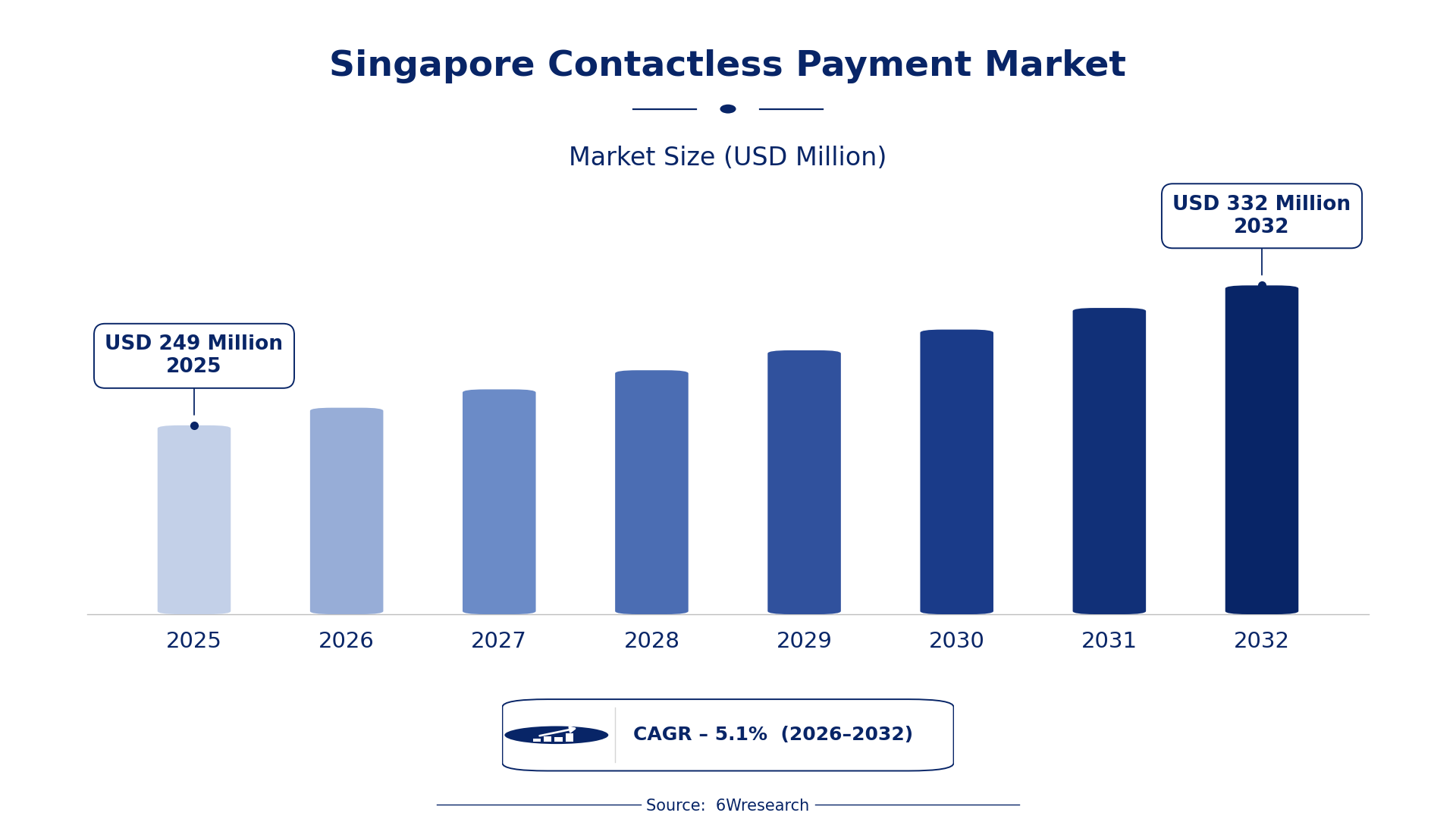
The Singapore Contactless Payment Market was estimated at USD 249 Million in 2025 and is projected to reach USD 332 Million by 2032, growing at a CAGR of 5.1% from 2026 to 2032.
Singapore Contactless Payment Market Synopsis
At the forefront of the Singapore Contactless Payment Market is the rapid shift in consumer behavior towards digital and touchless payment methods. This trend, propelled by the COVID-19 pandemic, has made consumers more inclined to seek out efficient, hygienic payment solutions at the point of sale.
In addition, the widespread acceptance of mobile wallets and contactless cards among merchants has catalyzed the growth of this market. As businesses adapt to evolving consumer preferences, the integration of advanced technologies will continue to redefine the payment experience in Singapore.
Singapore Contactless Payment Market Year-wise Growth Rate and Key Drivers
This graph illustrates the annual growth rates of the Singapore Contactless Payment Market from 2021 to 2032, highlighting a steady upward trajectory and projected expansion over the forecast period.
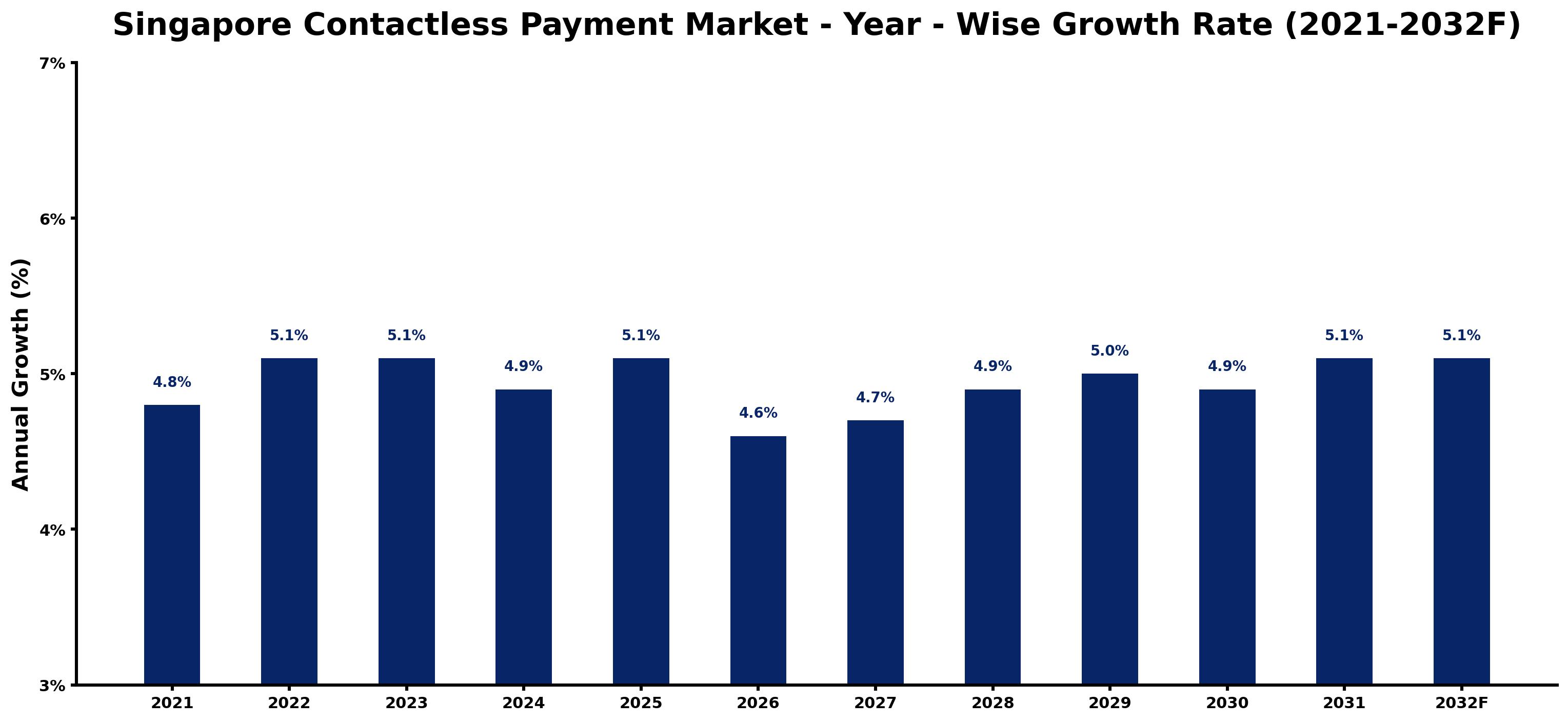
The table below presents the year‑wise growth rates along with the key drivers influencing the market
| Year | Growth Rate | Major Drivers |
| 2021 | 4.8% | Government initiatives promoting cashless transactions in Singapore. |
| 2022 | 5.1% | Increased smartphone adoption driving mobile payment usage. |
| 2023 | 5.1% | Enhanced cybersecurity regulations boosting consumer trust in payments. |
| 2024 | 4.9% | Retail sector's push for contactless payment integration. |
| 2025 | 5.1% | Growing e-commerce trends accelerating contactless payment growth. |
| 2026 | 4.6% | Ongoing investments in digital payment infrastructure enhancements. |
| 2027 | 4.7% | Rise in health-conscious consumer preference for contactless solutions. |
| 2028 | 4.9% | Successful marketing campaigns educating users on contactless benefits. |
| 2029 | 5.0% | Government incentives for businesses adopting digital payment systems. |
| 2030 | 4.9% | Integration of digital wallets with public transport systems. |
| 2031 | 5.1% | Increased international tourists using contactless for convenience. |
| 2032 | 5.1% | Regulatory support encouraging innovation in payment technologies. |
Note: Market size estimations and growth projections presented in this report are based on 6Wresearch's proprietary forecasting methodology, utilizing the latest available industry data, government publications, and primary research inputs.
Singapore Contactless Payment Market Key Takeaways
Below are some of the specific key takeaways from the market, including:
- Consumer demand for secure, fast payment options is driving market growth.
- The COVID-19 pandemic has accelerated the adoption of contactless payment methods.
- Technological advancements, such as NFC and QR code payments, are enhancing user experiences.
- Regulatory support from the government is fostering a favorable environment for contactless payment solutions.
- Merchants are increasingly investing in contactless infrastructure to meet consumer expectations.
Evaluation of Restraints in Singapore Contactless Payment Market
Despite the positive momentum, the Singapore Contactless Payment Market faces several restraints. Concerns around data security and consumer trust pose significant challenges to widespread adoption. The risk of fraud remains a pressing issue, necessitating robust security measures. on top of that, the need for interoperability among various payment platforms complicates the infrastructure landscape, hindering seamless transactions across different systems.
Singapore Contactless Payment Market Trends
Several trends are shaping the future of the contactless payment market in Singapore. The growing prevalence of mobile wallets, driven by enhanced smartphone penetration, is a key factor. on top of that, businesses are increasingly adopting integrated payment solutions that facilitate a more cohesive customer experience. There is also a notable rise in consumer acceptance of wearable payment devices, reflecting a shift towards convenience and innovation in payment methods.
Singapore Contactless Payment Market Opportunities
Opportunities abound in the Singapore Contactless Payment Market, particularly in technological innovation. Companies that can develop secure, user-friendly payment solutions stand to benefit immensely. Additionally, collaboration between financial institutions and technology providers can lead to groundbreaking services that meet the evolving needs of consumers. Expansion into underbanked segments presents another avenue for growth, as more consumers gain access to digital payment solutions.
Government Initiatives in the Singapore Contactless Payment Market
The Singapore government plays a crucial role in the advancement of the contactless payment market through various initiatives aimed at promoting cashless transactions. With a focus on enhancing digital payment infrastructure, public policy is strategically aligned with the goal of fostering innovation and ensuring security in payment systems.
- A recent initiative launched in early 2023 focuses on upgrading the national digital payment infrastructure to support a wider range of contactless payment options.
- Current efforts include a public-private partnership aimed at improving cybersecurity measures for digital transactions, which is ongoing and expected to yield results by mid-2026.
- Plans for an upcoming regulatory framework are set to be introduced in 2025, aiming to standardize contactless payment processes across different platforms.
- The government is also promoting awareness campaigns to educate consumers about the benefits and security of contactless payment methods.
Future Insights of the Singapore Contactless Payment Market
Looking ahead to 2026-2032, the Singapore Contactless Payment Market is expected to flourish as technology continues to advance. Consumer preferences will increasingly lean towards faster, more secure payment options, pushing businesses to innovate and adapt. As regulatory frameworks solidify, the market will likely see enhanced stability, fostering an environment where contactless payments become even more ingrained in daily transactions.
Singapore Contactless Payment Market Latest Developments
In the last year, the Singapore Contactless Payment Market has experienced a surge in activity, reflecting the ongoing transformation in how consumers engage with payment technologies. As businesses and financial institutions adapt to the changing landscape, notable developments have emerged, indicating a strong commitment to the growth of contactless payment solutions.
- A major technology vendor announced a partnership with local banks in Q1 2023 to enhance the security features of mobile wallets, with implementation expected by early 2024.
- An initiative to expand the acceptance of QR code payments across retail sectors began in mid-2023 and is currently underway.
- A product launch for a new contactless payment card featuring advanced security measures was completed in late 2023, receiving positive feedback from consumers.
- Upcoming in late 2024, a new public awareness campaign is set to launch, aimed at increasing consumer confidence in contactless payment technologies.
Singapore Contactless Payment Market - Key Attractiveness of the Report
- 10 Years of Market Numbers
- Historical Data Starting from 2022 to 2025
- Base Year: 2025
- Forecast Data until 2032
- Key Performance Indicators Impacting the Market
- Major Upcoming Developments and Projects
Key Highlights of the Report:
- Singapore Contactless Payment Market Outlook
- Market Size of Singapore Contactless Payment Market, 2025
- Forecast of Singapore Contactless Payment Market, 2032
- Historical Data and Forecast of Singapore Contactless Payment Revenues & Volume for the Period 2022-2032F
- Singapore Contactless Payment Market Trend Evolution
- Singapore Contactless Payment Market Drivers and Challenges
- Singapore Contactless Payment Price Trends
- Singapore Contactless Payment Porter's Five Forces
- Singapore Contactless Payment Industry Life Cycle
- Historical Data and Forecast of Singapore Contactless Payment Market Revenues & Volume By Component for the Period 2022-2032F
- Historical Data and Forecast of Singapore Contactless Payment Market Revenues & Volume By Hardware for the Period 2022-2032F
- Historical Data and Forecast of Singapore Contactless Payment Market Revenues & Volume By Solutions for the Period 2022-2032F
- Historical Data and Forecast of Singapore Contactless Payment Market Revenues & Volume By Services for the Period 2022-2032F
- Historical Data and Forecast of Singapore Contactless Payment Market Revenues & Volume By Vertical for the Period 2022-2032F
- Historical Data and Forecast of Singapore Contactless Payment Market Revenues & Volume By Retail for the Period 2022-2032F
- Historical Data and Forecast of Singapore Contactless Payment Market Revenues & Volume By Hospitality for the Period 2022-2032F
- Historical Data and Forecast of Singapore Contactless Payment Market Revenues & Volume By Healthcare for the Period 2022-2032F
- Historical Data and Forecast of Singapore Contactless Payment Market Revenues & Volume By Energy and Utilities for the Period 2022-2032F
- Historical Data and Forecast of Singapore Contactless Payment Market Revenues & Volume By Transportation and Logistics for the Period 2022-2032F
- Historical Data and Forecast of Singapore Contactless Payment Market Revenues & Volume By BFSI for the Period 2022-2032F
- Historical Data and Forecast of Singapore Contactless Payment Market Revenues & Volume By Others (Government, telecommunications, and education) for the Period 2022-2032F
- Singapore Contactless Payment Import Export Trade Statistics
- Market Opportunity Assessment By Component
- Market Opportunity Assessment By Vertical
- Singapore Contactless Payment Top Companies Market Share
- Singapore Contactless Payment Competitive Benchmarking By Technical and Operational Parameters
- Singapore Contactless Payment Company Profiles
- Singapore Contactless Payment Key Strategic Recommendations






































