Singapore Content Intelligence Market Size & Growth Rate (2026-2032)
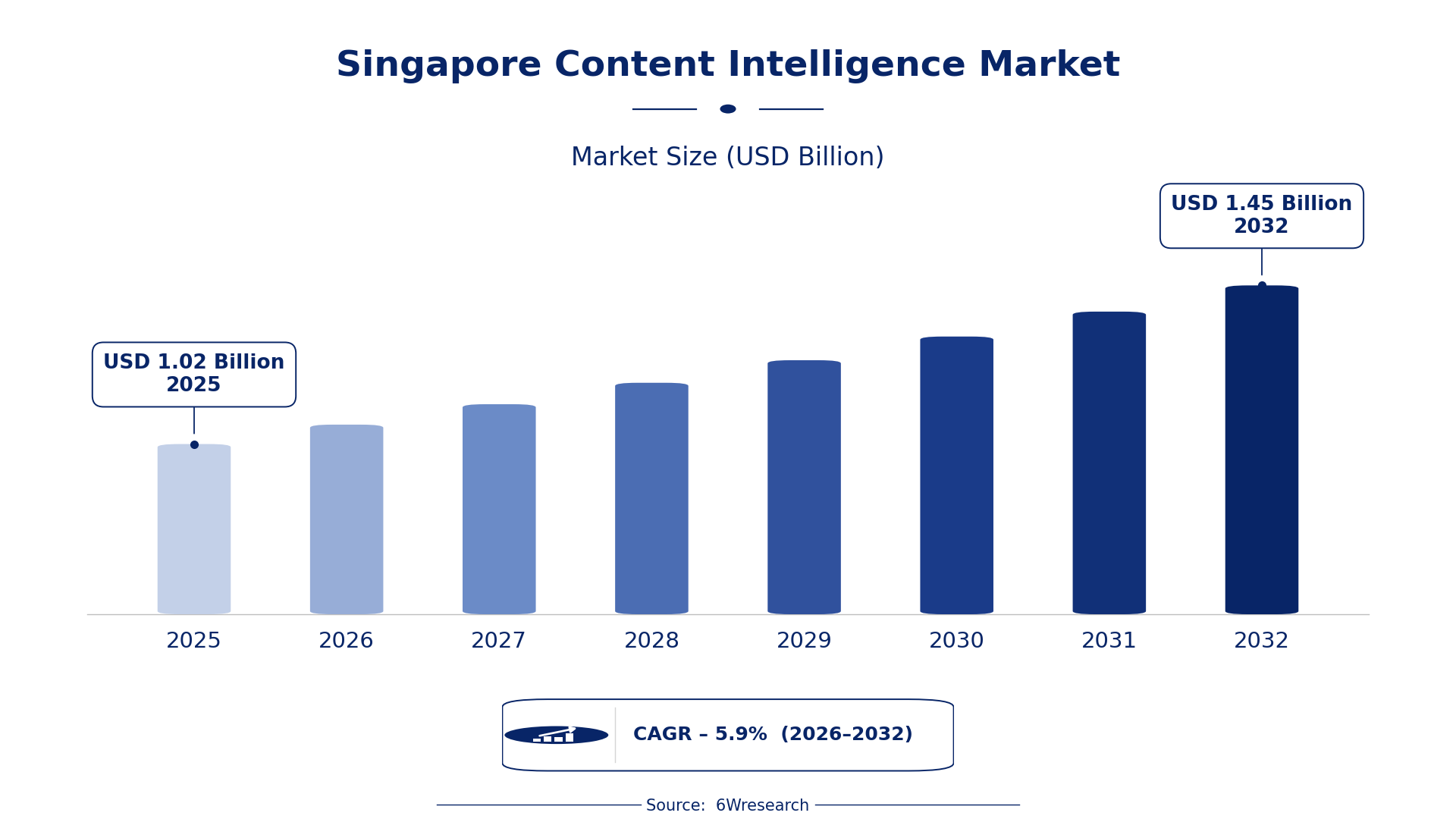
The Singapore Content Intelligence Market was estimated at USD 1023 Million in 2025 and is projected to reach USD 1452 Million by 2032, growing at a CAGR of 5.9% from 2026 to 2032.
Singapore Content Intelligence Market Synopsis
The surge in digital content creation is the primary force driving the Singapore Content Intelligence Market. With businesses inundated with vast amounts of data, the demand for actionable insights has never been higher. Companies are recognizing that to stay competitive, they must adapt to the changing dynamics of consumer behavior.
Organizations are increasingly turning to content intelligence solutions to refine their strategies. Enhanced personalization, better engagement metrics, and improved decision-making processes are vital outcomes that these technologies can provide. This is not just about understanding what content exists but about leveraging that information for real business benefits.
Singapore Content Intelligence Market Year-wise Growth Rate and Key Drivers
This graph illustrates the annual growth rates of the Singapore Content Intelligence Market from 2021 to 2032, highlighting a steady upward trajectory and projected expansion over the forecast period.
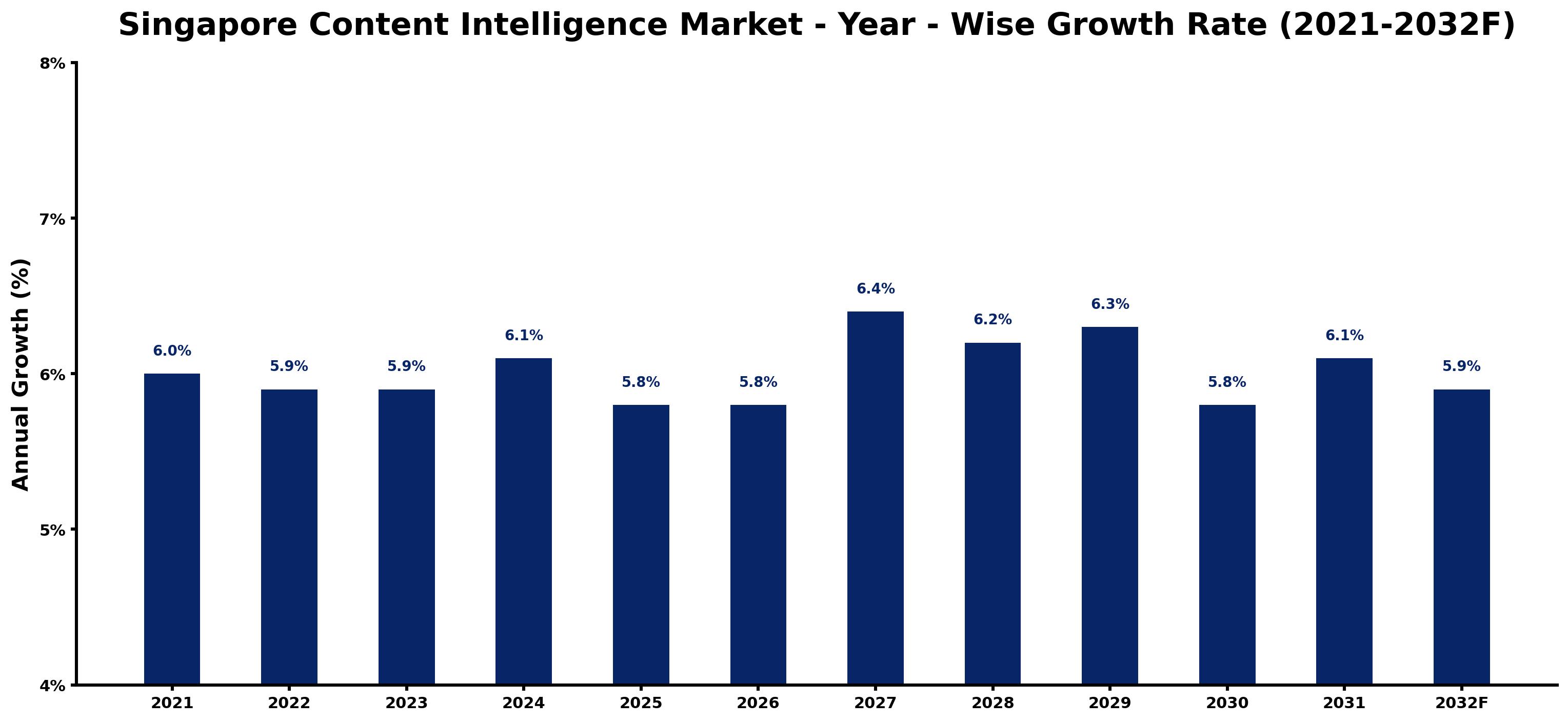
The table below presents the year‑wise growth rates along with the key drivers influencing the market
| Year | Growth Rate | Major Drivers |
| 2021 | 6.0% | Government funding for AI-driven content analytics tools. |
| 2022 | 5.9% | Increase in media consumption among younger demographics. |
| 2023 | 5.9% | Adoption of data-driven storytelling by local brands. |
| 2024 | 6.1% | Singapore's Smart Nation initiative promotes content tech innovation. |
| 2025 | 5.8% | Partnerships between tech firms and educational institutions grow. |
| 2026 | 5.8% | Rise in demand for local language content optimization. |
| 2027 | 6.4% | Increased investment in influencer marketing strategies. |
| 2028 | 6.2% | Emergence of regulations supporting content authenticity measures. |
| 2029 | 6.3% | Surge in online video platforms enhancing content engagement. |
| 2030 | 5.8% | Focus on content security following cybersecurity policy updates. |
| 2031 | 6.1% | Support for startups in content and media analytics sectors. |
| 2032 | 5.9% | Rising importance of content transparency in marketing strategies. |
Note: Market size estimations and growth projections presented in this report are based on 6Wresearch's proprietary forecasting methodology, utilizing the latest available industry data, government publications, and primary research inputs.
Singapore Content Intelligence Market Key Takeaways
Below are some of the specific key takeaways from the market, including:
- The need for advanced content analysis tools is growing, fueled by the explosion of digital content.
- AI and machine learning are becoming essential for extracting actionable insights from content.
- Businesses are prioritizing content personalization to enhance customer engagement.
- Data privacy concerns are emerging as a critical issue in content intelligence solutions.
- COVID-19 has accelerated the adoption of content intelligence technologies across sectors.
Evaluation of Restraints in Singapore Content Intelligence Market
Despite its growth, the Singapore Content Intelligence Market faces several constraints. A key concern is the accuracy and relevance of content analyzed. As algorithms evolve, they must keep pace with rapidly changing consumer preferences and emerging trends. Additionally, issues surrounding data privacy are more pressing than ever, necessitating continuous monitoring and adaptation of solutions to mitigate potential biases. Without addressing these challenges, companies may struggle to fully harness the power of content intelligence.
Singapore Content Intelligence Market Trends
Current trends indicate a shift toward more sophisticated content curation and sentiment analysis tools. Companies are increasingly investing in solutions that integrate AI-driven analytics, enabling them to offer personalized content experiences to their users. on top of that, as remote work continues to normalize, the demand for effective content management systems is on the rise, with organizations striving for improved digital collaboration.
Singapore Content Intelligence Market Opportunities
The future holds substantial opportunities for growth within the Singapore Content Intelligence Market. Companies that invest in AI and machine learning will likely find themselves ahead of the curve, especially as consumers demand higher levels of personalization. Additionally, businesses can tap into emerging technologies such as natural language processing to further refine their content strategies. The convergence of content intelligence with other digital initiatives presents a chance for companies to innovate and capture new market segments.
Government Initiatives in the Singapore Content Intelligence Market
Government support plays a crucial role in shaping the Singapore Content Intelligence Market. Public policy is increasingly focused on fostering innovation and enhancing digital capabilities among local enterprises. This proactive stance is vital for ensuring that Singapore remains competitive in the global digital economy, particularly in content intelligence.
- A recently completed initiative aimed to enhance the digital skills of the workforce, focusing on content creation and analysis.
- A currently ongoing program is the development of a national framework for data privacy and protection, ensuring that content intelligence solutions comply with stringent regulations.
- A planned public-private partnership is expected to launch in 2026, aimed at funding startups focusing on AI-driven content intelligence solutions.
- Upcoming initiatives will focus on integrating content intelligence into educational institutions to better prepare future professionals.
Future Insights of the Singapore Content Intelligence Market
Looking ahead to 2026-2032, the Singapore Content Intelligence Market is expected to expand significantly as organizations prioritize data-driven strategies. The integration of more advanced AI technologies will likely enhance capabilities in understanding consumer sentiment and behavior. As businesses adapt to the shifting digital landscape, those who embrace these innovations will position themselves for sustained growth and competitive advantage.
Singapore Content Intelligence Market Latest Developments
Recent activity within the Singapore Content Intelligence Market reflects a dynamic environment. In the past year, there has been a notable increase in partnerships aimed at developing cutting-edge content analysis tools. Companies are actively seeking to enhance their offerings through innovative technologies.
- A major technology vendor launched a new content analytics platform in Q1 2025, designed to improve sentiment analysis for businesses.
- An initiative that began in mid-2025 and remains underway focuses on enhancing AI capabilities for more effective content recommendations.
- A rollout expected to begin in the second half of 2026 will introduce new standards for content security and privacy across the sector.
- A collaborative project initiated in early 2025 aims to integrate content intelligence solutions into existing CRM systems.
Singapore Content Intelligence Market - Key Attractiveness of the Report
- 10 Years of Market Numbers
- Historical Data Starting from 2022 to 2025
- Base Year: 2025
- Forecast Data until 2032
- Key Performance Indicators Impacting the Market
- Major Upcoming Developments and Projects
Key Highlights of the Report:
- Singapore Content Intelligence Market Outlook
- Market Size of Singapore Content Intelligence Market, 2025
- Forecast of Singapore Content Intelligence Market, 2032
- Historical Data and Forecast of Singapore Content Intelligence Revenues & Volume for the Period 2022-2032F
- Singapore Content Intelligence Market Trend Evolution
- Singapore Content Intelligence Market Drivers and Challenges
- Singapore Content Intelligence Price Trends
- Singapore Content Intelligence Porter's Five Forces
- Singapore Content Intelligence Industry Life Cycle
- Historical Data and Forecast of Singapore Content Intelligence Market Revenues & Volume By Component for the Period 2022-2032F
- Historical Data and Forecast of Singapore Content Intelligence Market Revenues & Volume By Solutions for the Period 2022-2032F
- Historical Data and Forecast of Singapore Content Intelligence Market Revenues & Volume By Services for the Period 2022-2032F
- Historical Data and Forecast of Singapore Content Intelligence Market Revenues & Volume By Vertical for the Period 2022-2032F
- Historical Data and Forecast of Singapore Content Intelligence Market Revenues & Volume By BFSI for the Period 2022-2032F
- Historical Data and Forecast of Singapore Content Intelligence Market Revenues & Volume By Government & Public Sector for the Period 2022-2032F
- Historical Data and Forecast of Singapore Content Intelligence Market Revenues & Volume By Healthcare & Life Sciences for the Period 2022-2032F
- Historical Data and Forecast of Singapore Content Intelligence Market Revenues & Volume By IT & Telecommunications for the Period 2022-2032F
- Historical Data and Forecast of Singapore Content Intelligence Market Revenues & Volume By Manufacturing for the Period 2022-2032F
- Historical Data and Forecast of Singapore Content Intelligence Market Revenues & Volume By Media & Entertainment for the Period 2022-2032F
- Historical Data and Forecast of Singapore Content Intelligence Market Revenues & Volume By Retail & Consumer Goods for the Period 2022-2032F
- Historical Data and Forecast of Singapore Content Intelligence Market Revenues & Volume By Deployment Type for the Period 2022-2032F
- Historical Data and Forecast of Singapore Content Intelligence Market Revenues & Volume By Cloud for the Period 2022-2032F
- Historical Data and Forecast of Singapore Content Intelligence Market Revenues & Volume By On-Premises for the Period 2022-2032F
- Historical Data and Forecast of Singapore Content Intelligence Market Revenues & Volume By Hybrid for the Period 2022-2032F
- Historical Data and Forecast of Singapore Content Intelligence Market Revenues & Volume By Organization Size for the Period 2022-2032F
- Historical Data and Forecast of Singapore Content Intelligence Market Revenues & Volume By Large enterprises for the Period 2022-2032F
- Historical Data and Forecast of Singapore Content Intelligence Market Revenues & Volume By Small and Medium-sized Enterprises (SMEs) for the Period 2022-2032F
- Singapore Content Intelligence Import Export Trade Statistics
- Market Opportunity Assessment By Component
- Market Opportunity Assessment By Vertical
- Market Opportunity Assessment By Deployment Type
- Market Opportunity Assessment By Organization Size
- Singapore Content Intelligence Top Companies Market Share
- Singapore Content Intelligence Competitive Benchmarking By Technical and Operational Parameters
- Singapore Content Intelligence Company Profiles
- Singapore Content Intelligence Key Strategic Recommendations






































