Singapore Conveyors Systems Market Size, Share & Growth Rate
The Singapore Conveyors Systems Market was estimated at USD 488 Million in 2025 and is projected to reach USD 683 Million by 2032, growing at a CAGR of 4.9% from 2026 to 2032. This growth trajectory is predominantly driven by the increasing demand for automation in logistics and manufacturing sectors, as companies look to enhance efficiency and reduce reliance on manual handling. The surge in e-commerce has further accelerated the need for sophisticated conveyor solutions, allowing for quicker order processing and improved supply chain responsiveness.
Singapore Conveyors Systems Market Year-wise Growth Rate and Key Drivers
This graph highlights how the Singapore Conveyors Systems Market has steadily grown over the years, supported by major growth factors.
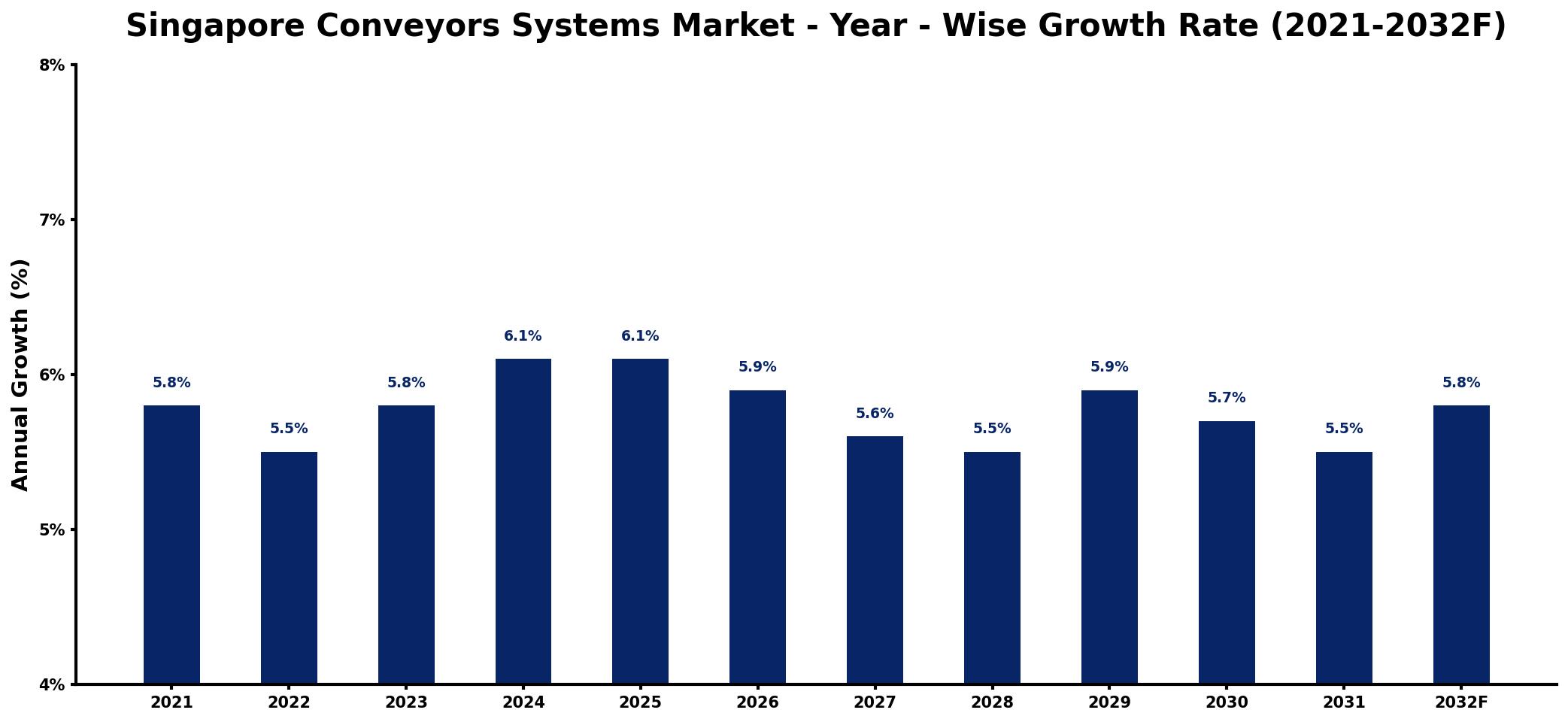
The table below presents the year‑wise growth rates along with the key drivers influencing the market
| Year | Growth Rate | Major Drivers |
| 2021 | 5.8% | increased automation in manufacturing |
| 2022 | 5.5% | growing e-commerce logistics demand |
| 2023 | 5.8% | expansion of warehouse facilities |
| 2024 | 6.1% | rising investment in infrastructure |
| 2025 | 6.1% | enhanced supply chain efficiency |
| 2026 | 5.9% | growing demand for retail automation |
| 2027 | 5.6% | increased focus on sustainability initiatives |
| 2028 | 5.5% | growing regional consumption patterns |
| 2029 | 5.9% | development of smart technologies |
| 2030 | 5.7% | increased urbanization driving logistics |
| 2031 | 5.5% | rising popularity of robotics integration |
| 2032 | 5.8% | growing need for industrial automation |
Note: Market size estimations and growth projections presented in this report are based on 6Wresearch's proprietary forecasting methodology, utilizing the latest available industry data, government publications, and primary research inputs.
Singapore Conveyors Systems Market Synopsis
The strongest force shaping the Singapore Conveyors Systems Market currently is the rapid digitization of supply chains. As logistics firms and manufacturers embrace smart technologies, the integration of automated conveyor systems is becoming a standard practice to optimize material handling processes. This shift not only enhances productivity but also allows for better resource allocation, vital in a competitive trading environment.
Additionally, the country's strategic position as a trading hub underscores the necessity for efficient and reliable conveyor systems. Industries are increasingly focused on minimizing bottlenecks and ensuring swift movement of goods, which directly aligns with Singapore's aim to maintain its status in the global market. The push towards sustainability is also prompting businesses to explore energy-efficient conveyor solutions.
Singapore Conveyors Systems Market Key Takeaways
- Robust growth driven by the expansion of e-commerce and automation adoption.
- Manufacturers are seeking customized solutions to meet specific operational requirements.
- Integration with advanced technologies poses both challenges and opportunities for market players.
- Sustainability concerns are prompting innovations in eco-friendly conveyor systems.
- Post-pandemic recovery is expected to fuel further market development.
Evaluation of Restraints in Singapore Conveyors Systems Market
While the Singapore conveyors systems market is poised for growth, it faces certain constraints that may hinder its pace. Customization demands require significant engineering expertise, which can lead to extended lead times and increased project costs. Moreover, the evolving landscape of automation necessitates seamless integration with existing systems, a process that can be complex and resource-intensive. Additionally, the industry's growing focus on sustainability means that companies must invest in developing energy-efficient solutions, which can further strain resources in the short term.
Singapore Conveyors Systems Market Trends
The current trends in the Singapore Conveyors Systems Market reflect a shift towards intelligent automation and system interoperability. Businesses are increasingly adopting IoT-enabled conveyor systems that allow for real-time monitoring and data analytics, facilitating proactive maintenance and operational improvements. Furthermore, as sustainability becomes a focal point for industries, there is a notable rise in the development of conveyors designed with eco-friendly materials and energy-efficient technologies. The demand for modular conveyor systems, which offer scalability and flexibility, is also gaining traction as companies seek to adapt to changing market needs.
Singapore Conveyors Systems Market Opportunities
There are substantial opportunities for growth in the Singapore conveyors systems market, particularly in sectors such as e-commerce, pharmaceuticals, and food processing. The ongoing digital transformation presents an avenue for companies to innovate and introduce smart conveyor solutions that enhance operational efficiency. Additionally, as industries pivot towards sustainability, there is potential for investment in developing greener technologies that comply with environmental standards. Companies that can offer customizable and scalable conveyor solutions tailored to specific industry needs will likely capture significant market share.
Government Initiatives in the Singapore Conveyors Systems Market
The Singapore government actively promotes initiatives aimed at enhancing industrial automation and efficiency, which directly benefits the conveyors systems market. Through various programs, public spending, and incentives, there is a concerted effort to support the adoption of advanced manufacturing technologies. This includes funding for R&D in automation solutions and partnerships with industry stakeholders to drive innovation. Such supportive policies align with the broader national agenda of boosting the productivity and sustainability of Singapores manufacturing and logistics sectors.
Future Insights of the Singapore Conveyors Systems Market
Looking ahead to the period between 2026 and 2032, the Singapore Conveyors Systems Market is anticipated to experience significant advancements fueled by technological integration and a heightened focus on efficiency. The push for automation will continue to reshape how industries approach material handling, with a growing emphasis on real-time data utilization and system adaptability. As businesses increasingly recognize the value of sustainable practices, the market is expected to see more innovations aimed at reducing environmental impact while maintaining high operational standards.
Singapore Conveyors Systems Market Latest Developments (2025 - 2026)
The Singapore conveyors systems market has recently seen a notable shift towards enhanced automation solutions as companies invest in technology to improve efficiency. Additionally, there has been a significant increase in collaborative efforts between manufacturers and technology firms to develop smart conveyor systems. These advancements are focusing on creating systems that offer greater flexibility and can be seamlessly integrated with existing workflows. Companies are also prioritizing sustainability, leading to the introduction of environmentally friendly conveyor technologies and practices.
Singapore Conveyors Systems Market - Key Attractiveness of the Report
- 10 Years of Market Numbers
- Historical Data Starting from 2022 to 2025
- Base Year: 2025
- Forecast Data until 2032
- Key Performance Indicators Impacting the Market
- Major Upcoming Developments and Projects
Key Highlights of the Report:
- Singapore Conveyors Systems Market Outlook
- Market Size of Singapore Conveyors Systems Market, 2025
- Forecast of Singapore Conveyors Systems Market, 2032
- Historical Data and Forecast of Singapore Conveyors Systems Revenues & Volume for the Period 2022-2032F
- Singapore Conveyors Systems Market Trend Evolution
- Singapore Conveyors Systems Market Drivers and Challenges
- Singapore Conveyors Systems Price Trends
- Singapore Conveyors Systems Porter's Five Forces
- Singapore Conveyors Systems Industry Life Cycle
- Historical Data and Forecast of Singapore Conveyors Systems Market Revenues & Volume By Type for the Period 2022-2032F
- Historical Data and Forecast of Singapore Conveyors Systems Market Revenues & Volume By Roller for the Period 2022-2032F
- Historical Data and Forecast of Singapore Conveyors Systems Market Revenues & Volume By Flat Belt for the Period 2022-2032F
- Historical Data and Forecast of Singapore Conveyors Systems Market Revenues & Volume By Wheel for the Period 2022-2032F
- Historical Data and Forecast of Singapore Conveyors Systems Market Revenues & Volume By Vertical for the Period 2022-2032F
- Historical Data and Forecast of Singapore Conveyors Systems Market Revenues & Volume By Others for the Period 2022-2032F
- Historical Data and Forecast of Singapore Conveyors Systems Market Revenues & Volume By Location for the Period 2022-2032F
- Historical Data and Forecast of Singapore Conveyors Systems Market Revenues & Volume By In-floor for the Period 2022-2032F
- Historical Data and Forecast of Singapore Conveyors Systems Market Revenues & Volume By On-floor for the Period 2022-2032F
- Historical Data and Forecast of Singapore Conveyors Systems Market Revenues & Volume By Overhead for the Period 2022-2032F
- Historical Data and Forecast of Singapore Conveyors Systems Market Revenues & Volume By Load for the Period 2022-2032F
- Historical Data and Forecast of Singapore Conveyors Systems Market Revenues & Volume By Unit Load for the Period 2022-2032F
- Historical Data and Forecast of Singapore Conveyors Systems Market Revenues & Volume By Bulk Load for the Period 2022-2032F
- Historical Data and Forecast of Singapore Conveyors Systems Market Revenues & Volume By Application for the Period 2022-2032F
- Historical Data and Forecast of Singapore Conveyors Systems Market Revenues & Volume By Food & Beverages for the Period 2022-2032F
- Historical Data and Forecast of Singapore Conveyors Systems Market Revenues & Volume By Pharmaceuticals for the Period 2022-2032F
- Historical Data and Forecast of Singapore Conveyors Systems Market Revenues & Volume By Supply chain & Logistics for the Period 2022-2032F
- Historical Data and Forecast of Singapore Conveyors Systems Market Revenues & Volume By Manufacturing for the Period 2022-2032F
- Historical Data and Forecast of Singapore Conveyors Systems Market Revenues & Volume By Mining for the Period 2022-2032F
- Historical Data and Forecast of Singapore Conveyors Systems Market Revenues & Volume By Others for the Period 2022-2032F
- Singapore Conveyors Systems Import Export Trade Statistics
- Market Opportunity Assessment By Type
- Market Opportunity Assessment By Location
- Market Opportunity Assessment By Load
- Market Opportunity Assessment By Application
- Singapore Conveyors Systems Top Companies Market Share
- Singapore Conveyors Systems Competitive Benchmarking By Technical and Operational Parameters
- Singapore Conveyors Systems Company Profiles
- Singapore Conveyors Systems Key Strategic Recommendations






































