Singapore Corporate Learning Management System (LMS) Market Size & Growth Rate (2026-2032)
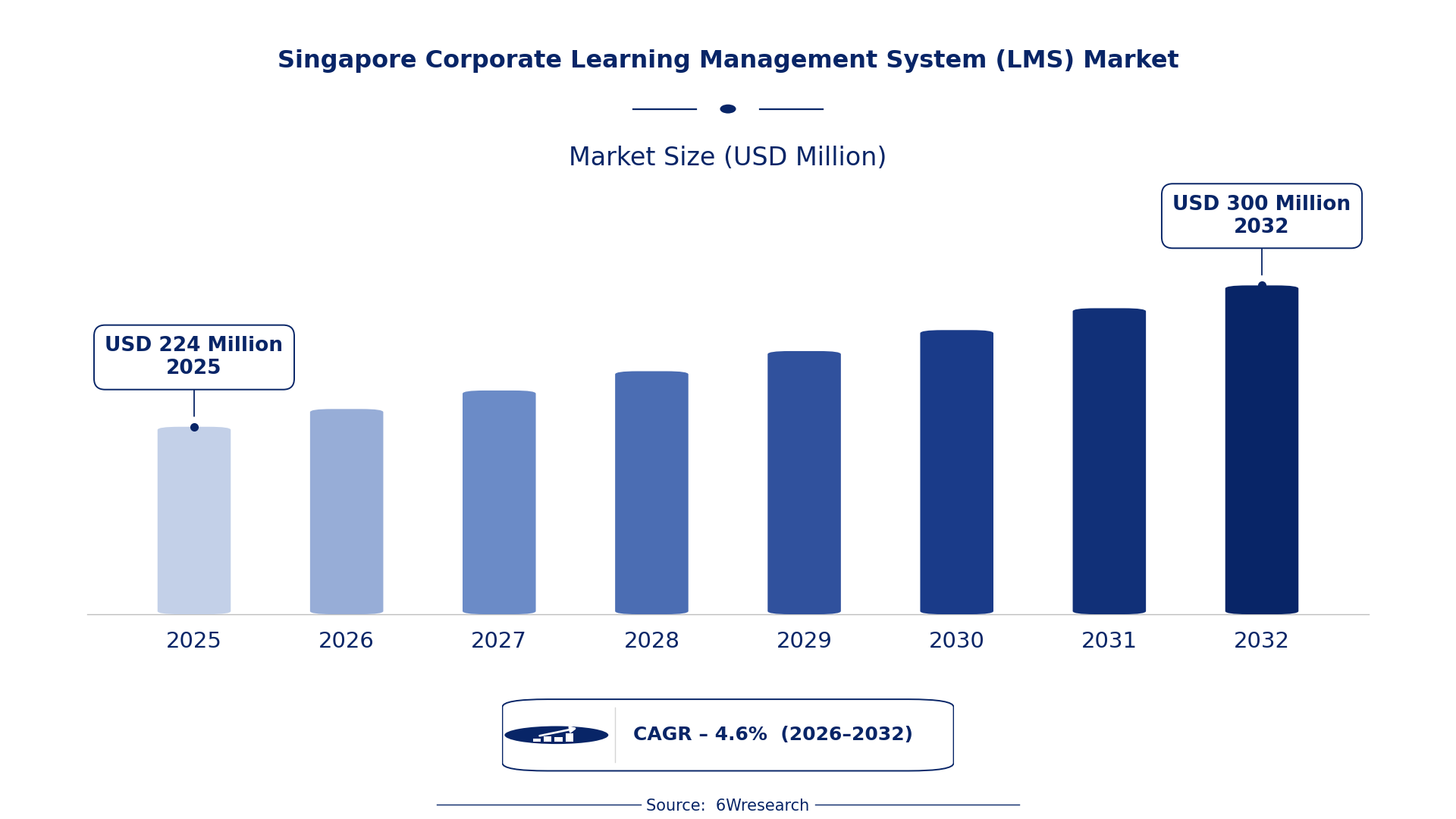
The Singapore Corporate Learning Management System (LMS) Market was estimated at USD 224 Million in 2025 and is projected to reach USD 300 Million by 2032, growing at a CAGR of 4.6% from 2026 to 2032.
Singapore Corporate Learning Management System (LMS) Market Synopsis
The Singapore Corporate Learning Management System (LMS) Market has recently experienced heightened momentum, driven largely by the urgent need for remote training solutions during the pandemic. As organizations adapt to a rapidly changing environment, they are increasingly turning to LMS platforms to facilitate employee development and skill enhancement.
Looking ahead, the market is expected to sustain its growth trajectory as businesses recognize the long-term value of continuous learning. The demand for customized, flexible training solutions tailored to specific corporate needs will likely shape the future of LMS offerings in Singapore.
Singapore Corporate Learning Management System (LMS) Market Year-wise Growth Rate and Key Drivers
This graph illustrates the annual growth rates of the Singapore Corporate Learning Management System (LMS) Market from 2021 to 2032, highlighting a steady upward trajectory and projected expansion over the forecast period.
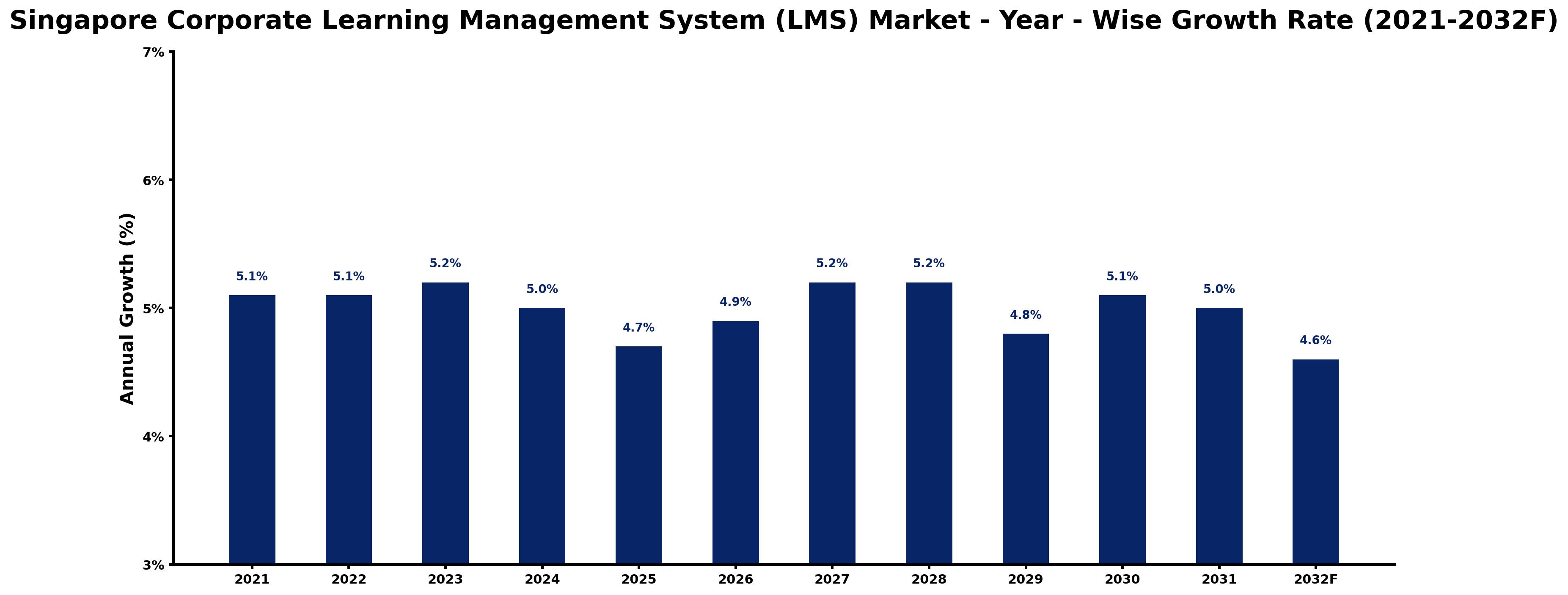
The table below presents the year‑wise growth rates along with the key drivers influencing the market
| Year | Growth Rate | Major Drivers |
| 2021 | 5.1% | Government push for digital skills transformation programs |
| 2022 | 5.1% | Rise in remote work culture necessitates online training solutions |
| 2023 | 5.2% | Integration of AI in educational tools for personalized learning |
| 2024 | 5.0% | Increased corporate spending on employee upskilling initiatives |
| 2025 | 4.7% | Focus on regulatory compliance mandates enhancing training needs |
| 2026 | 4.9% | Emergence of local edtech startups driving innovation in LMS |
| 2027 | 5.2% | Growing emphasis on lifelong learning among Singaporean workforce |
| 2028 | 5.2% | Partnerships between corporations and universities for skill development |
| 2029 | 4.8% | Advancements in mobile learning technologies attracting new users |
| 2030 | 5.1% | Government incentives for companies adopting e-learning platforms |
| 2031 | 5.0% | Corporate sustainability initiatives including training for green skills |
| 2032 | 4.6% | Demand for continuous professional development in financial services |
Note: Market size estimations and growth projections presented in this report are based on 6Wresearch's proprietary forecasting methodology, utilizing the latest available industry data, government publications, and primary research inputs.
Singapore Corporate Learning Management System (LMS) Market Key Takeaways
Below are some of the specific key takeaways from the market, including:
- The market is witnessing a shift towards digital and hybrid learning models, emphasizing flexibility and accessibility.
- Organizations are increasingly prioritizing employee upskilling and reskilling initiatives to remain competitive.
- Data security and privacy concerns are critical factors influencing LMS adoption and implementation.
- Integration of advanced technologies, such as AI and analytics, is enhancing the functionality of LMS platforms.
- The support from government initiatives is bolstering market growth by fostering a culture of continuous learning.
Evaluation of Restraints in Singapore Corporate Learning Management System (LMS) Market
The Singapore Corporate Learning Management System (LMS) Market faces several restraints that could impede its growth. One primary concern is the challenge of providing engaging and effective training experiences. Many LMS solutions struggle with user interface issues, which can lead to lower user adoption rates. on top of that, the diverse range of corporate training needs across various industries complicates the development of one-size-fits-all solutions. Ensuring robust data security and privacy is also crucial, as breaches can undermine trust in these platforms.
Singapore Corporate Learning Management System (LMS) Market Trends
Several trends are currently shaping the Singapore Corporate Learning Management System (LMS) Market. The rise of personalized learning experiences is becoming increasingly prominent, with organizations seeking to tailor content to individual employee needs. The incorporation of gamification elements is enhancing engagement, making training more interactive and enjoyable. Additionally, the use of mobile learning solutions is gaining traction, allowing employees to access training on-the-go, which is particularly vital in today’s remote work environment.
Singapore Corporate Learning Management System (LMS) Market Opportunities
The Singapore Corporate Learning Management System (LMS) Market presents numerous growth and investment opportunities. Companies can capitalize on the increasing demand for LMS solutions that incorporate data analytics for performance tracking and personalized learning paths. Additionally, there is potential for collaboration between LMS providers and educational institutions to create tailored programs that address skill gaps in the workforce. Organizations focusing on niche markets, such as compliance training or industry-specific skill development, may also find lucrative opportunities.
Government Initiatives in the Singapore Corporate Learning Management System (LMS) Market
The Singapore government has been proactive in fostering an environment conducive to corporate learning and development. With a strong focus on workforce resilience and adaptability, public policy is increasingly prioritizing the integration of digital learning solutions. These initiatives aim to ensure that the workforce is equipped with the necessary skills to thrive in a competitive economy. Such government backing is crucial for the growth of the LMS market, as it encourages businesses to invest in employee training.
- A recent initiative launched in 2023 focused on enhancing digital literacy among workers, providing funding for companies to implement LMS solutions.
- Currently underway is a nationwide campaign aimed at promoting lifelong learning, encouraging organizations to adopt LMS platforms as part of their training strategies.
- Plans for a public-private partnership initiative are set to roll out in 2024, which aims to expand access to advanced learning technologies for small and medium-sized enterprises.
- In 2025, the government intends to introduce a regulatory framework that mandates continuous professional development for all employees, reinforcing the need for effective LMS systems.
Future Insights of the Singapore Corporate Learning Management System (LMS) Market
From 2026 to 2032, the Singapore Corporate Learning Management System (LMS) Market is expected to evolve significantly. As businesses increasingly embrace technology-driven learning, there will be a surge in demand for integrated LMS solutions that offer data analytics, AI-driven insights, and customizable content. The focus on employee well-being and engagement will further drive innovation in LMS offerings, as companies seek to create enriching learning experiences that contribute to overall job satisfaction and productivity.
Singapore Corporate Learning Management System (LMS) Market Latest Developments
In the past year, the Singapore Corporate Learning Management System (LMS) Market has seen a flurry of activity as organizations strive to enhance their training capabilities. The shift towards digital platforms has prompted many companies to upgrade their LMS systems, ensuring they remain competitive. As demand for effective remote training solutions grows, various LMS providers have been actively innovating to meet these needs.
- A major technology vendor announced the rollout of an advanced LMS platform in early 2023, featuring enhanced AI capabilities for personalized learning.
- An ongoing partnership between a leading training provider and local businesses aims to integrate LMS solutions into existing corporate training frameworks, enhancing engagement and effectiveness.
- A planned launch of a mobile-friendly LMS is expected in Q3 2024, designed to cater to the needs of remote employees.
- A successful pilot program for an LMS focused on compliance training was completed in late 2022, leading to wider adoption across various sectors.
Singapore Corporate Learning Management System (LMS) Market - Key Attractiveness of the Report
- 10 Years of Market Numbers
- Historical Data Starting from 2022 to 2025
- Base Year: 2025
- Forecast Data until 2032
- Key Performance Indicators Impacting the Market
- Major Upcoming Developments and Projects
Key Highlights of the Report:
- Singapore Corporate Learning Management System (LMS) Market Outlook
- Market Size of Singapore Corporate Learning Management System (LMS) Market, 2025
- Forecast of Singapore Corporate Learning Management System (LMS) Market, 2032
- Historical Data and Forecast of Singapore Corporate Learning Management System (LMS) Revenues & Volume for the Period 2022-2032F
- Singapore Corporate Learning Management System (LMS) Market Trend Evolution
- Singapore Corporate Learning Management System (LMS) Market Drivers and Challenges
- Singapore Corporate Learning Management System (LMS) Price Trends
- Singapore Corporate Learning Management System (LMS) Porter's Five Forces
- Singapore Corporate Learning Management System (LMS) Industry Life Cycle
- Historical Data and Forecast of Singapore Corporate Learning Management System (LMS) Market Revenues & Volume By Vertical for the Period 2022-2032F
- Historical Data and Forecast of Singapore Corporate Learning Management System (LMS) Market Revenues & Volume By Software for the Period 2022-2032F
- Historical Data and Forecast of Singapore Corporate Learning Management System (LMS) Market Revenues & Volume By Technology for the Period 2022-2032F
- Historical Data and Forecast of Singapore Corporate Learning Management System (LMS) Market Revenues & Volume By Healthcare for the Period 2022-2032F
- Historical Data and Forecast of Singapore Corporate Learning Management System (LMS) Market Revenues & Volume By Retail for the Period 2022-2032F
- Historical Data and Forecast of Singapore Corporate Learning Management System (LMS) Market Revenues & Volume By BFSI for the Period 2022-2032F
- Historical Data and Forecast of Singapore Corporate Learning Management System (LMS) Market Revenues & Volume By Telecommunications for the Period 2022-2032F
- Historical Data and Forecast of Singapore Corporate Learning Management System (LMS) Market Revenues & Volume By Offering for the Period 2022-2032F
- Historical Data and Forecast of Singapore Corporate Learning Management System (LMS) Market Revenues & Volume By Solutions for the Period 2022-2032F
- Historical Data and Forecast of Singapore Corporate Learning Management System (LMS) Market Revenues & Volume By Services for the Period 2022-2032F
- Historical Data and Forecast of Singapore Corporate Learning Management System (LMS) Market Revenues & Volume By Deployment Mode for the Period 2022-2032F
- Historical Data and Forecast of Singapore Corporate Learning Management System (LMS) Market Revenues & Volume By Cloud for the Period 2022-2032F
- Historical Data and Forecast of Singapore Corporate Learning Management System (LMS) Market Revenues & Volume By On-premises for the Period 2022-2032F
- Historical Data and Forecast of Singapore Corporate Learning Management System (LMS) Market Revenues & Volume By Organization Size for the Period 2022-2032F
- Historical Data and Forecast of Singapore Corporate Learning Management System (LMS) Market Revenues & Volume By SMEs for the Period 2022-2032F
- Historical Data and Forecast of Singapore Corporate Learning Management System (LMS) Market Revenues & Volume By Large Enterprises for the Period 2022-2032F
- Singapore Corporate Learning Management System (LMS) Import Export Trade Statistics
- Market Opportunity Assessment By Vertical
- Market Opportunity Assessment By Offering
- Market Opportunity Assessment By Deployment Mode
- Market Opportunity Assessment By Organization Size
- Singapore Corporate Learning Management System (LMS) Top Companies Market Share
- Singapore Corporate Learning Management System (LMS) Competitive Benchmarking By Technical and Operational Parameters
- Singapore Corporate Learning Management System (LMS) Company Profiles
- Singapore Corporate Learning Management System (LMS) Key Strategic Recommendations






































