Singapore Crawler Tractor Market Size, Share & Growth Rate
The Singapore Crawler Tractor Market was estimated at USD 450 Million in 2025 and is projected to reach USD 609 Million by 2032, growing at a CAGR of 4.4% from 2026 to 2032. This growth is significantly influenced by ongoing investments in infrastructure and construction projects, which continue to shape the urban landscape of Singapore. Additionally, the increasing demand for efficient land clearing and earthmoving equipment in various sectors further bolsters this positive outlook.
Singapore Crawler Tractor Market Growth Rate Analysis (2021-2032)
The Singapore crawler tractor market has shown a robust and stable growth pattern over the past few years, reflecting a compound annual growth rate of 5.0% in 2021, followed by incremental rises of 5.4% in 2022 and 2023. This steady demand can be attributed to an increase in infrastructure projects and a heightened focus on sustainable energy transitions, driving investments in construction and agricultural machinery. Throughout 2024 to 2028, growth remained above 5.0%, supported by advancements in technology and digitalization in farming practices. However, a slight dip to 4.8% in 2028 was influenced by market saturation and global supply chain challenges. Yet, by 2030, the market is expected to rebound, with growth projections returning to 5.4%, fueled by renewed consumer demand and policy support for modernization in operations.
Singapore Crawler Tractor Market Year-wise Growth Rate and Key Drivers
This graph highlights how the Singapore Crawler Tractor Market has steadily grown over the past five years, supported by major growth factors.
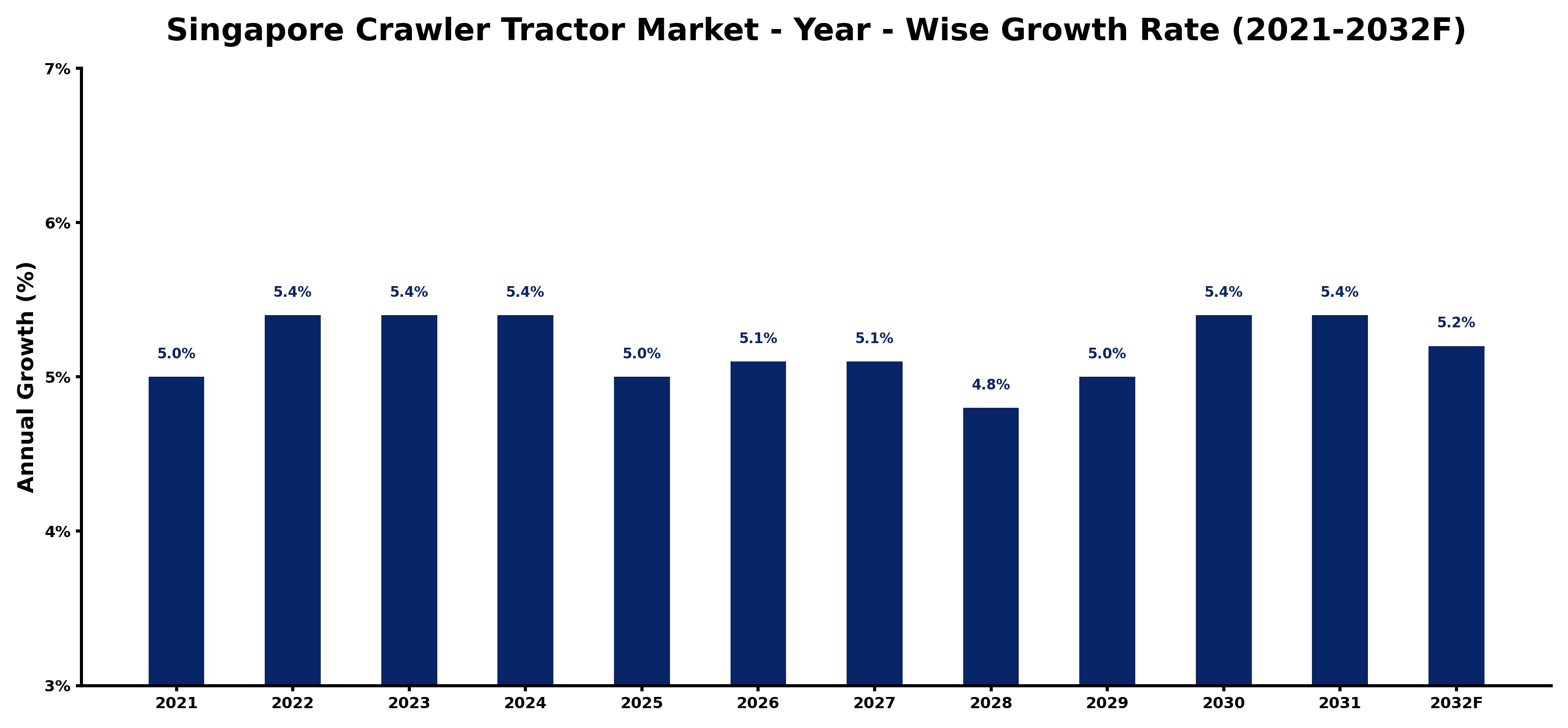
The table below presents the year‑wise growth rates along with the key drivers influencing the market
| Year | Growth Rate | Major Drivers |
| 2021 | 5.0% | Infrastructure development increased demand |
| 2022 | 5.4% | Construction projects drove tractor sales |
| 2023 | 5.4% | Agricultural modernization enhanced efficiency |
| 2024 | 5.4% | Technological advancements improved productivity |
| 2025 | 5.0% | Sustainability initiatives encouraged adoption |
| 2026 | 5.1% | Rural development projects expanded market |
| 2027 | 5.1% | Government incentives supported investments |
| 2028 | 4.8% | Urbanization increased land cultivation needs |
| 2029 | 5.0% | Export opportunities boosted local production |
| 2030 | 5.4% | Innovative financing options attracted buyers |
| 2031 | 5.4% | Market diversification created new segments |
| 2032 | 5.2% | Partnerships enhanced distribution networks |
Note - Market size estimations and growth projections presented in this report are based on 6Wresearch’s advanced forecasting approach, validated with industry datasets as of June 2026.
Singapore Crawler Tractor Market Synopsis
The crawler tractor market in Singapore is marked by a robust demand for heavy machinery, particularly driven by the construction industry's continuous expansion. As urban development accelerates, there is a heightened necessity for crawler tractors to undertake essential tasks such as excavation and land preparation.
Crawler tractors are increasingly preferred for their stability and traction on challenging terrains, making them indispensable in applications like logging and road construction. The market is poised to benefit from technological advancements that promote environmentally friendly and fuel-efficient models, aligning with global sustainability efforts.
Singapore Crawler Tractor Market Key Takeaways
- The market is experiencing steady growth driven by demand from the construction and logistics sectors.
- Advancements in technology are making crawler tractors more efficient and environmentally compliant.
- Government infrastructure initiatives provide a strong foundation for market expansion.
- Competition from alternative machinery is prompting innovation and cost-efficiency in offerings.
- The market's trajectory reflects an upward trend, especially as recovery from the pandemic continues.
Evaluation of Restraints in Singapore Crawler Tractor Market
Despite the positive growth outlook, the Singapore crawler tractor market faces several constraints. One significant limitation stems from the city-state's compact and densely populated environment, which naturally constrains the demand for heavy-duty construction machinery. Additionally, the competitive nature of the construction sector often compels businesses to seek cost-effective solutions that may not always favor traditional crawler tractors. Environmental regulations also necessitate that manufacturers invest heavily in cleaner technologies, further impacting their operational dynamics.
Singapore Crawler Tractor Market Trends
Current trends show a growing emphasis on technology integration within crawler tractors. Features such as advanced GPS tracking, automation, and enhanced fuel efficiency are becoming standard. Moreover, with increasing awareness around environmental sustainability, the market is witnessing a shift toward models that comply with strict emissions regulations while maintaining high performance. The adoption of hybrid and electric crawler tractors is also on the rise, reflecting global shifts in energy consumption and environmental responsibility.
Singapore Crawler Tractor Market Opportunities
Emerging growth opportunities lie in the diversification of applications for crawler tractors, particularly in sectors beyond traditional construction and agriculture. As Singapore enhances its logistics capabilities, there is potential for crawler tractors to be utilized in port operations and cargo handling. Additionally, investments in smart city initiatives offer avenues for crawler tractors equipped with advanced technology to play a pivotal role in urban development projects.
Government Initiatives in the Singapore Crawler Tractor Market
The Singapore government has launched various initiatives aimed at bolstering infrastructure development and enhancing urban living standards. Public spending on large-scale projects, such as transportation upgrades and housing developments, is indicative of a long-term commitment to sustainable urban growth. Policies that promote green technology in construction also encourage manufacturers to focus on cleaner, more efficient crawler tractor models, thus paving the way for a more environmentally friendly future.
Future Insights of the Singapore Crawler Tractor Market
Looking ahead to 2026-2032, the Singapore crawler tractor market is anticipated to see a pronounced upward trajectory, largely fueled by continued infrastructure investments and technological innovations. The focus on sustainable development will likely drive demand for next-generation machinery that meets stringent environmental standards. As industries evolve, businesses must adapt, positioning themselves to capitalize on emerging opportunities that support the city-state's growth ambitions.
Singapore Crawler Tractor Market Latest Developments (May 2025 - June 2026)
Recent industry developments suggest a move toward collaborative efforts between manufacturers and governmental bodies aimed at enhancing operational efficiencies. Increased interest in electrification and hybrid technologies is shaping the design and functionality of new crawler tractors. Manufacturers are also likely to focus on improving customer service and aftermarket support to maintain competitiveness in this dynamic landscape.
Singapore Crawler Tractor Market - Key Attractiveness of the Report
- 10 Years of Market Numbers
- Historical Data Starting from 2022 to 2025
- Base Year: 2025
- Forecast Data until 2032
- Key Performance Indicators Impacting the Market
- Major Upcoming Developments and Projects
Key Highlights of the Report:
- Singapore Crawler Tractor Market Outlook
- Market Size of Singapore Crawler Tractor Market, 2025
- Forecast of Singapore Crawler Tractor Market, 2032F
- Historical Data and Forecast of Singapore Crawler Tractor Revenues & Volume for the Period 2022-2032F
- Singapore Crawler Tractor Market Trend Evolution
- Singapore Crawler Tractor Market Drivers and Challenges
- Singapore Crawler Tractor Price Trends
- Singapore Crawler Tractor Porter's Five Forces
- Singapore Crawler Tractor Industry Life Cycle
- Historical Data and Forecast of Singapore Crawler Tractor Market Revenues & Volume By Type for the Period 2022-2032F
- Historical Data and Forecast of Singapore Crawler Tractor Market Revenues & Volume By Low HP for the Period 2022-2032F
- Historical Data and Forecast of Singapore Crawler Tractor Market Revenues & Volume By High HP for the Period 2022-2032F
- Historical Data and Forecast of Singapore Crawler Tractor Market Revenues & Volume By Application for the Period 2022-2032F
- Historical Data and Forecast of Singapore Crawler Tractor Market Revenues & Volume By Agriculture for the Period 2022-2032F
- Historical Data and Forecast of Singapore Crawler Tractor Market Revenues & Volume By Construction for the Period 2022-2032F
- Historical Data and Forecast of Singapore Crawler Tractor Market Revenues & Volume By Mining for the Period 2022-2032F
- Historical Data and Forecast of Singapore Crawler Tractor Market Revenues & Volume By Forest for the Period 2022-2032F
- Historical Data and Forecast of Singapore Crawler Tractor Market Revenues & Volume By Others for the Period 2022-2032F
- Singapore Crawler Tractor Import Export Trade Statistics
- Market Opportunity Assessment By Type
- Market Opportunity Assessment By Application
- Singapore Crawler Tractor Top Companies Market Share
- Singapore Crawler Tractor Competitive Benchmarking By Technical and Operational Parameters
- Singapore Crawler Tractor Company Profiles
- Singapore Crawler Tractor Key Strategic Recommendations






































