Singapore Crystal Lighting Market Summary
The singapore crystal lighting market was estimated at USD 1124 Million in 2025 and is projected to reach USD 1605 Million by 2032, growing at a CAGR of 6.1% from 2026 to 2032.
Singapore Crystal Lighting Market Year-wise Growth Rate and Key Drivers
This graph highlights how the Singapore Crystal Lighting Market has steadily grown over the past five years, supported by major growth factors.
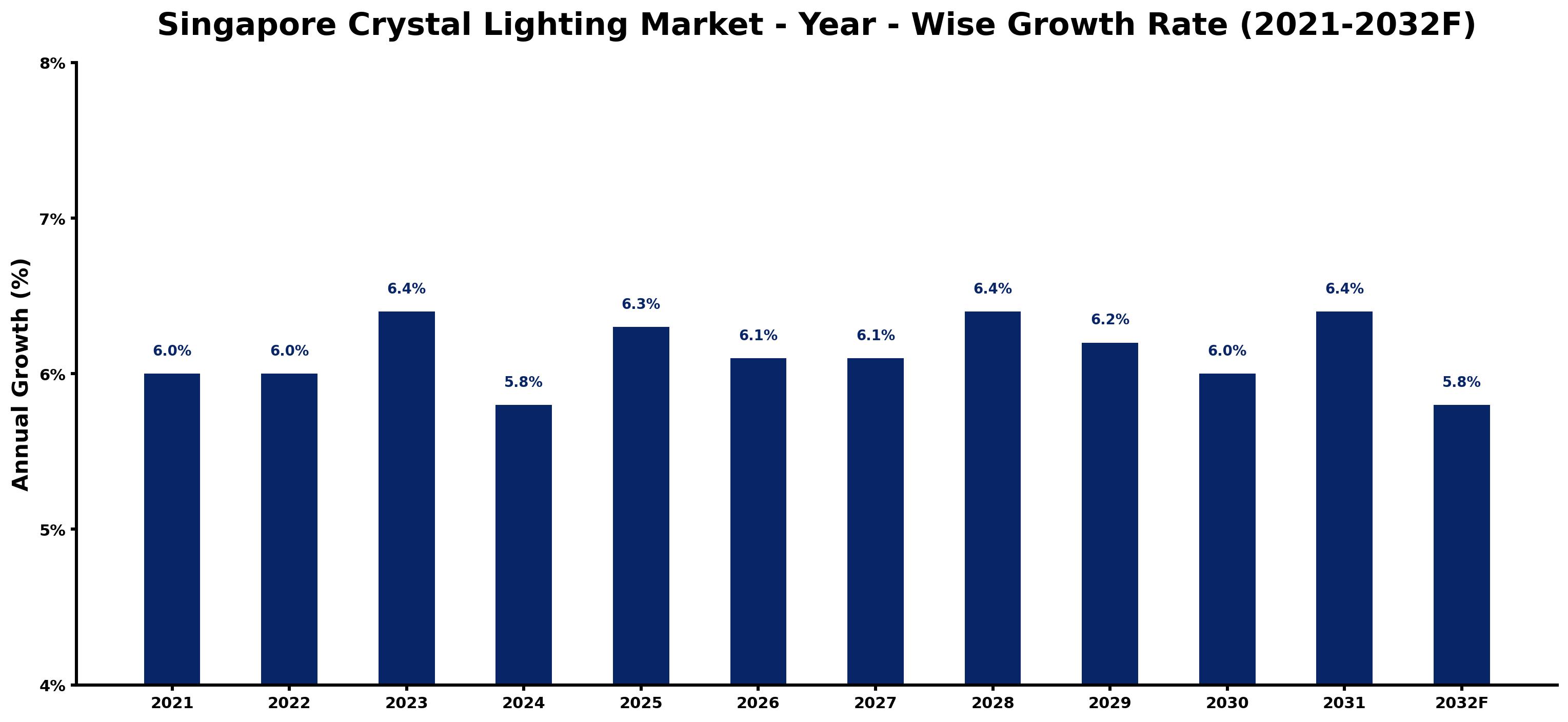
The table below presents the year wise growth rates along with the key drivers influencing the market
| Year | Growth Rate | Major Drivers |
| 2021 | 6.0% | Post-pandemic recovery initiatives boosted consumer interest in home aesthetic improvements. |
| 2022 | 6.0% | Sustainability trends led to increased demand for energy-efficient lighting solutions. |
| 2023 | 6.4% | Luxury property developments prioritized unique lighting designs to attract affluent buyers. |
| 2024 | 5.8% | Smart home technology integration encouraged innovative lighting systems among tech-savvy consumers. |
| 2025 | 6.3% | Urbanization resulted in heightened competition among luxury interior design firms. |
| 2026 | 6.1% | Cultural emphasis on celebratory events increased the use of decorative crystal lighting. |
| 2027 | 6.1% | Online marketplaces expanded, making specialized crystal lighting more accessible to consumers. |
| 2028 | 6.4% | Partnerships between local artisans and designers fostered unique product offerings and collaborations. |
| 2029 | 6.2% | Increased residential developments featured crystal lighting as a key design element. |
| 2030 | 6.0% | Investment in hospitality sector renovations emphasized high-quality lighting for guest experiences. |
| 2031 | 6.4% | Consumer awareness of local craftsmanship reinforced loyalty to Singaporean crystal lighting brands. |
| 2032 | 5.8% | Market consolidation began as major players acquired innovative startups for competitive edge. |
Note - Market size estimations and growth projections presented in this report are based on 6Wresearch's advanced forecasting approach, validated with industry datasets as of June 2026.
Singapore Crystal Lighting Market Synopsis
The Singapore Crystal Lighting Market is projected to reach 6.1% and witness significant growth during the forecast period (2026-2032). This growth is attributed to several macroeconomic factors, including the booming construction sector and a paradigm shift towards energy-efficient lighting solutions. As various sectors, both residential and commercial, embrace crystal lighting technologies, the market is set to benefit from enhanced aesthetic appeal, functionality, and sustainability.
Singapore Crystal Lighting Market Growth Drivers
The expansion of the Singapore Crystal Lighting Market is being propelled by two critical drivers that are reshaping the lighting landscape in the region:
- The growing demand for energy-efficient solutions has resulted in a marked preference for advanced lighting systems that reduce power consumption while enhancing illumination quality. This trend aligns with increasing environmental awareness among consumers.
- Ongoing developments in the local construction industry support the adoption of crystal lighting. Landmark projects, such as major public infrastructure developments, drive the demand for sophisticated lighting systems that meet modern design standards.
- The aesthetic appeal of crystal lighting fixtures plays a significant role in their market acceptance. By blending functionality with elegance, these fixtures are increasingly sought after for their ability to enhance the ambiance of both residential and commercial spaces.
- Technological advancements in lighting design and manufacturing are also encouraging the growth of the Singapore crystal lighting market. Innovations lead to more efficient production processes and sophisticated designs that cater to diverse consumer preferences.
- As urbanization continues to rise, the need for modern lighting solutions in new residential and commercial projects is a pivotal factor driving market growth. The integration of advanced lighting options in urban planning reflects a forward-looking approach to urban development.
Singapore Crystal Lighting Market Challenges and Restraints
Despite the favorable factors driving the market, several challenges hinder the full potential of the Singapore Crystal Lighting Market:
- The high initial costs associated with crystal lighting fixtures present a significant barrier. Although these products offer enhanced longevity and efficiency, the upfront investment can deter many potential buyers, particularly in mid-tier market segments.
- Limited availability of local suppliers for crystal lighting fixtures often results in dependency on imports. This reliance on international suppliers, particularly from regions like China, can lead to potential supply chain disruptions and elevated costs.
- The perception of crystal lighting as a luxury item can restrict its adoption in markets that prioritize cost-effective solutions. Many consumers remain hesitant to invest in crystal lighting due to the costs involved.
- Consumer education around the advantages of crystal lighting compared to traditional options is still lacking. Without sufficient awareness, consumers may default to familiar alternatives that may not offer the same level of efficiency.
- Regulatory compliance related to energy efficiency and safety standards can pose challenges for manufacturers and suppliers. Adhering to these regulations is essential but can be resource-intensive for companies seeking to introduce new products into the market.
Singapore Crystal Lighting Market Investment Opportunities
As the market dynamics evolve, several investment opportunities are emerging within the Singapore Crystal Lighting Market:
- Investing in research and development (R&D) can lead to innovative crystal lighting solutions that cater to evolving consumer preferences for design and functionality. Companies focusing on R&D are likely to attain a competitive advantage.
- Expansion into emerging markets within Southeast Asia presents substantial growth opportunities for companies in the crystal lighting sector. As disposable income rises in neighboring countries, there is potential for market expansion beyond Singapore.
- Strategic partnerships with local construction firms can enhance market penetration. Collaborating with these firms allows lighting companies to secure contracts for large-scale projects requiring sophisticated lighting solutions.
- Offering financing options or leasing plans for high-cost crystal lighting solutions can attract more budget-conscious consumers. This approach can help mitigate the barrier of high initial costs.
- Advancements in sustainable production techniques can not only reduce costs but also appeal to environmentally-conscious consumers. Developing a sustainable product line can differentiate brands in a competitive marketplace.
Singapore Crystal Lighting Market Government Investment and Initiatives
The Singaporean government plays a pivotal role in the evolution of the crystal lighting market through various investments and initiatives aimed at promoting sustainable development:
- Government policies that prioritize energy efficiency and sustainability are crucial in driving the adoption of advanced lighting solutions. Programs incentivizing energy-efficient lighting approaches support consumer transition from traditional bulbs to modern alternatives.
- Regular investments in large-scale public infrastructure projects create a sustained demand for crystal lighting products, as these projects necessitate high-quality fixtures that meet both aesthetic and functional requirements.
- Incentives and grants for manufacturers developing innovative and efficient lighting solutions can boost local production capabilities, reducing dependency on imports and promoting economic growth.
- Government-led campaigns aimed at increasing public awareness of energy-efficient lighting technologies encourage consumers to consider alternatives to conventional lighting options, fostering a greater market acceptance for crystal lighting.
- Regulatory frameworks governing building codes and standards facilitate the integration of energy-efficient lighting solutions in both new and retrofit constructions, propelling demand for crystal lighting fixtures.
Singapore Crystal Lighting Market Latest Developments (May 2025 - June 2026)
Recent developments in the Singapore Crystal Lighting Market reflect a strategic pivot towards innovation and sustainability. There has been an uptick in companies focusing on developing advanced LED crystal lighting solutions that offer enhanced energy efficiency and longevity.
Additionally, collaborative efforts between local and international manufacturers have led to the introduction of new product lines tailored to meet the unique requirements of Singapore's urban landscape. The increasing emphasis on aesthetics in interior design is driving the demand for decorative crystal lighting, particularly in high-end residential projects.
Furthermore, several construction projects have prompted a surge in crystal lighting fixture orders as developers focus on creating visually appealing spaces. These trends indicate a promising trajectory for the market, supported by consumer preference for upscale lighting solutions.
Singapore Crystal Lighting Market - Key Attractiveness of the Report
- 10 Years of Market Numbers
- Historical Data Starting from 2022 to 2025
- Base Year: 2025
- Forecast Data until 2032
- Key Performance Indicators Impacting the Market
- Major Upcoming Developments and Projects
Key Highlights of the Report:
- Singapore Crystal Lighting Market Outlook
- Market Size of Singapore Crystal Lighting Market, 2025
- Forecast of Singapore Crystal Lighting Market, 2032
- Historical Data and Forecast of Singapore Crystal Lighting Revenues & Volume for the Period 2022-2032
- Singapore Crystal Lighting Market Trend Evolution
- Singapore Crystal Lighting Market Drivers and Challenges
- Singapore Crystal Lighting Price Trends
- Singapore Crystal Lighting Porter's Five Forces
- Singapore Crystal Lighting Industry Life Cycle
- Historical Data and Forecast of Singapore Crystal Lighting Market Revenues & Volume By Product Type for the Period 2022-2032
- Historical Data and Forecast of Singapore Crystal Lighting Market Revenues & Volume By Ceiling Crystal Lights for the Period 2022-2032
- Historical Data and Forecast of Singapore Crystal Lighting Market Revenues & Volume By Crystal Chandeliers for the Period 2022-2032
- Historical Data and Forecast of Singapore Crystal Lighting Market Revenues & Volume By Others for the Period 2022-2032
- Historical Data and Forecast of Singapore Crystal Lighting Market Revenues & Volume By Applications for the Period 2022-2032
- Historical Data and Forecast of Singapore Crystal Lighting Market Revenues & Volume By Commercial for the Period 2022-2032
- Historical Data and Forecast of Singapore Crystal Lighting Market Revenues & Volume By Designer for the Period 2022-2032
- Historical Data and Forecast of Singapore Crystal Lighting Market Revenues & Volume By Superior Residential for the Period 2022-2032
- Singapore Crystal Lighting Import Export Trade Statistics
- Market Opportunity Assessment By Product Type
- Market Opportunity Assessment By Applications
- Singapore Crystal Lighting Top Companies Market Share
- Singapore Crystal Lighting Competitive Benchmarking By Technical and Operational Parameters
- Singapore Crystal Lighting Company Profiles
- Singapore Crystal Lighting Key Strategic Recommendations






































