Singapore Data Catalog Market Size & Growth Rate (2026-2032)
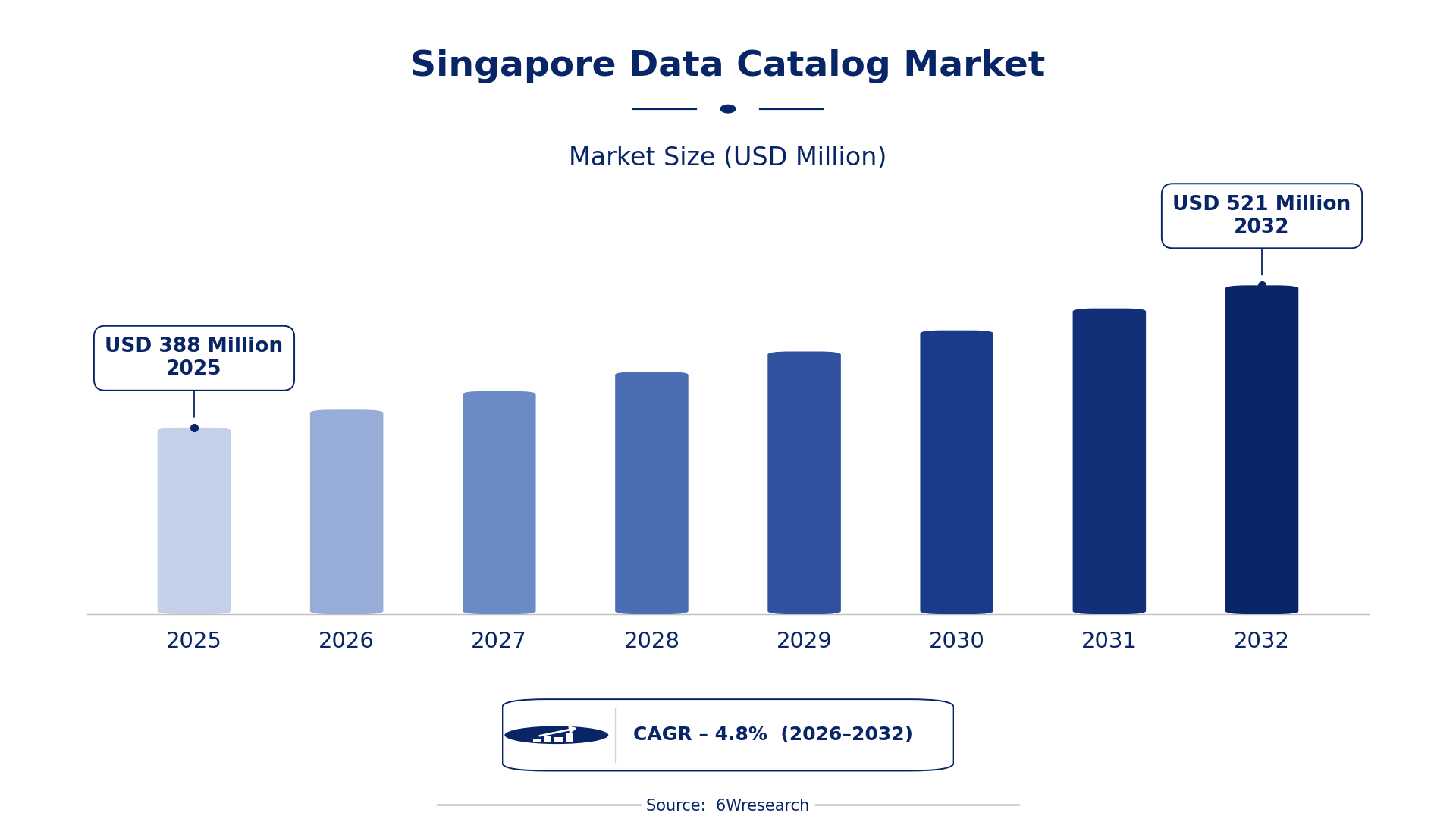
The Singapore Data Catalog Market was estimated at USD 388 Million in 2025 and is projected to reach USD 521 Million by 2032, growing at a CAGR of 4.8% from 2026 to 2032.
Singapore Data Catalog Market Synopsis
The Singapore Data Catalog Market is currently experiencing a noteworthy surge, driven by organizations' increasing need to manage vast amounts of data. As companies in Singapore ramp up their data-driven initiatives, the necessity for efficient data management and governance becomes crucial for ensuring compliance and maximizing data utility.
In this climate, data catalog solutions have emerged as indispensable tools that allow businesses to systematically catalog, organize, and discover their data assets. These platforms not only enhance data governance but also empower organizations to make informed, data-driven decisions that are critical for maintaining a competitive edge.
Singapore Data Catalog Market Year-wise Growth Rate and Key Drivers
This graph illustrates the annual growth rates of the Singapore Data Catalog Market from 2021 to 2032, highlighting a steady upward trajectory and projected expansion over the forecast period.
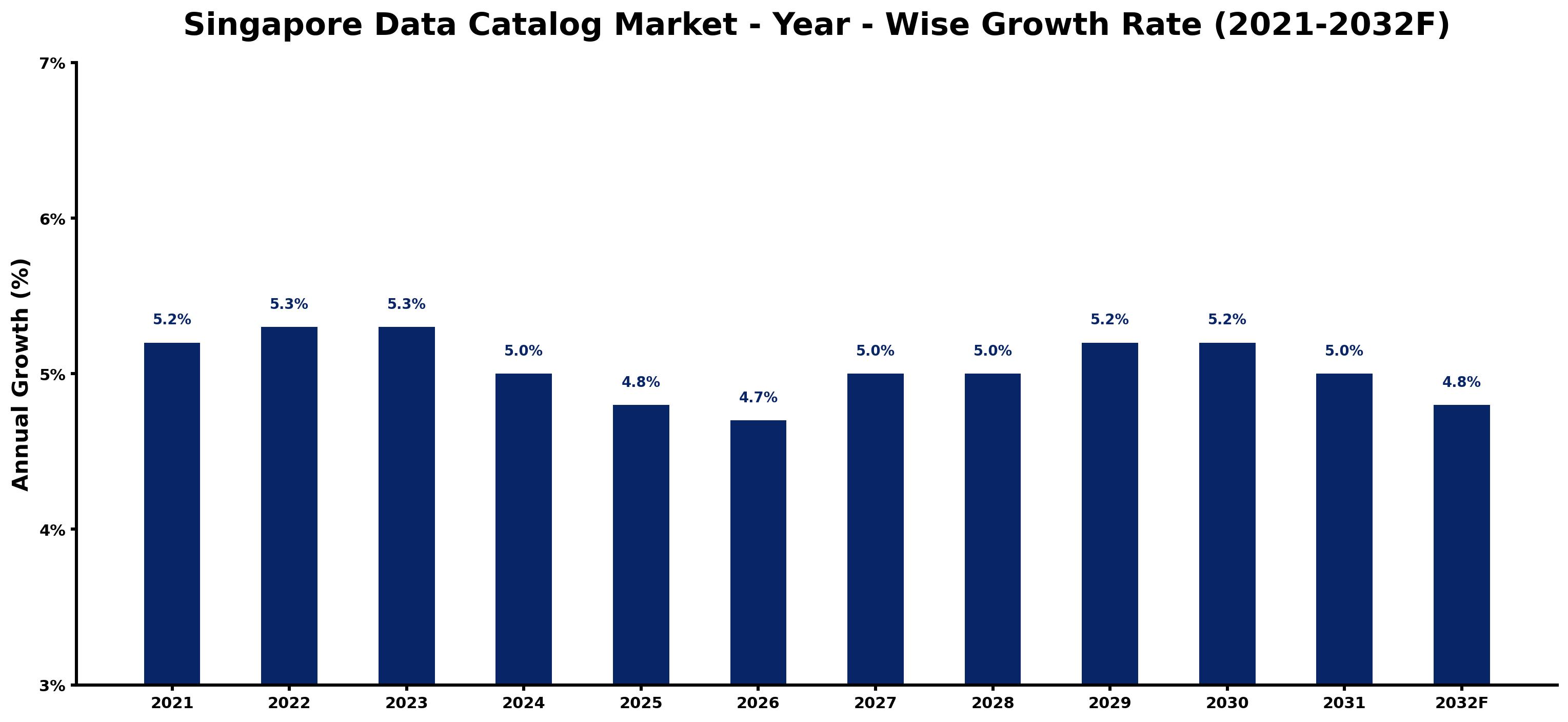
The table below presents the year‑wise growth rates along with the key drivers influencing the market
| Year | Growth Rate | Major Drivers |
| 2021 | 5.2% | Government's Smart Nation initiative boosts data connectivity. |
| 2022 | 5.3% | Increase in AI adoption drives demand for data catalogs. |
| 2023 | 5.3% | New data protection regulations enhance enterprise data management. |
| 2024 | 5.0% | Digital transformation initiatives propel cataloging solutions uptake. |
| 2025 | 4.8% | Healthcare sector seeks integrated data for patient insights. |
| 2026 | 4.7% | Financial services demand improved data governance solutions. |
| 2027 | 5.0% | Growing e-commerce drives need for robust data architecture. |
| 2028 | 5.0% | Increased data literacy initiatives foster market growth. |
| 2029 | 5.2% | Government incentives promote data-driven decision-making practices. |
| 2030 | 5.2% | Rising cybersecurity concerns necessitate secure data management. |
| 2031 | 5.0% | Smart logistics projects require effective data cataloging solutions. |
| 2032 | 4.8% | Surge in remote work emphasizes organized data access. |
Note: Market size estimations and growth projections presented in this report are based on 6Wresearch's proprietary forecasting methodology, utilizing the latest available industry data, government publications, and primary research inputs.
Singapore Data Catalog Market Key Takeaways
Below are some of the specific key takeaways from the market, including:
- The market is expected to grow significantly, reflecting an increasing reliance on data catalog solutions.
- Organizations are prioritizing data governance and compliance to enhance decision-making processes.
- The demand for data visibility and quality is driving innovations in data catalog technologies.
- Businesses face challenges in integrating diverse data sources, complicating data management efforts.
- COVID-19 has accelerated the adoption of data catalog solutions, highlighting their importance in a remote work environment.
Evaluation of Restraints in Singapore Data Catalog Market
The Singapore Data Catalog Market is hindered by several key limitations. Organizations often struggle with the complexity of managing diverse data assets, which can lead to inefficiencies. The accuracy of metadata is crucial for effective data governance, yet achieving this accuracy presents ongoing challenges. Data privacy concerns add another layer of difficulty, as businesses must ensure compliance while handling sensitive information. on top of that, the need to adapt data catalogs to various data sources and formats complicates the landscape, necessitating ongoing investment in technology and training.
Singapore Data Catalog Market Trends
Several trends are currently shaping the Singapore Data Catalog Market. First, the emphasis on data quality and governance is driving organizations to adopt more sophisticated cataloging solutions. The integration of artificial intelligence and machine learning within data catalogs is gaining traction, enhancing data discovery and management capabilities. Additionally, as organizations increasingly focus on compliance with data privacy regulations, there is a growing demand for solutions that ensure regulatory adherence while maximizing data utility.
Singapore Data Catalog Market Opportunities
The potential for growth in the Singapore Data Catalog Market is substantial. As businesses continue to generate and collect vast amounts of data, the need for effective cataloging solutions will only intensify. Companies can seize opportunities by investing in innovative data catalog technologies that enhance data governance and compliance. on top of that, the rising trend of cloud adoption presents a chance for data catalog solutions that integrate seamlessly with cloud environments, allowing for more agile and scalable data management practices.
Government Initiatives in the Singapore Data Catalog Market
The Singapore government plays a crucial role in shaping the Data Catalog Market through various initiatives aimed at enhancing data governance and infrastructure. With a commitment to fostering a data-driven economy, public policies focus on ensuring compliance with data privacy regulations while encouraging businesses to harness the full potential of their data assets.
- A recently completed initiative involved the rollout of a national data governance framework that emphasizes transparency and accountability in data management.
- Currently underway is a program aimed at upgrading the digital infrastructure to support better data cataloging and governance capabilities across public and private sectors.
- A planned initiative expected to launch in 2027 focuses on promoting collaboration between government agencies and businesses to enhance data sharing and accessibility.
- The government is also working on a regulatory framework anticipated to be introduced in 2026, which will mandate stricter data quality and governance standards.
- Ongoing efforts include workshops and training programs designed to equip businesses with the necessary skills to implement effective data catalog solutions.
Future Insights of the Singapore Data Catalog Market
Looking ahead to 2026-2032, the Singapore Data Catalog Market is expected to continue its upward trajectory, driven by the increasing emphasis on data-driven decision-making across industries. As organizations seek to improve their data governance frameworks, the adoption of advanced cataloging solutions will become more widespread. on top of that, with the anticipated advancements in technology, including AI and machine learning, data catalog solutions will likely evolve to offer even more powerful capabilities, making them essential tools for businesses in the digital age.
Singapore Data Catalog Market Latest Developments
In the past year, the Singapore Data Catalog Market has witnessed a flurry of activity, reflecting the increasing recognition of the importance of effective data management. Organizations are actively investing in solutions that not only streamline data governance but also enhance data-driven insights.
- A major technology vendor launched a new data catalog platform in early 2025, incorporating advanced AI features to improve data discovery processes.
- A partnership between two leading data management companies is currently underway, aimed at integrating their catalog solutions for enhanced interoperability, expected to be completed by mid-2026.
- An initiative focusing on data quality assessment tools began in Q3 2025 and remains ongoing, helping organizations meet compliance standards more effectively.
- Plans for a new training program designed to enhance data literacy among employees are set to roll out in late 2026, aiming to boost the adoption of data catalog solutions.
- A regional operator is currently testing a pilot project to evaluate the impact of cloud-based data catalogs on operational efficiency, with results expected by early 2026.
Singapore Data Catalog Market - Key Attractiveness of the Report
- 10 Years of Market Numbers
- Historical Data Starting from 2022 to 2025
- Base Year: 2025
- Forecast Data until 2032
- Key Performance Indicators Impacting the Market
- Major Upcoming Developments and Projects
Key Highlights of the Report:
- Singapore Data Catalog Market Outlook
- Market Size of Singapore Data Catalog Market, 2025
- Forecast of Singapore Data Catalog Market, 2032
- Historical Data and Forecast of Singapore Data Catalog Revenues & Volume for the Period 2022-2032F
- Singapore Data Catalog Market Trend Evolution
- Singapore Data Catalog Market Drivers and Challenges
- Singapore Data Catalog Price Trends
- Singapore Data Catalog Porter's Five Forces
- Singapore Data Catalog Industry Life Cycle
- Historical Data and Forecast of Singapore Data Catalog Market Revenues & Volume By Component for the Period 2022-2032F
- Historical Data and Forecast of Singapore Data Catalog Market Revenues & Volume By Solutions for the Period 2022-2032F
- Historical Data and Forecast of Singapore Data Catalog Market Revenues & Volume By Services for the Period 2022-2032F
- Historical Data and Forecast of Singapore Data Catalog Market Revenues & Volume By Data Consumer for the Period 2022-2032F
- Historical Data and Forecast of Singapore Data Catalog Market Revenues & Volume By Business Intelligence tools for the Period 2022-2032F
- Historical Data and Forecast of Singapore Data Catalog Market Revenues & Volume By Enterprise Applications for the Period 2022-2032F
- Historical Data and Forecast of Singapore Data Catalog Market Revenues & Volume By Mobile and Web Applications for the Period 2022-2032F
- Historical Data and Forecast of Singapore Data Catalog Market Revenues & Volume By Deployment Mode for the Period 2022-2032F
- Historical Data and Forecast of Singapore Data Catalog Market Revenues & Volume By Cloud for the Period 2022-2032F
- Historical Data and Forecast of Singapore Data Catalog Market Revenues & Volume By On-premises for the Period 2022-2032F
- Historical Data and Forecast of Singapore Data Catalog Market Revenues & Volume By Metadata Type for the Period 2022-2032F
- Historical Data and Forecast of Singapore Data Catalog Market Revenues & Volume By Technical Metadata for the Period 2022-2032F
- Historical Data and Forecast of Singapore Data Catalog Market Revenues & Volume By Business Metadata for the Period 2022-2032F
- Historical Data and Forecast of Singapore Data Catalog Market Revenues & Volume By Organization Size for the Period 2022-2032F
- Historical Data and Forecast of Singapore Data Catalog Market Revenues & Volume By SMEs for the Period 2022-2032F
- Historical Data and Forecast of Singapore Data Catalog Market Revenues & Volume By Large Enterprises for the Period 2022-2032F
- Historical Data and Forecast of Singapore Data Catalog Market Revenues & Volume By Vertical for the Period 2022-2032F
- Historical Data and Forecast of Singapore Data Catalog Market Revenues & Volume By BFSI for the Period 2022-2032F
- Historical Data and Forecast of Singapore Data Catalog Market Revenues & Volume By Retail and eCommerce for the Period 2022-2032F
- Historical Data and Forecast of Singapore Data Catalog Market Revenues & Volume By Manufacturing for the Period 2022-2032F
- Historical Data and Forecast of Singapore Data Catalog Market Revenues & Volume By Government and Defence for the Period 2022-2032F
- Historical Data and Forecast of Singapore Data Catalog Market Revenues & Volume By Healthcare and Life Sciences for the Period 2022-2032F
- Historical Data and Forecast of Singapore Data Catalog Market Revenues & Volume By Telecom for the Period 2022-2032F
- Historical Data and Forecast of Singapore Data Catalog Market Revenues & Volume By Media and Entertainment for the Period 2022-2032F
- Historical Data and Forecast of Singapore Data Catalog Market Revenues & Volume By Transportation and Logistics for the Period 2022-2032F
- Singapore Data Catalog Import Export Trade Statistics
- Market Opportunity Assessment By Component
- Market Opportunity Assessment By Data Consumer
- Market Opportunity Assessment By Deployment Mode
- Market Opportunity Assessment By Metadata Type
- Market Opportunity Assessment By Organization Size
- Market Opportunity Assessment By Vertical
- Singapore Data Catalog Top Companies Market Share
- Singapore Data Catalog Competitive Benchmarking By Technical and Operational Parameters
- Singapore Data Catalog Company Profiles
- Singapore Data Catalog Key Strategic Recommendations






































