Singapore Data Center Market Growth Rate
According to 6Wresearch internal databases and industry insights, Singapore Data Center Market is projected to grow at a steady compound annual growth rate (CAGR) of 4.5% during the forecast period 2026–2032.
Singapore Data Center Market Year-wise Growth Rate and Key Drivers (2022-2032)
This graph illustrates the annual growth rates of the Singapore Data Center Market from 2022 to 2032, highlighting a steady upward trajectory and projected market expansion over the forecast period.
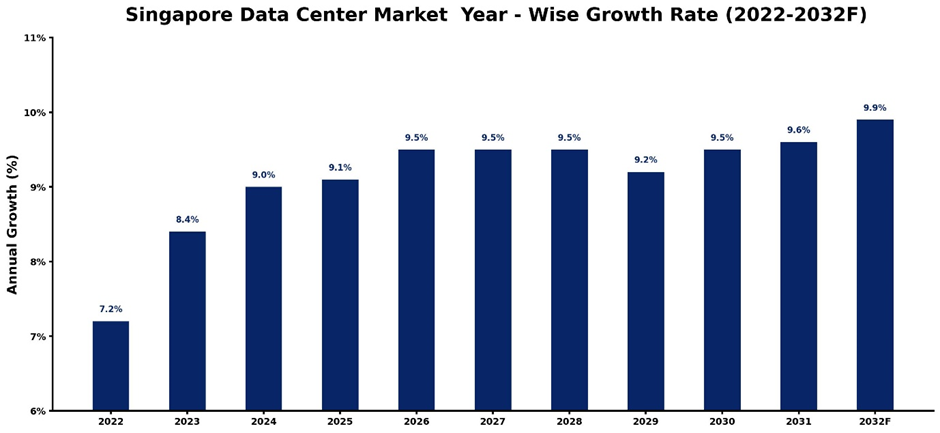
The following table summarizes the historical and forecasted growth rates of Singapore Data Center Market, along with the rationale behind each year’s performance.
| Year | Estimated Growth (%) | Market Rationale |
| 2022 | 7.2% | Recovery phase after global slowdown; early cloud expansion |
| 2023 | 8.4% | Strong hyper scaler demand and digital acceleration |
| 2024 | 9% | AI adoption and renewed data center investments |
| 2025 | 9.1% | Expansion of 5G, IoT, and cloud infrastructure |
| 2026 | 9.5% | Green data center push and hyperscale expansion |
| 2027 | 9.5% | Rising APAC interconnection and edge computing demand |
| 2028 | 9.5% | AI workloads and fintech cloud migration surge |
| 2029 | 9.2% | Subsea cable expansion improves connectivity |
| 2030 | 9.5% | Government-led sustainable digital infrastructure growth |
| 2031 | 9.6% | Data sovereignty laws increase local hosting demand |
| 2032 | 9.9% | Mature hyperscale ecosystem and APAC dominance |
Topics Covered in the Singapore Data Center Market Report
The Singapore Data Center Market report thoroughly covers the market by component and vertical. The report provides an unbiased and detailed analysis of the on-going market trends, opportunities/high growth areas, and market drivers which would help the stakeholders to devise and align their market strategies according to the current and future market dynamics.
Singapore Data Center Market Highlights
| Report Name | Singapore Data Center Market |
| Forecast period | 2026-2032 |
| CAGR | 4.5% |
| Growing Sector | BFSI (Banking, Financial Services and Insurance) |
Singapore Data Center Market Synopsis
Singapore Data Center Market has benefited from a strong digital economy. In recent years, Singapore has emerged as a key player in the data center market, with a boom in data center development and foreign investment pouring in. Additionally, the increasing demand for cloud services and the adoption of IoT, big data, and AI has fueled the growth of data centers in Singapore. The trend in the industry is shift towards more energy-efficient and sustainable data center facilities.
Evaluation of Growth Drivers in Singapore Data Center Market (2026–2032)
Below are the major drivers influencing market dynamics:
| Drivers | Primary Segment Affected | Why It Matters (Evidence) |
| Hyperscale Demand Recovery (Post Moratorium) | Hyperscale & Colocation | Lifting of earlier restrictions allows controlled resumption of large-scale data center builds with stricter sustainability thresholds. |
| Strategic Global Connectivity Hub | Cloud, CDN, Hyperscale | Singapore’s position as a regional interconnection hub strengthens its role in APAC cloud routing and latency-sensitive workloads. |
| AI & High-Density Compute Demand | Hyperscale / AI Data Centers | Rising GPU-based workloads from AI training and inference increase demand for ultra-high-density racks and advanced cooling systems. |
| Strong Regulatory Framework (Sustainability-First Policy) | All Segments | Government prioritizes energy-efficient approvals, pushing operators toward green-certified, high-performance facilities. |
| Financial Services & Digital Economy Demand | BFSI, Cloud, Edge | Singapore’s strong BFSI sector requires sovereign-grade, low-latency, highly secure infrastructure. |
The Singapore Data Center market share is projected to grow at a CAGR of 4.5% during 2025-2032. The increasing demand for cloud-based services, big data, and the Internet of Things (IoT) are the driving force for the market growth. Singapore's location has made it a favorable destination for data center operators. This growth is also expected to enhance Singapore’s reputation as a trusted, high-performance digital infrastructure center in Asia-Pacific, attracting hyper scalers and enterprise investments despite ongoing power constraints.
Evaluation of Restraints in Singapore Data Center Market
Below are the major restraints influencing market dynamics:
| Restraints | Primary Segment Affected | What This Means (Evidence) |
| Strict Land & Power Allocation Limits | Hyperscale Operators | Limited physical expansion due to land scarcity and controlled electricity quotas. |
| High Energy Cost Structure | Colocation & Enterprise DCs | Singapore’s electricity pricing pressures operating margins compared to regional alternatives like Malaysia. |
| Regulatory Approval Bottlenecks | New Build Hyperscale | Government initiatives are prioritizing ESG compliance and efficiency benchmarks. |
| Water & Cooling Resource Constraints | High-Density AI Facilities | Water and heat management policies, results in sustainability restrictions on cooling-intensive AI workloads. |
| High Real Estate & Construction Costs | Small & Mid Operators | Extremely high CAPEX per MW makes entry barriers significant for new players. |
Singapore Data Center Market Challenges
Despite the growth factors, the market is restricted by resource scarcity and policy tightening. One of the major challenges is balancing digital infrastructure expansion with national sustainability goals, particularly in energy efficiency. Another key challenge is capacity allocation control and data centers operating at 95% occupancy with very limited new supply pipeline. Also, rising AI workloads create pressure for higher power density, which conflicts with existing sustainability caps. Finally, Singapore’s role as a premium hub leads to cost-driven displacement risk.
Singapore Data Center Market Trends
Important trends shaping the Singapore data center market are detailed below:
- AI-Optimized High-Density Facilities: Extreme compute density need transition toward GPU-centric data halls with advanced liquid and hybrid cooling systems for AI workloads.
- Green & Carbon-Neutral Data Centers: To comply with strict national sustainability mandates, there is heavy push toward net-zero operations, renewable PPAs, and energy-efficient certifications.
- Edge & Distributed Cloud Expansion: Real-time responsiveness paves way for Growth of micro-edge nodes to support low-latency applications in fintech, gaming, and smart city systems.
- Interconnection & Subsea Cable Dominance: Enhanced global redundancy and data routing resilience capabilities lead to continued expansion of subsea cable landing points.
Investment Opportunities in Singapore Data Center Market
Major investment opportunities in the Singapore data center industry are presented below:
- Green Data Center Engineering Solutions: Investment required in energy-efficient cooling and renewable integration technologies to assist long-term sustainability compliance.
- Hyperscale Partnership Ecosystems: Stable revenue visibility across cycles by
strategic joint ventures with global cloud providers for constrained but premium capacity deployment. - DCIM & AI-Based Optimization Platforms: Enhanced operational efficiency and reduced overall power consumption intensity by investing in software solutions for predictive cooling and workload balancing.
- Subsea Cable & Interconnection Infrastructure: Funding needed in connectivity infrastructure to enhance Singapore’s role as a regional digital backbone, supporting high-throughput data exchange.
Top Leading Players in Singapore Data Center Market
Below is a curated list of leading companies in the Singapore data center market:
1. Equinix
| Company Name | Equinix |
|---|---|
| Established Year | 1998 |
| Headquarters | Redwood City, California, USA |
| Official Website | Click Here |
Providing interconnection-rich colocation services across SG1–SG5 facilities, anchoring Singapore’s digital ecosystem with strong hyperscale connectivity and planned expansion.
2. Digital Realty
| Company Name | Digital Realty |
|---|---|
| Established Year | 2004 |
| Headquarters | Austin, Texas, USA |
| Official Website | Click Here |
Providing large-scale colocation and hyperscale infrastructure across Singapore and the region, supporting enterprise workloads with high-spec facilities and leveraging Data Gravity strategies.
3. ST Telemedia Global Data Centres
| Company Name | ST Telemedia Global Data Centres |
|---|---|
| Established Year | 2014 |
| Headquarters | Singapore |
| Official Website | Click Here |
Providing hyperscale and carrier-neutral colocation services across Asia, backed by Temasek and KKR, with strong focus on scalable infrastructure and AI-ready deployments.
4. Singtel (Nxera)
| Company Name | Singtel (Nxera) |
|---|---|
| Established Year | 1992 |
| Headquarters | Singapore |
| Official Website | Click Here |
Providing next-generation AI-ready and sustainable data center infrastructure under the Nxera brand, integrating telecom backbone capabilities with sovereign cloud and green digital infrastructure initiatives.
5. Keppel Data Centres
| Company Name | Keppel Data Centres |
|---|---|
| Established Year | 2015 |
| Headquarters | Singapore |
| Official Website | Click Here |
Providing sustainable colocation and investment-grade data center assets, managing REIT-backed infrastructure and pioneering innovations such as floating data centers.
Government Initiatives Introduced in the Singapore Data Center Market
According to the government data of Singapore, the country has been at the forefront in the development of data center industry for over a decade, and the government has continued to reinforce the ecosystem. Singapore’s Board of Investment, Enterprise Singapore, Infocomm Media Development Authority, and other government agencies have implemented several initiatives to support expansion of the Singapore Data Center Market size and growth of the data center sector. Likewise, these programs have enhanced the Singapore Data Center Market Share.
Future Insights of the Singapore Data Center Market
The market is an important and competitive player in the Asia-Pacific region, with a thriving ecosystem of data center providers and a supportive regulatory framework. The strategic location, reliable infrastructure, and government initiatives make Singapore an attractive destination for businesses looking to set up their data centers in the region, leads to hike in the Singapore Data Center Market revenue by 67%. The future outlook for the market is positive, with increasing demand for digital transformation and emerging technologies.
Market Segmentation Analysis
This report presents a detailed analysis of the market segments along with their leading categories:
By Component - Mechanical systems Led the Market and Set for Rapid Growth
According to Ravi Bhandari, Senior Research Analyst, 6Wresearch, by component, in 2025, Mechanical systems dominated the data center market with 45% share, backed by intense demand for advanced cooling solutions. And by 2032, Mechanical will continue to lead with a 7% CAGR, owning to thermal management.
By Vertical - IT & Telecom Dominated the Market and Set for Rapid Expansion
By Vertical, IT & Telecom led the market with 32% share, in 2025, supported by hyperscale cloud adoption and AI workloads. And by 2032, IT & Telecom continues to command the market with 8% CAGR, fueled by edge computing, AI network expansion, and data-heavy digital services.
Note: Market size estimations and growth projections presented in this report are based on 6Wresearch's proprietary forecasting methodology, utilizing the latest available industry data, government publications, and primary research inputs.
Key Attractiveness of the Report:
- 10 Years of Market Numbers
- Historical Data Starting from 2022 to 2025
- Base Year: 2025
- Forecast Data until 2032
- Key Performance Indicators Impacting the Market
- Major Upcoming Developments and Projects
Key Highlights of the Report:
- Singapore Data Center Market Overview
- Singapore Data Center Market Outlook
- Singapore Data Center Market Forecast
- Market Size of Singapore Data Center Market, 2025
- Forecast of Singapore Data Center Market, 2032
- Historical Data and Forecast of Singapore Data Center Revenues & Volume for the Period 2022-2032
- Singapore Data Center Market Trend Evolution
- Singapore Data Center Market Drivers and Challenges
- Singapore Data Center Price Trends
- Singapore Data Center Porter's Five Forces
- Singapore Data Center Industry Life Cycle
- Historical Data and Forecast of Singapore Data Center Market Revenues & Volume By Component for the Period 2022-2032
- Historical Data and Forecast of Singapore Data Center Market Revenues & Volume By Electrical for the Period 2022-2032
- Historical Data and Forecast of Singapore Data Center Market Revenues & Volume By Mechanical for the Period 2022-2032
- Historical Data and Forecast of Singapore Data Center Market Revenues & Volume By Networking for the Period 2022-2032
- Historical Data and Forecast of Singapore Data Center Market Revenues & Volume By Racks for the Period 2022-2032
- Historical Data and Forecast of Singapore Data Center Market Revenues & Volume By Security Systems for the Period 2022-2032
- Historical Data and Forecast of Singapore Data Center Market Revenues & Volume By Fire Systems for the Period 2022-2032
- Historical Data and Forecast of Singapore Data Center Market Revenues & Volume By Vertical for the Period 2022-2032
- Historical Data and Forecast of Singapore Data Center Market Revenues & Volume By Banking Financial Services & Insurance (BFSI) for the Period 2022-2032
- Historical Data and Forecast of Singapore Data Center Market Revenues & Volume By Government for the Period 2022-2032
- Historical Data and Forecast of Singapore Data Center Market Revenues & Volume By IT & Telecom for the Period 2022-2032
- Historical Data and Forecast of Singapore Data Center Market Revenues & Volume By Media for the Period 2022-2032
- Historical Data and Forecast of Singapore Data Center Market Revenues & Volume By Retail for the Period 2022-2032
- Historical Data and Forecast of Singapore Data Center Market Revenues & Volume By Manufacturing for the Period 2022-2032
- Historical Data and Forecast of Singapore Data Center Market Revenues & Volume By Others for the Period 2022-2032
- Singapore Data Center Import Export Trade Statistics
- Market Opportunity Assessment By Component
- Market Opportunity Assessment By Vertical
- Singapore Data Center Top Companies Market Share
- Singapore Data Center Competitive Benchmarking By Technical and Operational Parameters
- Singapore Data Center Company Profiles
- Singapore Data Center Key Strategic Recommendations
Markets Covered
The Singapore Data Center market report provides a detailed analysis of the following market segments:
By Component
- Electrical
- Mechanical
- Networking
- Racks
- Security Systems
- Fire Systems
By Vertical
- Banking Financial Services & Insurance (BFSI)
- Government
- IT & Telecom
- Media
- Retail
- Manufacturing
- Others






































