Singapore Data Center Networking Market Size & Growth Rate (2026-2032)
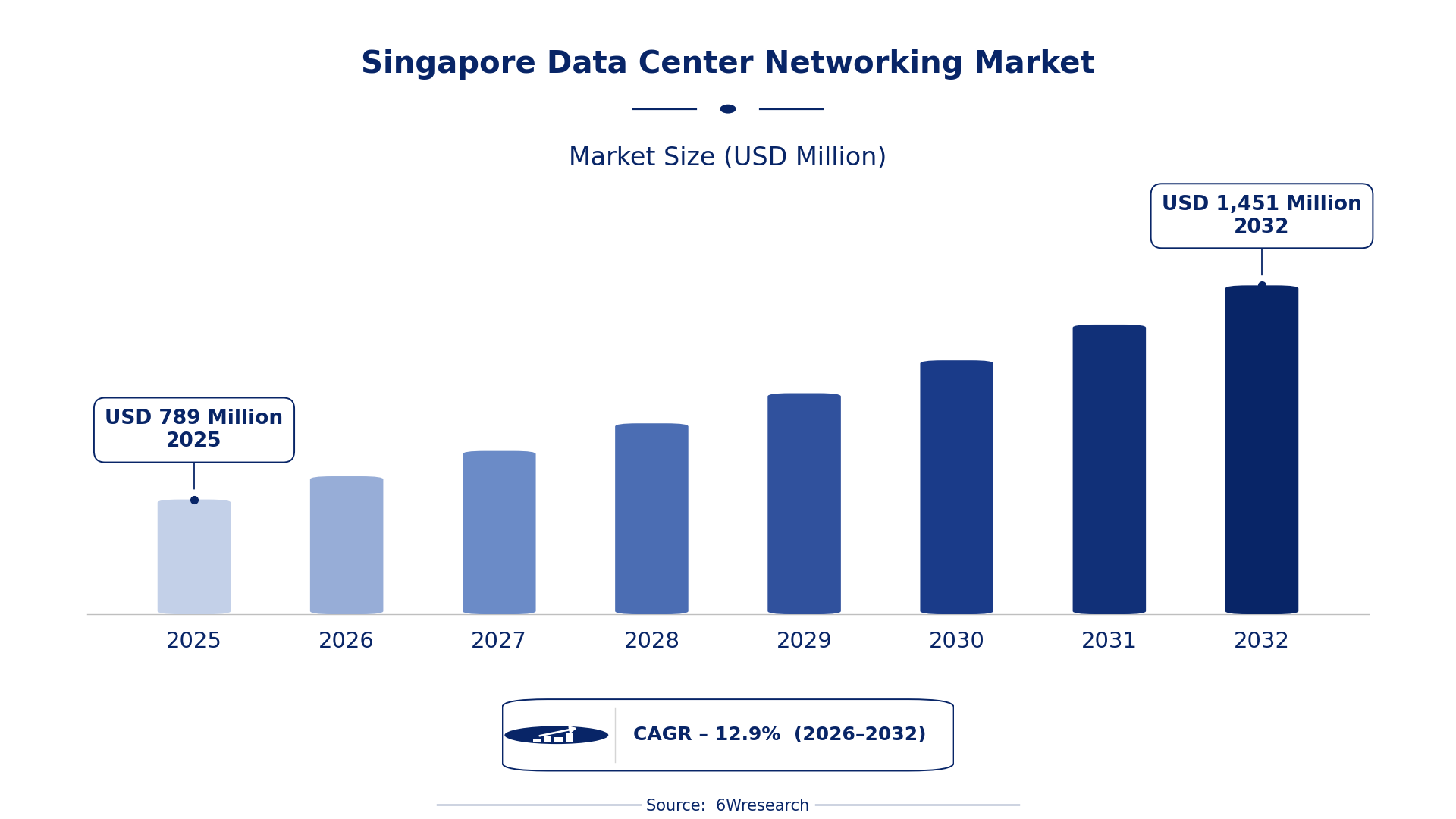
The Singapore Data Center Networking Market was estimated at USD 789 Million in 2025 and is projected to reach USD 1451 Million by 2032, growing at a CAGR of 12.9% from 2026 to 2032.
Singapore Data Center Networking Market Synopsis
The Singapore Data Center Networking Market has gained remarkable momentum in recent years, driven by escalating demands for data management and advanced networking capabilities. As businesses shift toward cloud solutions and digital operations, the necessity for high-performance networking infrastructure has never been clearer.
Looking ahead, the market is set to evolve further, with the integration of cutting-edge technologies like 5G and IoT. These innovations will significantly influence networking strategies, compelling operators to adopt more sophisticated solutions to maintain competitive advantage.
Singapore Data Center Networking Market Year-wise Growth Rate and Key Drivers
This graph illustrates the annual growth rates of the Singapore Data Center Networking Market from 2021 to 2032, highlighting a steady upward trajectory and projected expansion over the forecast period.
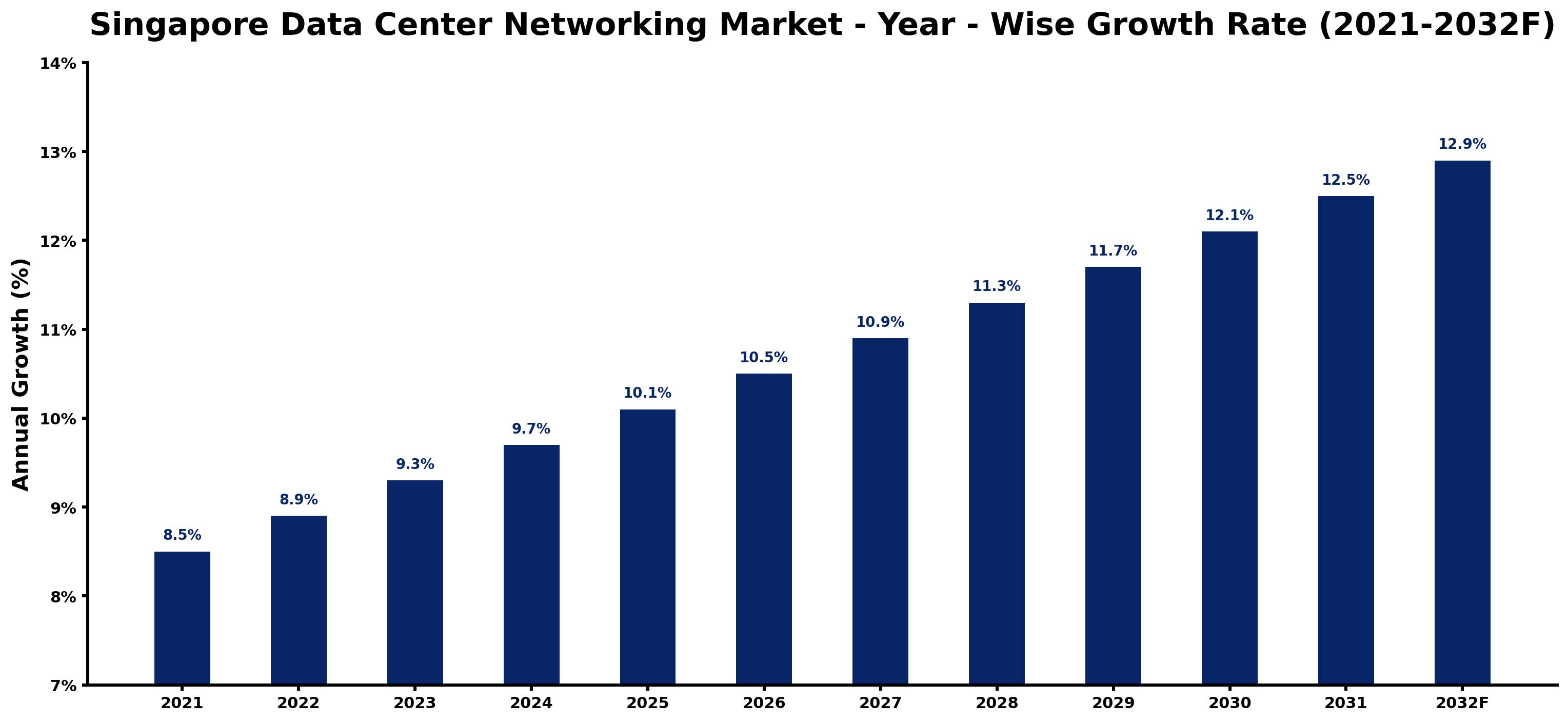
The table below presents the year‑wise growth rates along with the key drivers influencing the market
| Year | Growth Rate | Major Drivers |
| 2021 | 8.5% | Government's push for data privacy regulations driving investments |
| 2022 | 8.9% | Increased foreign investments enhancing data center capabilities |
| 2023 | 9.3% | Local universities producing skilled workforce in networking technology |
| 2024 | 9.7% | 5G rollout boosting demand for enhanced data connectivity |
| 2025 | 10.1% | Rising e-commerce growth requiring robust network infrastructure |
| 2026 | 10.5% | Developments in AI applications increasing data processing needs |
| 2027 | 10.9% | Local tech startups driving innovative networking solutions |
| 2028 | 11.3% | Green data center initiatives aligning with sustainability goals |
| 2029 | 11.7% | Regulatory incentives for sustainable energy in data centers |
| 2030 | 12.1% | Corporate digital transformation projects fueling network expansion |
| 2031 | 12.5% | Partnerships between telecom companies enhancing network infrastructure |
| 2032 | 12.9% | Increased remote work leading to higher data traffic volumes |
Note: Market size estimations and growth projections presented in this report are based on 6Wresearch's proprietary forecasting methodology, utilizing the latest available industry data, government publications, and primary research inputs.
Singapore Data Center Networking Market Key Takeaways
Below are some of the specific key takeaways from the market, including:
- Cloud services continue to be a major driver for networking solutions.
- Technological advancements are reshaping data center architectures.
- Cybersecurity remains a critical focus for data center operators.
- 5G rollout is expected to enhance networking capabilities significantly.
- Regulatory frameworks are adapting to meet evolving market needs.
Evaluation of Restraints in Singapore Data Center Networking Market
Despite the impressive growth, several constraints limit market potential. The rapid rise in demand necessitates continuous infrastructure expansion, putting pressure on operators to scale efficiently. Balancing performance with reliability amid stringent compliance and security requirements presents additional challenges. The threat of cyber-attacks is ever-present, compelling operators to invest heavily in security measures while keeping operational costs in check.
Singapore Data Center Networking Market Trends
Several trends are currently shaping the Singapore Data Center Networking Market. The shift toward hybrid cloud environments is encouraging operators to adopt flexible networking solutions that can adapt to changing workloads. on top of that, the increasing reliance on edge computing is prompting investments in low-latency networking infrastructure. Enhanced focus on energy-efficient technologies and sustainability practices is also emerging, as operators seek to reduce operational costs while meeting regulatory demands.
Singapore Data Center Networking Market Opportunities
Opportunities abound for businesses looking to invest in the Singapore Data Center Networking Market. The convergence of 5G technology and IoT is opening up avenues for innovative networking solutions tailored to specific industry needs. As digital transformation accelerates across sectors, demand for managed services and consultancy in network optimization is also rising. Additionally, the increasing interest in data privacy solutions presents a lucrative market for companies specializing in cybersecurity and compliance technologies.
Government Initiatives in the Singapore Data Center Networking Market
Government policy plays a crucial role in shaping the Singapore Data Center Networking Market. The authorities are focused on enhancing the nation's digital infrastructure, which is vital for maintaining its status as a global data hub. Public initiatives aim to foster innovation, support cybersecurity measures, and encourage sustainable practices within the industry.
- A national digital infrastructure upgrade programme launched in early 2023 aims to bolster connectivity and performance across data centers.
- Current efforts include a regulatory framework introduced in 2024 that mandates greater transparency in data management practices.
- A planned public-private partnership expected to enhance fiber optic network access is set for rollout in late 2025.
- Recent initiatives to provide grants for adopting green technologies in data centers have already begun, supporting sustainability goals.
Future Insights of the Singapore Data Center Networking Market
From 2026 to 2032, the Singapore Data Center Networking Market is likely to witness a transformative phase. The growing integration of AI and machine learning into networking solutions will drive efficiency and performance. As data needs expand exponentially, operators will increasingly focus on hybrid and multi-cloud solutions that can adapt to diverse business requirements. The emphasis on sustainability and energy efficiency will also shape investment decisions, pushing the market toward greener technologies.
Singapore Data Center Networking Market Latest Developments
Recent industry activity indicates a strong push towards technological innovation in the Singapore Data Center Networking Market. Companies are actively investing in next-generation networking solutions to cater to the rising data demands. The ongoing evolution of cloud services is also driving partnerships aimed at enhancing service delivery.
- A major technology vendor announced a partnership in Q1 2025 to develop low-latency networking solutions specifically for IoT applications.
- A leading regional operator began a rollout of advanced software-defined networking solutions in early 2025 to optimize data traffic management.
- A new initiative focusing on the integration of AI in network management is currently underway, expected to yield results by mid-2026.
- Plans to launch a high-capacity fiber optic network were unveiled in late 2025, aiming to enhance data transmission speeds.
Singapore Data Center Networking Market - Key Attractiveness of the Report
- 10 Years of Market Numbers
- Historical Data Starting from 2022 to 2025
- Base Year: 2025
- Forecast Data until 2032
- Key Performance Indicators Impacting the Market
- Major Upcoming Developments and Projects
Key Highlights of the Report:
- Singapore Data Center Networking Market Outlook
- Market Size of Singapore Data Center Networking Market, 2025
- Forecast of Singapore Data Center Networking Market, 2032
- Historical Data and Forecast of Singapore Data Center Networking Revenues & Volume for the Period 2022-2032F
- Singapore Data Center Networking Market Trend Evolution
- Singapore Data Center Networking Market Drivers and Challenges
- Singapore Data Center Networking Price Trends
- Singapore Data Center Networking Porter's Five Forces
- Singapore Data Center Networking Industry Life Cycle
- Historical Data and Forecast of Singapore Data Center Networking Market Revenues & Volume By Component for the Period 2022-2032F
- Historical Data and Forecast of Singapore Data Center Networking Market Revenues & Volume By Solution for the Period 2022-2032F
- Historical Data and Forecast of Singapore Data Center Networking Market Revenues & Volume By Services for the Period 2022-2032F
- Historical Data and Forecast of Singapore Data Center Networking Market Revenues & Volume By End User for the Period 2022-2032F
- Historical Data and Forecast of Singapore Data Center Networking Market Revenues & Volume By IT and telecom for the Period 2022-2032F
- Historical Data and Forecast of Singapore Data Center Networking Market Revenues & Volume By Retail for the Period 2022-2032F
- Historical Data and Forecast of Singapore Data Center Networking Market Revenues & Volume By BFSI for the Period 2022-2032F
- Historical Data and Forecast of Singapore Data Center Networking Market Revenues & Volume By Public sector and utilities for the Period 2022-2032F
- Historical Data and Forecast of Singapore Data Center Networking Market Revenues & Volume By Energy for the Period 2022-2032F
- Historical Data and Forecast of Singapore Data Center Networking Market Revenues & Volume By Manufacturing for the Period 2022-2032F
- Historical Data and Forecast of Singapore Data Center Networking Market Revenues & Volume By Healthcare for the Period 2022-2032F
- Historical Data and Forecast of Singapore Data Center Networking Market Revenues & Volume By Others for the Period 2022-2032F
- Singapore Data Center Networking Import Export Trade Statistics
- Market Opportunity Assessment By Component
- Market Opportunity Assessment By End User
- Singapore Data Center Networking Top Companies Market Share
- Singapore Data Center Networking Competitive Benchmarking By Technical and Operational Parameters
- Singapore Data Center Networking Company Profiles
- Singapore Data Center Networking Key Strategic Recommendations






































