Singapore Data Monetization Market Size & Growth Rate (2026-2032)
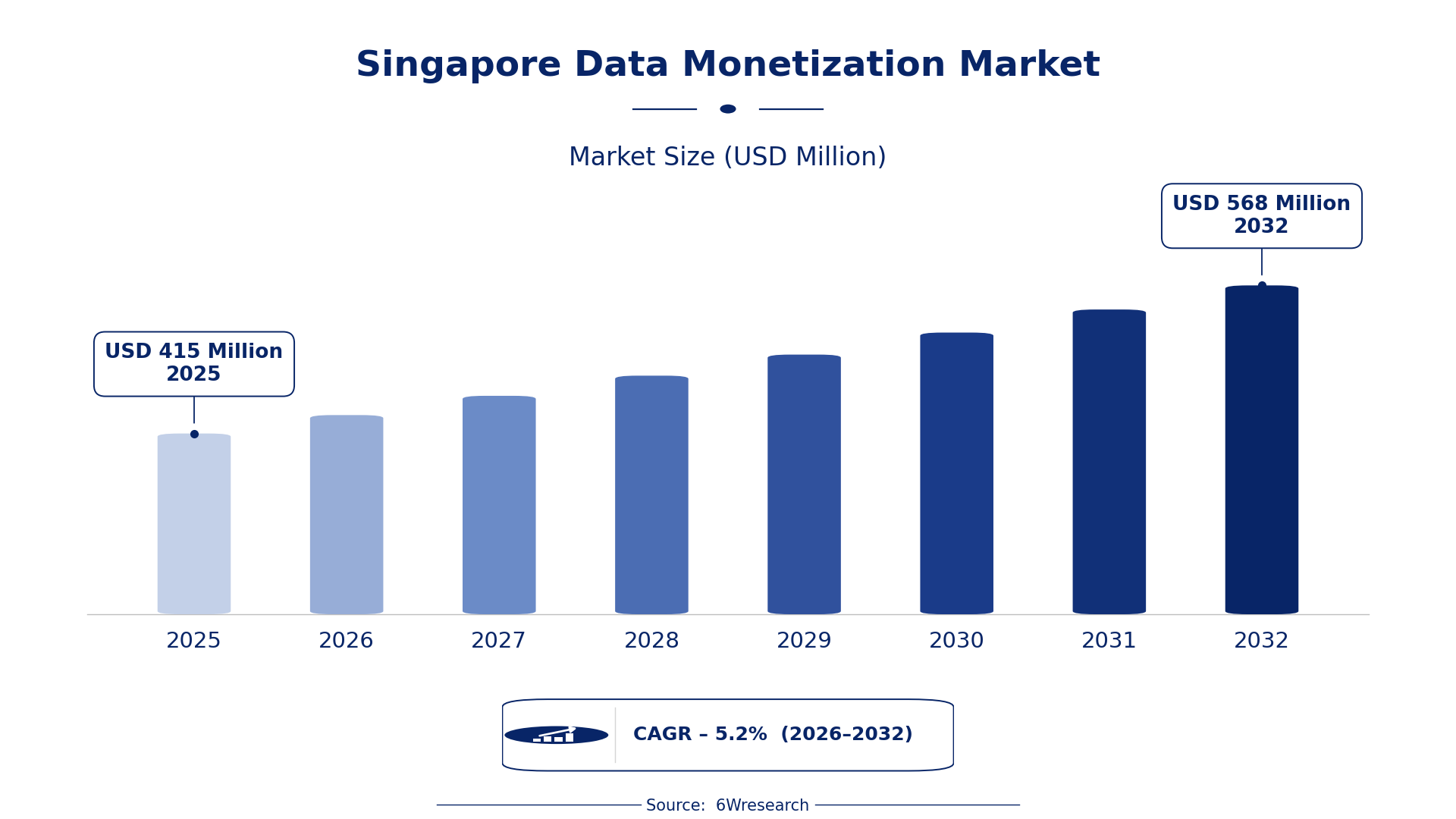
The Singapore Data Monetization Market was estimated at USD 415 Million in 2025 and is projected to reach USD 568 Million by 2032, growing at a CAGR of 5.2% from 2026 to 2032.
Singapore Data Monetization Market Synopsis
The Singapore Data Monetization Market has gained notable momentum as organizations increasingly view their data as a valuable asset. As companies harness data for improved decision-making and revenue generation, the market is shifting toward innovative monetization strategies.
Looking ahead, the focus on ethical data usage and compliance with stringent regulations will shape the market's trajectory. Companies are investing in advanced analytics and data-sharing initiatives to unlock new revenue streams and gain competitive advantages.
Singapore Data Monetization Market Year-wise Growth Rate and Key Drivers
This graph illustrates the annual growth rates of the Singapore Data Monetization Market from 2021 to 2032, highlighting a steady upward trajectory and projected expansion over the forecast period.
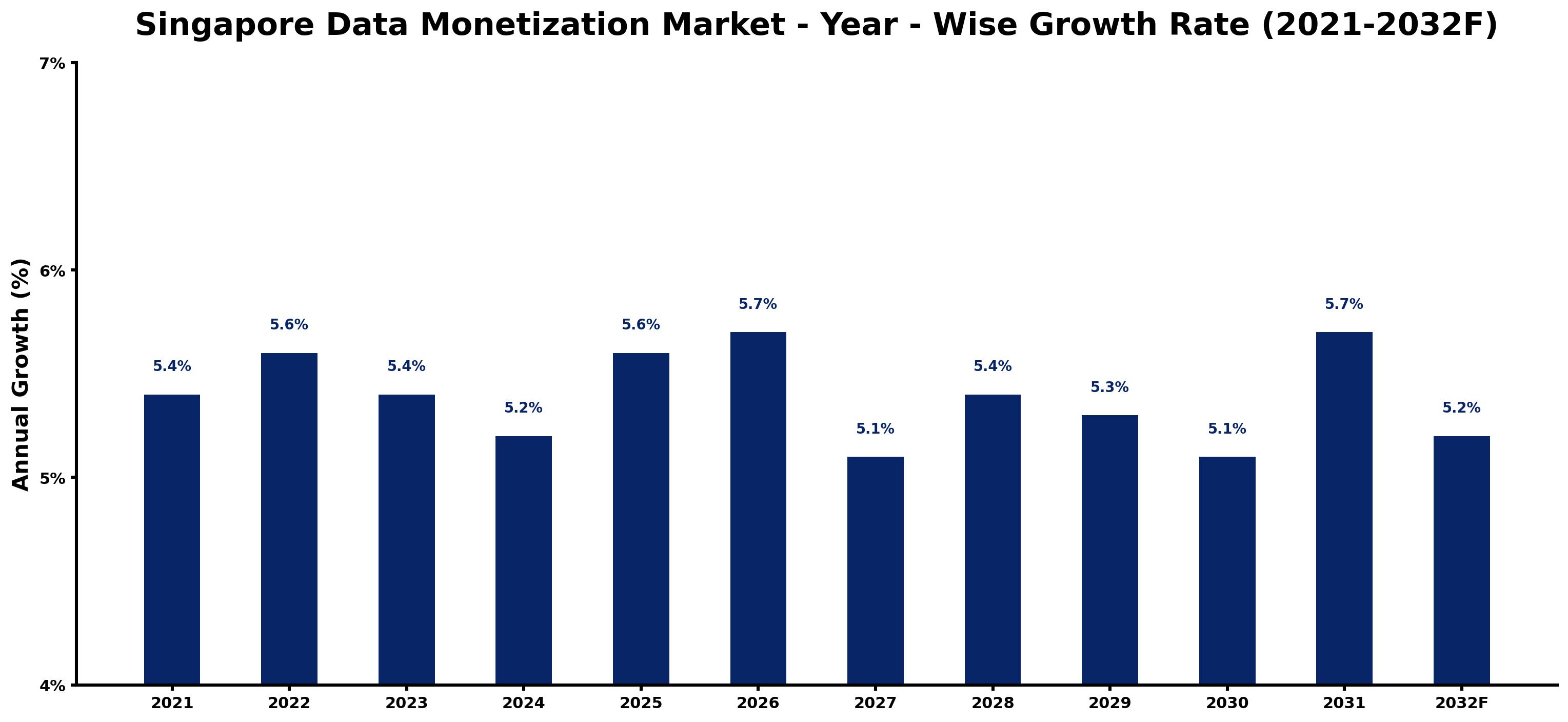
The table below presents the year‑wise growth rates along with the key drivers influencing the market
| Year | Growth Rate | Major Drivers |
| 2021 | 5.4% | Implementation of Personal Data Protection Act boosts trust. |
| 2022 | 5.6% | Government's Smart Nation initiative accelerates data usage. |
| 2023 | 5.4% | Increased demand for AI-driven data analytics services. |
| 2024 | 5.2% | Growing fintech sector drives demand for data insights. |
| 2025 | 5.6% | Enhanced partnerships with tech firms for data solutions. |
| 2026 | 5.7% | Strengthening of cybersecurity policies encourages data monetization. |
| 2027 | 5.1% | Rising adoption of IoT devices increases data generation. |
| 2028 | 5.4% | Expanding digital economy fosters data-sharing ecosystems. |
| 2029 | 5.3% | Emergence of startup incubators enhances data innovation. |
| 2030 | 5.1% | Government grants stimulate investment in data solutions. |
| 2031 | 5.7% | Continued rise in cloud services boosts data monetization. |
| 2032 | 5.2% | Focus on smart city projects increases data utility. |
Note: Market size estimations and growth projections presented in this report are based on 6Wresearch's proprietary forecasting methodology, utilizing the latest available industry data, government publications, and primary research inputs.
Singapore Data Monetization Market Key Takeaways
Below are some of the specific key takeaways from the market, including:
- The market is transitioning towards data-driven revenue models, emphasizing the monetization of data assets.
- Organizations are increasingly adopting analytics and data-sharing solutions to extract value from their data.
- Compliance with data privacy regulations poses a significant challenge for businesses aiming to monetize their data.
- The COVID-19 pandemic has accelerated the shift towards data monetization strategies as businesses seek new revenue sources.
- Key players in the market are continually innovating to provide advanced data monetization solutions tailored to various industries.
Evaluation of Restraints in Singapore Data Monetization Market
Despite the promising growth of the Singapore Data Monetization Market, several restraints hinder its full potential. Companies face challenges in identifying viable monetization opportunities while ensuring compliance with strict data privacy laws. The need to balance data extraction with ethical considerations and consumer trust remains a critical hurdle. on top of that, developing sustainable business models that can adapt to changing regulations and evolving market demands is essential for long-term success.
Singapore Data Monetization Market Trends
A significant trend shaping the Singapore Data Monetization Market is the increasing adoption of artificial intelligence and machine learning technologies. These tools enable businesses to analyze vast amounts of data efficiently, uncovering insights that drive monetization efforts. Additionally, a growing emphasis on data sharing between organizations is fostering collaboration and creating new revenue opportunities. The focus on real-time analytics and the integration of data from various sources are also becoming prevalent as businesses strive for agility in their operations.
Singapore Data Monetization Market Opportunities
Opportunities abound for businesses looking to capitalize on data monetization in Singapore. The rising demand for personalized customer experiences drives organizations to leverage data for targeted marketing and product development. Industries such as finance, healthcare, and retail are particularly ripe for investment in data analytics and monetization strategies. on top of that, as regulatory frameworks evolve, companies that proactively adapt to compliance requirements will find themselves at a competitive advantage in the data-driven economy.
Government Initiatives in the Singapore Data Monetization Market
The Singapore government plays a crucial role in shaping the Data Monetization Market through various initiatives aimed at enhancing data utilization while ensuring privacy and security. With a focus on fostering innovation, public policies are increasingly geared towards creating a conducive environment for data sharing and monetization. As regulatory frameworks evolve, businesses must align their strategies with government priorities to thrive in this market.
- A national digital infrastructure upgrade programme now in its rollout phase aims to enhance data connectivity and accessibility for businesses.
- A regulatory framework introduced in 2025 mandating data transparency and consumer consent is currently underway to bolster trust in data usage.
- A planned public-private initiative expected to expand data analytics capabilities across sectors by 2028 is gaining traction.
- The launch of a grant scheme in early 2025 to support small and medium-sized enterprises (SMEs) in developing data monetization strategies has recently been completed.
Future Insights of the Singapore Data Monetization Market
From 2026 to 2032, the Singapore Data Monetization Market is expected to experience substantial growth driven by technological advancements and increased data utilization across industries. Companies that prioritize ethical data practices and invest in innovative analytics solutions will likely lead the way. The ongoing evolution of regulatory frameworks will require businesses to remain agile, adapting their monetization strategies to meet compliance demands while maximizing data value.
Singapore Data Monetization Market Latest Developments
In the past year, the Singapore Data Monetization Market has seen dynamic changes as organizations pivot towards data-centric strategies. Companies are increasingly collaborating to develop innovative solutions, while investments in technology and infrastructure are on the rise. This trend indicates a growing recognition of the importance of data as a strategic asset.
- A leading technology vendor launched an advanced analytics platform in Q2 2025, enabling businesses to derive insights from their data more effectively.
- An initiative that began in early 2025 and remains underway aims to enhance data-sharing capabilities among financial institutions to promote innovation.
- A major telecommunications operator announced plans to upgrade its data infrastructure by mid-2026, facilitating improved data access for enterprises.
- A partnership between two regional firms focused on developing a data marketplace was finalized in late 2025, enhancing monetization options for SMEs.
Singapore Data Monetization Market - Key Attractiveness of the Report
- 10 Years of Market Numbers
- Historical Data Starting from 2022 to 2025
- Base Year: 2025
- Forecast Data until 2032
- Key Performance Indicators Impacting the Market
- Major Upcoming Developments and Projects
Key Highlights of the Report:
- Singapore Data Monetization Market Outlook
- Market Size of Singapore Data Monetization Market, 2025
- Forecast of Singapore Data Monetization Market, 2032
- Historical Data and Forecast of Singapore Data Monetization Revenues & Volume for the Period 2022-2032F
- Singapore Data Monetization Market Trend Evolution
- Singapore Data Monetization Market Drivers and Challenges
- Singapore Data Monetization Price Trends
- Singapore Data Monetization Porter's Five Forces
- Singapore Data Monetization Industry Life Cycle
- Historical Data and Forecast of Singapore Data Monetization Market Revenues & Volume By Component for the Period 2022-2032F
- Historical Data and Forecast of Singapore Data Monetization Market Revenues & Volume By Tools for the Period 2022-2032F
- Historical Data and Forecast of Singapore Data Monetization Market Revenues & Volume By Services for the Period 2022-2032F
- Historical Data and Forecast of Singapore Data Monetization Market Revenues & Volume By Consulting for the Period 2022-2032F
- Historical Data and Forecast of Singapore Data Monetization Market Revenues & Volume By Support and Maintenance for the Period 2022-2032F
- Historical Data and Forecast of Singapore Data Monetization Market Revenues & Volume By Implementation and Integration for the Period 2022-2032F
- Historical Data and Forecast of Singapore Data Monetization Market Revenues & Volume By Data Type for the Period 2022-2032F
- Historical Data and Forecast of Singapore Data Monetization Market Revenues & Volume By Customer Data for the Period 2022-2032F
- Historical Data and Forecast of Singapore Data Monetization Market Revenues & Volume By Product Data for the Period 2022-2032F
- Historical Data and Forecast of Singapore Data Monetization Market Revenues & Volume By Financial Data for the Period 2022-2032F
- Historical Data and Forecast of Singapore Data Monetization Market Revenues & Volume By Supplier Data for the Period 2022-2032F
- Historical Data and Forecast of Singapore Data Monetization Market Revenues & Volume By Business Function for the Period 2022-2032F
- Historical Data and Forecast of Singapore Data Monetization Market Revenues & Volume By Supply Chain Management for the Period 2022-2032F
- Historical Data and Forecast of Singapore Data Monetization Market Revenues & Volume By Sales and Marketing for the Period 2022-2032F
- Historical Data and Forecast of Singapore Data Monetization Market Revenues & Volume By Operations for the Period 2022-2032F
- Historical Data and Forecast of Singapore Data Monetization Market Revenues & Volume By Finance for the Period 2022-2032F
- Historical Data and Forecast of Singapore Data Monetization Market Revenues & Volume By Others (Legal, R&D, and HR) for the Period 2022-2032F
- Historical Data and Forecast of Singapore Data Monetization Market Revenues & Volume By Deployment Type for the Period 2022-2032F
- Historical Data and Forecast of Singapore Data Monetization Market Revenues & Volume By On-premises for the Period 2022-2032F
- Historical Data and Forecast of Singapore Data Monetization Market Revenues & Volume By Cloud for the Period 2022-2032F
- Historical Data and Forecast of Singapore Data Monetization Market Revenues & Volume By Industry Vertical for the Period 2022-2032F
- Historical Data and Forecast of Singapore Data Monetization Market Revenues & Volume By BFSI for the Period 2022-2032F
- Historical Data and Forecast of Singapore Data Monetization Market Revenues & Volume By Telecom for the Period 2022-2032F
- Historical Data and Forecast of Singapore Data Monetization Market Revenues & Volume By Consumer Goods and Retail for the Period 2022-2032F
- Historical Data and Forecast of Singapore Data Monetization Market Revenues & Volume By Media and Entertainment for the Period 2022-2032F
- Historical Data and Forecast of Singapore Data Monetization Market Revenues & Volume By Manufacturing for the Period 2022-2032F
- Historical Data and Forecast of Singapore Data Monetization Market Revenues & Volume By Transportation and Logistics for the Period 2022-2032F
- Historical Data and Forecast of Singapore Data Monetization Market Revenues & Volume By Energy and Utilities for the Period 2022-2032F
- Historical Data and Forecast of Singapore Data Monetization Market Revenues & Volume By Healthcare for the Period 2022-2032F
- Historical Data and Forecast of Singapore Data Monetization Market Revenues & Volume By Organization Size for the Period 2022-2032F
- Historical Data and Forecast of Singapore Data Monetization Market Revenues & Volume By Small and Medium-Sized Enterprises(SMEs) for the Period 2022-2032F
- Historical Data and Forecast of Singapore Data Monetization Market Revenues & Volume By Large Enterprises for the Period 2022-2032F
- Singapore Data Monetization Import Export Trade Statistics
- Market Opportunity Assessment By Component
- Market Opportunity Assessment By Data Type
- Market Opportunity Assessment By Business Function
- Market Opportunity Assessment By Deployment Type
- Market Opportunity Assessment By Industry Vertical
- Market Opportunity Assessment By Organization Size
- Singapore Data Monetization Top Companies Market Share
- Singapore Data Monetization Competitive Benchmarking By Technical and Operational Parameters
- Singapore Data Monetization Company Profiles
- Singapore Data Monetization Key Strategic Recommendations






































