Singapore Data Protection Market Size & Growth Rate (2026-2032)
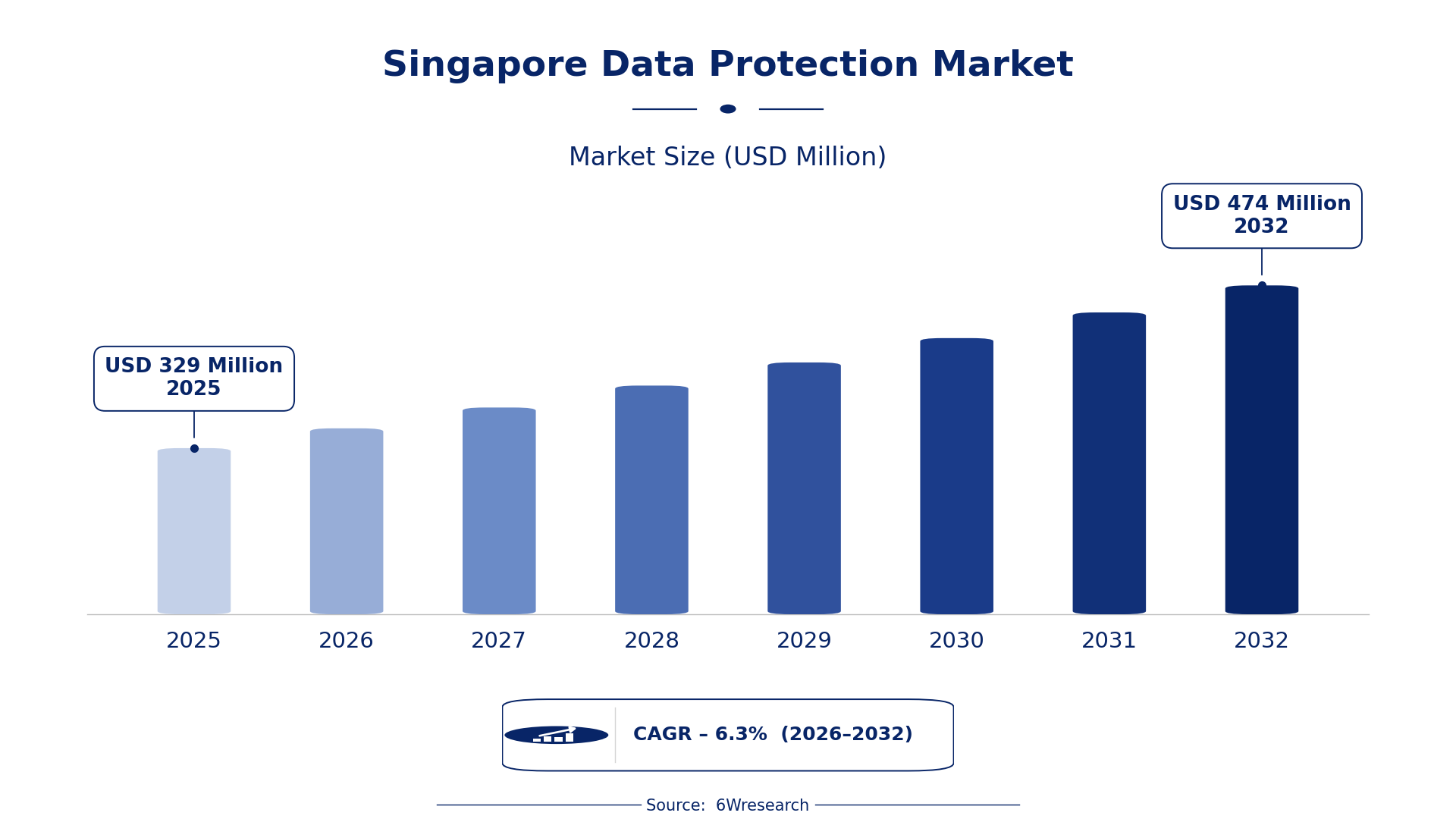
The Singapore Data Protection Market was estimated at USD 329 Million in 2025 and is projected to reach USD 474 Million by 2032, growing at a CAGR of 6.3% from 2026 to 2032.
Singapore Data Protection Market Synopsis
The Singapore Data Protection market has seen a surge in activity as organizations face growing threats to data integrity and security. With increasing regulations and awareness around data privacy, businesses are ramping up investments in data protection solutions, setting a strong momentum for future growth.
Looking ahead, the demand for comprehensive data protection measures is anticipated to expand further, driven by evolving cyber threats and a stringent regulatory environment. Organizations are not just reacting to compliance needs; they are increasingly viewing robust data protection as a competitive differentiator.
Singapore Data Protection Market Year-wise Growth Rate and Key Drivers
This graph illustrates the annual growth rates of the Singapore Data Protection Market from 2021 to 2032, highlighting a steady upward trajectory and projected expansion over the forecast period.
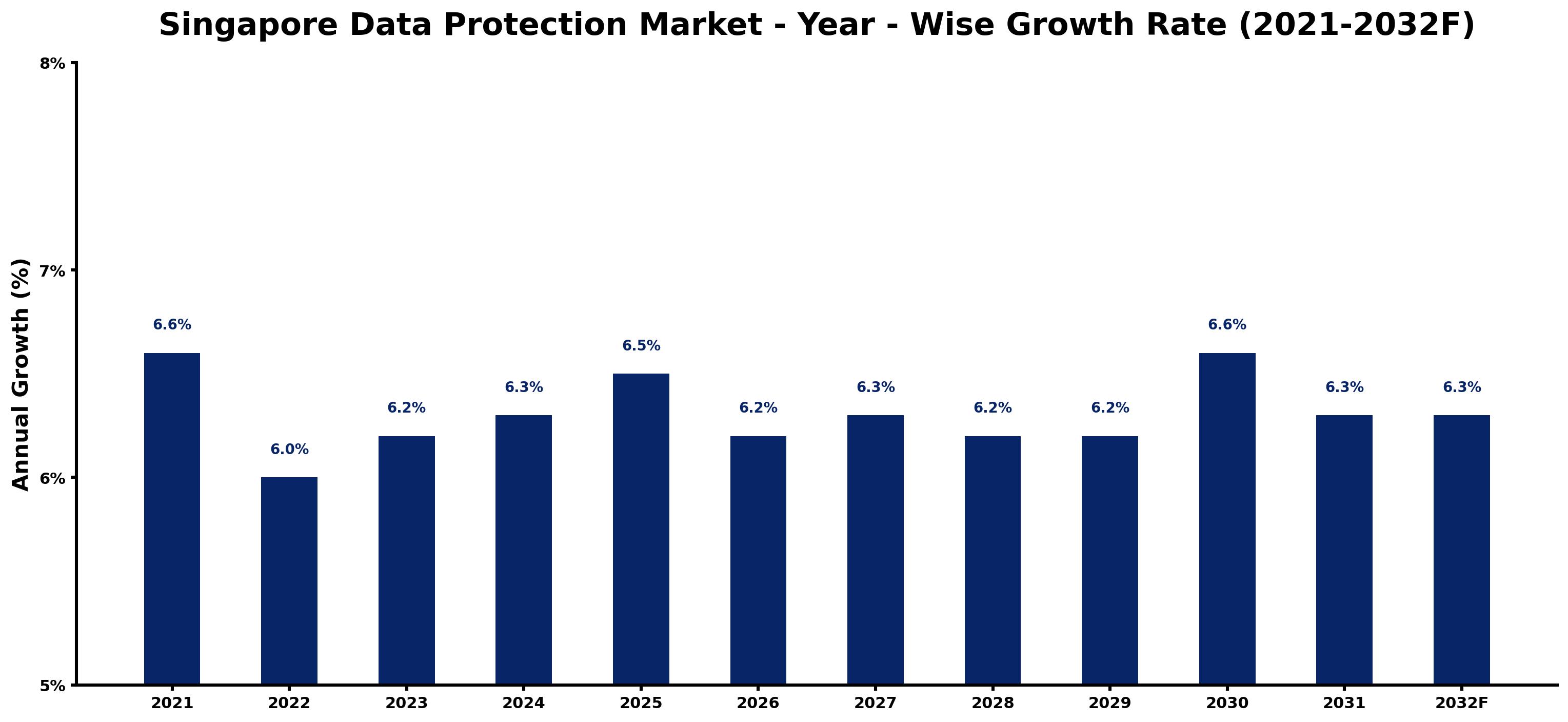
The table below presents the year‑wise growth rates along with the key drivers influencing the market
| Year | Growth Rate | Major Drivers |
| 2021 | 6.6% | PDPA amendments strengthen compliance obligations for businesses. |
| 2022 | 6.0% | Government's Smart Nation initiative boosts data sovereignty focus. |
| 2023 | 6.2% | Surge in cyber threats drives demand for advanced solutions. |
| 2024 | 6.3% | Increased remote work heightens emphasis on data security. |
| 2025 | 6.5% | Growing e-commerce sector demands stronger consumer data protection. |
| 2026 | 6.2% | Greater awareness of data privacy impacts public sentiment. |
| 2027 | 6.3% | Regulatory updates enhance focus on breach notification processes. |
| 2028 | 6.2% | Rise in cross-border data transfers increases regulatory complexity. |
| 2029 | 6.2% | Continued digital transformation fuels investment in data governance. |
| 2030 | 6.6% | Local firms adopting international standards for data protection. |
| 2031 | 6.3% | Increased mobile app usage heightens data security priorities. |
| 2032 | 6.3% | Public sector digital initiatives emphasize citizen data rights. |
Note: Market size estimations and growth projections presented in this report are based on 6Wresearch's proprietary forecasting methodology, utilizing the latest available industry data, government publications, and primary research inputs.
Singapore Data Protection Market Key Takeaways
Below are some of the specific key takeaways from the market, including:
- The surge in remote working models has intensified the need for enhanced data protection strategies.
- Regulatory compliance, particularly with the PDPA, remains a critical driver for market growth.
- Investment in advanced data protection technologies is rising as organizations seek to combat sophisticated cyber threats.
- Growing public awareness around data privacy is compelling companies to adopt more stringent data safeguarding measures.
- Organizations are increasingly prioritizing solutions that enable data visibility and control across multiple platforms.
Evaluation of Restraints in Singapore Data Protection Market
Several barriers continue to challenge the Singapore Data Protection market. Organizations grapple with the complexity of diverse data ecosystems, making it difficult to identify and classify sensitive data effectively. The legal compliance landscape is also nuanced and can be overwhelming, especially for businesses managing cross-border data flows. on top of that, the rapid evolution of cyber threats demands that companies continuously adapt and improve their data protection measures, straining resources and focus.
Singapore Data Protection Market Trends
Key trends shaping the Singapore Data Protection market include a shift towards cloud-based solutions that provide scalable and flexible data protection. Organizations are increasingly integrating machine learning and AI capabilities into their data security frameworks to predict and counteract threats more effectively. Additionally, there's a growing emphasis on user education and awareness as companies realize that the human element is often the weakest link in data security.
Singapore Data Protection Market Opportunities
Investment opportunities are emerging in sectors such as data analytics, where organizations can enhance their data protection strategies while leveraging insights for decision-making. Companies that can offer specialized solutions that cater to specific industries, such as finance or healthcare, are likely to find a strong foothold in this competitive market. on top of that, with regulatory compliance at the forefront, firms providing consulting and auditing services in data protection can tap into a growing demand.
Government Initiatives in the Singapore Data Protection Market
The Singapore government plays a crucial role in shaping the Data Protection market through robust regulatory frameworks and initiatives aimed at enhancing data security across the nation. As digital transformation accelerates, government policies emphasize compliance and best practices in data handling, reflecting the urgency to maintain public trust and ensure data integrity.
- A recently completed initiative involved updating the Personal Data Protection Act (PDPA) to strengthen penalties for data breaches, effective from mid-2025.
- A currently ongoing national campaign focuses on public education regarding data privacy and security, set to continue through 2026.
- Upcoming plans include a regulatory framework expected to roll out by 2027, mandating improved transparency in data processing practices across all sectors.
- The government is investing in a national digital infrastructure upgrade programme to bolster data security measures among public agencies, scheduled for completion by early 2026.
Future Insights of the Singapore Data Protection Market
From 2026 to 2032, the Singapore Data Protection market is set to evolve significantly. As organizations become more proactive in their approach to data security, innovations in technology and compliance will be critical. The emphasis on real-time data monitoring and response systems will likely lead to more sophisticated data protection offerings, catering to an increasingly aware consumer base that expects higher standards of data safety.
Singapore Data Protection Market Latest Developments
The Singapore Data Protection market has experienced notable developments over the past year, with organizations actively enhancing their data security frameworks in response to emerging threats and regulatory changes. The adoption of advanced technologies and strategic partnerships has become commonplace as businesses strive for greater resilience against data breaches.
- A leading technology vendor launched a new encryption solution in early 2025 designed specifically for cloud environments, enhancing security for remote work applications.
- An ongoing partnership between major consulting firms aims to develop a comprehensive framework for organizations to strengthen compliance with evolving data regulations, which is currently underway.
- By Q3 2025, a prominent regional provider plans to introduce a subscription-based model for data protection services, making it more accessible for SMEs.
- A rollout expected to begin in mid-2026 will implement AI-driven analytics tools for real-time threat detection and response among larger enterprises.
Singapore Data Protection Market - Key Attractiveness of the Report
- 10 Years of Market Numbers
- Historical Data Starting from 2022 to 2025
- Base Year: 2025
- Forecast Data until 2032
- Key Performance Indicators Impacting the Market
- Major Upcoming Developments and Projects
There’s a noticeable trend towards cloud-based data protection solutions, enhanced user education, and the incorporation of AI technology for proactive threat detection. These trends reflect a shift towards more sophisticated and agile data security measures.
Key Highlights of the Report:
- Singapore Data Protection Market Outlook
- Market Size of Singapore Data Protection Market, 2025
- Forecast of Singapore Data Protection Market, 2032
- Historical Data and Forecast of Singapore Data Protection Revenues & Volume for the Period 2022-2032F
- Singapore Data Protection Market Trend Evolution
- Singapore Data Protection Market Drivers and Challenges
- Singapore Data Protection Price Trends
- Singapore Data Protection Porter's Five Forces
- Singapore Data Protection Industry Life Cycle
- Historical Data and Forecast of Singapore Data Protection Market Revenues & Volume By Component for the Period 2022-2032F
- Historical Data and Forecast of Singapore Data Protection Market Revenues & Volume By Solutions for the Period 2022-2032F
- Historical Data and Forecast of Singapore Data Protection Market Revenues & Volume By Services (Professional Services and Managed Services) for the Period 2022-2032F
- Historical Data and Forecast of Singapore Data Protection Market Revenues & Volume By Deployment Mode for the Period 2022-2032F
- Historical Data and Forecast of Singapore Data Protection Market Revenues & Volume By On-premises for the Period 2022-2032F
- Historical Data and Forecast of Singapore Data Protection Market Revenues & Volume By Cloud for the Period 2022-2032F
- Historical Data and Forecast of Singapore Data Protection Market Revenues & Volume By Industry Vertical for the Period 2022-2032F
- Historical Data and Forecast of Singapore Data Protection Market Revenues & Volume By Government and defense for the Period 2022-2032F
- Historical Data and Forecast of Singapore Data Protection Market Revenues & Volume By Banking, Financial Services, and Insurance (BFSI) for the Period 2022-2032F
- Historical Data and Forecast of Singapore Data Protection Market Revenues & Volume By Healthcare for the Period 2022-2032F
- Historical Data and Forecast of Singapore Data Protection Market Revenues & Volume By IT and telecom for the Period 2022-2032F
- Historical Data and Forecast of Singapore Data Protection Market Revenues & Volume By Consumer goods and retail for the Period 2022-2032F
- Historical Data and Forecast of Singapore Data Protection Market Revenues & Volume By Education for the Period 2022-2032F
- Historical Data and Forecast of Singapore Data Protection Market Revenues & Volume By Media and entertainment for the Period 2022-2032F
- Historical Data and Forecast of Singapore Data Protection Market Revenues & Volume By Organization Size Large Enterprises for the Period 2022-2032F
- Historical Data and Forecast of Singapore Data Protection Market Revenues & Volume By SMEs for the Period 2022-2032F
- Historical Data and Forecast of Singapore Data Protection Market Revenues & Volume By Large Enterprises for the Period 2022-2032F
- Singapore Data Protection Import Export Trade Statistics
- Market Opportunity Assessment By Component
- Market Opportunity Assessment By Deployment Mode
- Market Opportunity Assessment By Industry Vertical
- Market Opportunity Assessment By Organization Size Large Enterprises
- Singapore Data Protection Top Companies Market Share
- Singapore Data Protection Competitive Benchmarking By Technical and Operational Parameters
- Singapore Data Protection Company Profiles
- Singapore Data Protection Key Strategic Recommendations






































