Singapore Decorative Film Market: Import Trend Analysis
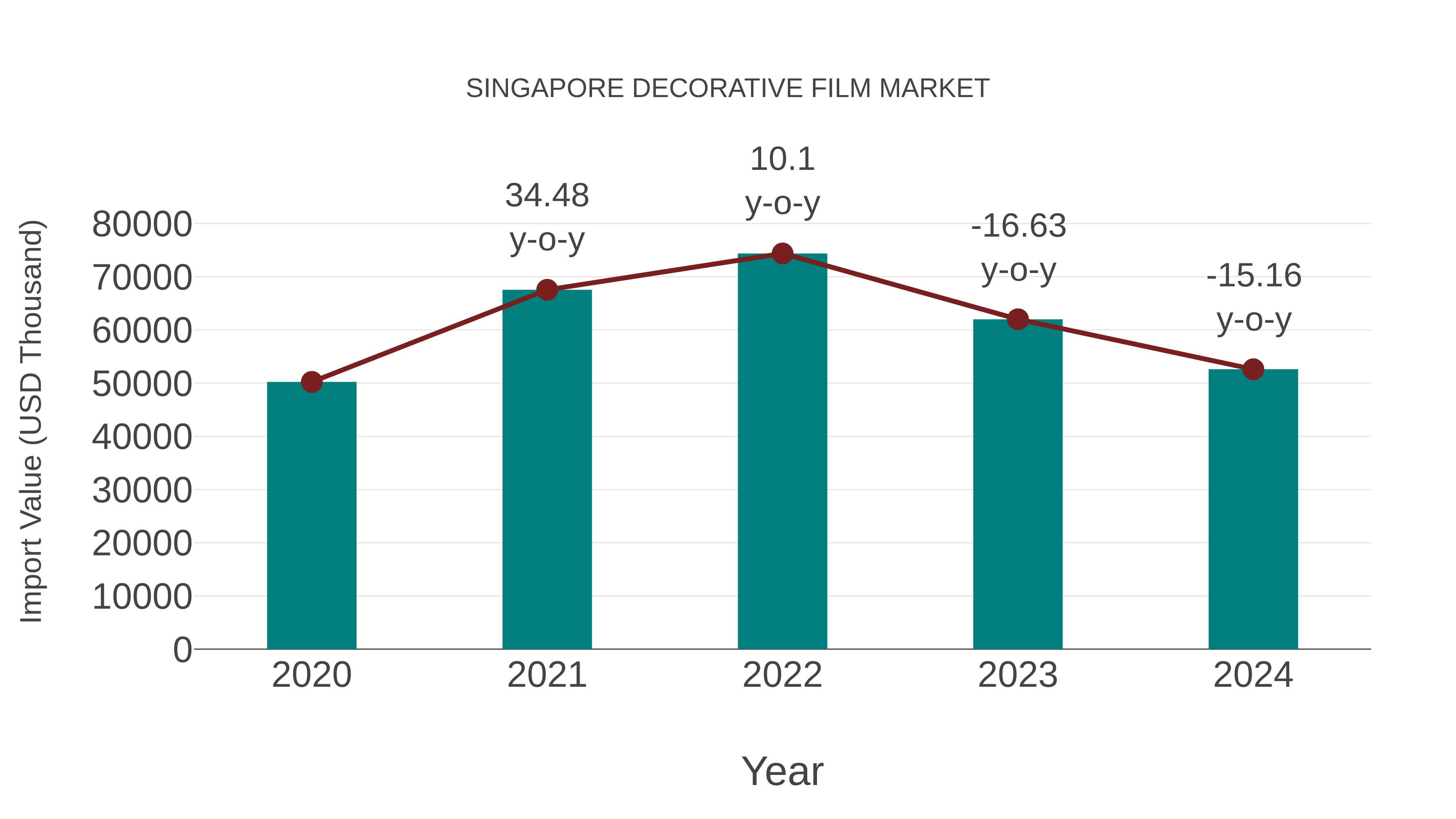
In the Singapore decorative film market, the import trend experienced a decline from 2023 to 2024, with a growth rate of -15.16%. However, the compound annual growth rate (CAGR) for imports from 2020 to 2024 stood at 1.16%. This decrease in import momentum could be attributed to shifting consumer preferences or changes in trade policies impacting market stability.
Singapore Decorative Film Market Synopsis
The Singapore decorative film market is projected to grow at a CAGR of 4.7% during the forecast period (2020-2026). The growing demand for interior decoration, rising disposable income, and increasing consumer spending are expected to drive the growth of the Singapore decorative film market over the forecast period. Decorative films can be used on any flat glass surface such as windows, mirrors, shower doors, countertops etc., due to its self-adhesive property it provides an easy installation facility which also drives its demand in both residential and commercial applications. Increasing awareness regarding energy savings along with developing economic conditions has further supplemented the growth of Singapore decorative film market.
However, availability of substitutes along with high cost associated with some type of decorative films might restrain the growth of this market over coming years. Moreover, rapid advancement in technology for manufacturing efficient materials would create lucrative opportunity for this industry in near future.
Key Highlights of the Report:
- Singapore Decorative Film Market Outlook
- Market Size of Singapore Decorative Film Market, 2019
- Forecast of Singapore Decorative Film Market, 2026
- Historical Data and Forecast of Singapore Decorative Film Revenues & Volume for the Period 2016 - 2026
- Singapore Decorative Film Market Trend Evolution
- Singapore Decorative Film Market Drivers and Challenges
- Singapore Decorative Film Price Trends
- Singapore Decorative Film Porter's Five Forces
- Singapore Decorative Film Industry Life Cycle
- Historical Data and Forecast of Singapore Decorative Film Market Revenues & Volume By Product Type for the Period 2016 - 2026
- Historical Data and Forecast of Singapore Decorative Film Market Revenues & Volume By Stained Window Film for the Period 2016 - 2026
- Historical Data and Forecast of Singapore Decorative Film Market Revenues & Volume By Frosted Window Film for the Period 2016 - 2026
- Historical Data and Forecast of Singapore Decorative Film Market Revenues & Volume By Applications for the Period 2016 - 2026
- Historical Data and Forecast of Singapore Decorative Film Market Revenues & Volume By Residential for the Period 2016 - 2026
- Historical Data and Forecast of Singapore Decorative Film Market Revenues & Volume By Commercial for the Period 2016 - 2026
- Singapore Decorative Film Import Export Trade Statistics
- Market Opportunity Assessment By Product Type
- Market Opportunity Assessment By Applications
- Singapore Decorative Film Top Companies Market Share
- Singapore Decorative Film Competitive Benchmarking By Technical and Operational Parameters
- Singapore Decorative Film Company Profiles
- Singapore Decorative Film Key Strategic Recommendations






































