Singapore Decorative tile Market Summary
The singapore decorative tile market was estimated at USD 327 Million in 2025 and is projected to reach USD 458 Million by 2032, growing at a CAGR of 5.9% from 2026 to 2032.
Singapore Decorative tile Market Year-wise Growth Rate and Key Drivers
This graph highlights how the Singapore Decorative tile Market has steadily grown over the past five years, supported by major growth factors.
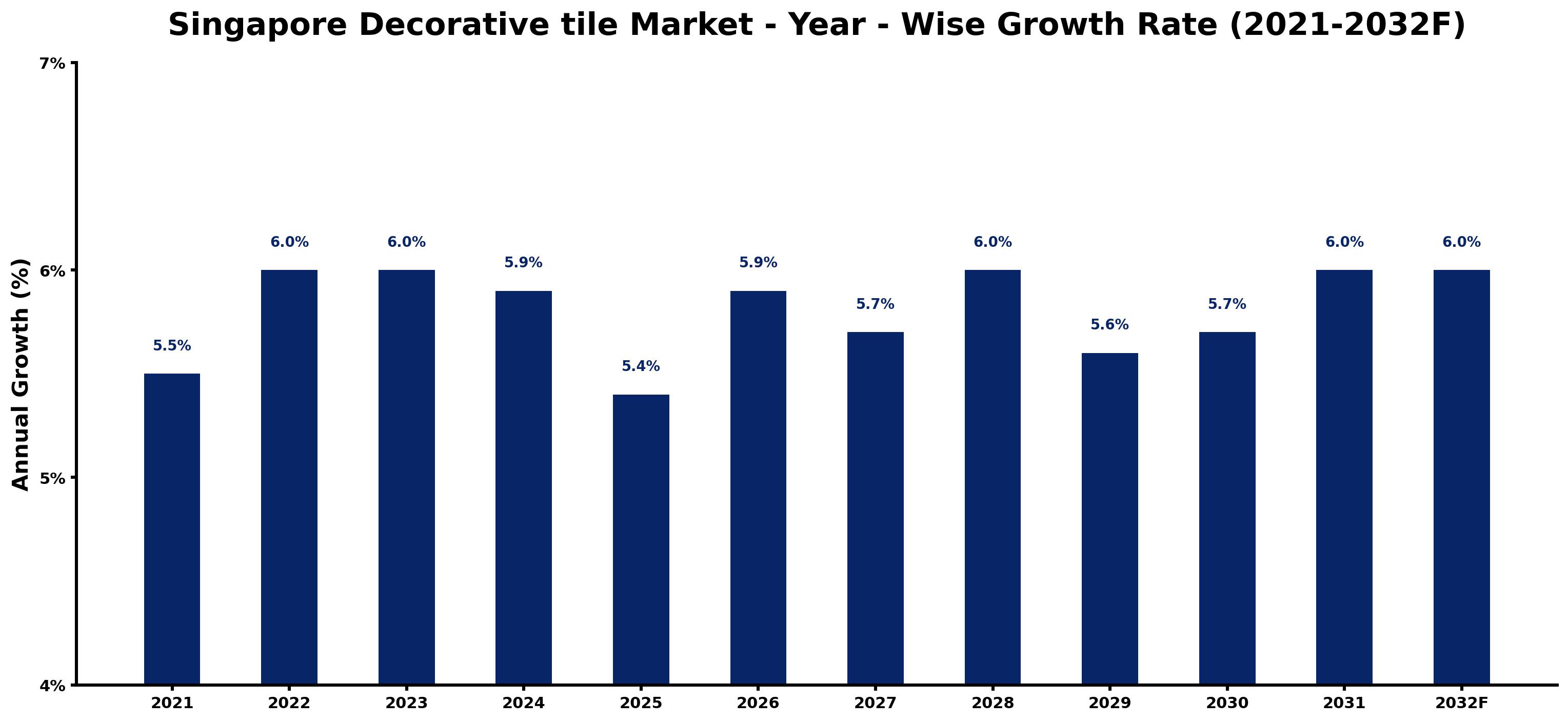
The table below presents the year wise growth rates along with the key drivers influencing the market
| Year | Growth Rate | Major Drivers |
| 2021 | 5.5% | Post-lockdown retail projects have rekindled interest in home renovation investments. |
| 2022 | 6.0% | An uptick in real estate ventures has boosted demand for unique decorative tiles. |
| 2023 | 6.0% | Homeowners focus on sustainable building materials, elevating eco-friendly tile options. |
| 2024 | 5.9% | Technological innovation in tile production enhances design customization possibilities. |
| 2025 | 5.4% | Luxury lifestyle trends encourage creative integration of decorative tiles in interiors. |
| 2026 | 5.9% | Hospitality sector expansion necessitates bespoke tile designs for enhanced guest experiences. |
| 2027 | 5.7% | Shifts towards minimalist aesthetics prompt interest in simpler tile patterns and colors. |
| 2028 | 6.0% | Digital platforms facilitate easier access to global tile designs and trends. |
| 2029 | 5.6% | Local artisans gain recognition, promoting handcrafted tiles in the market. |
| 2030 | 5.7% | Retro and vintage designs resonate with consumers seeking nostalgia in decor. |
| 2031 | 6.0% | Urban planners emphasize decorative tiles in public spaces for aesthetic appeal. |
| 2032 | 6.0% | Emerging trends in biophilic design drive the popularity of nature-inspired tiles. |
Note - Market size estimations and growth projections presented in this report are based on 6Wresearch's advanced forecasting approach, validated with industry datasets as of June 2026.
Singapore Decorative tile Market Synopsis
The Singapore Decorative tile Market is projected to reach 5.9% and witness significant growth during the forecast period (2026-2032). This growth trajectory is primarily driven by an established construction industry and a rising demand for aesthetically pleasing living spaces. Government initiatives aimed at enhancing infrastructure and promoting smart living environments further bolster the market, particularly in the residential segment, where luxury properties are becoming increasingly sought after.
Singapore Decorative tile Market Growth Drivers
Several key factors contribute to the growth of the Singapore decorative tile market. These include:
- The ongoing expansion of the construction sector, which serves as a vital element of Singapore's economic framework, fueled by continued public and private investments.
- An uptick in disposable incomes among residents, which correlates with a growing appetite for luxury living spaces and, consequently, high-quality decorative tiles.
- Innovative advancements in manufacturing technologies, including 3D printing, allow for customization, catering to consumer preferences while also optimizing production costs.
- Increased consumer awareness regarding the variety of designs and materials available in decorative tiles, spurring demand across various applications including residential, commercial, and educational institutions.
- An upward trend in home decor spending as consumers prioritize aesthetics and quality, further solidifying the market potential for decorative tiles.
Singapore Decorative tile Market Challenges and Restraints
Despite the promising growth, the Singapore decorative tile market faces several challenges that could hinder its progress:
- The high cost of decorative tiles relative to traditional ceramics poses a significant barrier for budget-conscious consumers, limiting broader market adoption.
- Availability issues, particularly for specialty decorative tiles, can disrupt supply chains due to reliance on specific suppliers, especially during peak demand periods.
- Market saturation in certain segments may lead to increased competition, resulting in price wars that could squeeze profit margins for companies operating in this space.
- Economic fluctuations and uncertainties can influence consumer spending habits, potentially impacting the demand for decorative tiles.
- Shifts in consumer preferences toward sustainable and eco-friendly building materials may challenge traditional decorative tile manufacturers to innovate or risk losing market share.
Singapore Decorative tile Market Government Investment and Initiatives
The Singaporean government has taken significant steps to stimulate the decorative tile market by investing in public infrastructure and promoting sustainable construction practices. Initiatives such as the Smart Nation Programme aim to enhance urban living and bolster the construction sector's efficiency through digital transformation. Additionally, major public spending on infrastructure projects, including transport and residential developments, provides a steady demand for high-quality building materials, including decorative tiles. These initiatives not only encourage local manufacturing but also aim to improve supply chain resilience in the decorative tile market.
Singapore Decorative tile Market Latest Developments (May 2025 - June 2026)
In the period from May 2025 to June 2026, the Singapore decorative tile market has experienced notable developments in response to evolving consumer preferences and technological advancements. Manufacturers are increasingly adopting innovative design technologies, which include the use of augmented reality for customer visualization. This trend enhances the purchasing experience by allowing consumers to visualize the decorative tiles in their spaces before making a purchase. Additionally, the market has seen a shift towards eco-friendly tiles, as sustainability becomes a priority for both consumers and regulatory bodies. Companies are also exploring strategic partnerships to improve distribution channels and address availability challenges, thereby ensuring consistency in product supply.
Singapore Decorative tile Market - Key Attractiveness of the Report
- 10 Years of Market Numbers
- Historical Data Starting from 2022 to 2025
- Base Year: 2025
- Forecast Data until 2032
- Key Performance Indicators Impacting the Market
- Major Upcoming Developments and Projects
Key Highlights of the Report:
- Singapore Decorative tile Market Outlook
- Market Size of Singapore Decorative tile Market, 2025
- Forecast of Singapore Decorative tile Market, 2032F
- Historical Data and Forecast of Singapore Decorative tile Revenues & Volume for the Period 2022-2032F
- Singapore Decorative tile Market Trend Evolution
- Singapore Decorative tile Market Drivers and Challenges
- Singapore Decorative tile Price Trends
- Singapore Decorative tile Porter's Five Forces
- Singapore Decorative tile Industry Life Cycle
- Historical Data and Forecast of Singapore Decorative tile Market Revenues & Volume By Type for the Period 2022-2032F
- Historical Data and Forecast of Singapore Decorative tile Market Revenues & Volume By Ceramic Wall Tiles for the Period 2022-2032F
- Historical Data and Forecast of Singapore Decorative tile Market Revenues & Volume By Vinyl Wall Tiles for the Period 2022-2032F
- Historical Data and Forecast of Singapore Decorative tile Market Revenues & Volume By Stone Wall Tiles for the Period 2022-2032F
- Historical Data and Forecast of Singapore Decorative tile Market Revenues & Volume By Other Types for the Period 2022-2032F
- Historical Data and Forecast of Singapore Decorative tile Market Revenues & Volume By End-users for the Period 2022-2032F
- Historical Data and Forecast of Singapore Decorative tile Market Revenues & Volume By Residential for the Period 2022-2032F
- Historical Data and Forecast of Singapore Decorative tile Market Revenues & Volume By Commercial for the Period 2022-2032F
- Historical Data and Forecast of Singapore Decorative tile Market Revenues & Volume By Application for the Period 2022-2032F
- Historical Data and Forecast of Singapore Decorative tile Market Revenues & Volume By Flooring for the Period 2022-2032F
- Historical Data and Forecast of Singapore Decorative tile Market Revenues & Volume By Wall Coverings for the Period 2022-2032F
- Historical Data and Forecast of Singapore Decorative tile Market Revenues & Volume By Other Applications for the Period 2022-2032F
- Singapore Decorative tile Import Export Trade Statistics
- Market Opportunity Assessment By Type
- Market Opportunity Assessment By End-users
- Market Opportunity Assessment By Application
- Singapore Decorative tile Top Companies Market Share
- Singapore Decorative tile Competitive Benchmarking By Technical and Operational Parameters
- Singapore Decorative tile Company Profiles
- Singapore Decorative tile Key Strategic Recommendations






































