Singapore Dehydrated Culture Media Market Size, Share & Growth Rate
The Singapore Dehydrated Culture Media Market was estimated at USD 357 Million in 2025 and is projected to reach USD 470 Million by 2032, growing at a CAGR of 4.0% from 2026 to 2032. This growth trajectory is primarily fueled by the burgeoning biotechnology and pharmaceutical sectors in Singapore, which demand high-quality culture media for research and diagnostics. Furthermore, heightened awareness around food safety and the increasing prevalence of healthcare-associated infections are propelling the need for effective microbiological testing.
Singapore Dehydrated Culture Media Market Year-wise Growth Rate and Key Drivers
This graph highlights how the Singapore Dehydrated Culture Media Market has steadily grown over the years, supported by major growth factors.
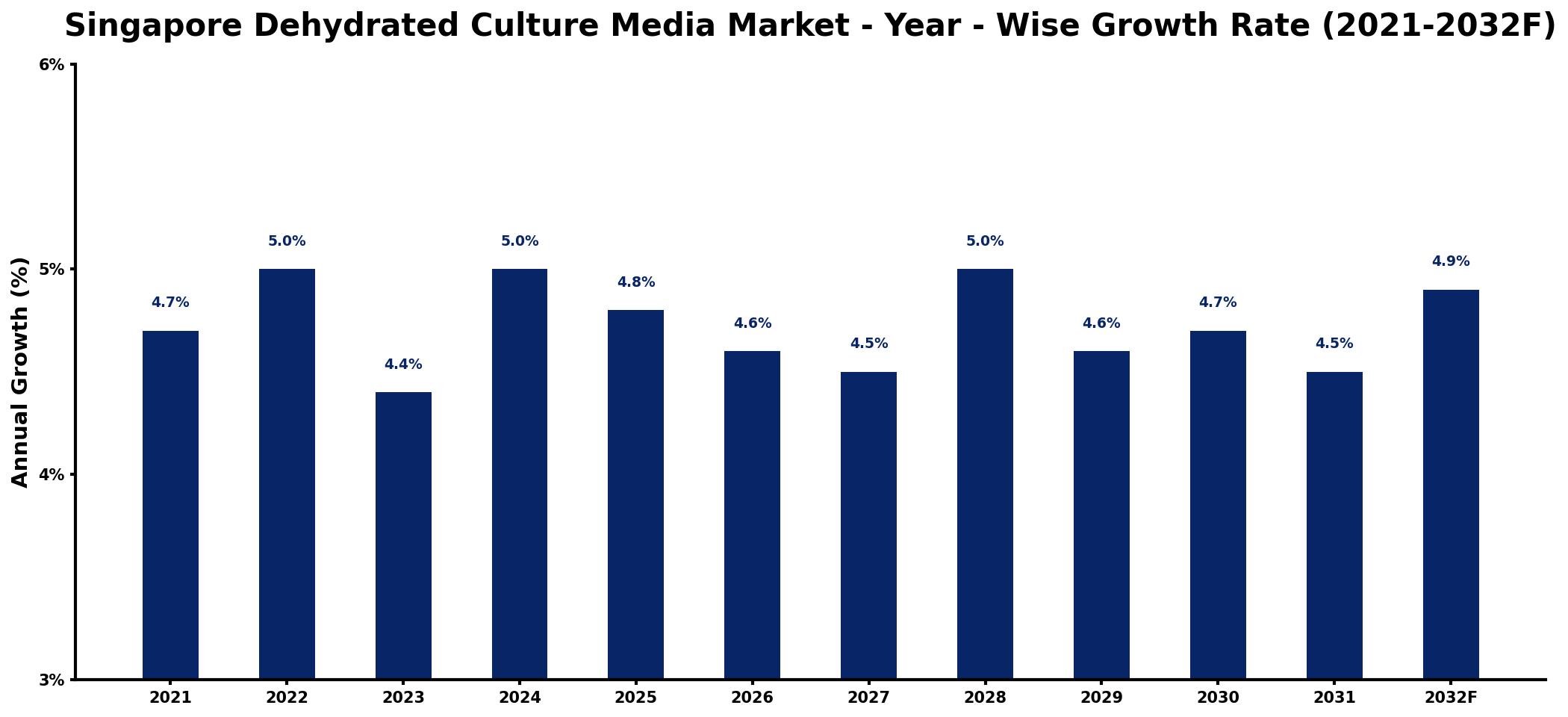
The table below presents the year‑wise growth rates along with the key drivers influencing the market
| Year | Growth Rate | Major Drivers |
| 2021 | 4.7% | Rising demand from biotechnology sector |
| 2022 | 5.0% | Increased investments in healthcare research |
| 2023 | 4.4% | Growth in pharmaceutical applications |
| 2024 | 5.0% | Expansion of food safety testing |
| 2025 | 4.8% | Surge in educational laboratory use |
| 2026 | 4.6% | Emerging trends in diagnostics industry |
| 2027 | 4.5% | Advancements in microbiological research |
| 2028 | 5.0% | Heightened focus on quality control |
| 2029 | 4.6% | Growing interest in environmental studies |
| 2030 | 4.7% | Increased funding for academic research |
| 2031 | 4.5% | Boost in clinical trial activities |
| 2032 | 4.9% | Rising need for innovative solutions |
Note: Market size estimations and growth projections presented in this report are based on 6Wresearch's proprietary forecasting methodology, utilizing the latest available industry data, government publications, and primary research inputs.
Singapore Dehydrated Culture Media Market Synopsis
In Singapore, the dehydrated culture media market plays a pivotal role in advancing research and quality control across various sectors, including healthcare and food production. As a nation committed to strengthening its life sciences sector, the continuous influx of investments is significantly enhancing the capabilities and applications of dehydrated culture media.
The reliance on dehydrated culture media for accurate microbial identification cannot be overstated. With laboratories increasingly demanding consistency and reliability, these products have become indispensable for ensuring that rigorous scientific and clinical standards are met, thereby supporting the nations health initiatives.
Singapore Dehydrated Culture Media Market Key Takeaways
- The market is poised for steady growth driven by increasing needs in biotechnology and pharmaceuticals.
- Heightened concerns over food safety and diagnostic accuracy are key demand drivers.
- Robust research and development efforts are further pushing the boundaries of dehydrated culture media applications.
- Stringent quality control measures and regulatory compliance remain pivotal for market players.
- Technological advancements in production methods are paving the way for innovative product formulations.
Evaluation of Restraints in Singapore Dehydrated Culture Media Market
Despite the promising outlook, the Singapore dehydrated culture media market faces significant restraints. One of the foremost challenges is maintaining stringent quality control while adhering to regulatory standards. The complexity of formulating specialized products for diverse research applications often leads to increased production costs. This creates pressure on manufacturers to balance cost efficiency with the necessity for high-quality offerings that meet the diverse needs of laboratories and research institutions.
Singapore Dehydrated Culture Media Market Trends
The market is witnessing notable trends that are shaping its future. Increased automation in laboratory settings is leading to the integration of advanced technologies in the formulation and testing of dehydrated culture media. Additionally, there is a growing emphasis on sustainable practices, prompting manufacturers to explore environmentally friendly raw materials and processes. Furthermore, the rise of personalized medicine and tailored therapeutic solutions is generating demand for specialized media that can support niche microbiological applications.
Singapore Dehydrated Culture Media Market Opportunities
Opportunities for growth are abundant within the Singapore dehydrated culture media market. The ongoing expansion of the biotechnology sector presents vast potential for product innovation and development tailored to emerging research needs. Moreover, collaborations between academic institutions and industry players are fostering an environment conducive to pioneering research initiatives. The surge in diagnostic testing, particularly in the wake of the pandemic, further bolsters the demand for reliable culture media, making this a prime area for investment and development.
Government Initiatives in the Singapore Dehydrated Culture Media Market
The Singapore government has implemented various initiatives aimed at bolstering the life sciences sector, which indirectly benefits the dehydrated culture media market. These include funding for research and development, support for innovation in biotechnology, and strategic public-private partnerships aimed at enhancing healthcare infrastructure. Such policies not only aim to improve healthcare outcomes but also ensure that the local market is equipped with the necessary resources to thrive in a competitive landscape.
Future Insights of the Singapore Dehydrated Culture Media Market
Looking ahead to the period from 2026 to 2032, the Singapore dehydrated culture media market is likely to experience transformative developments. The interplay of increasing public health awareness and ongoing investments in biotechnology will further stimulate demand. Additionally, as laboratories evolve with technological advancements, there will be a heightened emphasis on media that supports rapid and accurate microbial testing. The future landscape will undoubtedly require adaptability from manufacturers to address the dynamic needs of the market.
Singapore Dehydrated Culture Media Market Latest Developments (2025 - 2026)
Recent developments in the Singapore dehydrated culture media market have been characterized by a notable shift toward enhanced product offerings. Companies are increasingly focusing on developing specialized media that caters to specific research niches, reflecting the growing demand for tailored solutions. Moreover, there has been a push toward greater sustainability in production processes, with several players beginning to adopt eco-friendly practices in sourcing and manufacturing. This evolution indicates a responsive market that is aligning with global trends toward sustainability and innovation.
Singapore Dehydrated Culture Media Market - Key Attractiveness of the Report
- 10 Years of Market Numbers
- Historical Data Starting from 2022 to 2025
- Base Year: 2025
- Forecast Data until 2032
- Key Performance Indicators Impacting the Market
- Major Upcoming Developments and Projects
Key Highlights of the Report:
- Singapore Dehydrated Culture Media Market Outlook
- Market Size of Singapore Dehydrated Culture Media Market, 2025
- Forecast of Singapore Dehydrated Culture Media Market, 2032
- Historical Data and Forecast of Singapore Dehydrated Culture Media Revenues & Volume for the Period 2022-2032F
- Singapore Dehydrated Culture Media Market Trend Evolution
- Singapore Dehydrated Culture Media Market Drivers and Challenges
- Singapore Dehydrated Culture Media Price Trends
- Singapore Dehydrated Culture Media Porter's Five Forces
- Singapore Dehydrated Culture Media Industry Life Cycle
- Historical Data and Forecast of Singapore Dehydrated Culture Media Market Revenues & Volume By Type for the Period 2022-2032F
- Historical Data and Forecast of Singapore Dehydrated Culture Media Market Revenues & Volume By Natural Medium for the Period 2022-2032F
- Historical Data and Forecast of Singapore Dehydrated Culture Media Market Revenues & Volume By Mixed Medium for the Period 2022-2032F
- Historical Data and Forecast of Singapore Dehydrated Culture Media Market Revenues & Volume By Semi-Composite Medium for the Period 2022-2032F
- Historical Data and Forecast of Singapore Dehydrated Culture Media Market Revenues & Volume By End-User for the Period 2022-2032F
- Historical Data and Forecast of Singapore Dehydrated Culture Media Market Revenues & Volume By Hospitals for the Period 2022-2032F
- Historical Data and Forecast of Singapore Dehydrated Culture Media Market Revenues & Volume By Diagnostic centers for the Period 2022-2032F
- Historical Data and Forecast of Singapore Dehydrated Culture Media Market Revenues & Volume By Biotechnology & Pharmaceutical Industries for the Period 2022-2032F
- Historical Data and Forecast of Singapore Dehydrated Culture Media Market Revenues & Volume By Academic and Research Institutes for the Period 2022-2032F
- Historical Data and Forecast of Singapore Dehydrated Culture Media Market Revenues & Volume By Others for the Period 2022-2032F
- Singapore Dehydrated Culture Media Import Export Trade Statistics
- Market Opportunity Assessment By Type
- Market Opportunity Assessment By End-User
- Singapore Dehydrated Culture Media Top Companies Market Share
- Singapore Dehydrated Culture Media Competitive Benchmarking By Technical and Operational Parameters
- Singapore Dehydrated Culture Media Company Profiles
- Singapore Dehydrated Culture Media Key Strategic Recommendations






































