Singapore Disposable Razor Blades Market Size, Share & Growth Rate
The Singapore Disposable Razor Blades Market was estimated at USD 478 Million in 2025 and is projected to reach USD 626 Million by 2032, growing at a CAGR of 3.9% from 2026 to 2032. This growth trajectory is primarily fueled by the increasing urbanization within the country, which has resulted in a demographic shift towards more modern grooming habits. Additionally, the rising disposable incomes of Singaporeans play a crucial role, as consumers are increasingly willing to invest in personal care products that promise convenience and superior hygiene.
Singapore Disposable Razor Blades Market Year-wise Growth Rate and Key Drivers
This graph highlights how the Singapore Disposable Razor Blades Market has steadily grown over the years, supported by major growth factors.
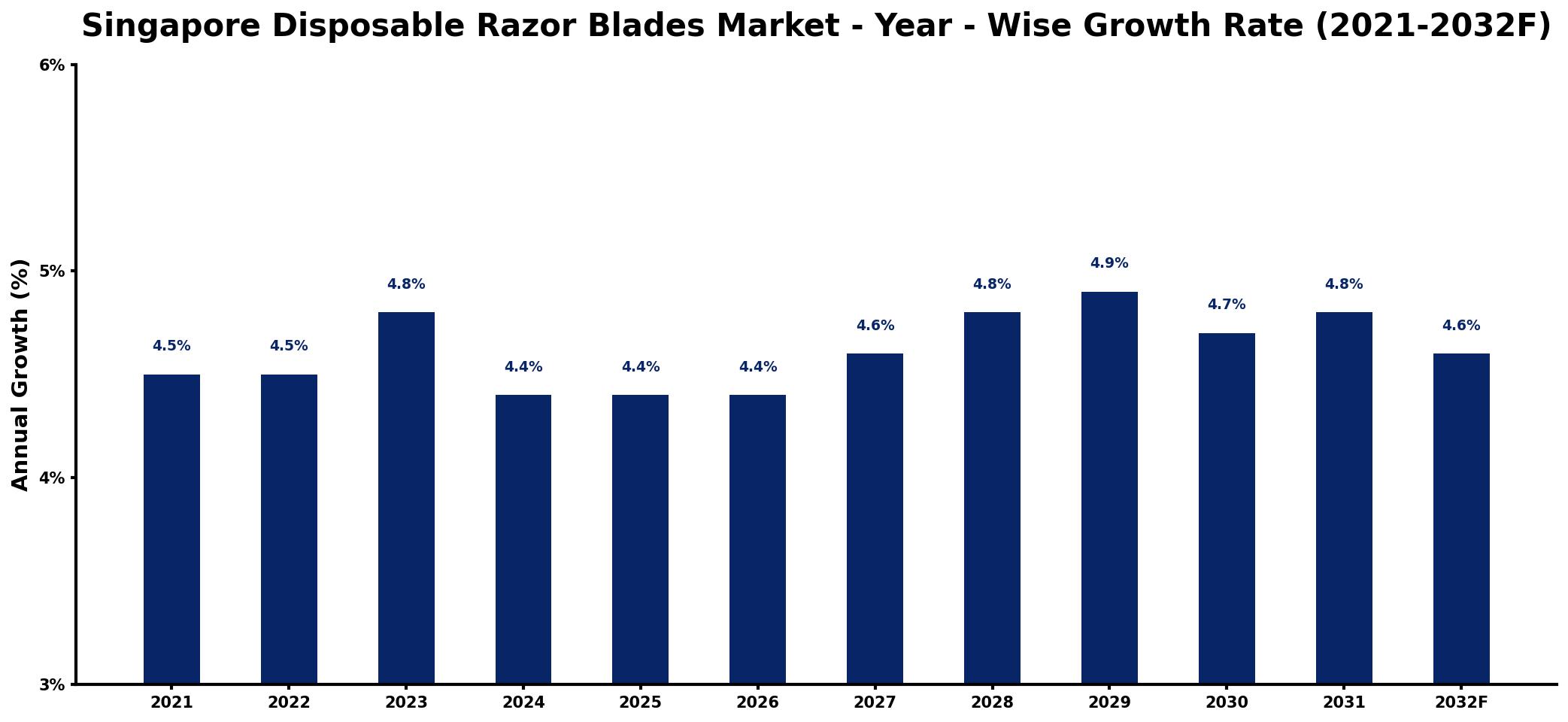
The table below presents the year‑wise growth rates along with the key drivers influencing the market
| Year | Growth Rate | Major Drivers |
| 2021 | 4.5% | Increased grooming product consumption |
| 2022 | 4.5% | Growing e-commerce retail expansion |
| 2023 | 4.8% | Rising awareness of personal hygiene |
| 2024 | 4.4% | Emergence of sustainable product options |
| 2025 | 4.4% | Innovations in consumer packaging solutions |
| 2026 | 4.4% | Increased demand for convenience products |
| 2027 | 4.6% | growing downstream application demand |
| 2028 | 4.8% | expanding healthcare application demand |
| 2029 | 4.9% | Increase in urban population demographics |
| 2030 | 4.7% | rising infrastructure development spending |
| 2031 | 4.8% | Growth in male grooming segment |
| 2032 | 4.6% | Expansion of retail distribution channels |
Note: Market size estimations and growth projections presented in this report are based on 6Wresearch's proprietary forecasting methodology, utilizing the latest available industry data, government publications, and primary research inputs.
Singapore Disposable Razor Blades Market Synopsis
The demand for disposable razors in Singapore is significantly influenced by the fast-paced lifestyles of its urban population. With busy schedules and a heightened focus on personal grooming, consumers are turning to disposable razors for their ease of use and minimal maintenance requirements. Furthermore, the growing awareness of hygiene and safety in grooming practices has propelled the market, as individuals seek reliable, single-use solutions.
In response to changing consumer preferences, manufacturers are continually innovating. New designs that emphasize ergonomic handling, along with variations like multi-blade configurations, are becoming standard features that enhance the shaving experience. This dedication to innovation not only meets consumer expectations but also helps manufacturers stand out in a competitive market.
Singapore Disposable Razor Blades Market Key Takeaways
- The market is driven by urbanization and evolving grooming habits.
- Product innovation is key to maintaining competitiveness.
- Consumer demand is shifting towards hygiene-focused grooming solutions.
- Rising disposable incomes enable increased investment in personal care products.
- Sustainability concerns are emerging as significant factors influencing purchasing decisions.
Evaluation of Restraints in Singapore Disposable Razor Blades Market
The Singapore Disposable Razor Blades Market faces notable restraints primarily related to environmental sustainability. As awareness surrounding ecological issues grows, consumers are increasingly inclined to favor environmentally friendly alternatives. This shift necessitates a strategic pivot for manufacturers, urging them to explore the integration of sustainable materials into their products. Balancing performance and eco-friendliness is a challenge that must be navigated to align with evolving consumer values.
Singapore Disposable Razor Blades Market Trends
Current trends indicate a significant move towards personalization in grooming products. Consumers are looking for tailored solutions that cater specifically to their individual skin types and shaving preferences. Additionally, there's an increased adoption of subscription models for personal care products, allowing consumers to receive their preferred razors conveniently at home. This trend not only reflects convenience but also represents a shift in purchasing behavior, with a focus on long-term value.
Singapore Disposable Razor Blades Market Opportunities
The future of the Singapore Disposable Razor Blades Market is ripe with opportunities, particularly in the realm of sustainability. Brands that can successfully develop and market eco-friendly disposable razors stand to capture a significant share of the growing environmentally conscious consumer base. Additionally, the ongoing trend towards male grooming presents an opportunity for expanding product lines to include specialized disposable razors targeted at men.
Government Initiatives in the Singapore Disposable Razor Blades Market
The Singapore government has increasingly emphasized sustainable development across various sectors, including consumer goods. Initiatives aimed at promoting eco-friendly practices could impact the disposable razor blades market, pushing manufacturers to adopt greener production processes. Public campaigns that encourage sustainable consumption will likely motivate brands to innovate towards more environmentally friendly options while aligning with national priorities.
Future Insights of the Singapore Disposable Razor Blades Market
Looking ahead to 2026-2032, the Singapore Disposable Razor Blades Market is poised for continued growth. As personal grooming becomes an ingrained aspect of daily routines, the demand for disposable razors will likely rise. Innovations that enhance user experience and cater to sustainability will be critical in shaping market dynamics. Furthermore, as e-commerce continues to grow, online retail channels are expected to play a crucial role in reaching a broader audience.
Singapore Disposable Razor Blades Market Latest Developments (2025 - 2026)
The market has recently seen a flurry of activity, with numerous brands launching product lines that emphasize ergonomic designs and sustainability. Manufacturers have begun to pivot towards eco-friendly materials, responding to consumer demand for greener alternatives. Additionally, several companies are exploring collaborative partnerships to enhance their distribution channels, focusing on online platforms to cater to changing shopping behaviors in the post-pandemic era.
Singapore Disposable Razor Blades Market - Key Attractiveness of the Report
- 10 Years of Market Numbers
- Historical Data Starting from 2022 to 2025
- Base Year: 2025
- Forecast Data until 2032
- Key Performance Indicators Impacting the Market
- Major Upcoming Developments and Projects
Key Highlights of the Report:
- Singapore Disposable Razor Blades Market Outlook
- Market Size of Singapore Disposable Razor Blades Market, 2025
- Forecast of Singapore Disposable Razor Blades Market, 2032
- Historical Data and Forecast of Singapore Disposable Razor Blades Revenues & Volume for the Period 2022-2032F
- Singapore Disposable Razor Blades Market Trend Evolution
- Singapore Disposable Razor Blades Market Drivers and Challenges
- Singapore Disposable Razor Blades Price Trends
- Singapore Disposable Razor Blades Porter's Five Forces
- Singapore Disposable Razor Blades Industry Life Cycle
- Historical Data and Forecast of Singapore Disposable Razor Blades Market Revenues & Volume By Blade Count for the Period 2022-2032F
- Historical Data and Forecast of Singapore Disposable Razor Blades Market Revenues & Volume By 1 & 2 Blades for the Period 2022-2032F
- Historical Data and Forecast of Singapore Disposable Razor Blades Market Revenues & Volume By 3 & 4 Blades for the Period 2022-2032F
- Historical Data and Forecast of Singapore Disposable Razor Blades Market Revenues & Volume By 5 & More Blades for the Period 2022-2032F
- Historical Data and Forecast of Singapore Disposable Razor Blades Market Revenues & Volume By End-user for the Period 2022-2032F
- Historical Data and Forecast of Singapore Disposable Razor Blades Market Revenues & Volume By Men for the Period 2022-2032F
- Historical Data and Forecast of Singapore Disposable Razor Blades Market Revenues & Volume By Women for the Period 2022-2032F
- Historical Data and Forecast of Singapore Disposable Razor Blades Market Revenues & Volume By Distribution Channel for the Period 2022-2032F
- Historical Data and Forecast of Singapore Disposable Razor Blades Market Revenues & Volume By Hypermarkets/Supermarkets for the Period 2022-2032F
- Historical Data and Forecast of Singapore Disposable Razor Blades Market Revenues & Volume By Pharmacies for the Period 2022-2032F
- Historical Data and Forecast of Singapore Disposable Razor Blades Market Revenues & Volume By Online for the Period 2022-2032F
- Historical Data and Forecast of Singapore Disposable Razor Blades Market Revenues & Volume By Others for the Period 2022-2032F
- Singapore Disposable Razor Blades Import Export Trade Statistics
- Market Opportunity Assessment By Blade Count
- Market Opportunity Assessment By End-user
- Market Opportunity Assessment By Distribution Channel
- Singapore Disposable Razor Blades Top Companies Market Share
- Singapore Disposable Razor Blades Competitive Benchmarking By Technical and Operational Parameters
- Singapore Disposable Razor Blades Company Profiles
- Singapore Disposable Razor Blades Key Strategic Recommendations






































