Singapore Dry-Cleaning And Laundry Services Market Size, Share & Growth Rate
The Singapore Dry-Cleaning And Laundry Services Market was estimated at USD 429 Million in 2025 and is projected to reach USD 598 Million by 2032, growing at a CAGR of 4.9% from 2026 to 2032. This growth trajectory is fueled by the fast-paced urban lifestyle of Singaporean residents, who increasingly prioritize convenience in garment care. The rising emphasis on sustainable practices is also reshaping service offerings, aligning with the eco-conscious mindset of many consumers in the region.
Singapore Dry-Cleaning And Laundry Services Market Year-wise Growth Rate and Key Drivers
This graph highlights how the Singapore Dry-Cleaning And Laundry Services Market has steadily grown over the years, supported by major growth factors.
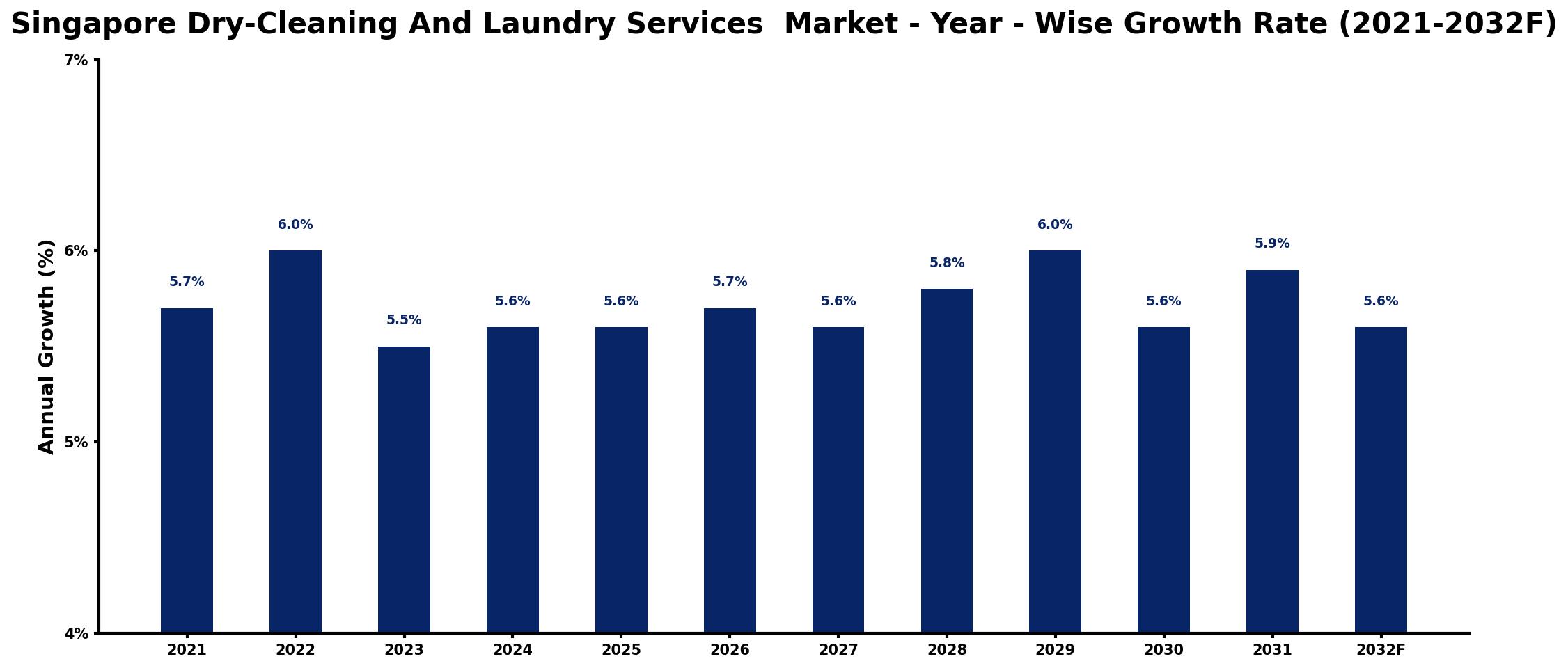
The table below presents the year‑wise growth rates along with the key drivers influencing the market
| Year | Growth Rate | Major Drivers |
| 2021 | 5.7% | Rise in disposable income levels |
| 2022 | 6.0% | Increased urbanization and population |
| 2023 | 5.5% | Growth in hospitality industry demand |
| 2024 | 5.6% | Expansion of e-commerce platforms |
| 2025 | 5.6% | Heightened consumer awareness sustainability |
| 2026 | 5.7% | Technological advancements in automation |
| 2027 | 5.6% | Surge in expatriate population growth |
| 2028 | 5.8% | Boost in corporate sector engagements |
| 2029 | 6.0% | Growing trend of convenience shopping |
| 2030 | 5.6% | Investment in green technologies |
| 2031 | 5.9% | growing regional consumption patterns |
| 2032 | 5.6% | Increase in leisure travel activities |
Note: Market size estimations and growth projections presented in this report are based on 6Wresearch's proprietary forecasting methodology, utilizing the latest available industry data, government publications, and primary research inputs.
Singapore Dry-Cleaning And Laundry Services Market Synopsis
In Singapore, the dry-cleaning and laundry services sector is witnessing a shift towards innovative service models that cater to the demands of busy urban dwellers. Many service providers are incorporating technology to streamline operations, such as online booking systems and contactless payment options, making it easier for consumers to access services.
The market is not only responding to consumer convenience but also grappling with increasing expectations regarding quality and sustainability. As awareness of environmental issues rises, many consumers are seeking providers that utilize eco-friendly cleaning methods and biodegradable products, creating a competitive edge for those that can adapt to these demands.
Singapore Dry-Cleaning And Laundry Services Market Key Takeaways
- Urbanization and busy lifestyles are significantly driving demand for dry cleaning and laundry services.
- Innovations in technology are enhancing service delivery and customer experience.
- Environmental sustainability is becoming a crucial factor influencing consumer choices in the market.
- Adapting to shifting consumer preferences is vital for competitive advantage among service providers.
- Recovery from the COVID-19 pandemic is expected to bolster market growth in the coming years.
Evaluation of Restraints in Singapore Dry-Cleaning And Laundry Services Market
Despite its growth potential, the Singapore Dry-Cleaning And Laundry Services Market faces significant restraints that could limit its development. A primary concern is the need for high-quality textile care and consistent laundry freshness, which is paramount in maintaining consumer satisfaction. Moreover, as the market becomes more competitive, providers must navigate price pressures while maintaining quality standards. Additionally, changes in consumer preferences, particularly post-COVID-19, have introduced uncertainty in demand for traditional laundry services, compelling businesses to adapt swiftly to remain viable.
Singapore Dry-Cleaning And Laundry Services Market Trends
The market is experiencing several key trends, notably the integration of technology in service provision. Companies are increasingly adopting mobile applications and online platforms for booking and tracking laundry services, thereby enhancing convenience for customers. Sustainability trends also dominate, with many businesses exploring eco-friendly cleaning agents and energy-efficient machinery to meet the demands of environmentally conscious consumers. Furthermore, the rise of subscription-based laundry services reflects changing consumer preferences, emphasizing a desire for hassle-free, regular garment care solutions.
Singapore Dry-Cleaning And Laundry Services Market Opportunities
Investment opportunities abound in the Singapore Dry-Cleaning And Laundry Services Market, particularly in the realm of technology. Companies that can leverage automation, artificial intelligence, and machine learning to optimize operations will likely see substantial benefits. Additionally, the growing demand for sustainable practices offers a fertile ground for businesses that innovate in eco-friendly solutions. The increasing focus on corporate contracts with hospitality and healthcare sectors also presents a lucrative avenue for growth, enabling service providers to secure long-term revenue streams.
Government Initiatives in the Singapore Dry-Cleaning And Laundry Services Market
The Singaporean government has implemented various initiatives aimed at enhancing sustainability and technological advancements across industries, including dry cleaning and laundry services. Support programs encourage businesses to adopt cleaner technologies and reduce their carbon footprint. Additionally, investments in public awareness campaigns highlight the benefits of sustainable practices, thereby influencing consumer behavior positively towards eco-friendly services. These policies not only bolster industry compliance with environmental standards but also promote a sustainable business landscape.
Future Insights of the Singapore Dry-Cleaning And Laundry Services Market
Looking ahead to the 2026-2032 timeframe, the Singapore Dry-Cleaning And Laundry Services Market is set to evolve significantly. The anticipated recovery from the COVID-19 disruptions is likely to stimulate renewed consumer interest and spending in garment care. As technology continues to advance, we can expect to see more integrated service models that align with consumer preferences for convenience and sustainability. Moreover, as urbanization intensifies, the demand for efficient and reliable laundry solutions will only grow, reinforcing the sectors role as a critical service in Singapores bustling economy.
Singapore Dry-Cleaning And Laundry Services Market Latest Developments (2025 - 2026)
Recent industry movements indicate a substantial shift towards incorporating advanced cleaning technologies, with many providers investing in state-of-the-art equipment that minimizes environmental impact while maximizing efficiency. Additionally, the push for online service models continues to gain momentum, as more companies develop user-friendly platforms to enhance customer experience. Furthermore, partnerships with local businesses, particularly in the hospitality sector, are emerging as a strategy for growth, as service providers look to secure consistent demand amidst a competitive landscape.
Singapore Dry-Cleaning And Laundry Services Market - Key Attractiveness of the Report
- 10 Years of Market Numbers
- Historical Data Starting from 2022 to 2025
- Base Year: 2025
- Forecast Data until 2032
- Key Performance Indicators Impacting the Market
- Major Upcoming Developments and Projects
Key Highlights of the Report:
- Singapore Dry-Cleaning And Laundry Services Market Outlook
- Market Size of Singapore Dry-Cleaning And Laundry Services Market, 2025
- Forecast of Singapore Dry-Cleaning And Laundry Services Market, 2032
- Historical Data and Forecast of Singapore Dry-Cleaning And Laundry Services Revenues & Volume for the Period 2022-2032F
- Singapore Dry-Cleaning And Laundry Services Market Trend Evolution
- Singapore Dry-Cleaning And Laundry Services Market Drivers and Challenges
- Singapore Dry-Cleaning And Laundry Services Price Trends
- Singapore Dry-Cleaning And Laundry Services Porter's Five Forces
- Singapore Dry-Cleaning And Laundry Services Industry Life Cycle
- Historical Data and Forecast of Singapore Dry-Cleaning And Laundry Services Market Revenues & Volume By Type for the Period 2022-2032F
- Historical Data and Forecast of Singapore Dry-Cleaning And Laundry Services Market Revenues & Volume By Coin-Operated Laundries and Drycleaners for the Period 2022-2032F
- Historical Data and Forecast of Singapore Dry-Cleaning And Laundry Services Market Revenues & Volume By Dry-Cleaning and Laundry Services for the Period 2022-2032F
- Historical Data and Forecast of Singapore Dry-Cleaning And Laundry Services Market Revenues & Volume By Linen and Uniform Supply for the Period 2022-2032F
- Historical Data and Forecast of Singapore Dry-Cleaning And Laundry Services Market Revenues & Volume By End-Use for the Period 2022-2032F
- Historical Data and Forecast of Singapore Dry-Cleaning And Laundry Services Market Revenues & Volume By Commericial Dry-Cleaning and Laundry Services for the Period 2022-2032F
- Historical Data and Forecast of Singapore Dry-Cleaning And Laundry Services Market Revenues & Volume By Residential Dry-Cleaning and Laundry Services for the Period 2022-2032F
- Historical Data and Forecast of Singapore Dry-Cleaning And Laundry Services Market Revenues & Volume By Coin-Operated Laundries and Drycleaners for the Period 2022-2032F
- Historical Data and Forecast of Singapore Dry-Cleaning And Laundry Services Market Revenues & Volume By Distribution Channel for the Period 2022-2032F
- Historical Data and Forecast of Singapore Dry-Cleaning And Laundry Services Market Revenues & Volume By Offline for the Period 2022-2032F
- Historical Data and Forecast of Singapore Dry-Cleaning And Laundry Services Market Revenues & Volume By Online for the Period 2022-2032F
- Singapore Dry-Cleaning And Laundry Services Import Export Trade Statistics
- Market Opportunity Assessment By Type
- Market Opportunity Assessment By End-Use
- Market Opportunity Assessment By Distribution Channel
- Singapore Dry-Cleaning And Laundry Services Top Companies Market Share
- Singapore Dry-Cleaning And Laundry Services Competitive Benchmarking By Technical and Operational Parameters
- Singapore Dry-Cleaning And Laundry Services Company Profiles
- Singapore Dry-Cleaning And Laundry Services Key Strategic Recommendations






































