Singapore Edge Data Center Market Size & Growth Rate (2026-2032)
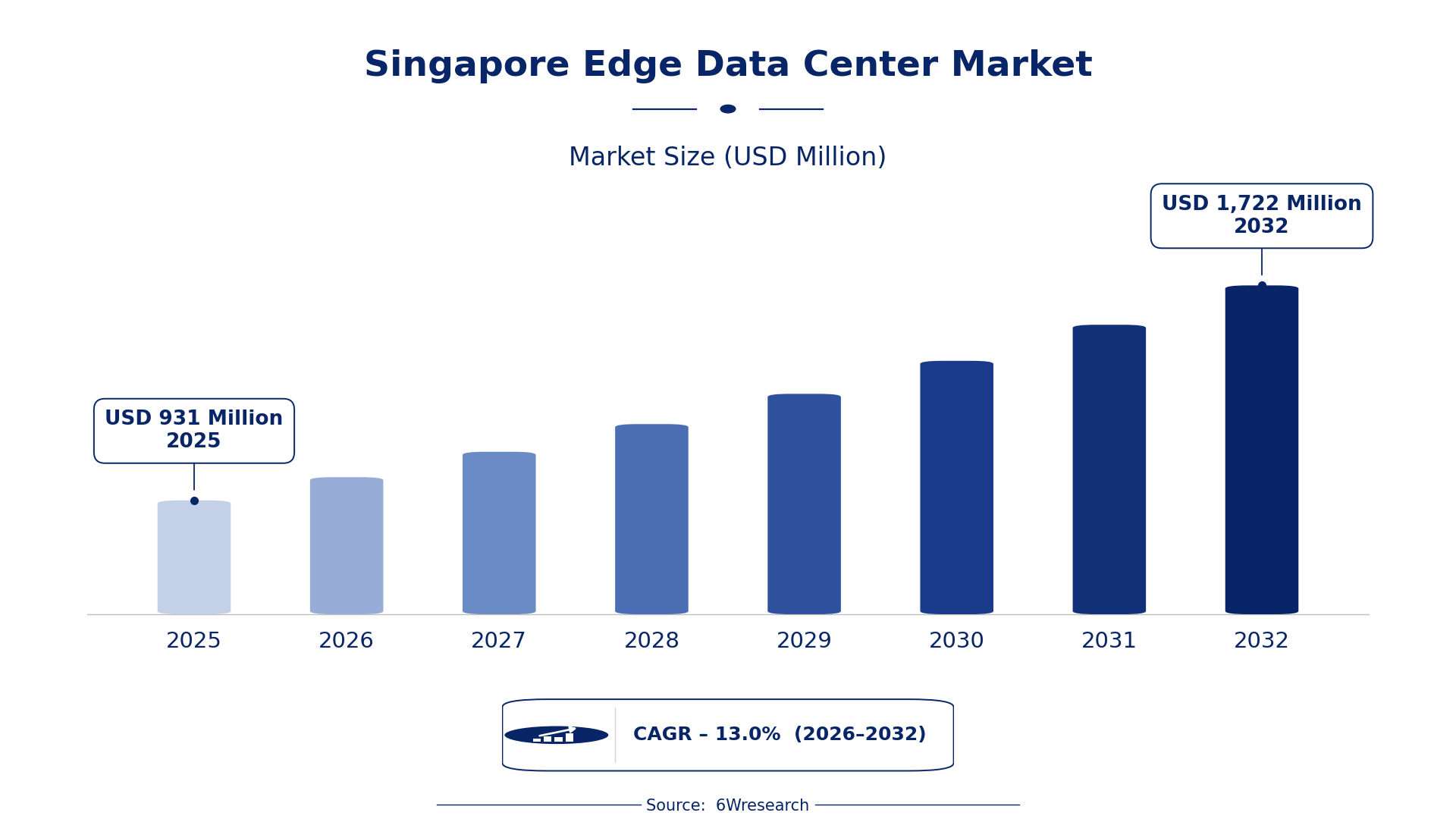
The Singapore Edge Data Center Market was estimated at USD 931 Million in 2025 and is projected to reach USD 1722 Million by 2032, growing at a CAGR of 13.0% from 2026 to 2032.
Singapore Edge Data Center Market Synopsis
The escalating demand for low-latency data processing is the primary force shaping the Singapore Edge Data Center Market. As organizations increasingly rely on real-time applications, the need for edge data centers to minimize latency has never been more critical.
Singapore's strategic geographical position enhances its appeal as a hub for edge computing. The rising proliferation of IoT devices and the rollout of 5G technology further cement its role in supporting cutting-edge applications that require immediate data processing and storage solutions.
Singapore Edge Data Center Market Year-wise Growth Rate and Key Drivers
This graph illustrates the annual growth rates of the Singapore Edge Data Center Market from 2021 to 2032, highlighting a steady upward trajectory and projected expansion over the forecast period.
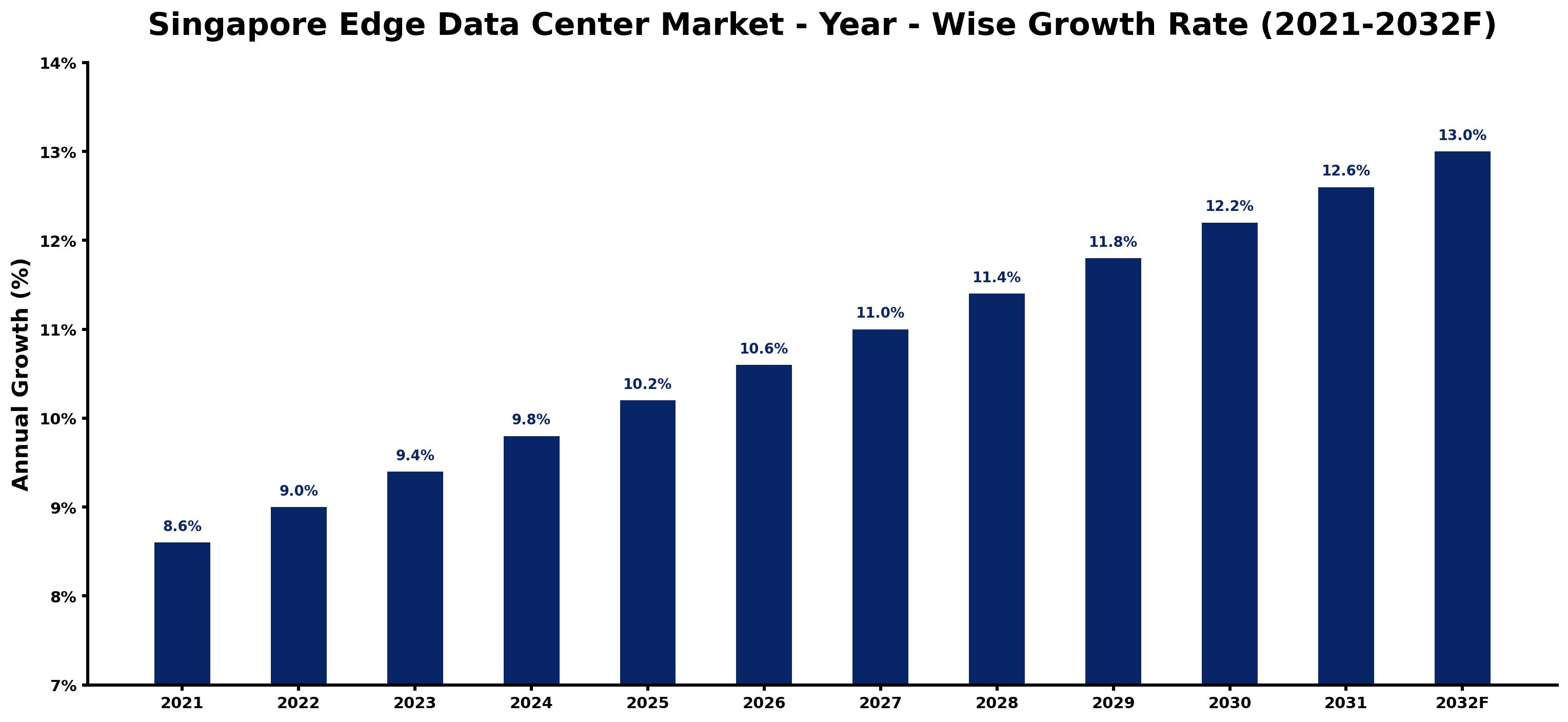
The table below presents the year‑wise growth rates along with the key drivers influencing the market
| Year | Growth Rate | Major Drivers |
| 2021 | 8.6% | Government support for digital economy initiatives boosts investment. |
| 2022 | 9.0% | Increased 5G deployment enhances edge computing capabilities. |
| 2023 | 9.4% | Accelerated data consumption from smart devices drives growth. |
| 2024 | 9.8% | Green building regulations promote eco-friendly data centers. |
| 2025 | 10.2% | Adoption of AI technology necessitates local data processing. |
| 2026 | 10.6% | Urbanization increases demand for localized data solutions. |
| 2027 | 11.0% | Cybersecurity regulations heighten need for secure data storage. |
| 2028 | 11.4% | E-commerce growth spurs edge data center usage. |
| 2029 | 11.8% | Rise in IoT devices creates local data processing needs. |
| 2030 | 12.2% | Partnerships with tech firms foster innovative edge solutions. |
| 2031 | 12.6% | Sustainability targets encourage energy-efficient data center designs. |
| 2032 | 13.0% | Regional digital transformation strategies fuel data center expansion. |
Note: Market size estimations and growth projections presented in this report are based on 6Wresearch's proprietary forecasting methodology, utilizing the latest available industry data, government publications, and primary research inputs.
Singapore Edge Data Center Market Key Takeaways
Below are some of the specific key takeaways from the market, including:
- Edge data centers in Singapore are crucial for reducing latency in IoT and real-time applications.
- The increasing adoption of 5G is driving demand for localized data processing solutions.
- Security challenges at the network edge require innovative strategies to protect data.
- Government initiatives are actively supporting infrastructure development in this sector.
- Prominent players are expanding their facilities to meet the growing market demands.
Evaluation of Restraints in Singapore Edge Data Center Market
The Singapore Edge Data Center Market faces several constraints that could hinder its growth. One significant challenge is the complexity of designing edge data centers capable of handling the computational demands of advanced technologies like IoT and 5G. Ensuring robust data security at the edge is another pressing concern, as cyber threats continue to evolve. Additionally, infrastructure limitations and the need for optimized designs remain critical hurdles that stakeholders must address to fully realize the market's potential.
Singapore Edge Data Center Market Trends
A marked trend in the Singapore Edge Data Center Market is the growing integration of artificial intelligence and machine learning to enhance operational efficiency. Organizations are increasingly employing these technologies to streamline data management and optimize resource allocation. on top of that, there is a strong push towards sustainability, with edge data centers adopting green practices to minimize their environmental impact. The demand for hyperlocal data processing solutions is also on the rise, aligning with consumer expectations for immediate access to services.
Singapore Edge Data Center Market Opportunities
The market presents numerous growth opportunities, particularly in sectors leveraging IoT and smart technologies. As enterprises embark on digital transformation journeys, edge data centers are well-positioned to support new applications and services requiring low latency. on top of that, the increasing demand for enhanced data privacy and security presents avenues for specialized solutions that cater to these needs. Investment in infrastructure development is also expected to rise, providing a conducive environment for new entrants and established players alike.
Government Initiatives in the Singapore Edge Data Center Market
Government policies are actively shaping the Singapore Edge Data Center Market, reflecting a commitment to enhancing digital infrastructure and promoting technological innovation. Regulatory frameworks are being developed to encourage investment in edge computing while ensuring data security and sustainability. Public-sector priorities focus on fostering an environment conducive to technological advancements and meeting the demands of the digital economy.
- A national digital infrastructure upgrade programme launched in early 2023 aimed to enhance connectivity and support edge computing initiatives.
- Current initiatives include a comprehensive regulatory framework that mandates data center efficiency and transparency, expected to roll out by late 2024.
- Upcoming plans involve a public-private partnership initiative projected to expand telecom infrastructure access by 2026.
- Ongoing efforts to implement cybersecurity standards for edge data centers, ensuring compliance with international regulations.
- The government is also investing in research and development grants to encourage innovation in edge computing technologies.
Future Insights of the Singapore Edge Data Center Market
Looking ahead to 2026-2032, the Singapore Edge Data Center Market is expected to undergo transformative changes driven by technological advancements and increased demand for real-time processing capabilities. As businesses continue to integrate IoT and 5G technologies, the necessity for localized data centers will intensify. on top of that, sustainability will remain a key focus, with stakeholders increasingly prioritizing eco-friendly operations. The competitive landscape will likely evolve, with new entrants striving to capture market share while established players enhance their offerings to meet emerging demands.
Singapore Edge Data Center Market Latest Developments
Recent activities in the Singapore Edge Data Center Market indicate a strong momentum towards expansion and innovation. Companies are actively pursuing initiatives to enhance their service offerings while meeting the growing demand for edge computing solutions. This period has seen significant investments in infrastructure and technology aimed at solidifying Singapore's position as a leading hub for edge data centers.
- A major regional operator announced the launch of a new edge data center facility in early 2024, designed to support low-latency applications.
- An ongoing project focused on integrating renewable energy sources into data center operations is set to enhance sustainability efforts.
- In mid-2024, a technology vendor is expected to roll out an innovative data management platform tailored for edge computing environments.
- A partnership between key stakeholders was formed to enhance security protocols for edge data centers, with implementation starting in late 2023.
- A planned expansion of existing facilities is expected to be completed by the end of 2025, increasing capacity to meet rising demand.
Singapore Edge Data Center Market - Key Attractiveness of the Report
- 10 Years of Market Numbers
- Historical Data Starting from 2022 to 2025
- Base Year: 2025
- Forecast Data until 2032
- Key Performance Indicators Impacting the Market
- Major Upcoming Developments and Projects
Key Highlights of the Report:
- Singapore Edge Data Center Market Outlook
- Market Size of Singapore Edge Data Center Market, 2025
- Forecast of Singapore Edge Data Center Market, 2032
- Historical Data and Forecast of Singapore Edge Data Center Revenues & Volume for the Period 2022-2032F
- Singapore Edge Data Center Market Trend Evolution
- Singapore Edge Data Center Market Drivers and Challenges
- Singapore Edge Data Center Price Trends
- Singapore Edge Data Center Porter's Five Forces
- Singapore Edge Data Center Industry Life Cycle
- Historical Data and Forecast of Singapore Edge Data Center Market Revenues & Volume By Component for the Period 2022-2032F
- Historical Data and Forecast of Singapore Edge Data Center Market Revenues & Volume By Solutions for the Period 2022-2032F
- Historical Data and Forecast of Singapore Edge Data Center Market Revenues & Volume By Services for the Period 2022-2032F
- Historical Data and Forecast of Singapore Edge Data Center Market Revenues & Volume By for the Period 2022-2032F
- Historical Data and Forecast of Singapore Edge Data Center Market Revenues & Volume By APAC for the Period 2022-2032F
- Historical Data and Forecast of Singapore Edge Data Center Market Revenues & Volume By Facility Size for the Period 2022-2032F
- Historical Data and Forecast of Singapore Edge Data Center Market Revenues & Volume By Small for the Period 2022-2032F
- Historical Data and Forecast of Singapore Edge Data Center Market Revenues & Volume By Medium Facilities for the Period 2022-2032F
- Historical Data and Forecast of Singapore Edge Data Center Market Revenues & Volume By Large Facility for the Period 2022-2032F
- Historical Data and Forecast of Singapore Edge Data Center Market Revenues & Volume By Vertical for the Period 2022-2032F
- Historical Data and Forecast of Singapore Edge Data Center Market Revenues & Volume By IT and Telecom for the Period 2022-2032F
- Historical Data and Forecast of Singapore Edge Data Center Market Revenues & Volume By BFSI for the Period 2022-2032F
- Historical Data and Forecast of Singapore Edge Data Center Market Revenues & Volume By Healthcare and Lifesciences for the Period 2022-2032F
- Historical Data and Forecast of Singapore Edge Data Center Market Revenues & Volume By Manufacturing for the Period 2022-2032F
- Historical Data and Forecast of Singapore Edge Data Center Market Revenues & Volume By Government for the Period 2022-2032F
- Historical Data and Forecast of Singapore Edge Data Center Market Revenues & Volume By Automotive for the Period 2022-2032F
- Historical Data and Forecast of Singapore Edge Data Center Market Revenues & Volume By Gaming and Entertainment for the Period 2022-2032F
- Historical Data and Forecast of Singapore Edge Data Center Market Revenues & Volume By Retail and E-commerce for the Period 2022-2032F
- Singapore Edge Data Center Import Export Trade Statistics
- Market Opportunity Assessment By Component
- Market Opportunity Assessment By
- Market Opportunity Assessment By Facility Size
- Market Opportunity Assessment By Vertical
- Singapore Edge Data Center Top Companies Market Share
- Singapore Edge Data Center Competitive Benchmarking By Technical and Operational Parameters
- Singapore Edge Data Center Company Profiles
- Singapore Edge Data Center Key Strategic Recommendations






































