Singapore Electrical Equipment Market Summary
The singapore electrical equipment market was estimated at USD 829 Million in 2025 and is projected to reach USD 1207 Million by 2032, growing at a CAGR of 6.3% from 2026 to 2032.
Singapore Electrical Equipment Market Year-wise Growth Rate and Key Drivers
This graph highlights how the Singapore Electrical Equipment Market has steadily grown over the past five years, supported by major growth factors.
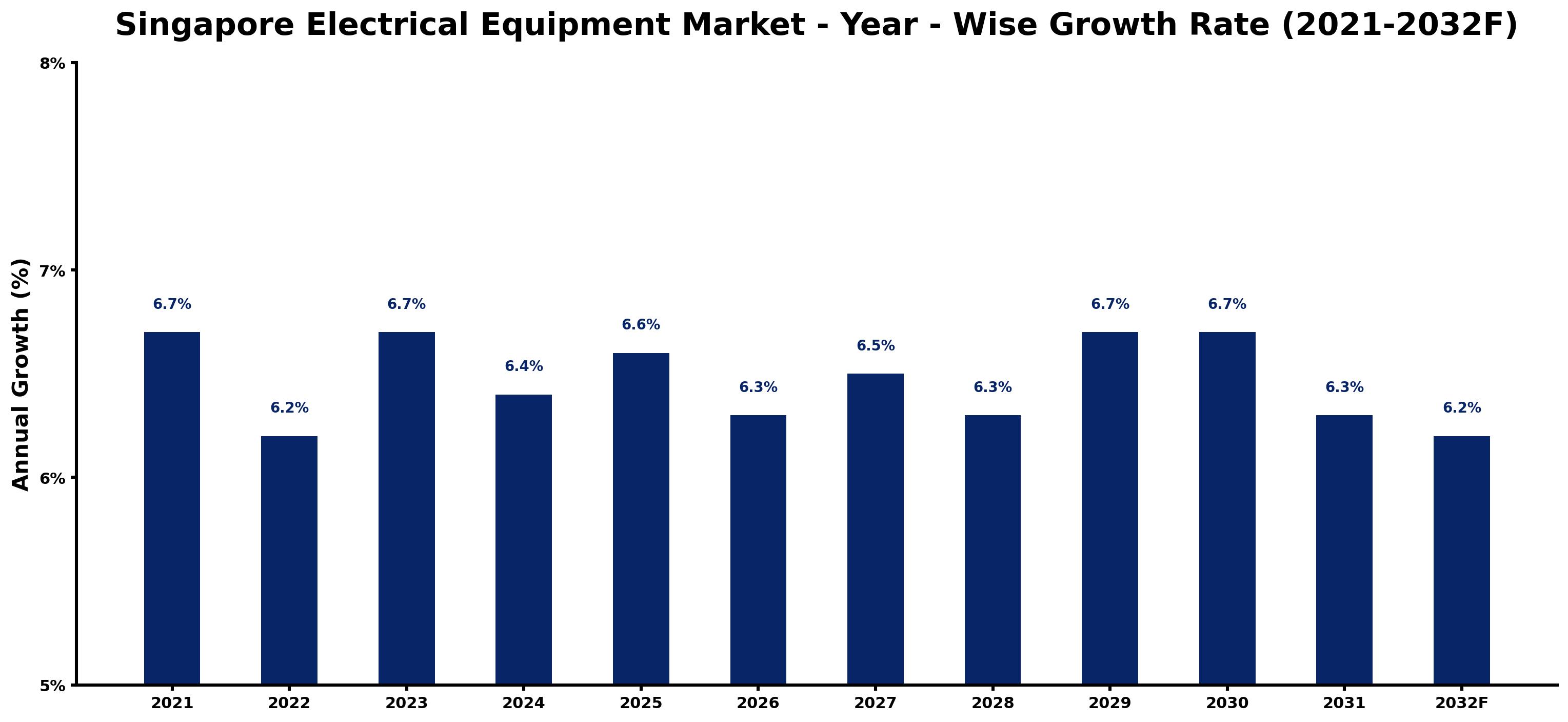
The table below presents the year wise growth rates along with the key drivers influencing the market
| Year | Growth Rate | Major Drivers |
| 2021 | 6.7% | Economic recovery efforts emphasized upgrading electrical infrastructure across key sectors. |
| 2022 | 6.2% | A surge in smart city projects fostered demand for advanced electrical solutions. |
| 2023 | 6.7% | Local manufacturing initiatives aimed to reduce dependency on imported electrical equipment. |
| 2024 | 6.4% | Technological integration in residential buildings highlighted the importance of energy-efficient systems. |
| 2025 | 6.6% | Emerging market trends indicated a shift towards renewable energy sources, driving innovation. |
| 2026 | 6.3% | Investment in digital transformation created opportunities for smart grid technologies and applications. |
| 2027 | 6.5% | Increased urbanization in Singapore accelerated the need for reliable electrical distribution networks. |
| 2028 | 6.3% | Sustainability practices among corporations prompted comprehensive upgrades in electrical systems. |
| 2029 | 6.7% | Corporate sustainability goals resulted in heightened interest for energy-saving electrical devices. |
| 2030 | 6.7% | Collaboration between tech firms and manufacturers advanced the Internet of Things in electrical appliances. |
| 2031 | 6.3% | The competitive landscape intensified, compelling companies to innovate and lower costs rapidly. |
| 2032 | 6.2% | Emerging regulations on energy efficiency incentivized businesses to adopt greener technologies. |
Note - Market size estimations and growth projections presented in this report are based on 6Wresearch's advanced forecasting approach, validated with industry datasets as of June 2026.
Singapore Electrical Equipment Market Synopsis
The Singapore Electrical Equipment Market is projected to reach 6.3% and witness significant growth during the forecast period (2026-2032). The anticipated compound annual growth rate (CAGR) of 3.8% highlights the increasing investments in the region's power sector and the shift toward renewable energy sources. Factors such as rapid urbanization, industrialization, and heightened consumer awareness regarding energy efficiency are key stimulants for the expansion of this market.
Singapore Electrical Equipment Market Growth Drivers
Several key drivers are propelling the growth of the Singapore Electrical Equipment Market:
- The increase in investments toward renewable energy has been pivotal, with government initiatives focusing on enhancing the clean energy mix. This effort aims to attract public-private partnerships and foreign investments into renewable energy projects, such as offshore wind farms and solar photovoltaic systems.
- Urbanization in Singapore continues to rise sharply, leading to a heightened demand for electricity from both residential and commercial users, thereby creating substantial opportunities for electric utility companies.
- Industrialization activities, particularly with a focus on developing smart cities, necessitate improved electrical networks. This digital transformation demands advanced electrical equipment, driving overall market demand.
- Consumer awareness regarding the benefits of energy-efficient technologies is fostering a favorable environment for investments in innovative electricity generation technologies such as hybrid systems.
- The ongoing push for sustainable development is influencing companies to adopt newer technologies and solutions, which in turn fuels demand for electrical equipment across various sectors.
Singapore Electrical Equipment Market Challenges and Restraints
Despite the promising growth prospects, the Singapore Electrical Equipment Market faces several challenges that may hinder its potential:
- The high installation costs associated with electrical equipment can pose a significant barrier to adoption. Many small-scale businesses struggle with budget constraints, limiting their ability to invest in necessary technologies and contributing to a slower overall market uptake.
- Market players may face intense competition, resulting in pricing pressures that can impact profitability. Companies must continuously innovate to maintain their market positions and meet the evolving demands of consumers.
- The rapid pace of technological advancements necessitates ongoing investment in research and development, which can strain financial resources for some companies.
- Regulatory compliance and adherence to safety standards can represent significant overhead costs for manufacturers, impacting their operational efficiency and pricing strategies.
- Global supply chain disruptions, although minimal in Singapore, can still affect the availability of critical components for electrical equipment, potentially delaying project timelines.
Singapore Electrical Equipment Market Government Investment and Initiatives
The Singaporean government has implemented numerous policies aimed at fostering growth within the Electrical Equipment Market. Key initiatives include:
- The commitment to achieving a sustainable energy landscape encourages investments in renewable energy infrastructure. This includes financial incentives for companies focusing on clean energy solutions.
- Public-private partnerships are actively promoted to enhance collaboration in developing smart grid technologies and other innovative electrical solutions.
- Government funding has been allocated to research projects aimed at advancing energy efficiency and the development of next-generation electrical equipment.
- Strategic frameworks, such as the Singapore Green Plan 2030, outline the roadmap for sustainable development and energy usage, reinforcing support for renewable energy investments.
- Regular assessments and updates of regulations ensure that the industry remains competitive and can adapt rapidly to market changes, fostering innovation and sustainable practices.
Singapore Electrical Equipment Market Latest Developments (May 2025 - June 2026)
In the period from May 2025 to June 2026, the Singapore Electrical Equipment Market experienced several noteworthy developments:
- New agreements between government authorities and private sector players led to the launch of collaborative projects focusing on enhancing grid infrastructure, particularly to support renewable energy integration.
- Investments in research and development surged, with companies allocating resources to create more energy-efficient technologies and solutions, reflecting the growing emphasis on sustainability.
- There was an uptick in the deployment of smart technologies within urban infrastructure, aimed at optimizing energy consumption and supporting the move towards smart cities.
- Industry events and forums witnessed increased participation, with stakeholders discussing advancements in electrical equipment technologies and the latest trends in energy efficiency.
- Government policies continued to evolve, addressing emerging challenges and promoting a framework conducive to innovation in the electrical equipment sector.
Singapore Electrical Equipment Market - Key Attractiveness of the Report
- 10 Years of Market Numbers
- Historical Data Starting from 2022 to 2025
- Base Year: 2025
- Forecast Data until 2032
- Key Performance Indicators Impacting the Market
- Major Upcoming Developments and Projects
Key Highlights of the Report:
- Singapore Electrical Equipment Market Outlook
- Market Size of Singapore Electrical Equipment Market, 2025
- Forecast of Singapore Electrical Equipment Market, 2032F
- Historical Data and Forecast of Singapore Electrical Equipment Revenues & Volume for the Period 2022-2032F
- Singapore Electrical Equipment Market Trend Evolution
- Singapore Electrical Equipment Market Drivers and Challenges
- Singapore Electrical Equipment Price Trends
- Singapore Electrical Equipment Porter's Five Forces
- Singapore Electrical Equipment Industry Life Cycle
- Historical Data and Forecast of Singapore Electrical Equipment Market Revenues & Volume By Types for the Period 2022-2032F
- Historical Data and Forecast of Singapore Electrical Equipment Market Revenues & Volume By Electronic and electrical wires and cables for the Period 2022-2032F
- Historical Data and Forecast of Singapore Electrical Equipment Market Revenues & Volume By Batteries and accumulators for the Period 2022-2032F
- Historical Data and Forecast of Singapore Electrical Equipment Market Revenues & Volume By Wiring devices for the Period 2022-2032F
- Historical Data and Forecast of Singapore Electrical Equipment Market Revenues & Volume By Electric lighting equipment for the Period 2022-2032F
- Historical Data and Forecast of Singapore Electrical Equipment Market Revenues & Volume By Others for the Period 2022-2032F
- Historical Data and Forecast of Singapore Electrical Equipment Market Revenues & Volume By Applications for the Period 2022-2032F
- Historical Data and Forecast of Singapore Electrical Equipment Market Revenues & Volume By Residential end-users for the Period 2022-2032F
- Historical Data and Forecast of Singapore Electrical Equipment Market Revenues & Volume By Non-residential end-users for the Period 2022-2032F
- Singapore Electrical Equipment Import Export Trade Statistics
- Market Opportunity Assessment By Types
- Market Opportunity Assessment By Applications
- Singapore Electrical Equipment Top Companies Market Share
- Singapore Electrical Equipment Competitive Benchmarking By Technical and Operational Parameters
- Singapore Electrical Equipment Company Profiles
- Singapore Electrical Equipment Key Strategic Recommendations






































