Singapore Electrical Steel Market Size, Share & Growth Rate
The Singapore Electrical Steel Market was estimated at USD 502 Million in 2025 and is projected to reach USD 725 Million by 2032, growing at a CAGR of 5.4% from 2026 to 2032. This growth trajectory underscores the increasing demand for high-performance electrical steel as Singapore enhances its energy efficiency and modernizes its electrical infrastructure. Additionally, the government's commitment to sustainable energy solutions further fuels the market as industries seek innovative materials to optimize performance.
Singapore Electrical Steel Market Year-wise Growth Rate and Key Drivers
This graph highlights how the Singapore Electrical Steel Market has steadily grown over the years, supported by major growth factors.
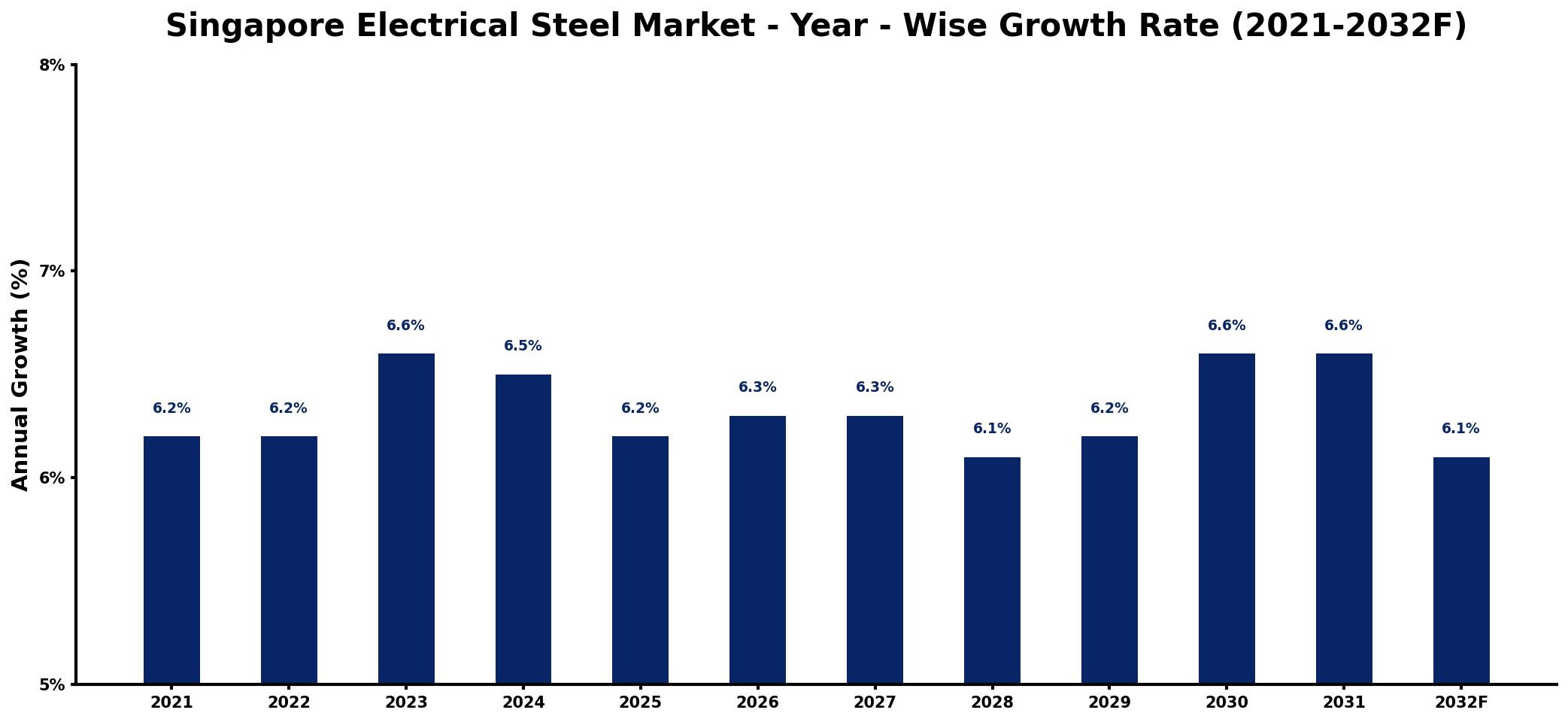
The table below presents the year‑wise growth rates along with the key drivers influencing the market
| Year | Growth Rate | Major Drivers |
| 2021 | 6.2% | Rising demand from automotive sector |
| 2022 | 6.2% | Increased investments in infrastructure projects |
| 2023 | 6.6% | Growth in renewable energy technologies |
| 2024 | 6.5% | Expansion of manufacturing capabilities |
| 2025 | 6.2% | Strong demand from consumer electronics |
| 2026 | 6.3% | Technological advancements in production |
| 2027 | 6.3% | Higher adoption of electric vehicles |
| 2028 | 6.1% | Growing industrial automation trends |
| 2029 | 6.2% | Surge in construction activities |
| 2030 | 6.6% | Increased focus on energy efficiency |
| 2031 | 6.6% | expanding manufacturing base activity |
| 2032 | 6.1% | increased domestic production output |
Note: Market size estimations and growth projections presented in this report are based on 6Wresearch's proprietary forecasting methodology, utilizing the latest available industry data, government publications, and primary research inputs.
Singapore Electrical Steel Market Synopsis
Recently, the Singapore electrical steel market has witnessed a revival, driven by advancements in power generation technologies and a robust focus on energy efficiency. As industries adapt to rapidly changing demands, the momentum indicates a promising future for electrical steel utilization across the electrical and power generation sectors.
Looking ahead, the market is poised for sustained growth, supported by the critical role electrical steel plays in transformers and electrical machinery. The trend towards sustainable energy solutions will continue to shape the landscape, establishing electrical steel as a key component in Singapore's energy transition.
Singapore Electrical Steel Market Key Takeaways
- The market is projected to grow steadily, reflecting increased reliance on efficient electrical components.
- Continuous advancements in magnetic properties are crucial for meeting industry standards.
- Efforts towards sustainability are driving heightened demand for electrical steel products.
- Investment in electrical infrastructure serves as a foundational driver of market growth.
- Manufacturers are prioritizing quality control to manage industry-specific challenges effectively.
Evaluation of Restraints in Singapore Electrical Steel Market
While the Singapore electrical steel market shows considerable promise, it faces specific restraints that could impact its trajectory. One significant challenge is the inconsistency in the magnetic properties of electrical steel, which can hinder manufacturers' ability to meet strict industry standards. Additionally, fluctuations in global demand and supply chain disruptions continue to pose risks, requiring manufacturers to adopt robust demand management strategies. Navigating these complexities effectively will be essential for sustained growth in the market.
Singapore Electrical Steel Market Trends
A notable trend shaping the Singapore electrical steel market is the growing emphasis on energy-efficient solutions in electrical applications. Innovations in electrical steel formulations are increasingly focused on reducing core losses, resulting in improved performance for transformers and motors. Moreover, as industries explore greener alternatives, the adoption of electrical steel in renewable energy applications, such as wind and solar, is gaining traction.
Singapore Electrical Steel Market Opportunities
The Singapore electrical steel market presents numerous growth opportunities, particularly in the renewable energy sector. As the nation intensifies its efforts towards sustainability, there is a rising need for high-performance electrical components that support cleaner energy generation. Additionally, investments in upgrading existing electrical infrastructure offer a lucrative avenue for electrical steel manufacturers, enhancing efficiency across various applications.
Government Initiatives in the Singapore Electrical Steel Market
The Singapore government has implemented several initiatives aimed at promoting energy efficiency and sustainability within the electrical sector. Public spending on infrastructure upgrades, alongside incentives for adopting green technologies, bolster demand for high-performance materials such as electrical steel. These policies not only drive market growth but also encourage innovation in production techniques, ensuring that Singapore remains at the forefront of electrical advancements.
Future Insights of the Singapore Electrical Steel Market
As we look forward to 2026-2032, the Singapore electrical steel market is expected to undergo significant transformation. The ongoing push towards renewable energy sources and smarter electrical systems will likely drive demand for advanced electrical steel products. Furthermore, with continuous investments in research and development, manufacturers will be better positioned to enhance the magnetic properties of their offerings, ensuring their competitiveness in an evolving marketplace.
Singapore Electrical Steel Market Latest Developments (2025 - 2026)
In recent months, the Singapore electrical steel market has seen a notable shift in product development, with companies focusing on enhancing the magnetic performance of their offerings. Additionally, efforts to streamline supply chains are being prioritized to address previous disruptions. The push for sustainability remains a central theme, with many players aligning their strategies to meet growing environmental standards.
Singapore Electrical Steel Market - Key Attractiveness of the Report
- 10 Years of Market Numbers
- Historical Data Starting from 2022 to 2025
- Base Year: 2025
- Forecast Data until 2032
- Key Performance Indicators Impacting the Market
- Major Upcoming Developments and Projects
Key Highlights of the Report:
- Singapore Electrical Steel Market Outlook
- Market Size of Singapore Electrical Steel Market, 2025
- Forecast of Singapore Electrical Steel Market, 2032
- Historical Data and Forecast of Singapore Electrical Steel Revenues & Volume for the Period 2022-2032F
- Singapore Electrical Steel Market Trend Evolution
- Singapore Electrical Steel Market Drivers and Challenges
- Singapore Electrical Steel Price Trends
- Singapore Electrical Steel Porter's Five Forces
- Singapore Electrical Steel Industry Life Cycle
- Historical Data and Forecast of Singapore Electrical Steel Market Revenues & Volume By Type for the Period 2022-2032F
- Historical Data and Forecast of Singapore Electrical Steel Market Revenues & Volume By Grain-oriented for the Period 2022-2032F
- Historical Data and Forecast of Singapore Electrical Steel Market Revenues & Volume By Non-grain-oriented for the Period 2022-2032F
- Historical Data and Forecast of Singapore Electrical Steel Market Revenues & Volume By End Use for the Period 2022-2032F
- Historical Data and Forecast of Singapore Electrical Steel Market Revenues & Volume By Energy for the Period 2022-2032F
- Historical Data and Forecast of Singapore Electrical Steel Market Revenues & Volume By Automotive for the Period 2022-2032F
- Historical Data and Forecast of Singapore Electrical Steel Market Revenues & Volume By Household Appliances for the Period 2022-2032F
- Historical Data and Forecast of Singapore Electrical Steel Market Revenues & Volume By Manufacturing for the Period 2022-2032F
- Historical Data and Forecast of Singapore Electrical Steel Market Revenues & Volume By Others for the Period 2022-2032F
- Historical Data and Forecast of Singapore Electrical Steel Market Revenues & Volume By Application for the Period 2022-2032F
- Historical Data and Forecast of Singapore Electrical Steel Market Revenues & Volume By Transformers for the Period 2022-2032F
- Historical Data and Forecast of Singapore Electrical Steel Market Revenues & Volume By Motors for the Period 2022-2032F
- Historical Data and Forecast of Singapore Electrical Steel Market Revenues & Volume By Inductors for the Period 2022-2032F
- Historical Data and Forecast of Singapore Electrical Steel Market Revenues & Volume By Others for the Period 2022-2032F
- Singapore Electrical Steel Import Export Trade Statistics
- Market Opportunity Assessment By Type
- Market Opportunity Assessment By End Use
- Market Opportunity Assessment By Application
- Singapore Electrical Steel Top Companies Market Share
- Singapore Electrical Steel Competitive Benchmarking By Technical and Operational Parameters
- Singapore Electrical Steel Company Profiles
- Singapore Electrical Steel Key Strategic Recommendations






































