Singapore Electrohydraulic Pumps Market Size, Share & Growth Rate
The Singapore Electrohydraulic Pumps Market was estimated at USD 818 Million in 2025 and is projected to reach USD 1190 Million by 2032, growing at a CAGR of 5.5% from 2026 to 2032. This upward trajectory is primarily driven by the increasing reliance on automation and advanced hydraulic systems in industries such as manufacturing, construction, and agriculture. As Singapore embraces technological advancements, the demand for energy-efficient and precisely controlled electrohydraulic pump solutions continues to gain momentum.
Singapore Electrohydraulic Pumps Market Year-wise Growth Rate and Key Drivers
This graph highlights how the Singapore Electrohydraulic Pumps Market has steadily grown over the years, supported by major growth factors.
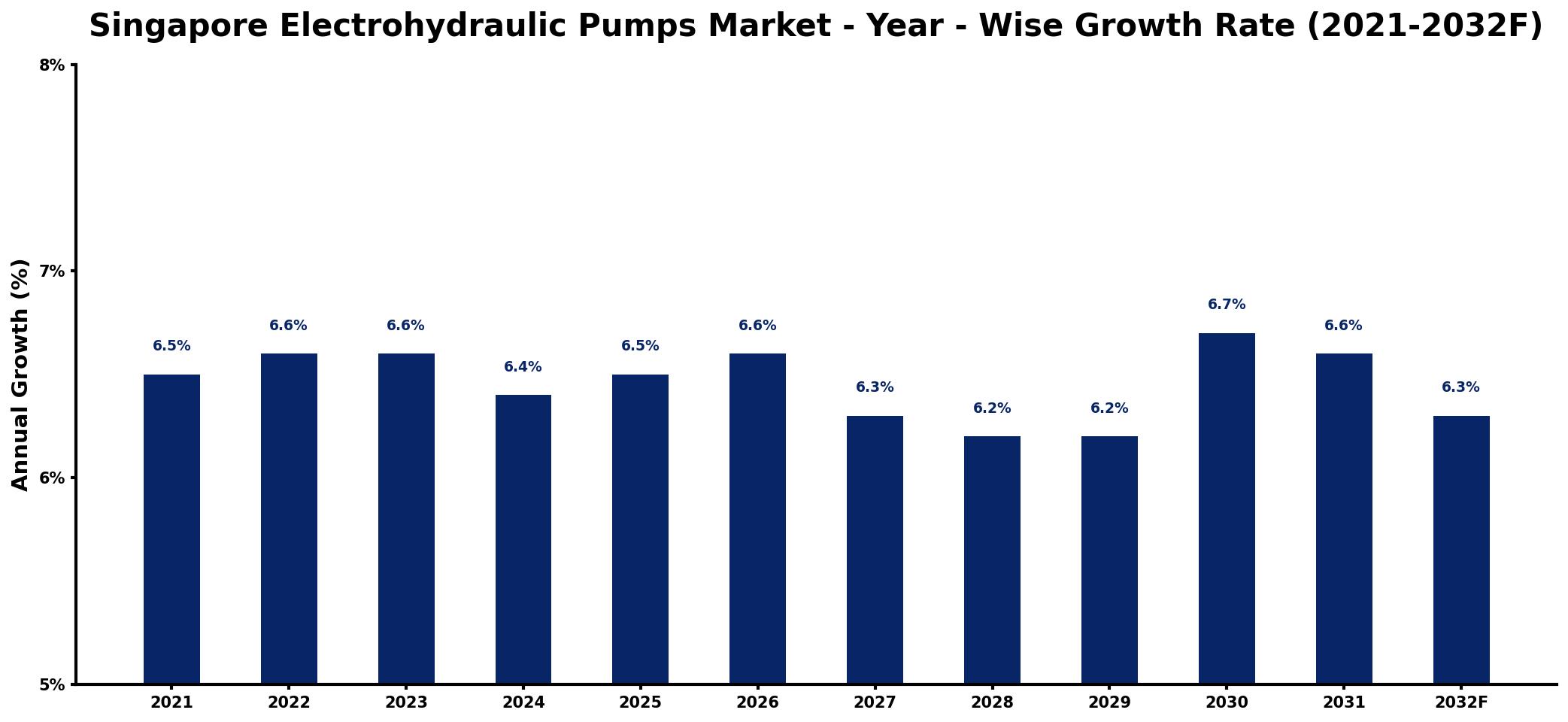
The table below presents the year‑wise growth rates along with the key drivers influencing the market
| Year | Growth Rate | Major Drivers |
| 2021 | 6.5% | Investment in renewable energy projects |
| 2022 | 6.6% | Growth in construction sector activities |
| 2023 | 6.6% | Increased automation in manufacturing |
| 2024 | 6.4% | Rising demand for hydraulic systems |
| 2025 | 6.5% | Expansion of offshore drilling operations |
| 2026 | 6.6% | Technological advancements in machinery |
| 2027 | 6.3% | Boost in infrastructure development projects |
| 2028 | 6.2% | Growing focus on energy efficiency |
| 2029 | 6.2% | Emergence of new industrial applications |
| 2030 | 6.7% | Surge in urbanization and development |
| 2031 | 6.6% | Strengthening of logistics and transport |
| 2032 | 6.3% | Rising investments in aerospace sector |
Note: Market size estimations and growth projections presented in this report are based on 6Wresearch's proprietary forecasting methodology, utilizing the latest available industry data, government publications, and primary research inputs.
Singapore Electrohydraulic Pumps Market Synopsis
The demand for electrohydraulic pumps in Singapore is significantly influenced by the robust growth of its industrial sectors, which require reliable hydraulic solutions for various applications. These pumps offer unparalleled precision and efficiency, ensuring optimal performance in equipment and machinery vital for construction and manufacturing operations.
Moreover, Singapores commitment to sustainability and energy conservation is further accelerating the adoption of electrohydraulic pump systems. With government incentives promoting advanced technology in industries, the market is ripe for innovation and modernization, paving the way for enhanced performance and reduced environmental impact.
Singapore Electrohydraulic Pumps Market Key Takeaways
- Strong growth trajectory fueled by the demand for automation across key industries.
- Government policies are significantly encouraging the adoption of energy-efficient hydraulic solutions.
- Technological advancements are playing a crucial role in enhancing the efficiency of electrohydraulic pumps.
- Manufacturers are focusing on R&D to overcome challenges related to precision and safety regulations.
- The post-pandemic era is witnessing renewed investments in upgrading hydraulic systems for improved productivity.
Evaluation of Restraints in Singapore Electrohydraulic Pumps Market
While the Singapore electrohydraulic pumps market shows promising growth, it is not without its limitations. The complexity involved in hydraulic systems demands ongoing investment in research and development to meet increasingly stringent efficiency and performance standards. Furthermore, international competition can pressure local manufacturers to adopt more cost-effective production methods, which may dilute quality. Compliance with evolving safety and environmental regulations also presents significant challenges, leading to increased operational costs that can restrain market growth.
Singapore Electrohydraulic Pumps Market Trends
Current trends indicate a rising focus on the integration of IoT technology into electrohydraulic systems, enabling real-time monitoring and enhanced automation capabilities. This technological evolution is driving demand for smarter, more responsive hydraulic solutions. Additionally, manufacturers are increasingly prioritizing sustainability, leading to the development of eco-friendly electrohydraulic pump systems designed to minimize energy consumption and reduce carbon footprints.
Singapore Electrohydraulic Pumps Market Opportunities
There exist substantial growth opportunities in the Singapore electrohydraulic pumps market, particularly for companies willing to invest in innovative technologies. The rising trend of smart manufacturing presents a chance to develop cutting-edge electrohydraulic systems that meet evolving industry demands. Additionally, with ongoing urbanization and infrastructure development projects in Singapore, the market for electrohydraulic pumps is expected to expand, opening new avenues for investment and collaboration.
Government Initiatives in the Singapore Electrohydraulic Pumps Market
The Singapore government has launched several initiatives aimed at fostering technology adoption and innovation within the electrohydraulic pumps market. Policies encouraging energy efficiency and sustainability play a crucial role in promoting advanced pump systems. Furthermore, public spending on infrastructure development projects provides a conducive environment for the growth of hydraulic solutions in various sectors, reinforcing the market's potential.
Future Insights of the Singapore Electrohydraulic Pumps Market
Looking ahead to 2026-2032, the Singapore electrohydraulic pumps market is expected to witness substantial transformation driven by continuous technological advancements. The integration of AI and IoT will likely redefine operational efficiencies, making hydraulic systems smarter and more adaptable. As businesses strive for enhanced productivity while adhering to sustainability goals, the market is set to evolve, promising lucrative opportunities for stakeholders invested in innovative solutions.
Singapore Electrohydraulic Pumps Market Latest Developments (2025 - 2026)
In recent months, the Singapore electrohydraulic pumps market has experienced a surge in interest from manufacturers keen on adopting advanced technologies. Developments include collaborations focused on integrating IoT and AI capabilities into pump systems, aimed at enhancing operational efficiency and reliability. Additionally, numerous industry events have highlighted the importance of sustainability in driving the future direction of hydraulic solutions, setting the stage for potential investments and partnerships.
Singapore Electrohydraulic Pumps Market - Key Attractiveness of the Report
- 10 Years of Market Numbers
- Historical Data Starting from 2022 to 2025
- Base Year: 2025
- Forecast Data until 2032
- Key Performance Indicators Impacting the Market
- Major Upcoming Developments and Projects
Key Highlights of the Report:
- Singapore Electrohydraulic Pumps Market Outlook
- Market Size of Singapore Electrohydraulic Pumps Market, 2025
- Forecast of Singapore Electrohydraulic Pumps Market, 2032
- Historical Data and Forecast of Singapore Electrohydraulic Pumps Revenues & Volume for the Period 2022-2032F
- Singapore Electrohydraulic Pumps Market Trend Evolution
- Singapore Electrohydraulic Pumps Market Drivers and Challenges
- Singapore Electrohydraulic Pumps Price Trends
- Singapore Electrohydraulic Pumps Porter's Five Forces
- Singapore Electrohydraulic Pumps Industry Life Cycle
- Historical Data and Forecast of Singapore Electrohydraulic Pumps Market Revenues & Volume By Type for the Period 2022-2032F
- Historical Data and Forecast of Singapore Electrohydraulic Pumps Market Revenues & Volume By Wound Field Motors for the Period 2022-2032F
- Historical Data and Forecast of Singapore Electrohydraulic Pumps Market Revenues & Volume By Permanent Magnet Motors for the Period 2022-2032F
- Historical Data and Forecast of Singapore Electrohydraulic Pumps Market Revenues & Volume By End User for the Period 2022-2032F
- Historical Data and Forecast of Singapore Electrohydraulic Pumps Market Revenues & Volume By Electric power steering for the Period 2022-2032F
- Historical Data and Forecast of Singapore Electrohydraulic Pumps Market Revenues & Volume By Electro-Hydraulic system and circuits. for the Period 2022-2032F
- Historical Data and Forecast of Singapore Electrohydraulic Pumps Market Revenues & Volume By Application for the Period 2022-2032F
- Historical Data and Forecast of Singapore Electrohydraulic Pumps Market Revenues & Volume By Buses and coaches and Vocational vehicles for the Period 2022-2032F
- Historical Data and Forecast of Singapore Electrohydraulic Pumps Market Revenues & Volume By Construction for the Period 2022-2032F
- Historical Data and Forecast of Singapore Electrohydraulic Pumps Market Revenues & Volume By Agricultural equipment for the Period 2022-2032F
- Singapore Electrohydraulic Pumps Import Export Trade Statistics
- Market Opportunity Assessment By Type
- Market Opportunity Assessment By End User
- Market Opportunity Assessment By Application
- Singapore Electrohydraulic Pumps Top Companies Market Share
- Singapore Electrohydraulic Pumps Competitive Benchmarking By Technical and Operational Parameters
- Singapore Electrohydraulic Pumps Company Profiles
- Singapore Electrohydraulic Pumps Key Strategic Recommendations






































