Singapore Enterprise Application Integration Market Size & Growth Rate (2026-2032)
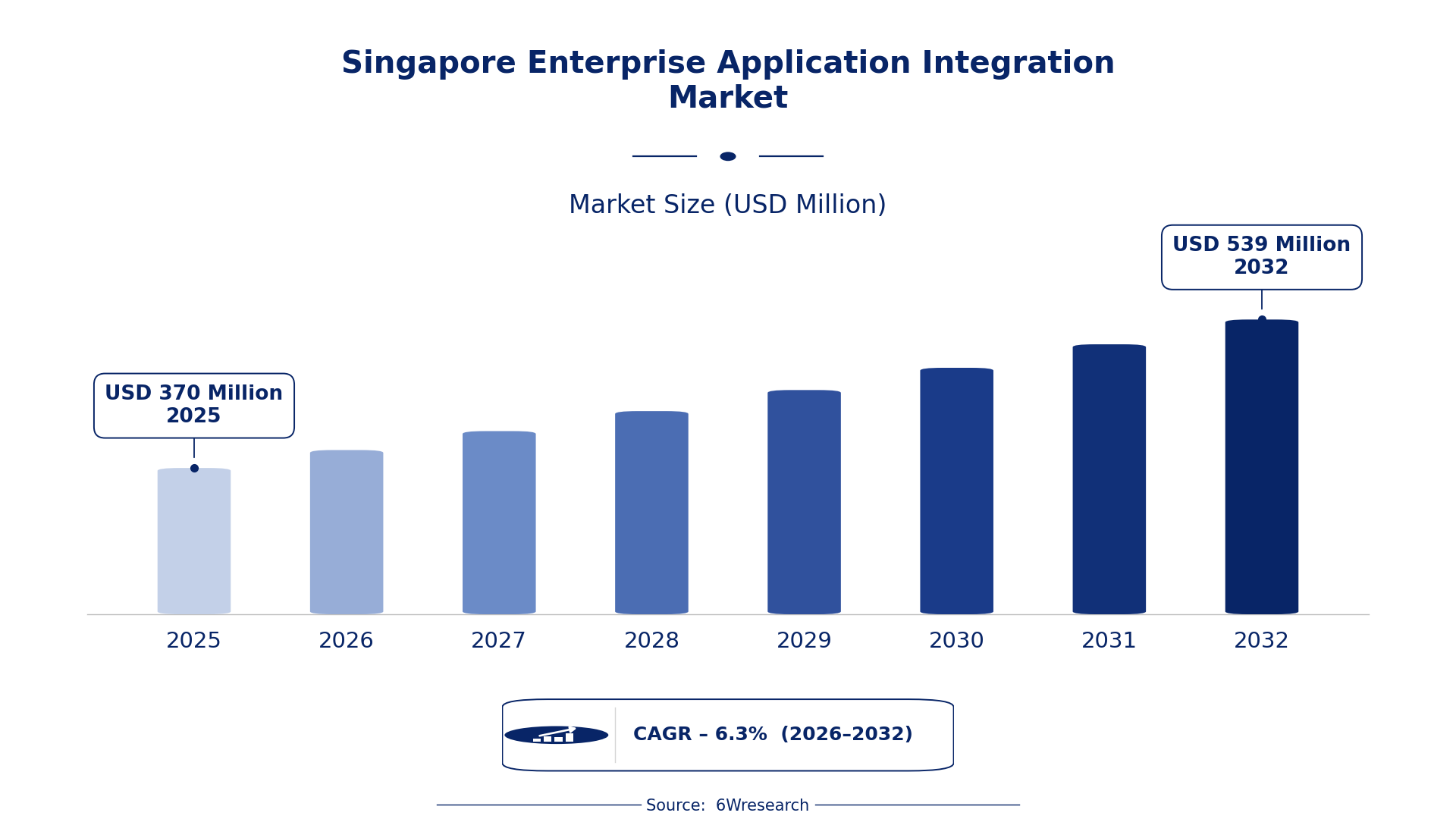
The Singapore Enterprise Application Integration Market was estimated at USD 370 Million in 2025 and is projected to reach USD 539 Million by 2032, growing at a CAGR of 6.3% from 2026 to 2032.
Singapore Enterprise Application Integration Market Synopsis
The primary force driving the Singapore Enterprise Application Integration market is the increasing demand for streamlined operations across various industries. Organizations in Singapore are adopting numerous software applications, leading to a pressing need for integration solutions that can connect these disparate systems efficiently.
As businesses strive to enhance productivity and customer experiences, enterprise application integration is becoming a necessity rather than a luxury. The market is evolving to provide a range of integration tools and platforms that empower organizations to tailor solutions to their unique needs, ensuring data flows unimpeded across all levels of operation.
Singapore Enterprise Application Integration Market Year-wise Growth Rate and Key Drivers
This graph illustrates the annual growth rates of the Singapore Enterprise Application Integration Market from 2021 to 2032, highlighting a steady upward trajectory and projected expansion over the forecast period.
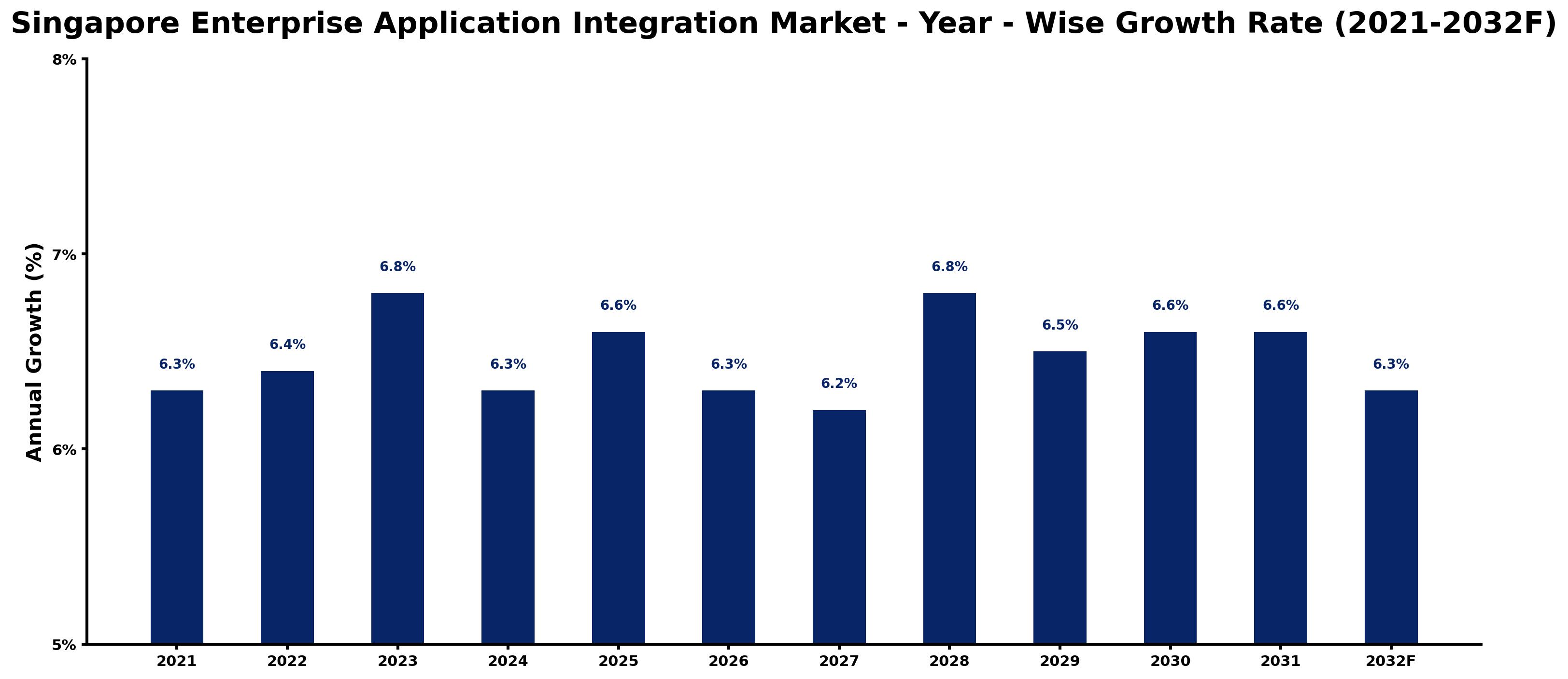
The table below presents the year‑wise growth rates along with the key drivers influencing the market
| Year | Growth Rate | Major Drivers |
| 2021 | 6.3% | Launch of Smart Nation initiative driving integration of services. |
| 2022 | 6.4% | Increased cloud adoption amongst SMEs fueling integration demands. |
| 2023 | 6.8% | Regulatory emphasis on data sovereignty boosts integration solutions. |
| 2024 | 6.3% | Growing enterprise focus on AI integration and analytics. |
| 2025 | 6.6% | Financial sector's digitalization leading to API integration needs. |
| 2026 | 6.3% | Emergence of FinTech startups increasing integration service requirements. |
| 2027 | 6.2% | Local push for sustainability driving integrated enterprise operations. |
| 2028 | 6.8% | Government's Digital Economy Strategy enhancing integration projects. |
| 2029 | 6.5% | Healthcare digital initiatives stimulate demand for integration solutions. |
| 2030 | 6.6% | Rising use of IoT applications necessitating robust integrations. |
| 2031 | 6.6% | Strong local tech ecosystem promoting enterprise collaboration needs. |
| 2032 | 6.3% | Demand for efficiency in logistics driving integration solutions. |
Note: Market size estimations and growth projections presented in this report are based on 6Wresearch's proprietary forecasting methodology, utilizing the latest available industry data, government publications, and primary research inputs.
Singapore Enterprise Application Integration Market Key Takeaways
Below are some of the specific key takeaways from the market, including:
- The market is driven by the need for operational efficiency and data exchange between various applications.
- Integration solutions are essential for supporting real-time data synchronization and automation.
- Data security and governance remain critical challenges within the market.
- Key players are focusing on innovative technologies to enhance their integration offerings.
- Government initiatives are actively promoting digital transformation across sectors.
Evaluation of Restraints in Singapore Enterprise Application Integration Market
Despite the growth potential, several restraints are impacting the Singapore Enterprise Application Integration market. The primary challenge lies in the complexity of integrating diverse systems and technologies, which can complicate data exchange. Additionally, businesses are increasingly concerned about data security and privacy, particularly when sensitive information is involved. The demand for real-time data synchronization adds another layer of difficulty, as organizations must ensure that updates are promptly reflected across all applications. Ongoing changes in technology and business processes further necessitate flexible integration solutions, creating a pressing need for robust management of integration initiatives.
Singapore Enterprise Application Integration Market Trends
Several trends are shaping the Singapore Enterprise Application Integration market. The rise of cloud-based integration solutions is prominent, offering scalability and flexibility for businesses of all sizes. Additionally, there is a growing interest in API management as organizations prioritize the development of APIs for better connectivity. The shift towards automation and AI integration is also gaining momentum, enabling companies to enhance their operational efficiency. on top of that, the focus on data-driven decision-making continues to drive demand for integration solutions that facilitate real-time data access and insights.
Singapore Enterprise Application Integration Market Opportunities
Opportunities abound in the Singapore Enterprise Application Integration market, particularly as businesses look to modernize their operations. The increasing reliance on hybrid cloud environments presents a significant chance for integration service providers to offer tailored solutions. on top of that, sectors such as healthcare and finance are under pressure to adopt integration technologies to improve service delivery and customer engagement. As companies continue to prioritize digital transformation, the demand for robust integration capabilities is expected to rise, making this an opportune time for investment and innovation.
Government Initiatives in the Singapore Enterprise Application Integration Market
The Singapore government is actively shaping the Enterprise Application Integration market through various initiatives aimed at enhancing digital infrastructure and promoting technology adoption. These efforts reflect a strategic focus on fostering innovation and improving operational efficiencies across sectors. The regulatory environment is supportive, encouraging organizations to integrate new technologies and streamline their processes, which is crucial in a highly competitive economy.
- A national digital infrastructure upgrade programme completed in late 2025 aimed at enhancing connectivity across industries.
- Current initiatives include a public-private partnership focused on developing cloud computing capabilities, which is expected to expand by 2026.
- A recently launched policy framework emphasizes data security protocols for integration projects, ensuring compliance with local regulations.
- Plans for an upcoming initiative to support small and medium-sized enterprises in adopting integration technologies are set to roll out by 2027.
Future Insights of the Singapore Enterprise Application Integration Market
Looking ahead to 2026-2032, the Singapore Enterprise Application Integration market is expected to witness significant evolution driven by technological advancements and the need for greater operational agility. Businesses will increasingly demand solutions that not only integrate applications but also provide analytical capabilities to harness data insights effectively. The shift towards more automated processes and AI-driven integration will further enhance operational efficiencies. With ongoing government support and a growing emphasis on digital transformation, the market's trajectory appears promising.
Singapore Enterprise Application Integration Market Latest Developments
In the past year, the Singapore Enterprise Application Integration market has seen a flurry of activity, characterized by advancements in technology and increased investment in integration solutions. Companies are actively seeking ways to enhance their integration capabilities, reflecting a broader trend towards digital transformation across sectors.
- A major technology vendor launched a next-generation API management platform in Q1 2025, enabling organizations to manage integrations more efficiently.
- An ongoing project focused on creating a centralized integration hub for public sector applications began in early 2025 and remains underway.
- In late 2025, a regional operator announced a strategic partnership to develop integration solutions tailored for the finance sector.
- Upcoming in 2026, a significant rollout of a new integration framework is expected to enhance interoperability among various enterprise applications.
Singapore Enterprise Application Integration Market - Key Attractiveness of the Report
- 10 Years of Market Numbers
- Historical Data Starting from 2022 to 2025
- Base Year: 2025
- Forecast Data until 2032
- Key Performance Indicators Impacting the Market
- Major Upcoming Developments and Projects
Key Highlights of the Report:
- Singapore Enterprise Application Integration Market Outlook
- Market Size of Singapore Enterprise Application Integration Market, 2025
- Forecast of Singapore Enterprise Application Integration Market, 2032
- Historical Data and Forecast of Singapore Enterprise Application Integration Revenues & Volume for the Period 2022-2032F
- Singapore Enterprise Application Integration Market Trend Evolution
- Singapore Enterprise Application Integration Market Drivers and Challenges
- Singapore Enterprise Application Integration Price Trends
- Singapore Enterprise Application Integration Porter's Five Forces
- Singapore Enterprise Application Integration Industry Life Cycle
- Historical Data and Forecast of Singapore Enterprise Application Integration Market Revenues & Volume By Deployment type for the Period 2022-2032F
- Historical Data and Forecast of Singapore Enterprise Application Integration Market Revenues & Volume By Hosted for the Period 2022-2032F
- Historical Data and Forecast of Singapore Enterprise Application Integration Market Revenues & Volume By On-Premise for the Period 2022-2032F
- Historical Data and Forecast of Singapore Enterprise Application Integration Market Revenues & Volume By Hybrid for the Period 2022-2032F
- Historical Data and Forecast of Singapore Enterprise Application Integration Market Revenues & Volume By Organization size for the Period 2022-2032F
- Historical Data and Forecast of Singapore Enterprise Application Integration Market Revenues & Volume By Small for the Period 2022-2032F
- Historical Data and Forecast of Singapore Enterprise Application Integration Market Revenues & Volume By Medium for the Period 2022-2032F
- Historical Data and Forecast of Singapore Enterprise Application Integration Market Revenues & Volume By Enterprises for the Period 2022-2032F
- Historical Data and Forecast of Singapore Enterprise Application Integration Market Revenues & Volume By Large Enterprises for the Period 2022-2032F
- Historical Data and Forecast of Singapore Enterprise Application Integration Market Revenues & Volume By Industry Vertical for the Period 2022-2032F
- Historical Data and Forecast of Singapore Enterprise Application Integration Market Revenues & Volume By Banking, financial services and insurance(BFSI) for the Period 2022-2032F
- Historical Data and Forecast of Singapore Enterprise Application Integration Market Revenues & Volume By Business services for the Period 2022-2032F
- Historical Data and Forecast of Singapore Enterprise Application Integration Market Revenues & Volume By IT and telecom for the Period 2022-2032F
- Historical Data and Forecast of Singapore Enterprise Application Integration Market Revenues & Volume By Manufacturing for the Period 2022-2032F
- Historical Data and Forecast of Singapore Enterprise Application Integration Market Revenues & Volume By Retail and wholesale for the Period 2022-2032F
- Historical Data and Forecast of Singapore Enterprise Application Integration Market Revenues & Volume By Healthcare for the Period 2022-2032F
- Historical Data and Forecast of Singapore Enterprise Application Integration Market Revenues & Volume By Government for the Period 2022-2032F
- Historical Data and Forecast of Singapore Enterprise Application Integration Market Revenues & Volume By Other verticals( education, entertainment and media, power and utilities) for the Period 2022-2032F
- Singapore Enterprise Application Integration Import Export Trade Statistics
- Market Opportunity Assessment By Deployment type
- Market Opportunity Assessment By Organization size
- Market Opportunity Assessment By Industry Vertical
- Singapore Enterprise Application Integration Top Companies Market Share
- Singapore Enterprise Application Integration Competitive Benchmarking By Technical and Operational Parameters
- Singapore Enterprise Application Integration Company Profiles
- Singapore Enterprise Application Integration Key Strategic Recommendations






































