Singapore Faucets, Mixers & Taps Market Summary
The singapore faucets, mixers & taps market was estimated at USD 195 Million in 2025 and is projected to reach USD 263 Million by 2032, growing at a CAGR of 5.2% from 2026 to 2032.
Singapore Faucets, Mixers & Taps Market Year-wise Growth Rate and Key Drivers
This graph highlights how the Singapore Faucets, Mixers & Taps Market has steadily grown over the past five years, supported by major growth factors.
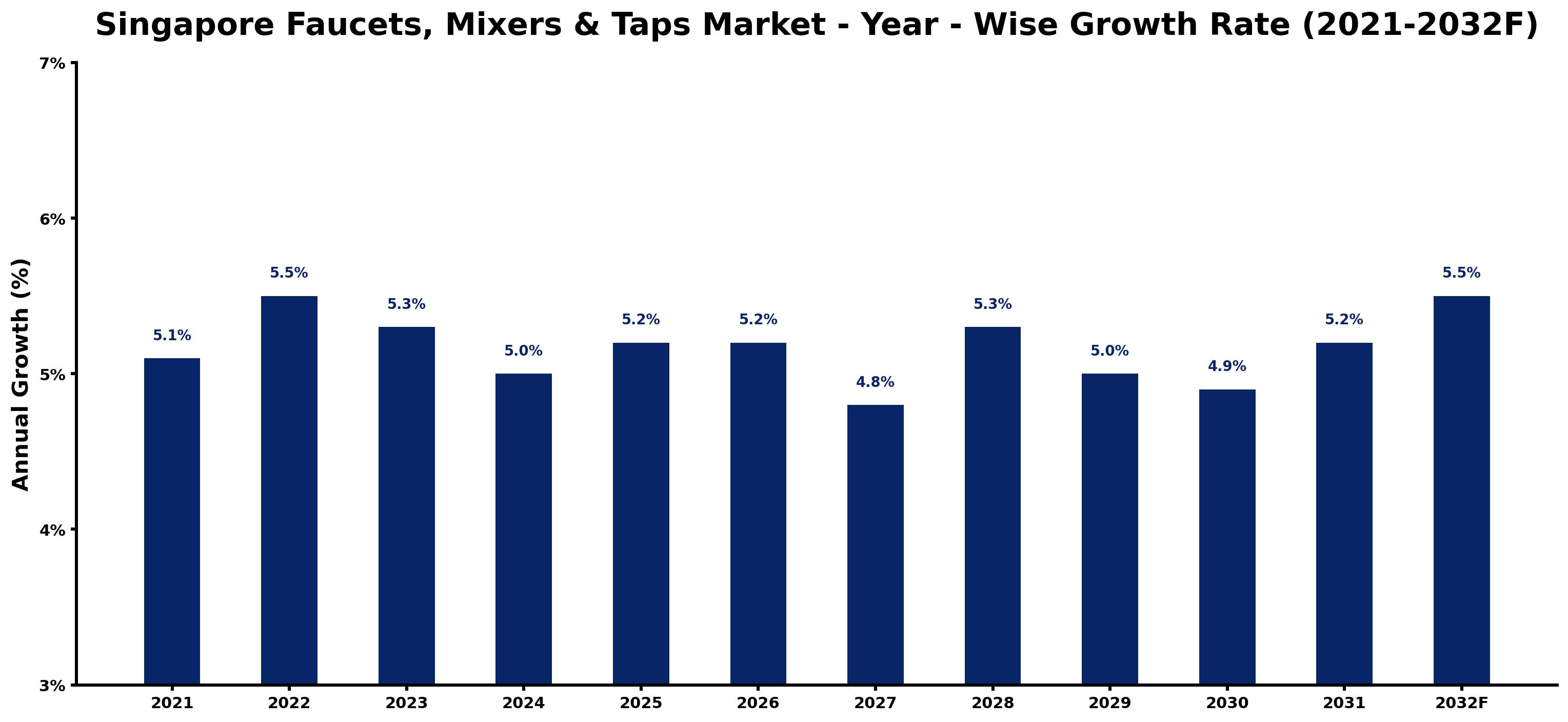
The table below presents the year wise growth rates along with the key drivers influencing the market
| Year | Growth Rate | Major Drivers |
| 2021 | 5.1% | Post-lockdown retail projects expanded the need for modern home fixtures and fittings. |
| 2022 | 5.5% | Increased urbanization pushed developers to prioritize high-quality plumbing solutions in projects. |
| 2023 | 5.3% | Home renovation trends encouraged consumers to invest in stylish and functional faucets. |
| 2024 | 5.0% | Sustainability concerns prompted the introduction of water-efficient products across the market. |
| 2025 | 5.2% | Technological innovations in smart home systems integrated advanced tap functionalities seamlessly. |
| 2026 | 5.2% | Rising disposable incomes allowed households to spend more on premium home essentials. |
| 2027 | 4.8% | Focus on health and hygiene led to enhanced interest in touchless faucet technologies. |
| 2028 | 5.3% | The construction sector's robust growth stimulated demand for diverse mixer designs. |
| 2029 | 5.0% | Emerging interior design trends increasingly highlighted the importance of elegant tap aesthetics. |
| 2030 | 4.9% | Local manufacturers adapted quickly to evolving consumer preferences for customizable products. |
| 2031 | 5.2% | Economic recovery post-pandemic fostered renewed investments in residential and commercial properties. |
| 2032 | 5.5% | Continuous enhancements in online retail platforms made faucet shopping more accessible than ever. |
Note - Market size estimations and growth projections presented in this report are based on 6Wresearch's advanced forecasting approach, validated with industry datasets as of June 2026.
Singapore Faucets, Mixers & Taps Market Synopsis
The Singapore Faucets, Mixers Taps Market is projected to reach 5.2% and witness significant growth during the forecast period (2026-2032). This projected growth is primarily driven by increasing construction activities across both residential and commercial sectors. Furthermore, the rise in disposable income among residents of Singapore is incentivizing greater investment in premium plumbing fixtures, including faucets, mixers, and taps. Innovations within the market, particularly with the introduction of touchless technology and voice-activated systems, are enhancing user experience and driving the demand for these products.
Singapore Faucets, Mixers & Taps Market Growth Drivers
The growth of the Singapore Faucets, Mixers & Taps Market can be attributed to several key factors:
- Increased Infrastructure Development: The Singaporean government is heavily investing in infrastructure development, resulting in a surge in demand for plumbing fixtures. This trend is expected to continue as urbanization efforts progress.
- Rising Disposable Income: As disposable incomes rise, consumers are more inclined to purchase higher-end plumbing fixtures. This shift towards luxury products is becoming a defining characteristic of the market.
- Focus on Hygiene and Quality: The COVID-19 pandemic has heightened public awareness regarding hygiene standards. This has led to increased emphasis on quality plumbing solutions that not only deliver on functionality but also enhance sanitary practices.
- Technological Innovations: The market has seen significant advancements with features such as touchless operation and smart technology, which cater to modern consumers' demands for convenience and efficiency.
- Aesthetic Appeal: Consumers are increasingly drawn to faucets, mixers, and taps that boast not only functionality but also visual appeal, leading to an uptick in demand for uniquely designed fixtures.
Singapore Faucets, Mixers & Taps Market Challenges and Restraints
Despite the promising trajectory of the Singapore Faucets, Mixers & Taps Market, several challenges could impede growth:
- High Manufacturing Costs: The rise in production costs, driven by innovative product development, poses challenges for manufacturers. These costs can impact pricing strategies and overall profitability.
- Limited Distribution Channels: The presence of fragmented distribution channels can complicate logistics and create difficulties in providing timely delivery and after-sales support to consumers.
- Market Competition: The Singapore market is witnessing an influx of new entrants, which intensifies competition. Established brands must continually innovate to maintain their market share.
- Regulatory Constraints: Compliance with local regulations and standards for plumbing fixtures can add layers of complexity and cost to manufacturers, potentially slowing down growth.
- Consumer Awareness: While there is a growing interest in high-tech features, a segment of the population remains unaware of innovations and their benefits, limiting market penetration.
Singapore Faucets, Mixers & Taps Market Government Investment and Initiatives
The Singapore government continues to play a pivotal role in boosting the faucets, mixers, and taps market through several initiatives aimed at enhancing infrastructure. Significant public spending on urban development projects is expected to create a robust demand for plumbing fixtures. Government policies focusing on sustainability and eco-friendly practices are encouraging manufacturers to innovate and adapt to such standards. Additionally, initiatives aimed at improving public housing and commercial buildings are likely to further elevate the demand for quality plumbing fixtures, thereby facilitating growth in the sector.
Singapore Faucets, Mixers & Taps Market Latest Developments (May 2025 - June 2026)
Recent months have seen a series of developments in the Singapore Faucets, Mixers & Taps Market that underscore a shift in consumer preferences and industry focus. Manufacturers are increasingly incorporating smart technologies in their offerings, with touchless and voice-controlled features gaining popularity among consumers looking for convenience and hygiene. Additionally, sustainability has emerged as a priority, with several firms adopting eco-friendly materials and water-saving technologies. The competitive landscape is evolving, as both established companies and new entrants are expanding their product portfolios to cater to a more discerning consumer base. Moreover, partnerships between local firms and international technology providers are fostering innovation and enhancing product offerings in the market.
Singapore Faucets, Mixers & Taps Market - Key Attractiveness of the Report
- 10 Years of Market Numbers
- Historical Data Starting from 2022 to 2025
- Base Year: 2025
- Forecast Data until 2032
- Key Performance Indicators Impacting the Market
- Major Upcoming Developments and Projects
Key Highlights of the Report:
- Singapore Faucets, Mixers & Taps Market Outlook
- Market Size of Singapore Faucets, Mixers & Taps Market, 2025
- Forecast of Singapore Faucets, Mixers & Taps Market, 2032F
- Historical Data and Forecast of Singapore Faucets, Mixers & Taps Revenues & Volume for the Period 2022-2032F
- Singapore Faucets, Mixers & Taps Market Trend Evolution
- Singapore Faucets, Mixers & Taps Market Drivers and Challenges
- Singapore Faucets, Mixers & Taps Price Trends
- Singapore Faucets, Mixers & Taps Porter's Five Forces
- Singapore Faucets, Mixers & Taps Industry Life Cycle
- Historical Data and Forecast of Singapore Faucets, Mixers & Taps Market Revenues & Volume By Technology for the Period 2022-2032F
- Historical Data and Forecast of Singapore Faucets, Mixers & Taps Market Revenues & Volume By Sensor for the Period 2022-2032F
- Historical Data and Forecast of Singapore Faucets, Mixers & Taps Market Revenues & Volume By Non-Sensor for the Period 2022-2032F
- Historical Data and Forecast of Singapore Faucets, Mixers & Taps Market Revenues & Volume By Product Type for the Period 2022-2032F
- Historical Data and Forecast of Singapore Faucets, Mixers & Taps Market Revenues & Volume By One-hand mixer for the Period 2022-2032F
- Historical Data and Forecast of Singapore Faucets, Mixers & Taps Market Revenues & Volume By Two-hand mixer for the Period 2022-2032F
- Historical Data and Forecast of Singapore Faucets, Mixers & Taps Market Revenues & Volume By Others for the Period 2022-2032F
- Historical Data and Forecast of Singapore Faucets, Mixers & Taps Market Revenues & Volume By End-Users for the Period 2022-2032F
- Historical Data and Forecast of Singapore Faucets, Mixers & Taps Market Revenues & Volume By Residential for the Period 2022-2032F
- Historical Data and Forecast of Singapore Faucets, Mixers & Taps Market Revenues & Volume By Commercial for the Period 2022-2032F
- Historical Data and Forecast of Singapore Faucets, Mixers & Taps Market Revenues & Volume By Industrial for the Period 2022-2032F
- Historical Data and Forecast of Singapore Faucets, Mixers & Taps Market Revenues & Volume By Applications for the Period 2022-2032F
- Historical Data and Forecast of Singapore Faucets, Mixers & Taps Market Revenues & Volume By Bathroom Faucets for the Period 2022-2032F
- Historical Data and Forecast of Singapore Faucets, Mixers & Taps Market Revenues & Volume By Kitchen Faucets for the Period 2022-2032F
- Singapore Faucets, Mixers & Taps Import Export Trade Statistics
- Market Opportunity Assessment By Technology
- Market Opportunity Assessment By Product Type
- Market Opportunity Assessment By End-Users
- Market Opportunity Assessment By Applications
- Singapore Faucets, Mixers & Taps Top Companies Market Share
- Singapore Faucets, Mixers & Taps Competitive Benchmarking By Technical and Operational Parameters
- Singapore Faucets, Mixers & Taps Company Profiles
- Singapore Faucets, Mixers & Taps Key Strategic Recommendations






































