Singapore Film Dubbing Market Size, Share & Growth Rate
The Singapore Film Dubbing Market was estimated at USD 165 Million in 2025 and is projected to reach USD 215 Million by 2032, growing at a CAGR of 3.9% from 2026 to 2032. This growth trajectory is driven by the increasing demand for localized content across various media platforms, reflecting the countrys diverse linguistic landscape. As entertainment production ramps up and the audience becomes more multicultural, the necessity for high-quality dubbing services will play an essential role in enhancing accessibility to entertainment.
Singapore Film Dubbing Market Year-wise Growth Rate and Key Drivers
This graph highlights how the Singapore Film Dubbing Market has steadily grown over the years, supported by major growth factors.
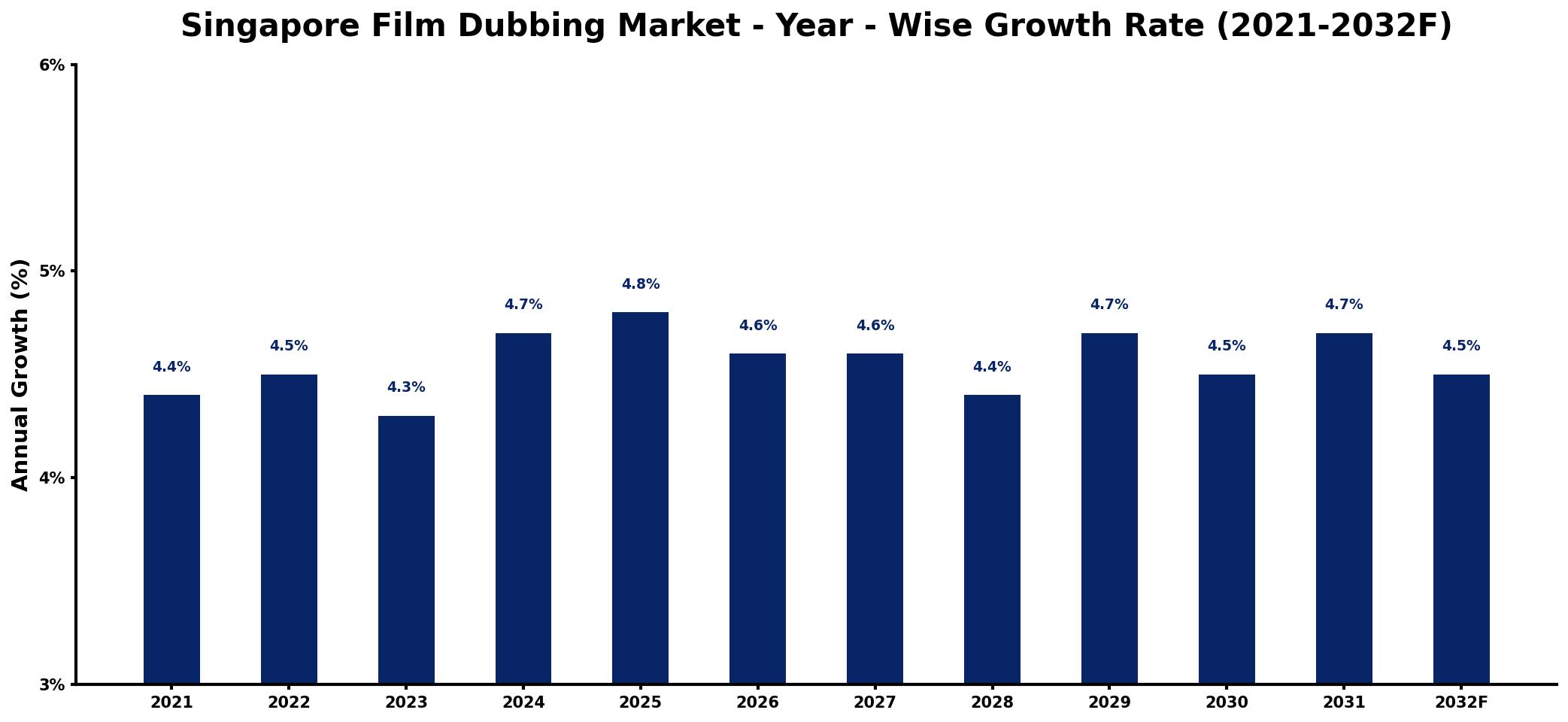
The table below presents the year‑wise growth rates along with the key drivers influencing the market
| Year | Growth Rate | Major Drivers |
| 2021 | 4.4% | Increased demand for localization services |
| 2022 | 4.5% | Growing popularity of international content |
| 2023 | 4.3% | Expansion of streaming platforms offerings |
| 2024 | 4.7% | Rising investment in content production |
| 2025 | 4.8% | Enhanced consumer engagement strategies |
| 2026 | 4.6% | Adoption of advanced audio technologies |
| 2027 | 4.6% | Improved collaboration across creative sectors |
| 2028 | 4.4% | Diversification of entertainment distribution channels |
| 2029 | 4.7% | Strengthened partnerships with global studios |
| 2030 | 4.5% | Emerging trends in multilingual content |
| 2031 | 4.7% | Heightened interest in niche genres |
| 2032 | 4.5% | rising infrastructure development spending |
Note: Market size estimations and growth projections presented in this report are based on 6Wresearch's proprietary forecasting methodology, utilizing the latest available industry data, government publications, and primary research inputs.
Singapore Film Dubbing Market Synopsis
Recently, the Singapore film dubbing market has experienced fluctuations due to the COVID-19 pandemic, which disrupted cinema activities and reduced demand for dubbing services. However, with the resumption of entertainment production, the market is positioning itself for a robust recovery and growth as localization becomes a priority for content creators aiming to engage a wider audience.
The dubbing sector is essential in bridging cultural gaps, ensuring that films and shows resonate with Singapores multicultural population. As the media landscape continues to evolve with technology, the demand for professional dubbing services is expected to flourish, reinforcing the market's stability and growth potential.
Singapore Film Dubbing Market Key Takeaways
- The market is integral to the entertainment sector, facilitating access to content through language translation.
- High-quality dubbing services are essential to meet the diverse linguistic preferences of Singapore's population.
- Growth opportunities lie in enhancing technological capabilities and investing in local talent.
- The market is adapting to post-pandemic dynamics, focusing on multilingual dubbing solutions.
- Increased collaboration between content creators and dubbing studios is fostering innovation in service delivery.
Evaluation of Restraints in Singapore Film Dubbing Market
Despite its growth potential, the Singapore film dubbing market faces significant challenges. The multicultural and multilingual environment necessitates that dubbing studios maintain high standards across various languages while ensuring synchronization with original content. Moreover, studios must navigate the varied linguistic preferences and cultural nuances, which can complicate the localization process. Addressing these challenges requires continuous investment in skilled talent and technology, as well as a keen understanding of the audience's needs.
Singapore Film Dubbing Market Trends
Several trends are shaping the Singapore film dubbing market. First, the rise of digital streaming platforms is increasing demand for localized content, prompting studios to expand their dubbing capabilities. Additionally, advancements in artificial intelligence and machine learning are streamlining the dubbing process, enhancing both efficiency and quality. Furthermore, an emphasis on diversity and representation in media is pushing studios to engage voice talents from various backgrounds, reflecting Singapores rich cultural tapestry.
Singapore Film Dubbing Market Opportunities
Significant growth opportunities exist in developing specialized dubbing services tailored to niche markets, including childrens content and educational programs. Investing in state-of-the-art technology to improve production quality will also differentiate services within a competitive landscape. Moreover, fostering partnerships with international studios can enhance capabilities and open avenues for larger projects, effectively positioning local dubbing studios on the global stage.
Government Initiatives in the Singapore Film Dubbing Market
The Singaporean government is keen on promoting the local film and media industry, initiating programs that support content creation and localization. By providing funding and grants for creative projects, there is an encouragement of homegrown talent and industry growth. Additionally, policies aimed at enhancing the media ecosystem and fostering international collaborations further bolster the market for film dubbing, creating a conducive environment for growth.
Future Insights of the Singapore Film Dubbing Market
Looking ahead to 2026-2032, the Singapore film dubbing market is expected to experience sustained growth driven by the continued expansion of digital platforms and demand for culturally relevant content. As more companies recognize the importance of localization, the role of dubbing will become increasingly pivotal. Innovations in technology and shifts in audience preferences will further shape the landscape, positioning the market for dynamic changes and opportunities.
Singapore Film Dubbing Market Latest Developments (2025 - 2026)
In the recent period, the Singapore film dubbing market has seen a resurgence as production schedules normalize following pandemic disruptions. Studios are increasingly focusing on developing multilingual dubbing options to cater to a wider audience, reflecting the country's multicultural identity. Collaborations between various media outlets and dubbing studios are becoming more prevalent, paving the way for innovative solutions that enhance production efficiency and service quality.
Singapore Film Dubbing Market - Key Attractiveness of the Report
- 10 Years of Market Numbers
- Historical Data Starting from 2022 to 2025
- Base Year: 2025
- Forecast Data until 2032
- Key Performance Indicators Impacting the Market
- Major Upcoming Developments and Projects
Key Highlights of the Report:
- Singapore Film Dubbing Market Outlook
- Market Size of Singapore Film Dubbing Market, 2025
- Forecast of Singapore Film Dubbing Market, 2032
- Historical Data and Forecast of Singapore Film Dubbing Revenues & Volume for the Period 2022-2032F
- Singapore Film Dubbing Market Trend Evolution
- Singapore Film Dubbing Market Drivers and Challenges
- Singapore Film Dubbing Price Trends
- Singapore Film Dubbing Porter's Five Forces
- Singapore Film Dubbing Industry Life Cycle
- Historical Data and Forecast of Singapore Film Dubbing Market Revenues & Volume By Type for the Period 2022-2032F
- Historical Data and Forecast of Singapore Film Dubbing Market Revenues & Volume By Native Language Dubbing for the Period 2022-2032F
- Historical Data and Forecast of Singapore Film Dubbing Market Revenues & Volume By Foreign Language Dubbing for the Period 2022-2032F
- Historical Data and Forecast of Singapore Film Dubbing Market Revenues & Volume By Minority Language Dubbing for the Period 2022-2032F
- Historical Data and Forecast of Singapore Film Dubbing Market Revenues & Volume By Special Language Dubbing for the Period 2022-2032F
- Historical Data and Forecast of Singapore Film Dubbing Market Revenues & Volume By Application for the Period 2022-2032F
- Historical Data and Forecast of Singapore Film Dubbing Market Revenues & Volume By Drama for the Period 2022-2032F
- Historical Data and Forecast of Singapore Film Dubbing Market Revenues & Volume By Comedy for the Period 2022-2032F
- Historical Data and Forecast of Singapore Film Dubbing Market Revenues & Volume By Horror Movie for the Period 2022-2032F
- Historical Data and Forecast of Singapore Film Dubbing Market Revenues & Volume By Romance for the Period 2022-2032F
- Historical Data and Forecast of Singapore Film Dubbing Market Revenues & Volume By Action Movie for the Period 2022-2032F
- Historical Data and Forecast of Singapore Film Dubbing Market Revenues & Volume By Other for the Period 2022-2032F
- Singapore Film Dubbing Import Export Trade Statistics
- Market Opportunity Assessment By Type
- Market Opportunity Assessment By Application
- Singapore Film Dubbing Top Companies Market Share
- Singapore Film Dubbing Competitive Benchmarking By Technical and Operational Parameters
- Singapore Film Dubbing Company Profiles
- Singapore Film Dubbing Key Strategic Recommendations






































