Singapore Financial Analytics Market Size & Growth Rate (2026-2032)
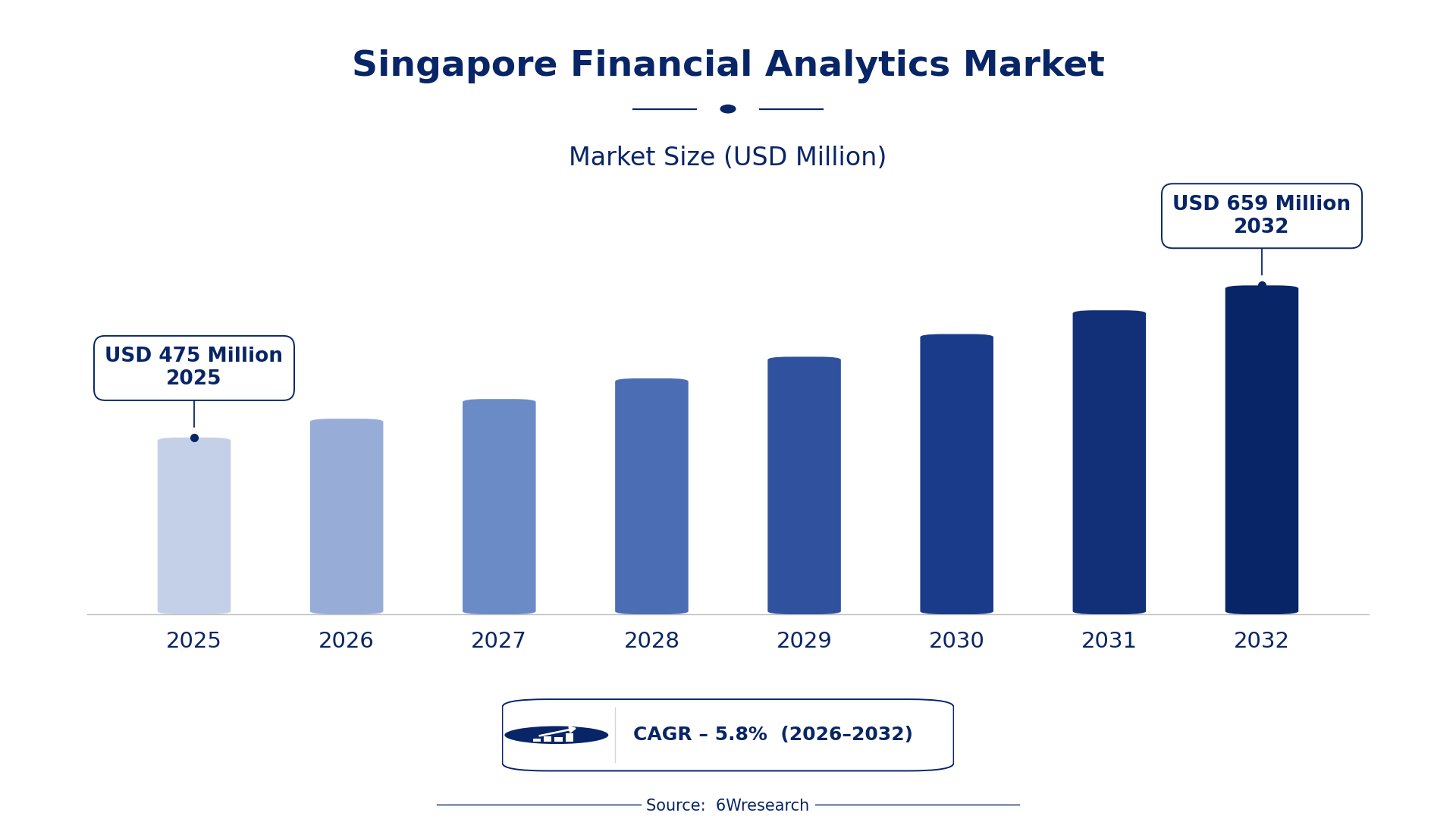
The Singapore Financial Analytics Market was estimated at USD 475 Million in 2025 and is projected to reach USD 659 Million by 2032, growing at a CAGR of 5.8% from 2026 to 2032.
Singapore Financial Analytics Market Synopsis
Singapore's financial analytics market is on an impressive growth trajectory, driven by the increasing reliance of financial institutions on data for strategic decision-making. Organizations are actively seeking advanced analytics solutions that can enhance their operational efficiency and financial performance.
The surge in demand for precise risk management and investment optimization tools underscores the urgency for financial analytics. As the market becomes more complex, institutions are prioritizing data-driven insights to maintain a competitive edge and navigate financial uncertainties.
Singapore Financial Analytics Market Year-wise Growth Rate and Key Drivers
This graph illustrates the annual growth rates of the Singapore Financial Analytics Market from 2021 to 2032, highlighting a steady upward trajectory and projected expansion over the forecast period.
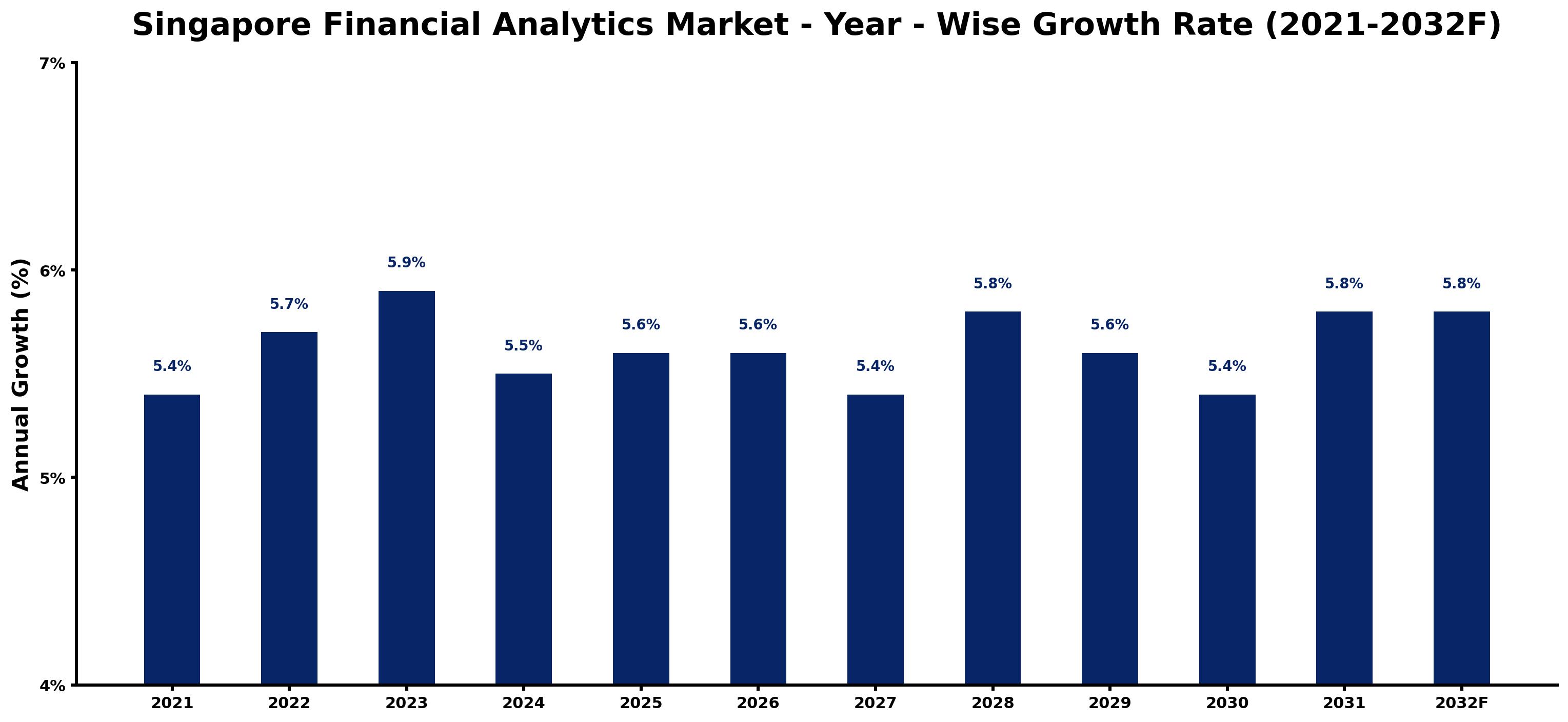
The table below presents the year‑wise growth rates along with the key drivers influencing the market
| Year | Growth Rate | Major Drivers |
| 2021 | 5.4% | MAS promoting fintech growth with regulatory sandbox initiatives. |
| 2022 | 5.7% | Increased investment in AI-driven financial decision-making tools. |
| 2023 | 5.9% | Enhanced cybersecurity regulations driving analytics adoption in finance. |
| 2024 | 5.5% | Rising wealth management sector boosting analytics service demand. |
| 2025 | 5.6% | Burgeoning e-commerce markets increasing financial transaction analytics needs. |
| 2026 | 5.6% | Regulatory pressure on banks for improved risk assessment tools. |
| 2027 | 5.4% | Digital payment trends necessitating advanced financial data analytics. |
| 2028 | 5.8% | Government grants supporting fintech startups focusing on analytics. |
| 2029 | 5.6% | Growing need for personalized finance solutions among millennials. |
| 2030 | 5.4% | Surge in ESG investment analytics driven by local guidelines. |
| 2031 | 5.8% | Local universities enhancing financial analytics education and research. |
| 2032 | 5.8% | Increased collaboration between banks and tech firms on analytics. |
Note: Market size estimations and growth projections presented in this report are based on 6Wresearch's proprietary forecasting methodology, utilizing the latest available industry data, government publications, and primary research inputs.
Singapore Financial Analytics Market Key Takeaways
Below are some of the specific key takeaways from the market, including:
- Rapid adoption of data analytics tools is reshaping investment strategies across financial institutions.
- Heightened focus on risk management solutions is driving market growth amid increasing economic volatility.
- The COVID-19 pandemic accelerated the demand for real-time financial data analysis and insights.
- Key players are continuously innovating to provide advanced solutions that meet evolving market needs.
- Government initiatives are fostering a supportive environment for financial analytics advancements.
Evaluation of Restraints in Singapore Financial Analytics Market
While the Singapore financial analytics market is thriving, it faces notable restraints that hinder its full potential. One of the primary challenges is ensuring the accuracy and security of financial data. As institutions generate vast amounts of data, the need for precise analysis becomes paramount, especially when making significant financial decisions.
on top of that, regulatory compliance poses an ongoing obstacle, as organizations must continually adapt their analytics solutions to meet stringent data privacy laws. The shifting nature of market conditions and customer demands further complicates the deployment and effectiveness of financial analytics tools, necessitating ongoing innovation and adaptation.
Singapore Financial Analytics Market Trends
A few trends are becoming increasingly prominent in the financial analytics space. The integration of artificial intelligence and machine learning into financial analytics tools is on the rise, allowing for more accurate predictions and risk assessments. Companies are also investing in cloud-based solutions to enhance accessibility and collaboration across departments.
Additionally, there is a growing trend towards personalized financial services driven by analytics, as institutions aim to better understand customer preferences and tailor offerings accordingly. This movement is likely to shape the future of financial analytics in Singapore.
Singapore Financial Analytics Market Opportunities
The opportunities within the Singapore financial analytics market are promising. As financial institutions seek to enhance their risk management capabilities, there is ample space for innovative analytics solutions that provide real-time insights. on top of that, the demand for regulatory compliance tools is on the rise, as organizations strive to navigate complex regulations effectively.
Investments in cybersecurity measures related to financial analytics also present a significant growth avenue, as data security remains a top priority. Lastly, collaborations between public and private sectors are expected to drive advancements in analytics technologies, creating a fertile environment for growth.
Government Initiatives in the Singapore Financial Analytics Market
The Singapore government is actively shaping the financial analytics market through various initiatives aimed at enhancing digital transformation and regulatory compliance. With a focus on innovation and technology, public policy is steering investments towards advanced data analytics capabilities in the finance sector.
- A recently launched national digital infrastructure upgrade program is enhancing data accessibility for financial institutions.
- Currently, a regulatory framework is being developed to improve billing transparency and consumer protection in financial services.
- A planned public-private initiative aims to facilitate knowledge-sharing and collaboration on financial analytics best practices by 2026.
- The government is also investing in workforce development programs to upskill professionals in data analytics within the finance sector.
Future Insights of the Singapore Financial Analytics Market
Looking ahead to 2026-2032, the Singapore financial analytics market is likely to continue its upward trajectory. With increasing economic complexities and a heightened focus on data-driven decision-making, organizations will increasingly invest in advanced analytics tools. The intersection of artificial intelligence and financial analytics will redefine how institutions approach risk management and investment strategies.
Additionally, collaboration among key stakeholders, including government agencies and private enterprises, will drive innovation and enhance the capabilities of financial analytics solutions. As regulatory frameworks evolve, the demand for compliant, secure analytics tools will create further growth opportunities in the market.
Singapore Financial Analytics Market Latest Developments
In the past year, the Singapore financial analytics market has experienced a surge of activity as institutions seek to capitalize on data-driven insights. Many organizations have accelerated their adoption of advanced analytics tools, responding to the increasing complexity of financial data.
- A leading regional operator launched a new suite of financial analytics tools in early 2025, enhancing its capabilities for risk assessment and investment analysis.
- A collaboration between a major technology vendor and a local financial institution is currently ongoing, focusing on the development of AI-driven analytics solutions.
- A regulatory body is finalizing a new compliance framework, expected to be implemented by mid-2026, aimed at enhancing data privacy in financial analytics.
- An initiative that began in Q1 2025 focuses on establishing a financial analytics research hub to foster innovation and collaboration among local startups and established firms.
Singapore Financial Analytics Market - Key Attractiveness of the Report
- 10 Years of Market Numbers
- Historical Data Starting from 2022 to 2025
- Base Year: 2025
- Forecast Data until 2032
- Key Performance Indicators Impacting the Market
- Major Upcoming Developments and Projects
Key Highlights of the Report:
- Singapore Financial Analytics Market Outlook
- Market Size of Singapore Financial Analytics Market, 2025
- Forecast of Singapore Financial Analytics Market, 2032
- Historical Data and Forecast of Singapore Financial Analytics Revenues & Volume for the Period 2022-2032F
- Singapore Financial Analytics Market Trend Evolution
- Singapore Financial Analytics Market Drivers and Challenges
- Singapore Financial Analytics Price Trends
- Singapore Financial Analytics Porter's Five Forces
- Singapore Financial Analytics Industry Life Cycle
- Historical Data and Forecast of Singapore Financial Analytics Market Revenues & Volume By Components for the Period 2022-2032F
- Historical Data and Forecast of Singapore Financial Analytics Market Revenues & Volume By Software for the Period 2022-2032F
- Historical Data and Forecast of Singapore Financial Analytics Market Revenues & Volume By Services for the Period 2022-2032F
- Historical Data and Forecast of Singapore Financial Analytics Market Revenues & Volume By Deployment Modes for the Period 2022-2032F
- Historical Data and Forecast of Singapore Financial Analytics Market Revenues & Volume By On-premises for the Period 2022-2032F
- Historical Data and Forecast of Singapore Financial Analytics Market Revenues & Volume By Cloud for the Period 2022-2032F
- Historical Data and Forecast of Singapore Financial Analytics Market Revenues & Volume By Application for the Period 2022-2032F
- Historical Data and Forecast of Singapore Financial Analytics Market Revenues & Volume By Wealth Management for the Period 2022-2032F
- Historical Data and Forecast of Singapore Financial Analytics Market Revenues & Volume By Governance, Risk, and Compliance Management for the Period 2022-2032F
- Historical Data and Forecast of Singapore Financial Analytics Market Revenues & Volume By Financial Forecasting and Budgeting for the Period 2022-2032F
- Historical Data and Forecast of Singapore Financial Analytics Market Revenues & Volume By Customer Management for the Period 2022-2032F
- Historical Data and Forecast of Singapore Financial Analytics Market Revenues & Volume By Transaction Monitoring for the Period 2022-2032F
- Historical Data and Forecast of Singapore Financial Analytics Market Revenues & Volume By Claim Management for the Period 2022-2032F
- Historical Data and Forecast of Singapore Financial Analytics Market Revenues & Volume By Fraud Detection and Prevention for the Period 2022-2032F
- Historical Data and Forecast of Singapore Financial Analytics Market Revenues & Volume By Stock Management for the Period 2022-2032F
- Historical Data and Forecast of Singapore Financial Analytics Market Revenues & Volume By Organization Size for the Period 2022-2032F
- Historical Data and Forecast of Singapore Financial Analytics Market Revenues & Volume By Small and Medium-sized Enterprises (SMEs) for the Period 2022-2032F
- Historical Data and Forecast of Singapore Financial Analytics Market Revenues & Volume By Large Enterprises for the Period 2022-2032F
- Historical Data and Forecast of Singapore Financial Analytics Market Revenues & Volume By Verticals for the Period 2022-2032F
- Historical Data and Forecast of Singapore Financial Analytics Market Revenues & Volume By Banking, Financial Services, and Insurance (BFSI) for the Period 2022-2032F
- Historical Data and Forecast of Singapore Financial Analytics Market Revenues & Volume By Telecom and IT for the Period 2022-2032F
- Historical Data and Forecast of Singapore Financial Analytics Market Revenues & Volume By Government for the Period 2022-2032F
- Historical Data and Forecast of Singapore Financial Analytics Market Revenues & Volume By Energy and Utilities for the Period 2022-2032F
- Historical Data and Forecast of Singapore Financial Analytics Market Revenues & Volume By Manufacturing and Automotive for the Period 2022-2032F
- Historical Data and Forecast of Singapore Financial Analytics Market Revenues & Volume By Healthcare and Pharmaceutical for the Period 2022-2032F
- Historical Data and Forecast of Singapore Financial Analytics Market Revenues & Volume By Retail and eCommerce for the Period 2022-2032F
- Historical Data and Forecast of Singapore Financial Analytics Market Revenues & Volume By Media and Entertainment for the Period 2022-2032F
- Singapore Financial Analytics Import Export Trade Statistics
- Market Opportunity Assessment By Components
- Market Opportunity Assessment By Deployment Modes
- Market Opportunity Assessment By Application
- Market Opportunity Assessment By Organization Size
- Market Opportunity Assessment By Verticals
- Singapore Financial Analytics Top Companies Market Share
- Singapore Financial Analytics Competitive Benchmarking By Technical and Operational Parameters
- Singapore Financial Analytics Company Profiles
- Singapore Financial Analytics Key Strategic Recommendations






































