Singapore Fleet Management Market Size & Growth Rate (2026-2032)
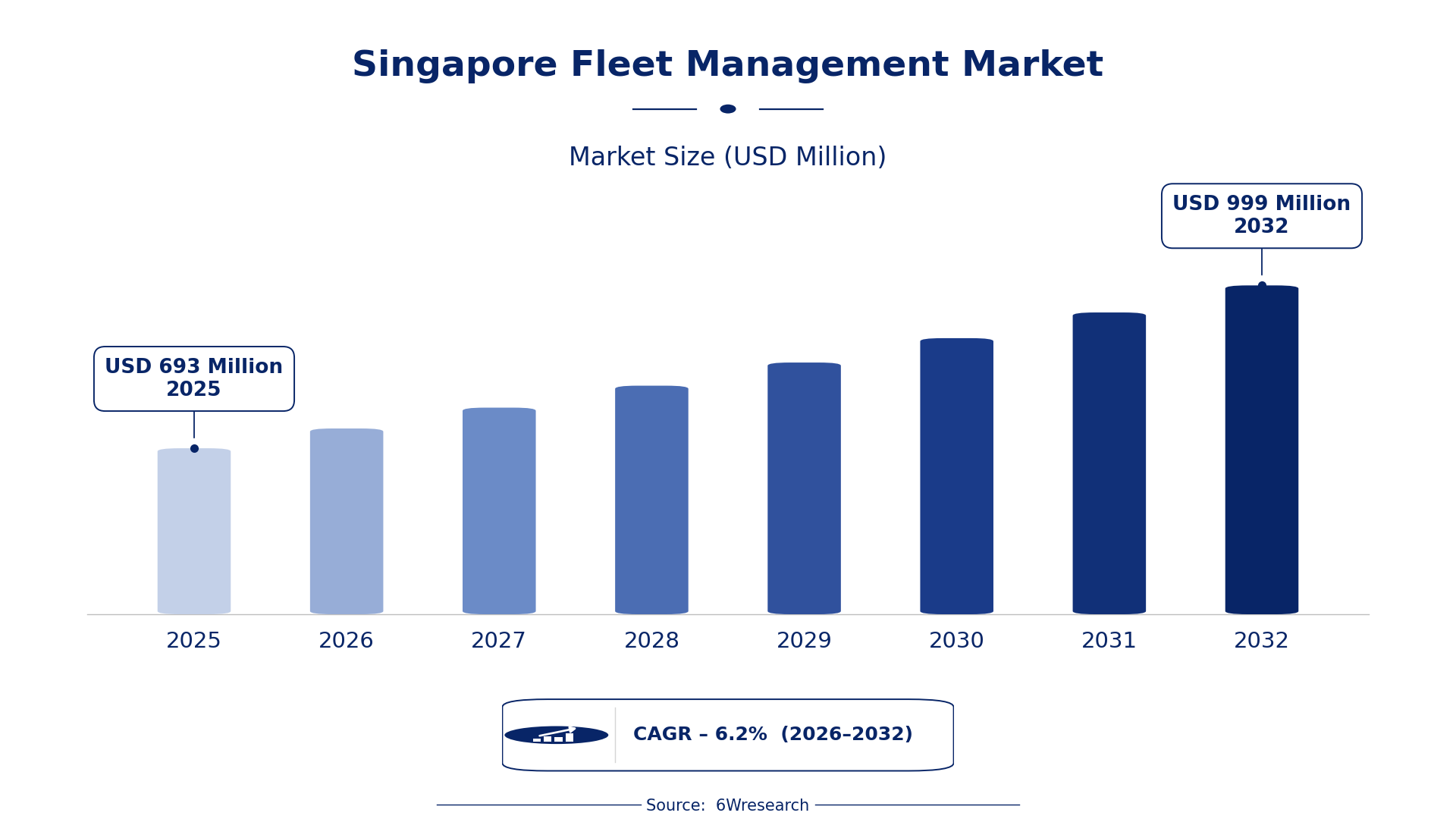
The Singapore Fleet Management Market was estimated at USD 693 Million in 2025 and is projected to reach USD 999 Million by 2032, growing at a CAGR of 6.2% from 2026 to 2032.
Singapore Fleet Management Market Synopsis
As Singapore’s economy continues to grow, the demand for efficient fleet management solutions is becoming increasingly pronounced. Companies are recognizing the importance of real-time data to enhance logistics operations, reduce costs, and ensure compliance with local regulations.
Fleet management systems in Singapore are not just about tracking vehicles; they are critical tools for achieving operational excellence. The integration of technology such as IoT and telematics has revolutionized how businesses manage their fleets, providing insights that drive decision-making and improve safety.
Singapore Fleet Management Market Year-wise Growth Rate and Key Drivers
This graph illustrates the annual growth rates of the Singapore Fleet Management Market from 2021 to 2032, highlighting a steady upward trajectory and projected expansion over the forecast period.
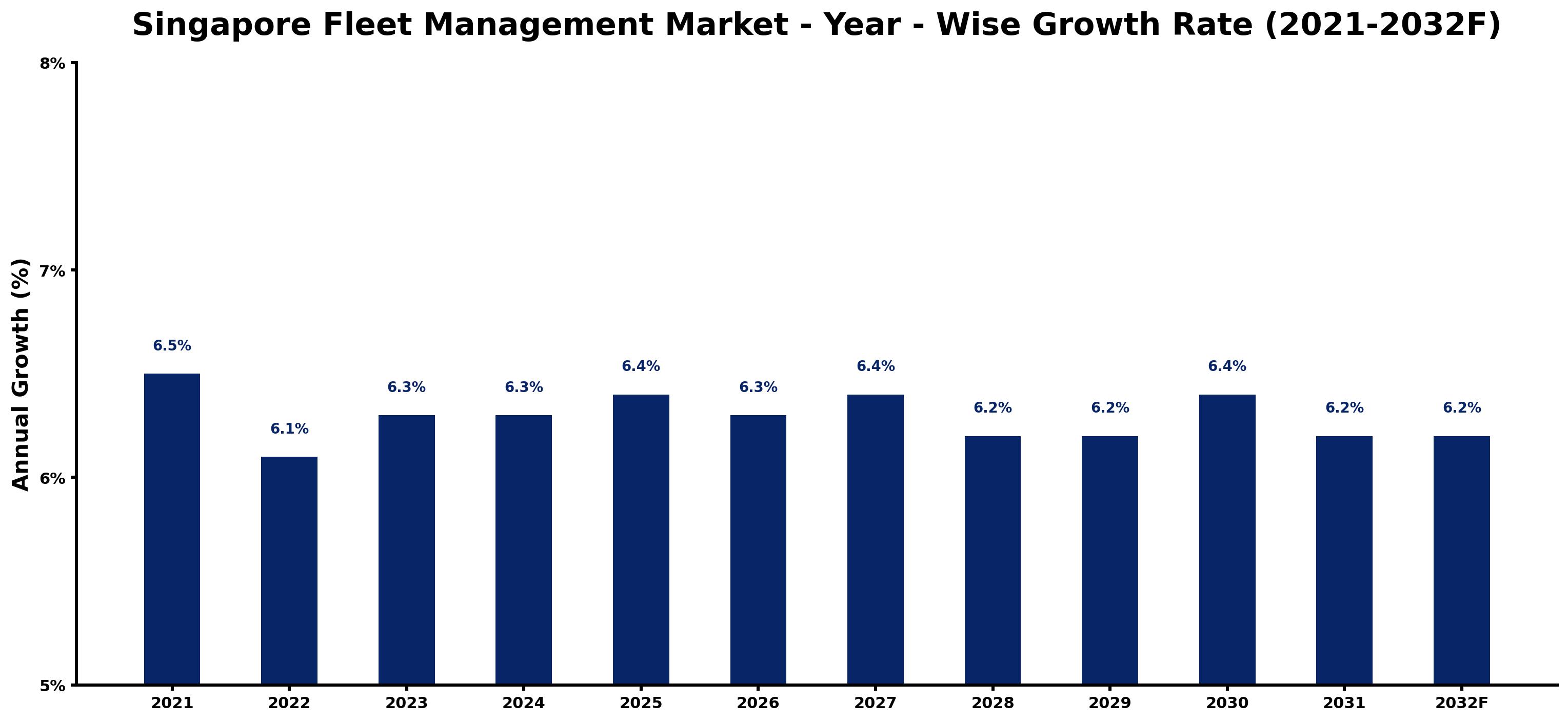
The table below presents the year‑wise growth rates along with the key drivers influencing the market
| Year | Growth Rate | Major Drivers |
| 2021 | 6.5% | Government's Green Plan boosting electric vehicle fleets |
| 2022 | 6.1% | Rise in e-commerce increasing delivery fleet demands |
| 2023 | 6.3% | Regulatory emphasis on emissions reduction driving fleet upgrades |
| 2024 | 6.3% | Singapore's logistics hub status increasing fleet management needs |
| 2025 | 6.4% | Digitalization of transport logistics enhancing fleet tracking systems |
| 2026 | 6.3% | Increased investments in AI for fleet operational efficiency |
| 2027 | 6.4% | Government incentives for adopting sustainable fleet technologies |
| 2028 | 6.2% | Growing urbanization pushing for optimized fleet solutions |
| 2029 | 6.2% | Integration of smart mobility solutions enhancing fleet efficiency |
| 2030 | 6.4% | Focus on data analytics improving fleet performance monitoring |
| 2031 | 6.2% | Rising concern for road safety driving fleet management solutions |
| 2032 | 6.2% | Emergence of innovative mobility services expanding fleet applications |
Note: Market size estimations and growth projections presented in this report are based on 6Wresearch's proprietary forecasting methodology, utilizing the latest available industry data, government publications, and primary research inputs.
Singapore Fleet Management Market Key Takeaways
Below are some of the specific key takeaways from the market, including:
- The market is driven by the need for enhanced operational efficiency and cost optimization.
- Adoption of real-time monitoring and maintenance scheduling is crucial for fleet operators.
- Data accuracy and security remain ongoing concerns as technology evolves.
- The COVID-19 pandemic has accelerated the shift toward digital fleet management solutions.
- Government initiatives are supporting the integration of advanced technologies in fleet management.
Evaluation of Restraints in Singapore Fleet Management Market
The Singapore Fleet Management Market is encountering several restraints that hinder its full potential. One major issue is the complexity of integrating fleet management solutions across different industries, which can lead to inconsistent data and operational challenges. Additionally, the need for continuous compliance with evolving transportation regulations adds another layer of difficulty for fleet operators. Ensuring data security in an increasingly digital environment remains a pressing concern, as businesses must safeguard sensitive information while optimizing their operations.
Singapore Fleet Management Market Trends
Several trends are shaping the future of fleet management in Singapore. Firstly, there is a strong shift towards sustainability, with companies looking to implement green practices in their logistics operations. Secondly, the use of artificial intelligence and machine learning in predictive maintenance is gaining traction, allowing companies to foresee potential issues before they escalate. Lastly, the demand for mobile fleet management applications is on the rise, as businesses seek solutions that enable remote access and real-time updates.
Singapore Fleet Management Market Opportunities
Opportunities abound for growth in the Singapore Fleet Management Market. Companies can invest in telematics solutions that offer enhanced tracking and reporting capabilities. The demand for electric vehicles is creating a niche for fleet operators to explore sustainable options, which can also lead to cost savings in the long run. on top of that, the increasing focus on data analytics presents an opportunity for fleet management firms to develop more sophisticated systems that provide actionable insights to their clients.
Government Initiatives in the Singapore Fleet Management Market
Government policy is significantly shaping the Singapore Fleet Management Market, with a clear focus on innovation and sustainability. The Singaporean government is actively promoting initiatives that encourage the adoption of technology in fleet operations. These policies are essential for ensuring that businesses comply with local regulations while improving their operational efficiency.
- A national initiative launched in early 2023 aims to enhance digital infrastructure for fleet management, promoting the adoption of telematics solutions.
- Currently, the government is conducting workshops to educate fleet operators on compliance with new safety regulations that came into effect in 2025.
- A public-private partnership is planned for 2026, focusing on developing sustainable transport solutions, including electric vehicle incentives.
- Ongoing government funding is available for companies that invest in green technology for their fleet operations, encouraging environmental responsibility.
Future Insights of the Singapore Fleet Management Market
Looking ahead to 2026-2032, the Singapore Fleet Management Market is expected to witness substantial growth driven by technological advancements and increased demand for efficiency. As businesses continue to recognize the value of data analytics in fleet operations, the emphasis on real-time monitoring and predictive maintenance will only intensify. on top of that, regulatory support for sustainable practices will likely influence market dynamics, encouraging a shift towards more eco-friendly fleet solutions.
Singapore Fleet Management Market Latest Developments
In the past year, the Singapore Fleet Management Market has seen notable developments, driven by both technological advancements and evolving industry needs. Companies are increasingly focused on integrating innovative solutions to enhance fleet efficiency and safety, setting the stage for a competitive landscape.
- A major technology vendor launched an advanced telematics platform in Q1 2025, designed to improve real-time vehicle tracking and data analysis capabilities.
- Ongoing trials for electric vehicle integration into fleet operations began in mid-2025, with several companies participating to assess performance and cost efficiency.
- In early 2025, a leading regional operator announced a partnership with a software firm to develop AI-driven predictive maintenance tools.
- A rollout expected to begin in late 2025 aims to enhance mobile applications for fleet management, allowing operators to manage their fleets remotely.
Singapore Fleet Management Market - Key Attractiveness of the Report
- 10 Years of Market Numbers
- Historical Data Starting from 2022 to 2025
- Base Year: 2025
- Forecast Data until 2032
- Key Performance Indicators Impacting the Market
- Major Upcoming Developments and Projects
Key Highlights of the Report:
- Singapore Fleet Management Market Outlook
- Market Size of Singapore Fleet Management Market, 2025
- Forecast of Singapore Fleet Management Market, 2032
- Historical Data and Forecast of Singapore Fleet Management Revenues & Volume for the Period 2022-2032F
- Singapore Fleet Management Market Trend Evolution
- Singapore Fleet Management Market Drivers and Challenges
- Singapore Fleet Management Price Trends
- Singapore Fleet Management Porter's Five Forces
- Singapore Fleet Management Industry Life Cycle
- Historical Data and Forecast of Singapore Fleet Management Market Revenues & Volume By Solution for the Period 2022-2032F
- Historical Data and Forecast of Singapore Fleet Management Market Revenues & Volume By Operations Management for the Period 2022-2032F
- Historical Data and Forecast of Singapore Fleet Management Market Revenues & Volume By Vehicle Maintenance and Diagnostics for the Period 2022-2032F
- Historical Data and Forecast of Singapore Fleet Management Market Revenues & Volume By Fleet Analytics and Reporting for the Period 2022-2032F
- Historical Data and Forecast of Singapore Fleet Management Market Revenues & Volume By Deployment Type for the Period 2022-2032F
- Historical Data and Forecast of Singapore Fleet Management Market Revenues & Volume By Cloud for the Period 2022-2032F
- Historical Data and Forecast of Singapore Fleet Management Market Revenues & Volume By On-premises for the Period 2022-2032F
- Historical Data and Forecast of Singapore Fleet Management Market Revenues & Volume By Fleet Type for the Period 2022-2032F
- Historical Data and Forecast of Singapore Fleet Management Market Revenues & Volume By Commercial Fleets for the Period 2022-2032F
- Historical Data and Forecast of Singapore Fleet Management Market Revenues & Volume By Passenger Cars for the Period 2022-2032F
- Historical Data and Forecast of Singapore Fleet Management Market Revenues & Volume By Service for the Period 2022-2032F
- Historical Data and Forecast of Singapore Fleet Management Market Revenues & Volume By Professional Services for the Period 2022-2032F
- Historical Data and Forecast of Singapore Fleet Management Market Revenues & Volume By Managed Services for the Period 2022-2032F
- Historical Data and Forecast of Singapore Fleet Management Market Revenues & Volume By Vertical for the Period 2022-2032F
- Historical Data and Forecast of Singapore Fleet Management Market Revenues & Volume By Retail for the Period 2022-2032F
- Historical Data and Forecast of Singapore Fleet Management Market Revenues & Volume By Healthcare and Pharmaceutical for the Period 2022-2032F
- Historical Data and Forecast of Singapore Fleet Management Market Revenues & Volume By Construction for the Period 2022-2032F
- Historical Data and Forecast of Singapore Fleet Management Market Revenues & Volume By Transportation and Logistics for the Period 2022-2032F
- Historical Data and Forecast of Singapore Fleet Management Market Revenues & Volume By Utilities for the Period 2022-2032F
- Historical Data and Forecast of Singapore Fleet Management Market Revenues & Volume By Oil, Gas, and Mining for the Period 2022-2032F
- Historical Data and Forecast of Singapore Fleet Management Market Revenues & Volume By Government for the Period 2022-2032F
- Historical Data and Forecast of Singapore Fleet Management Market Revenues & Volume By Other Verticals for the Period 2022-2032F
- Singapore Fleet Management Import Export Trade Statistics
- Market Opportunity Assessment By Solution
- Market Opportunity Assessment By Deployment Type
- Market Opportunity Assessment By Fleet Type
- Market Opportunity Assessment By Service
- Market Opportunity Assessment By Vertical
- Singapore Fleet Management Top Companies Market Share
- Singapore Fleet Management Competitive Benchmarking By Technical and Operational Parameters
- Singapore Fleet Management Company Profiles
- Singapore Fleet Management Key Strategic Recommendations






































