Singapore Flower and Ornamental Plants Market Summary
The singapore flower and ornamental plants market was estimated at USD 821 Million in 2025 and is projected to reach USD 1182 Million by 2032, growing at a CAGR of 6.5% from 2026 to 2032.
Singapore Flower and Ornamental Plants Market Year-wise Growth Rate and Key Drivers
This graph highlights how the Singapore Flower and Ornamental Plants Market has steadily grown over the past five years, supported by major growth factors.
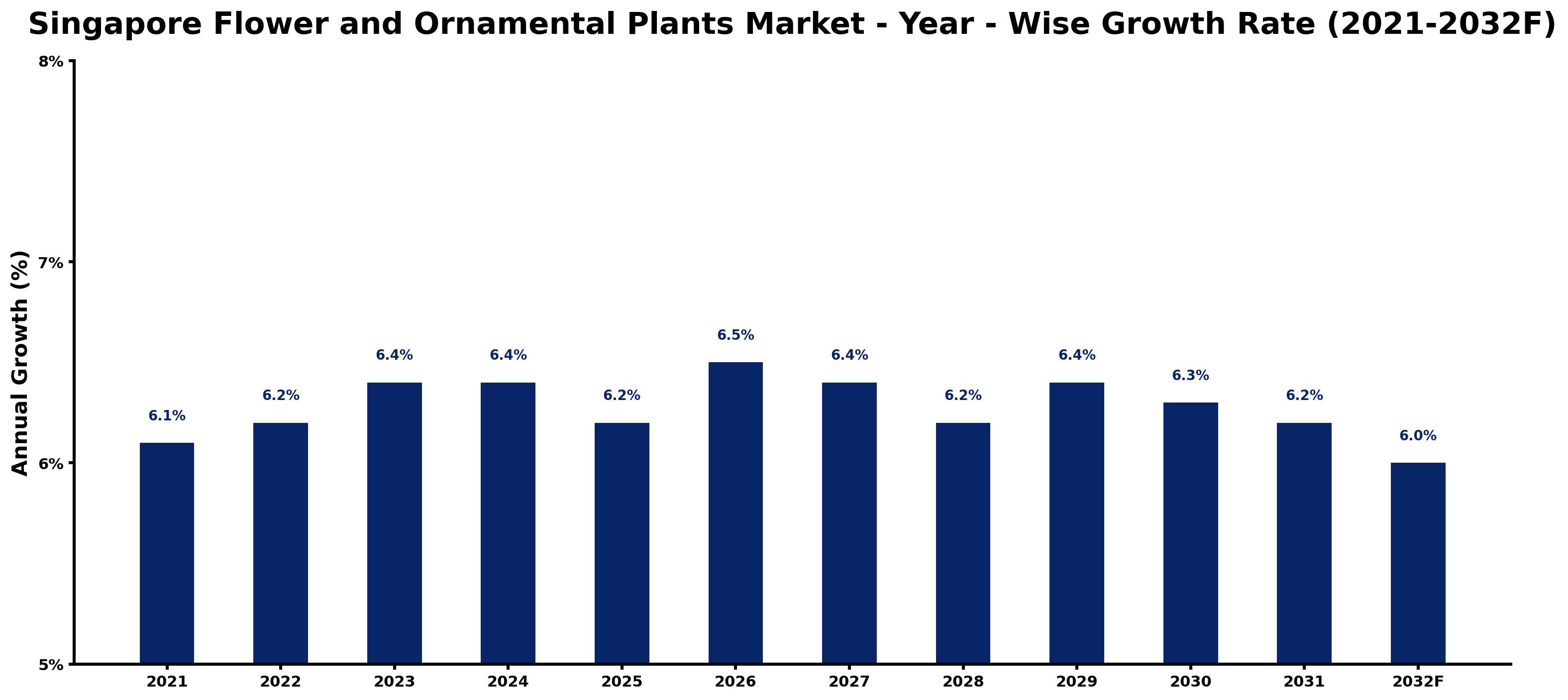
The table below presents the year wise growth rates along with the key drivers influencing the market
| Year | Growth Rate | Major Drivers |
| 2021 | 6.1% | Post-lockdown retail projects have sparked renewed interest in indoor gardening solutions. |
| 2022 | 6.2% | E-commerce platforms have transformed traditional flower purchasing habits among urban dwellers. |
| 2023 | 6.4% | Community gardening initiatives foster engagement, enhancing local biodiversity awareness efforts. |
| 2024 | 6.4% | Sustainable practices gain traction, influencing consumer choices towards eco-friendly plant options. |
| 2025 | 6.2% | Innovative landscaping designs incorporate vertical gardens, elevating aesthetic appeal in urban spaces. |
| 2026 | 6.5% | Growing wellness trends encourage households to invest in plants for improved mental health. |
| 2027 | 6.4% | Educational programs on ornamental horticulture attract younger demographics into the industry. |
| 2028 | 6.2% | Export opportunities expand as Singapore positions itself as a regional plant hub. |
| 2029 | 6.4% | Technological advancements in hydroponics enhance plant growth, attracting urban agriculture enthusiasts. |
| 2030 | 6.3% | Climate-responsive landscaping responds to rising temperatures in urban planning and development. |
| 2031 | 6.2% | Collaborative projects among botanists and designers create unique plant-centric urban experiences. |
| 2032 | 6.0% | Market diversification leads to the proliferation of rare and exotic species cultivation. |
Note - Market size estimations and growth projections presented in this report are based on 6Wresearch's advanced forecasting approach, validated with industry datasets as of June 2026.
Singapore Flower and Ornamental Plants Market Synopsis
The Singapore Flower and Ornamental Plants Market is projected to reach 6.5% and witness significant growth during the forecast period (2026-2032). This anticipated growth is driven by several factors including a rising demand for indoor and outdoor gardening, increasing disposable incomes, and an enhanced standard of living among urban citizens. The market is also benefiting from a notable shift towards organized retail garden centers, which are becoming prevalent in Singapore. The trend of home gardening, particularly among urban dwellers, is further fueled by a burgeoning array of online platforms offering diverse selections of flowers and ornamental plants. Additionally, the gifting culture surrounding specific varieties of flowers for occasions such as birthdays and anniversaries is expected to contribute positively to industry expansion in the coming years.
Singapore Flower and Ornamental Plants Market Growth Drivers
A variety of drivers are influencing growth in the Singapore Flower and Ornamental Plants Market. These include:
- Increasing Disposable Income: Consumers are allocating a larger portion of their income to lifestyle enhancements, including flowers and ornamental plants. This rise in spending is a critical driver behind market growth.
- Growing Urbanization: The rapid urbanization in Singapore is leading to an increase in residential and commercial spaces that require decorative floral elements, thereby boosting the market.
- Increased Demand for Home Décor Items: The importance of aesthetics in home and office environments prompts consumers to invest in decorative plants, further propelling market demand.
- Rise of Online Plant Retailers: The proliferation of e-commerce platforms is making a diverse range of flowers and ornamental plants more accessible to consumers, thereby stimulating demand.
- Societal Trends Towards Green Living: An increasing emphasis on sustainability and the health benefits of indoor plants has encouraged more individuals to incorporate greenery into their living spaces.
Singapore Flower and Ornamental Plants Market Challenges and Restraints
Despite the promising growth trajectory, the Singapore Flower and Ornamental Plants Market faces several challenges:
- Stringent Regulations Regarding Chemicals: The floriculture industry must navigate regulations concerning the use of chemical fertilizers and pesticides, impacting the cultivation practices and limiting certain marketing opportunities.
- Trade Restrictions: Import and export restrictions on certain plant species can limit the availability of diverse products within the market.
- Market Saturation: As more players enter the market, saturation can lead to intense competition, which may drive down profit margins.
- Environmental Concerns: Growing awareness of environmental issues may push consumers towards sustainable and organic options, potentially disadvantaging conventional flower and plant offerings.
- Impact of Seasonal Demand Fluctuations: The floral market can be highly seasonal, with demand peaking during specific holidays or occasions, leading to income volatility for producers.
Singapore Flower and Ornamental Plants Market Government Investment and Initiatives
The Singapore government has recognized the importance of the flower and ornamental plants sector and is actively promoting it through various initiatives. Investments in sustainable agricultural practices and urban gardening are being prioritized to enhance the sector's growth potential. Public spending on improving retail infrastructure for garden centers is also increasing, which will facilitate better access to floral products for consumers. Additionally, educational programs aimed at encouraging home gardening and the appreciation for floral aesthetics are being developed. The government is also providing incentives for businesses that engage in eco-friendly practices, thus promoting a sustainable approach to floriculture.
Singapore Flower and Ornamental Plants Market Latest Developments (May 2025 - June 2026)
Recent developments in the Singapore Flower and Ornamental Plants Market indicate a trend towards digitalization, with numerous players enhancing their online presence to facilitate sales. This shift has been catalyzed by consumer behavior changes due to the COVID-19 pandemic, which led to a surge in online purchases. Furthermore, there has been a notable increase in collaboration between local artisans and online platforms to promote unique floral offerings. Sustainability initiatives are gaining traction, with more consumers preferring organic and locally sourced products. Events and exhibitions focusing on horticulture innovations are being hosted, which aim to showcase the latest trends and products in the ornamental plants sector.
Singapore Flower and Ornamental Plants Market - Key Attractiveness of the Report
- 10 Years of Market Numbers
- Historical Data Starting from 2022 to 2025
- Base Year: 2025
- Forecast Data until 2032
- Key Performance Indicators Impacting the Market
- Major Upcoming Developments and Projects
Key Highlights of the Report:
- Singapore Flower and Ornamental Plants Market Outlook
- Market Size of Singapore Flower and Ornamental Plants Market, 2025
- Forecast of Singapore Flower and Ornamental Plants Market, 2032F
- Historical Data and Forecast of Singapore Flower and Ornamental Plants Revenues & Volume for the Period 2022-2032F
- Singapore Flower and Ornamental Plants Market Trend Evolution
- Singapore Flower and Ornamental Plants Market Drivers and Challenges
- Singapore Flower and Ornamental Plants Price Trends
- Singapore Flower and Ornamental Plants Porter's Five Forces
- Singapore Flower and Ornamental Plants Industry Life Cycle
- Historical Data and Forecast of Singapore Flower and Ornamental Plants Market Revenues & Volume By Product Type for the Period 2022-2032F
- Historical Data and Forecast of Singapore Flower and Ornamental Plants Market Revenues & Volume By Potted Plants for the Period 2022-2032F
- Historical Data and Forecast of Singapore Flower and Ornamental Plants Market Revenues & Volume By Cut Flowers for the Period 2022-2032F
- Historical Data and Forecast of Singapore Flower and Ornamental Plants Market Revenues & Volume By Application for the Period 2022-2032F
- Historical Data and Forecast of Singapore Flower and Ornamental Plants Market Revenues & Volume By Home for the Period 2022-2032F
- Historical Data and Forecast of Singapore Flower and Ornamental Plants Market Revenues & Volume By Commercial for the Period 2022-2032F
- Singapore Flower and Ornamental Plants Import Export Trade Statistics
- Market Opportunity Assessment By Product Type
- Market Opportunity Assessment By Application
- Singapore Flower and Ornamental Plants Top Companies Market Share
- Singapore Flower and Ornamental Plants Competitive Benchmarking By Technical and Operational Parameters
- Singapore Flower and Ornamental Plants Company Profiles
- Singapore Flower and Ornamental Plants Key Strategic Recommendations






































