Singapore Food Dehydrators Market Size, Share & Growth Rate
The Singapore Food Dehydrators Market was estimated at USD 230 Million in 2025 and is projected to reach USD 313 Million by 2032, growing at a CAGR of 4.5% from 2026 to 2032. This upward trajectory is fueled by the increasing consumer interest in health-conscious snacking and the convenience offered by dehydrated products. As more individuals turn to homemade preservation methods, the demand for food dehydrators is set to rise significantly, driven by a growing appreciation for sustainable and nutritious food options.
Singapore Food Dehydrators Market Year-wise Growth Rate and Key Drivers
This graph highlights how the Singapore Food Dehydrators Market has steadily grown over the years, supported by major growth factors.
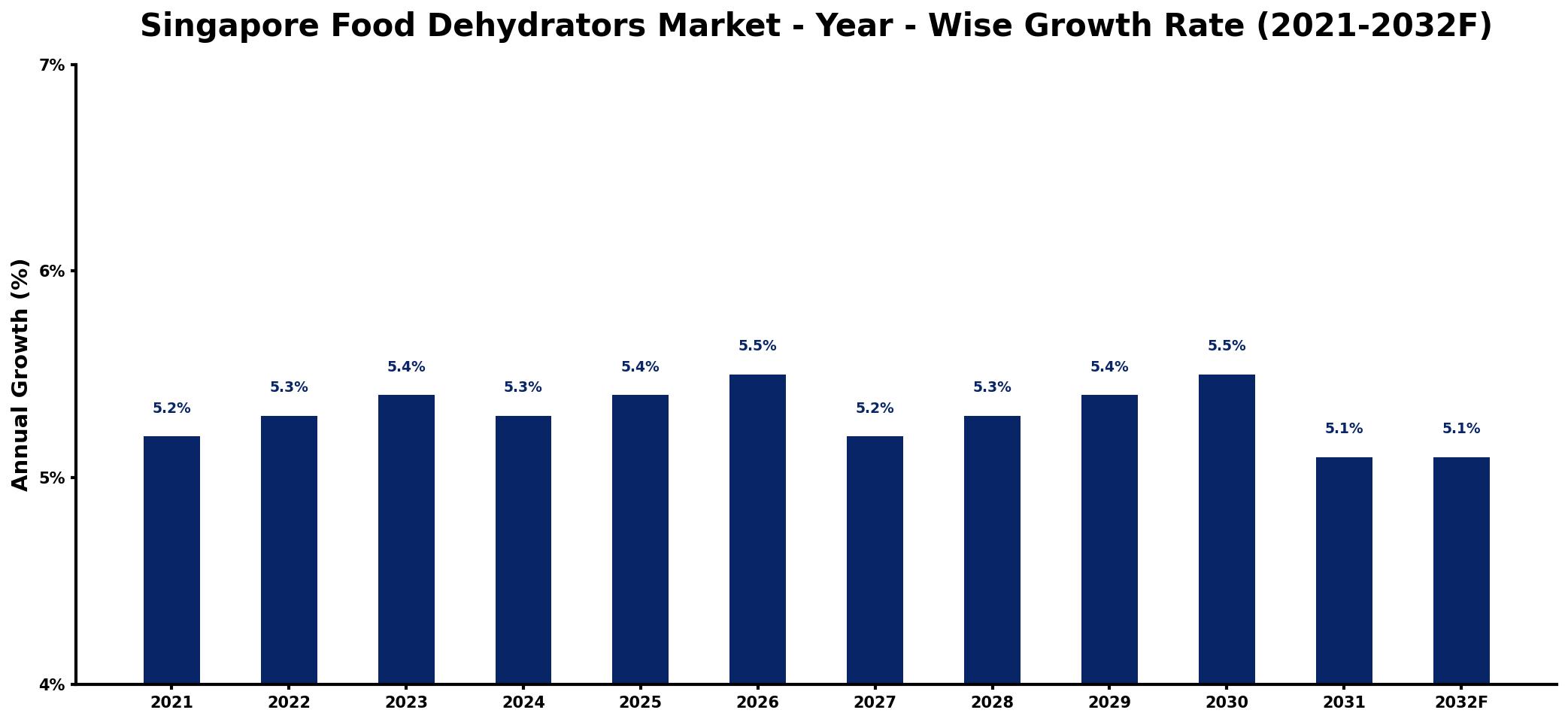
The table below presents the year‑wise growth rates along with the key drivers influencing the market
| Year | Growth Rate | Major Drivers |
| 2021 | 5.2% | Rising health consciousness among consumers |
| 2022 | 5.3% | Increased demand for sustainable practices |
| 2023 | 5.4% | Expansion of home cooking trends |
| 2024 | 5.3% | Growing popularity of snacking options |
| 2025 | 5.4% | Advancements in preservation technologies |
| 2026 | 5.5% | Rising interest in meal prep |
| 2027 | 5.2% | Emergence of eco-friendly packaging solutions |
| 2028 | 5.3% | Increase in online shopping platforms |
| 2029 | 5.4% | Growth of culinary tourism experiences |
| 2030 | 5.5% | Demand for convenience in meals |
| 2031 | 5.1% | Focus on nutrient retention methods |
| 2032 | 5.1% | improved raw material availability |
Note: Market size estimations and growth projections presented in this report are based on 6Wresearch's proprietary forecasting methodology, utilizing the latest available industry data, government publications, and primary research inputs.
Singapore Food Dehydrators Market Synopsis
The Singapore food dehydrators market is witnessing a unique demand, as urban dwellers seek to maximize their culinary experiences while promoting healthier eating habits. The rise in home cooking, particularly during and after the pandemic, has led many to explore food dehydration as an efficient way to extend the freshness of fruits, vegetables, and snacks.
In addition to preserving food, food dehydrators have gained traction as tools for creating nutrient-dense snacks that align with current dietary trends, including veganism and plant-based eating. This shift not only speaks to consumer health priorities but also to a growing interest in homemade solutions that reduce waste and enhance flavor.
Singapore Food Dehydrators Market Key Takeaways
- Rapid growth in the health-focused snack segment is driving demand for food dehydrators.
- Increased consumer awareness regarding the nutritional benefits of dehydrated foods is transforming eating habits.
- Home cooking trends are leading to higher adoption rates of food dehydrators among urban residents.
- Technological advancements in dehydrator efficiency are expanding their appeal to a broader audience.
- The flourishing dried fruits and nuts market is positively impacting food dehydrator sales.
Evaluation of Restraints in Singapore Food Dehydrators Market
Despite its promising growth trajectory, the Singapore food dehydrators market faces several restraints that limit its potential. Primarily, the market size remains relatively small compared to other regions, which constrains opportunities for manufacturers and distributors looking to expand. Additionally, the cost of quality food dehydrators can be a barrier for price-sensitive consumers, hindering widespread adoption. Furthermore, there exists a gap in consumer knowledge regarding the full benefits and proper utilization of dehydrators, which could stifle growth if not addressed. Lastly, competition from alternative food preservation methods, such as freezing and canning, poses challenges to market penetration.
Singapore Food Dehydrators Market Trends
Several trends are shaping the Singapore food dehydrators market, including a growing inclination toward plant-based diets and an increasing awareness of food sustainability. Consumers are more interested in understanding the source and processing of their food, leading to a rise in interest for dehydration as a healthy alternative to processed snacks. Furthermore, advancements in technology have enabled manufacturers to produce more efficient and user-friendly dehydrators, catering to the evolving demands of modern consumers.
Singapore Food Dehydrators Market Opportunities
Significant growth opportunities lie in the expansion of product lines and enhancements in marketing strategies aimed at health-conscious consumers. Educating the market about the versatility and benefits of food dehydrators can unlock new user demographics. Additionally, partnerships with health food brands and culinary influencers can boost visibility and encourage consumer interest. There is also a notable potential for innovation in dehydration technology that could enhance product efficiency, offering a competitive edge in this burgeoning market.
Government Initiatives in the Singapore Food Dehydrators Market
The Singapore government is actively promoting healthier eating habits and sustainable food practices through various initiatives and policies. Programs that encourage local food production and consumption, as well as efforts to reduce food waste, align with the growth of the food dehydrators market. Such governmental support not only aims to foster a healthier populace but also encourages innovation in food preservation technologies, creating a more conducive environment for market growth.
Future Insights of the Singapore Food Dehydrators Market
Looking ahead to 2026-2032, the Singapore food dehydrators market is poised for substantial growth, driven by consumer trends favoring health, convenience, and sustainability. Increased focus on home cooking and preservation techniques will continue to fuel demand. Furthermore, as consumers become more conscious of nutrition and the benefits of fresh produce, the food dehydrators market will likely see an expanding consumer base. Innovations in technology, along with effective marketing strategies, will play pivotal roles in shaping the future landscape of this dynamic market.
Singapore Food Dehydrators Market Latest Developments (2025 - 2026)
Recent developments in the Singapore food dehydrators market indicate a shift towards more sustainable practices, with manufacturers focusing on eco-friendly materials and energy-efficient designs. There has been a noticeable increase in the introduction of multifunctional dehydrators that cater to the diverse needs of modern consumers. Additionally, marketing efforts have intensified, leveraging digital platforms to reach a broader audience interested in home cooking and healthful snacking.
Singapore Food Dehydrators Market - Key Attractiveness of the Report
- 10 Years of Market Numbers
- Historical Data Starting from 2022 to 2025
- Base Year: 2025
- Forecast Data until 2032
- Key Performance Indicators Impacting the Market
- Major Upcoming Developments and Projects
Key Highlights of the Report:
- Singapore Food Dehydrators Market Outlook
- Market Size of Singapore Food Dehydrators Market, 2025
- Forecast of Singapore Food Dehydrators Market, 2032
- Historical Data and Forecast of Singapore Food Dehydrators Revenues & Volume for the Period 2022-2032F
- Singapore Food Dehydrators Market Trend Evolution
- Singapore Food Dehydrators Market Drivers and Challenges
- Singapore Food Dehydrators Price Trends
- Singapore Food Dehydrators Porter's Five Forces
- Singapore Food Dehydrators Industry Life Cycle
- Historical Data and Forecast of Singapore Food Dehydrators Market Revenues & Volume By Technology for the Period 2022-2032F
- Historical Data and Forecast of Singapore Food Dehydrators Market Revenues & Volume By Vertical Flow for the Period 2022-2032F
- Historical Data and Forecast of Singapore Food Dehydrators Market Revenues & Volume By Horizontal Flow for the Period 2022-2032F
- Historical Data and Forecast of Singapore Food Dehydrators Market Revenues & Volume By End-Use for the Period 2022-2032F
- Historical Data and Forecast of Singapore Food Dehydrators Market Revenues & Volume By Industrial for the Period 2022-2032F
- Historical Data and Forecast of Singapore Food Dehydrators Market Revenues & Volume By Commercial for the Period 2022-2032F
- Historical Data and Forecast of Singapore Food Dehydrators Market Revenues & Volume By Residential for the Period 2022-2032F
- Historical Data and Forecast of Singapore Food Dehydrators Market Revenues & Volume By Others for the Period 2022-2032F
- Historical Data and Forecast of Singapore Food Dehydrators Market Revenues & Volume By Energy Source for the Period 2022-2032F
- Historical Data and Forecast of Singapore Food Dehydrators Market Revenues & Volume By Electricity for the Period 2022-2032F
- Historical Data and Forecast of Singapore Food Dehydrators Market Revenues & Volume By Biofuel for the Period 2022-2032F
- Historical Data and Forecast of Singapore Food Dehydrators Market Revenues & Volume By Solar for the Period 2022-2032F
- Historical Data and Forecast of Singapore Food Dehydrators Market Revenues & Volume By Others for the Period 2022-2032F
- Singapore Food Dehydrators Import Export Trade Statistics
- Market Opportunity Assessment By Technology
- Market Opportunity Assessment By End-Use
- Market Opportunity Assessment By Energy Source
- Singapore Food Dehydrators Top Companies Market Share
- Singapore Food Dehydrators Competitive Benchmarking By Technical and Operational Parameters
- Singapore Food Dehydrators Company Profiles
- Singapore Food Dehydrators Key Strategic Recommendations






































