Singapore Food Processing & Handling Equipment Market Summary
The singapore food processing & handling equipment market was estimated at USD 1145 Million in 2025 and is projected to reach USD 1633 Million by 2032, growing at a CAGR of 6.1% from 2026 to 2032.
Singapore Food Processing & Handling Equipment Market Year-wise Growth Rate and Key Drivers
This graph highlights how the Singapore Food Processing & Handling Equipment Market has steadily grown over the past five years, supported by major growth factors.
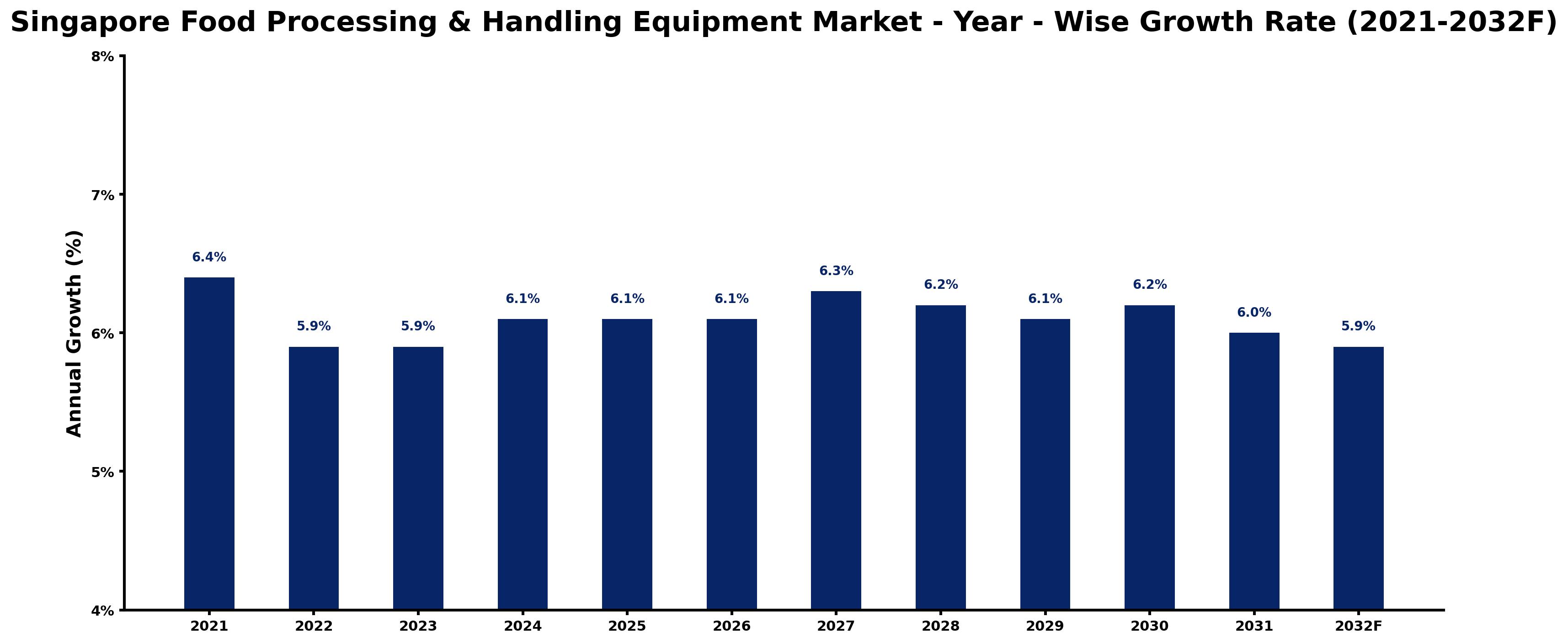
The table below presents the year wise growth rates along with the key drivers influencing the market
| Year | Growth Rate | Major Drivers |
| 2021 | 6.4% | Post-lockdown retail projects fuel demand for efficient processing and handling equipment. |
| 2022 | 5.9% | Emerging food tech startups are reshaping traditional processing standards and efficiency. |
| 2023 | 5.9% | Health-conscious consumers influence equipment choices, emphasizing sanitation and quality. |
| 2024 | 6.1% | Local sourcing trends push manufacturers to invest in adaptable processing solutions. |
| 2025 | 6.1% | Technological integration enhances automation, reducing labor costs for food processors. |
| 2026 | 6.1% | Sustainability practices lead to eco-friendly equipment innovations in food processing. |
| 2027 | 6.3% | Urbanization trends increase the demand for compact and efficient food handling equipment. |
| 2028 | 6.2% | Rising disposable incomes drive premium equipment purchases among upscale food businesses. |
| 2029 | 6.1% | Adoption of smart technologies becomes crucial for maintaining competitive market positions. |
| 2030 | 6.2% | Food safety regulations prompt upgrades in processing equipment across all sectors. |
| 2031 | 6.0% | Consumer preferences for convenience foods expand the market for specialized processing tools. |
| 2032 | 5.9% | Collaborations with tech firms enhance equipment integration, optimizing supply chain management. |
Note - Market size estimations and growth projections presented in this report are based on 6Wresearch's advanced forecasting approach, validated with industry datasets as of June 2026.
Singapore Food Processing & Handling Equipment Market Synopsis
The Singapore Food Processing Handling Equipment Market is projected to reach 6.1% and witness significant growth during the forecast period (2026-2032). This growth is primarily driven by an increasing demand for processed foods, technological advancements in the field, and rising urbanization rates contributing to changing consumer preferences. As disposable income levels climb, consumers are gravitating towards convenience, further fostering market expansion. This report delves into critical factors influencing the market landscape, providing a comprehensive overview of trends, challenges, and government initiatives that are shaping the future of food processing and handling in Singapore.
Singapore Food Processing & Handling Equipment Market Growth Drivers
A robust growth trajectory in the Singapore Food Processing & Handling Equipment Market can be attributed to several pivotal factors:
- The increasing demand for processed foods has significantly altered consumer behavior, leading to a surge in ready-to-eat meal consumption. This trend necessitates advanced processing and handling equipment, which propels market growth.
- Technological innovations, including automation and robotics, are revolutionizing traditional food processing methods. These advancements enhance efficiency, lower labor costs, and ensure product quality, thus attracting more manufacturers to adopt modern equipment.
- Urbanization is another critical driver, as an expanding urban population typically leads to higher demand for convenience foods and, subsequently, increased investment in processing and handling equipment.
- Rising disposable income levels allow consumers greater spending capacity on processed foods, which is stimulating production levels and driving manufacturers to invest in cutting-edge equipment.
- Government initiatives aimed at promoting food safety and quality standards have created an environment conducive for growth by encouraging manufacturers to upgrade their facilities and equipment to comply with new regulations.
Singapore Food Processing & Handling Equipment Market Challenges and Restraints
While the market exhibits promising growth potential, several challenges linger:
- One of the primary barriers is the high initial investment required for advanced equipment and technologies. This financial burden can deter smaller businesses from upgrading, limiting their competitive capabilities.
- Intense competition among manufacturers creates a pressure to continuously innovate and reduce costs, which can sometimes lead to compromises in quality and efficiency.
- Supply chain disruptions, exacerbated by global events such as the COVID-19 pandemic, continue to pose risks to operational stability and market progression.
- Fluctuations in raw material prices can impact production costs, leading to uncertainty in the market and affecting profit margins for companies trying to balance high-quality production with competitive pricing.
- Moreover, labor shortages in skilled positions such as equipment operators and maintenance technicians can hinder operational effectiveness, particularly when advanced technologies are involved.
Singapore Food Processing & Handling Equipment Market Government Investment and Initiatives
The Singapore government has recognized the importance of the food processing and handling sector, leading to various initiatives aimed at enhancing industry capabilities:
- Investment in R&D is prioritized, with public funding allocated for projects that focus on developing innovative processing techniques and technologies.
- Government regulations aimed at promoting food safety and hygiene are being strengthened, compelling manufacturers to invest in superior processing and handling equipment to comply.
- Public-private partnerships are being fostered to facilitate the sharing of knowledge and resources among industry stakeholders, enhancing overall productivity.
- Workshops and training programs are being conducted to upskill the workforce for handling advanced equipment, addressing labor shortages and improving operational competency.
- Incentives and grants are provided for small and medium-sized enterprises (SMEs) to encourage them to adopt newer technologies and solutions that enhance food processing efficiencies.
Singapore Food Processing & Handling Equipment Market Latest Developments (May 2025 - June 2026)
Recent developments within the Singapore Food Processing & Handling Equipment Market reflect evolving industry dynamics:
- The period has seen a noticeable shift towards sustainable practices, with companies increasingly adopting eco-friendly processing equipment to cater to the rising consumer demand for sustainability.
- Technological advancements have accelerated, particularly in automation and artificial intelligence, allowing for smarter production systems that enhance efficiency and reduce human error.
- Collaboration among industry players has intensified, leading to the establishment of innovation clusters focused on addressing common challenges and fostering growth.
- Trade shows and conferences have re-emerged post-pandemic, facilitating knowledge exchange and unveiling new product launches that reflect current trends in the market.
- The overall sentiment in the sector has shifted positively, as companies report gradual recovery from pandemic-related setbacks and an optimistic outlook towards meeting rising market demands.
Singapore Food Processing & Handling Equipment Market - Key Attractiveness of the Report
- 10 Years of Market Numbers
- Historical Data Starting from 2022 to 2025
- Base Year: 2025
- Forecast Data until 2032
- Key Performance Indicators Impacting the Market
- Major Upcoming Developments and Projects
Key Highlights of the Report:
- Singapore Food Processing & Handling Equipment Market Outlook
- Market Size of Singapore Food Processing & Handling Equipment Market, 2025
- Forecast of Singapore Food Processing & Handling Equipment Market, 2032F
- Historical Data and Forecast of Singapore Food Processing & Handling Equipment Revenues & Volume for the Period 2022-2032F
- Singapore Food Processing & Handling Equipment Market Trend Evolution
- Singapore Food Processing & Handling Equipment Market Drivers and Challenges
- Singapore Food Processing & Handling Equipment Price Trends
- Singapore Food Processing & Handling Equipment Porter's Five Forces
- Singapore Food Processing & Handling Equipment Industry Life Cycle
- Historical Data and Forecast of Singapore Food Processing & Handling Equipment Market Revenues & Volume By Equipment Type for the Period 2022-2032F
- Historical Data and Forecast of Singapore Food Processing & Handling Equipment Market Revenues & Volume By Food Processing equipment for the Period 2022-2032F
- Historical Data and Forecast of Singapore Food Processing & Handling Equipment Market Revenues & Volume By Foodservice equipment for the Period 2022-2032F
- Historical Data and Forecast of Singapore Food Processing & Handling Equipment Market Revenues & Volume By Food Packaging equipment for the Period 2022-2032F
- Historical Data and Forecast of Singapore Food Processing & Handling Equipment Market Revenues & Volume By Application for the Period 2022-2032F
- Historical Data and Forecast of Singapore Food Processing & Handling Equipment Market Revenues & Volume By Bakery & confectionery products for the Period 2022-2032F
- Historical Data and Forecast of Singapore Food Processing & Handling Equipment Market Revenues & Volume By Meat & poultry products for the Period 2022-2032F
- Historical Data and Forecast of Singapore Food Processing & Handling Equipment Market Revenues & Volume By Dairy products for the Period 2022-2032F
- Historical Data and Forecast of Singapore Food Processing & Handling Equipment Market Revenues & Volume By Alcoholic beverages for the Period 2022-2032F
- Historical Data and Forecast of Singapore Food Processing & Handling Equipment Market Revenues & Volume By Non-alcoholic beverages for the Period 2022-2032F
- Historical Data and Forecast of Singapore Food Processing & Handling Equipment Market Revenues & Volume By Fish & seafood products for the Period 2022-2032F
- Historical Data and Forecast of Singapore Food Processing & Handling Equipment Market Revenues & Volume By Others? for the Period 2022-2032F
- Historical Data and Forecast of Singapore Food Processing & Handling Equipment Market Revenues & Volume By Form for the Period 2022-2032F
- Historical Data and Forecast of Singapore Food Processing & Handling Equipment Market Revenues & Volume By Solid for the Period 2022-2032F
- Historical Data and Forecast of Singapore Food Processing & Handling Equipment Market Revenues & Volume By Liquid for the Period 2022-2032F
- Historical Data and Forecast of Singapore Food Processing & Handling Equipment Market Revenues & Volume By Semi-solid for the Period 2022-2032F
- Singapore Food Processing & Handling Equipment Import Export Trade Statistics
- Market Opportunity Assessment By Equipment Type
- Market Opportunity Assessment By Application
- Market Opportunity Assessment By Form
- Singapore Food Processing & Handling Equipment Top Companies Market Share
- Singapore Food Processing & Handling Equipment Competitive Benchmarking By Technical and Operational Parameters
- Singapore Food Processing & Handling Equipment Company Profiles
- Singapore Food Processing & Handling Equipment Key Strategic Recommendations






































