Singapore Food Service Equipment Market Summary
The singapore food service equipment market was estimated at USD 263 Million in 2025 and is projected to reach USD 369 Million by 2032, growing at a CAGR of 5.6% from 2026 to 2032.
Singapore Food Service Equipment Market Year-wise Growth Rate and Key Drivers
This graph highlights how the Singapore Food Service Equipment Market has steadily grown over the past five years, supported by major growth factors.
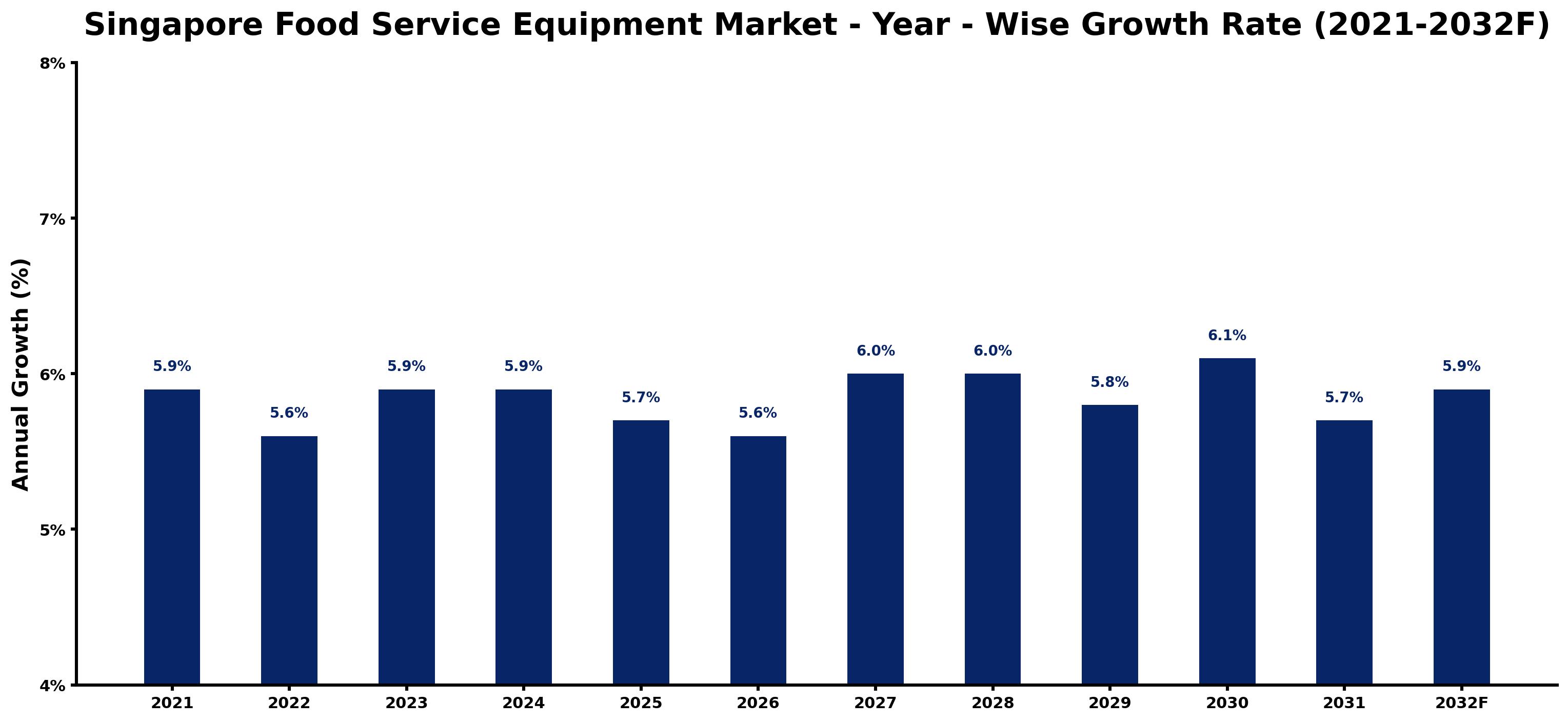
The table below presents the year wise growth rates along with the key drivers influencing the market
| Year | Growth Rate | Major Drivers |
| 2021 | 5.9% | Post-lockdown recovery fostered heightened investment in food service efficiency innovations. |
| 2022 | 5.6% | Emerging trends in plant-based diets increased demand for specialized cooking equipment. |
| 2023 | 5.9% | Culinary tourism popularity led to an influx of high-end restaurant establishments. |
| 2024 | 5.9% | Sustainability practices prompted shifts towards energy-efficient food service solutions. |
| 2025 | 5.7% | Technological integration in kitchens gained traction through smart appliance developments. |
| 2026 | 5.6% | Local manufacturing capabilities enhanced supply chain resilience in food service equipment. |
| 2027 | 6.0% | Increased focus on hygiene led businesses to upgrade sanitization equipment and practices. |
| 2028 | 6.0% | Investment in food delivery platforms drove demand for optimized kitchen layouts. |
| 2029 | 5.8% | Evolving consumer preferences encouraged restaurants to embrace diverse cooking methods. |
| 2030 | 6.1% | Food safety regulations necessitated modernized equipment compliant with health standards. |
| 2031 | 5.7% | Community-driven dining experiences prompted cafes to invest in modular kitchen systems. |
| 2032 | 5.9% | Digital transformation in restaurant operations fueled interest in advanced kitchen technologies. |
Note - Market size estimations and growth projections presented in this report are based on 6Wresearch's advanced forecasting approach, validated with industry datasets as of June 2026.
Singapore Food Service Equipment Market Synopsis
The Singapore Food Service Equipment Market is projected to reach USD 5.09 billion and witness significant growth during the forecast period (2026-2032). This growth trajectory is supported by an evolving landscape of consumer behavior and technological advancements within the sector. The market dynamics have experienced a notable shift toward increased demand for food service equipment across various establishments such as restaurants, hotels, and catering services, indicating a robust recovery and expansion following the disruptions caused during the COVID-19 pandemic.
Singapore Food Service Equipment Market Growth Drivers
The growth of the Singapore Food Service Equipment Market is primarily fueled by several key drivers:
- The rising consumer appetite for convenience foods, including pre-packaged meals and fast-food options, is propelling the demand for specialized cooking equipment such as ovens and fryers. This trend is particularly pronounced in the quick service restaurant (QSR) segment.
- Technological advancements continue to shape the market landscape, with a strong emphasis on the development of energy-efficient food service equipment. This transition not only caters to sustainability goals but also significantly reduces operational costs for businesses.
- Increased investment in the hospitality and food service sectors, spurred by a recovering economy and rising levels of disposable income, encourages establishments to upgrade their food preparation and serving equipment, thus driving market growth.
- The proliferation of digital solutions, such as IoT-enabled appliances, allows operators to streamline their processes and enhance operational efficiency. These innovations facilitate remote monitoring and management, proving valuable in optimizing kitchen operations.
- Growing health consciousness among consumers is leading food service operators to invest in equipment that supports healthier cooking methods, further expanding the range of products available in the market.
Singapore Food Service Equipment Market Challenges and Restraints
Despite its growth potential, the Singapore Food Service Equipment Market faces several challenges that could hinder its progress:
- The high capital investment required for the installation and maintenance of food service equipment can deter smaller establishments from making necessary upgrades, potentially limiting overall market revenue growth.
- Unreliable after-sales service from certain manufacturers can adversely affect customer satisfaction. This lack of support may lead to hesitancy among potential buyers, impacting the decision to invest in new equipment.
- Economic uncertainties, including fluctuations in material costs and supply chain disruptions, can impose additional burdens on food service operators, indirectly affecting their equipment purchasing decisions.
- The ongoing need for staff training on new technologies and equipment can present logistical challenges for operators, further complicating the adoption process.
- Intense competition among food service providers may lead to price wars, which can negatively impact profit margins and deter investments into high-quality equipment.
Singapore Food Service Equipment Market Government Investment and Initiatives
The Singaporean government has undertaken several initiatives aimed at boosting the food service equipment market. These include:
- Investment in smart city initiatives, which encompasses enhancing food service infrastructure through cutting-edge technologies that promote energy efficiency and sustainability.
- Government grants and subsidies aimed at supporting small and medium-sized enterprises (SMEs) in upgrading their food service equipment and improving operational efficiencies.
- Programs designed to foster innovation within the food sector, encouraging local manufacturers to develop new, advanced food service equipment that meets evolving consumer demands.
- Support for training and upskilling initiatives for workers in the food service sector, ensuring they are equipped to operate and maintain modern food service equipment effectively.
- Collaboration with industry stakeholders to create a conducive environment for the growth of food service businesses, particularly in relation to health and safety standards that indirectly affect equipment investments.
Singapore Food Service Equipment Market Latest Developments (May 2025 - June 2026)
From May 2025 to June 2026, the Singapore Food Service Equipment Market has witnessed several pivotal developments:
- A marked increase in investments towards sustainable food service equipment has been noted, with various establishments opting for eco-friendly options that reduce carbon footprints and operational costs.
- The integration of AI and machine learning technologies into food service equipment is on the rise, enhancing food preparation accuracy and operational efficiencies across commercial kitchens.
- The market has seen a resurgence in dining activities as consumer confidence returns, prompting an uptrend in equipment purchases to meet increasing demand for diverse meal options.
- Networking and collaboration opportunities among operators in the food service sector have increased, fostering a community focus that allows sharing of best practices relevant to equipment utilization.
- Emerging trends in food preparation and service technologies are continuously reshaping market priorities, indicating a shift towards more versatile and multi-functional food service equipment.
Singapore Food Service Equipment Market - Key Attractiveness of the Report
- 10 Years of Market Numbers
- Historical Data Starting from 2022 to 2025
- Base Year: 2025
- Forecast Data until 2032
- Key Performance Indicators Impacting the Market
- Major Upcoming Developments and Projects
Key Highlights of the Report:
- Singapore Food Service Equipment Market Outlook
- Market Size of Singapore Food Service Equipment Market, 2025
- Forecast of Singapore Food Service Equipment Market, 2032F
- Historical Data and Forecast of Singapore Food Service Equipment Revenues & Volume for the Period 2022-2032F
- Singapore Food Service Equipment Market Trend Evolution
- Singapore Food Service Equipment Market Drivers and Challenges
- Singapore Food Service Equipment Price Trends
- Singapore Food Service Equipment Porter's Five Forces
- Singapore Food Service Equipment Industry Life Cycle
- Historical Data and Forecast of Singapore Food Service Equipment Market Revenues & Volume By Type for the Period 2022-2032F
- Historical Data and Forecast of Singapore Food Service Equipment Market Revenues & Volume By Cooking Equipment for the Period 2022-2032F
- Historical Data and Forecast of Singapore Food Service Equipment Market Revenues & Volume By Storage & Handling Equipment for the Period 2022-2032F
- Historical Data and Forecast of Singapore Food Service Equipment Market Revenues & Volume By Ware washing Equipment for the Period 2022-2032F
- Historical Data and Forecast of Singapore Food Service Equipment Market Revenues & Volume By Food & Beverage Preparation Equipment for the Period 2022-2032F
- Historical Data and Forecast of Singapore Food Service Equipment Market Revenues & Volume By Serving Equipment for the Period 2022-2032F
- Historical Data and Forecast of Singapore Food Service Equipment Market Revenues & Volume By End-Use for the Period 2022-2032F
- Historical Data and Forecast of Singapore Food Service Equipment Market Revenues & Volume By Full-service Restaurants & Hotels for the Period 2022-2032F
- Historical Data and Forecast of Singapore Food Service Equipment Market Revenues & Volume By Quick-service Restaurants & Pubs for the Period 2022-2032F
- Historical Data and Forecast of Singapore Food Service Equipment Market Revenues & Volume By Catering for the Period 2022-2032F
- Singapore Food Service Equipment Import Export Trade Statistics
- Market Opportunity Assessment By Type
- Market Opportunity Assessment By End-Use
- Singapore Food Service Equipment Top Companies Market Share
- Singapore Food Service Equipment Competitive Benchmarking By Technical and Operational Parameters
- Singapore Food Service Equipment Company Profiles
- Singapore Food Service Equipment Key Strategic Recommendations






































