Singapore Gambling Market Summary
The singapore gambling market was estimated at USD 867 Million in 2025 and is projected to reach USD 1253 Million by 2032, growing at a CAGR of 6.3% from 2026 to 2032.
Singapore Gambling Market Year-wise Growth Rate and Key Drivers
This graph highlights how the Singapore Gambling Market has steadily grown over the past five years, supported by major growth factors.
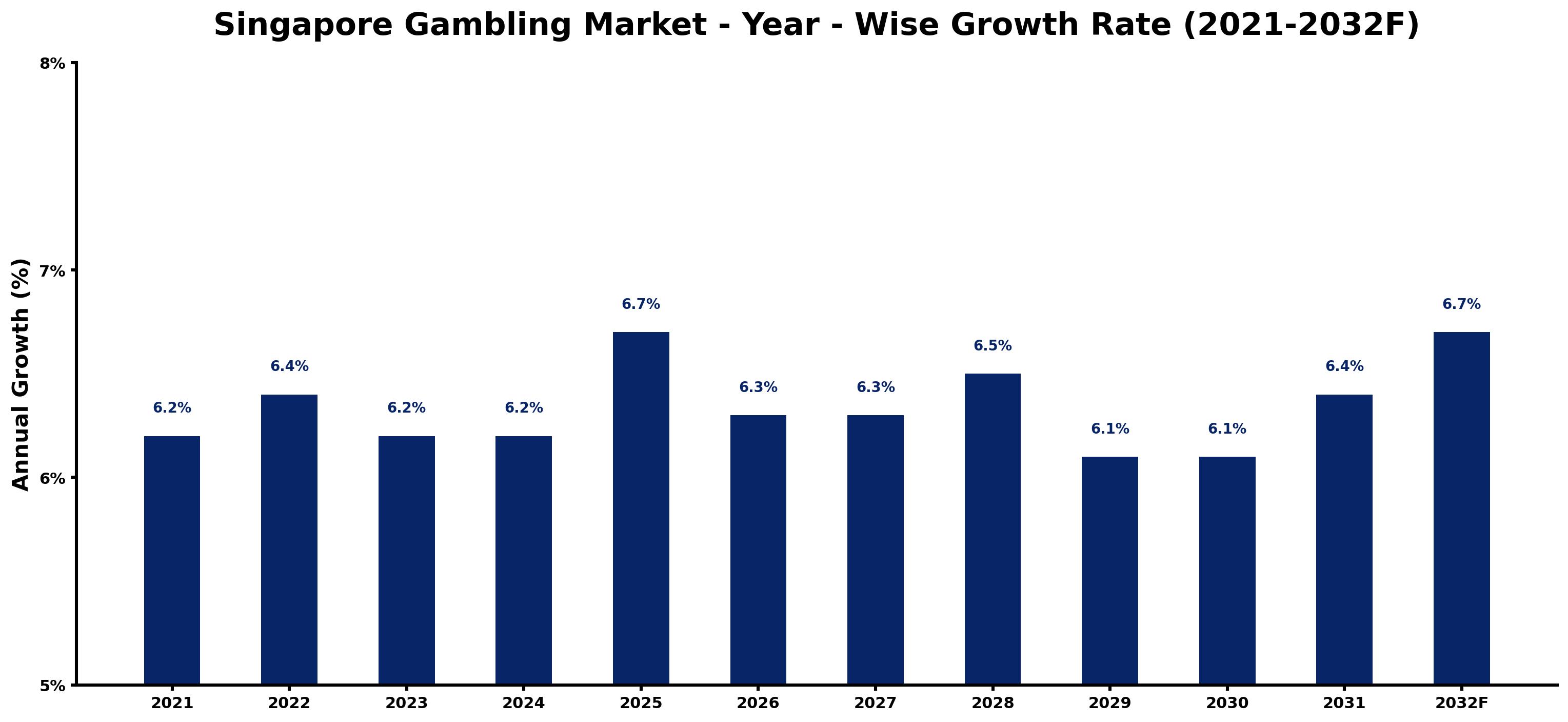
The table below presents the year wise growth rates along with the key drivers influencing the market
| Year | Growth Rate | Major Drivers |
| 2021 | 6.2% | Consumer interest in online gambling surged following pandemic restrictions on physical venues. |
| 2022 | 6.4% | Emerging technologies reshaped the gambling landscape, enhancing user experience and engagement. |
| 2023 | 6.2% | Localized marketing strategies connected with diverse demographics, broadening the market's appeal. |
| 2024 | 6.2% | International collaborations introduced innovative gaming concepts, attracting global attention to Singapore. |
| 2025 | 6.7% | An increase in disposable income allowed more residents to explore recreational gambling options. |
| 2026 | 6.3% | Public discussions on responsible gambling practices emphasized sustainability within the gaming sector. |
| 2027 | 6.3% | The integration of esports betting created new avenues for youthful engagement and participation. |
| 2028 | 6.5% | Partnerships with financial tech firms enabled seamless transactions and boosted consumer confidence. |
| 2029 | 6.1% | Cultural acceptance of gambling continued to evolve, further normalizing various betting activities. |
| 2030 | 6.1% | A shift towards mobile gaming captured the attention of tech-savvy younger audiences. |
| 2031 | 6.4% | Advancements in virtual reality offered immersive experiences, elevating the gambling experience. |
| 2032 | 6.7% | Data analytics provided insights into consumer behavior, optimizing marketing and operational strategies. |
Note - Market size estimations and growth projections presented in this report are based on 6Wresearch's advanced forecasting approach, validated with industry datasets as of June 2026.
Singapore Gambling Market Synopsis
The Singapore Gambling Market is projected to reach 6.3% and witness significant growth during the forecast period (2026-2032). The anticipated growth is primarily driven by a combination of increasing disposable incomes among residents, a surge in tourism, and attractive offers presented by both casinos and online gaming platforms. The regulatory framework governing the gambling sector, characterized by stringent government policies, also plays a pivotal role in shaping the market landscape, fostering an environment conducive to foreign investments across several related sectors such as retail, tourism, and entertainment.
Singapore Gambling Market Growth Drivers
Several factors contribute to the burgeoning growth of the Singapore gambling market. The following points illustrate these key drivers:
- The rise in disposable income has empowered consumers to spend more on leisure activities, including gambling, which in return drives market growth.
- The influx of tourists seeking entertainment options in Singapore has created a vibrant gambling environment where casinos and online platforms can thrive.
- Advances in technology, particularly in payment systems, have facilitated seamless transactions, enhancing the user experience in both physical and online gambling venues.
- Government regulations that promote responsible gaming while simultaneously encouraging overseas investments are fostering a diverse entertainment landscape inclusive of gaming activities.
- Innovative marketing strategies and promotional offers from casinos are increasingly attracting both local and international gamers, further propelling market dynamics.
Singapore Gambling Market Trends and Opportunities
The Singapore gambling market is witnessing evolving trends that are shaping its future landscape. Opportunities abound for stakeholders to capitalise on emerging consumer preferences and technological advancements.
- The potential growth of online gaming platforms emphasizes a shift in consumer behavior, steering towards digital alternatives that offer convenience and a wide array of gaming experiences.
- Enhanced mobile gaming capabilities are likely to boost participation from tech-savvy consumers, leading to further market expansion.
- Integration of Virtual Reality (VR) and Augmented Reality (AR) in gaming experiences is anticipated to attract a younger demographic and elevate the overall entertainment value.
- Collaboration between gaming operators and technology firms to develop innovative gaming solutions may unlock untapped revenue streams and enhance customer engagement.
- Environmental sustainability and responsible gaming initiatives are becoming increasingly important, providing opportunities for brands to resonate with socially conscious consumers.
Singapore Gambling Market Challenges and Restraints
Despite the promising growth trajectory, the Singapore gambling market faces various challenges and constraints that may impact its performance.
- Intense competition among local casinos and international online gaming operators may compress profitability margins, posing challenges for established and emerging players alike.
- Regulatory challenges and compliance costs associated with maintaining licenses and adhering to strict government policies can burden operators, particularly newcomers entering the market.
- Public perception surrounding gambling as a form of entertainment continues to fluctuate, impacting participation rates, especially among local residents.
- Economic fluctuations and changes in disposable income levels resulting from external factors can directly affect consumer spending in the gambling sector.
- Increased focus on responsible gambling and the implementation of related measures may limit promotional activities, thereby restricting growth potential for operators.
Singapore Gambling Market Government Investment and Initiatives
The government of Singapore has undertaken various initiatives aimed at fostering a sustainable gambling market while balancing economic growth and social responsibility. Key government investments and initiatives include:
- Continuous enhancement of infrastructure to support tourism and increase accessibility to major gaming hubs is a priority, boosting the overall attraction of the gambling sector.
- Investment in public awareness campaigns regarding responsible gaming is crucial in promoting a balanced approach to gambling, ensuring that recreational activities remain enjoyable and safe.
- Incentives for cross-industry collaboration are established to encourage synergies between the gambling sector and other industries such as tourism, leveraging combined strengths.
- Regulatory frameworks are regularly reviewed and updated to ensure the gambling market adapts to evolving consumer trends while safeguarding public interests.
- Funding for research initiatives aimed at understanding gambling behaviors and developing effective policies to address potential social impacts is prioritized.
Singapore Gambling Market Latest Developments (May 2025 - June 2026)
In recent months, the Singapore gambling market has undergone significant changes that reflect its dynamic nature. Key developments during the period from May 2025 to June 2026 include:
- The introduction of new regulatory measures aimed at strengthening the integrity of both online and offline gambling platforms, enhancing consumer trust and safety.
- Expansions in the physical infrastructure of casino properties are being observed, aimed at accommodating increasing visitor numbers and providing enhanced guest experiences.
- The adoption of cutting-edge technologies for payment processing is becoming more widespread, facilitating faster and more secure transactions for gamblers.
- Collaborative initiatives between tourism boards and gambling operators have emerged to create enticing packages for international tourists, enhancing Singapore's position as a leading gaming destination.
- Ongoing assessments of gambling impacts on local communities are being conducted to inform future policies and ensure they align with societal values and expectations.
Singapore Gambling Market - Key Attractiveness of the Report
- 10 Years of Market Numbers
- Historical Data Starting from 2022 to 2025
- Base Year: 2025
- Forecast Data until 2032
- Key Performance Indicators Impacting the Market
- Major Upcoming Developments and Projects
Key Highlights of the Report:
- Singapore Gambling Market Outlook
- Market Size of Singapore Gambling Market, 2025
- Forecast of Singapore Gambling Market, 2032F
- Historical Data and Forecast of Singapore Gambling Revenues & Volume for the Period 2022-2032F
- Singapore Gambling Market Trend Evolution
- Singapore Gambling Market Drivers and Challenges
- Singapore Gambling Price Trends
- Singapore Gambling Porter's Five Forces
- Singapore Gambling Industry Life Cycle
- Historical Data and Forecast of Singapore Gambling Market Revenues & Volume By Product Type for the Period 2022-2032F
- Historical Data and Forecast of Singapore Gambling Market Revenues & Volume By Betting for the Period 2022-2032F
- Historical Data and Forecast of Singapore Gambling Market Revenues & Volume By Casino for the Period 2022-2032F
- Historical Data and Forecast of Singapore Gambling Market Revenues & Volume By Lottery for the Period 2022-2032F
- Historical Data and Forecast of Singapore Gambling Market Revenues & Volume By Others for the Period 2022-2032F
- Historical Data and Forecast of Singapore Gambling Market Revenues & Volume By Channel Type for the Period 2022-2032F
- Historical Data and Forecast of Singapore Gambling Market Revenues & Volume By Offline for the Period 2022-2032F
- Historical Data and Forecast of Singapore Gambling Market Revenues & Volume By Online for the Period 2022-2032F
- Historical Data and Forecast of Singapore Gambling Market Revenues & Volume By Virtual Reality VR for the Period 2022-2032F
- Historical Data and Forecast of Singapore Gambling Market Revenues & Volume By Platform for the Period 2022-2032F
- Historical Data and Forecast of Singapore Gambling Market Revenues & Volume By Land-Based for the Period 2022-2032F
- Historical Data and Forecast of Singapore Gambling Market Revenues & Volume By Online for the Period 2022-2032F
- Singapore Gambling Import Export Trade Statistics
- Market Opportunity Assessment By Product Type
- Market Opportunity Assessment By Channel Type
- Market Opportunity Assessment By Platform
- Singapore Gambling Top Companies Market Share
- Singapore Gambling Competitive Benchmarking By Technical and Operational Parameters
- Singapore Gambling Company Profiles
- Singapore Gambling Key Strategic Recommendations






































