Singapore Gamification in Education Market Size & Growth Rate (2026-2032)
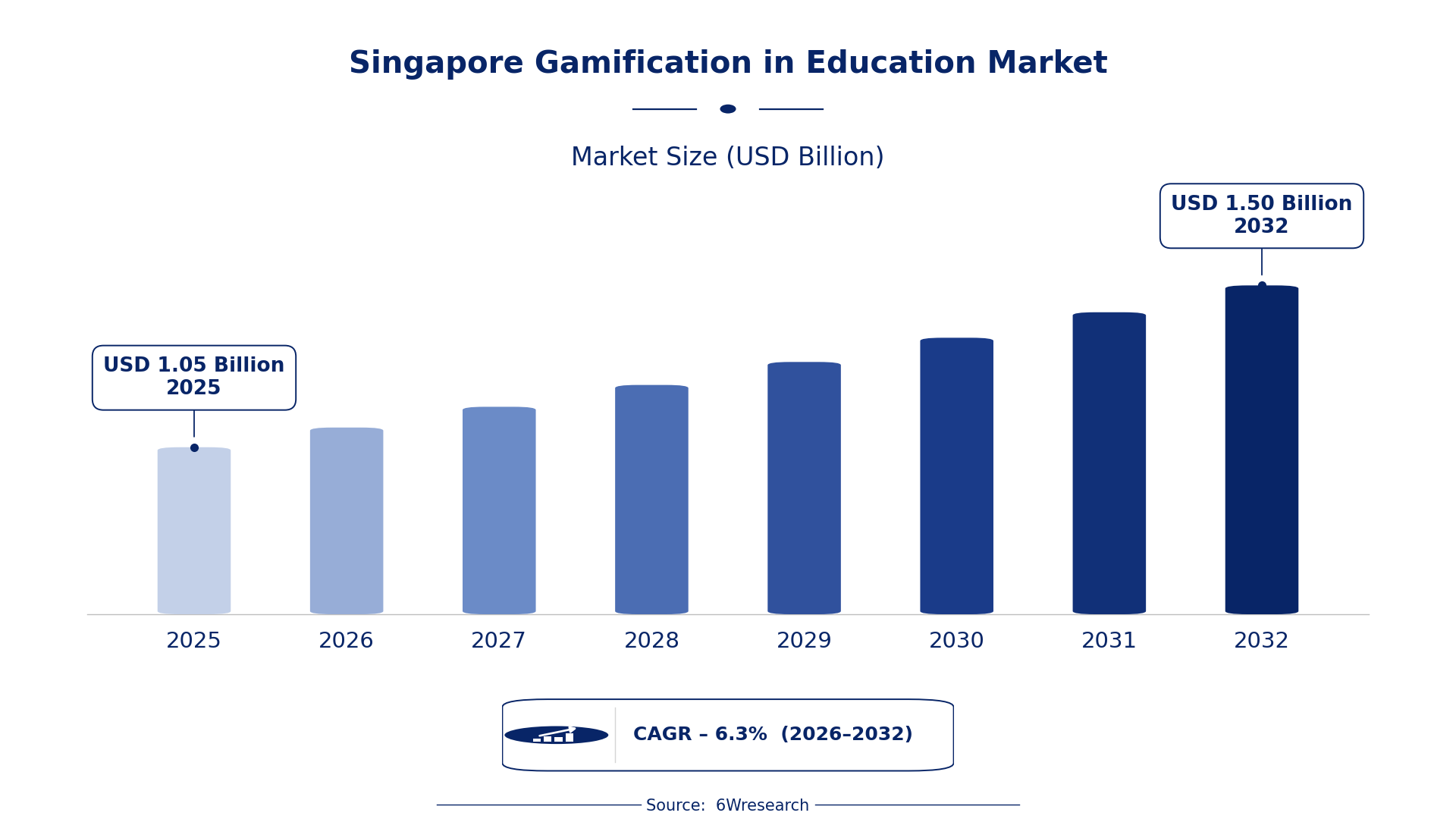
The Singapore Gamification in Education Market was estimated at USD 1046 Million in 2025 and is projected to reach USD 1502 Million by 2032, growing at a CAGR of 6.3% from 2026 to 2032.
Singapore Gamification in Education Market Synopsis
The Singapore Gamification in Education Market is currently riding a wave of innovation, with educational institutions increasingly integrating game mechanics into their teaching methods. This trend has gained traction over recent years, reflecting a substantial shift in pedagogical approaches aimed at fostering a more engaging learning environment.
Looking ahead, the market is expected to evolve further as technology continues to advance. With greater emphasis on personalized learning experiences and digital engagement, gamification will likely become an integral component of educational strategies across Singapore.
Singapore Gamification in Education Market Year-wise Growth Rate and Key Drivers
This graph illustrates the annual growth rates of the Singapore Gamification in Education Market from 2021 to 2032, highlighting a steady upward trajectory and projected expansion over the forecast period.
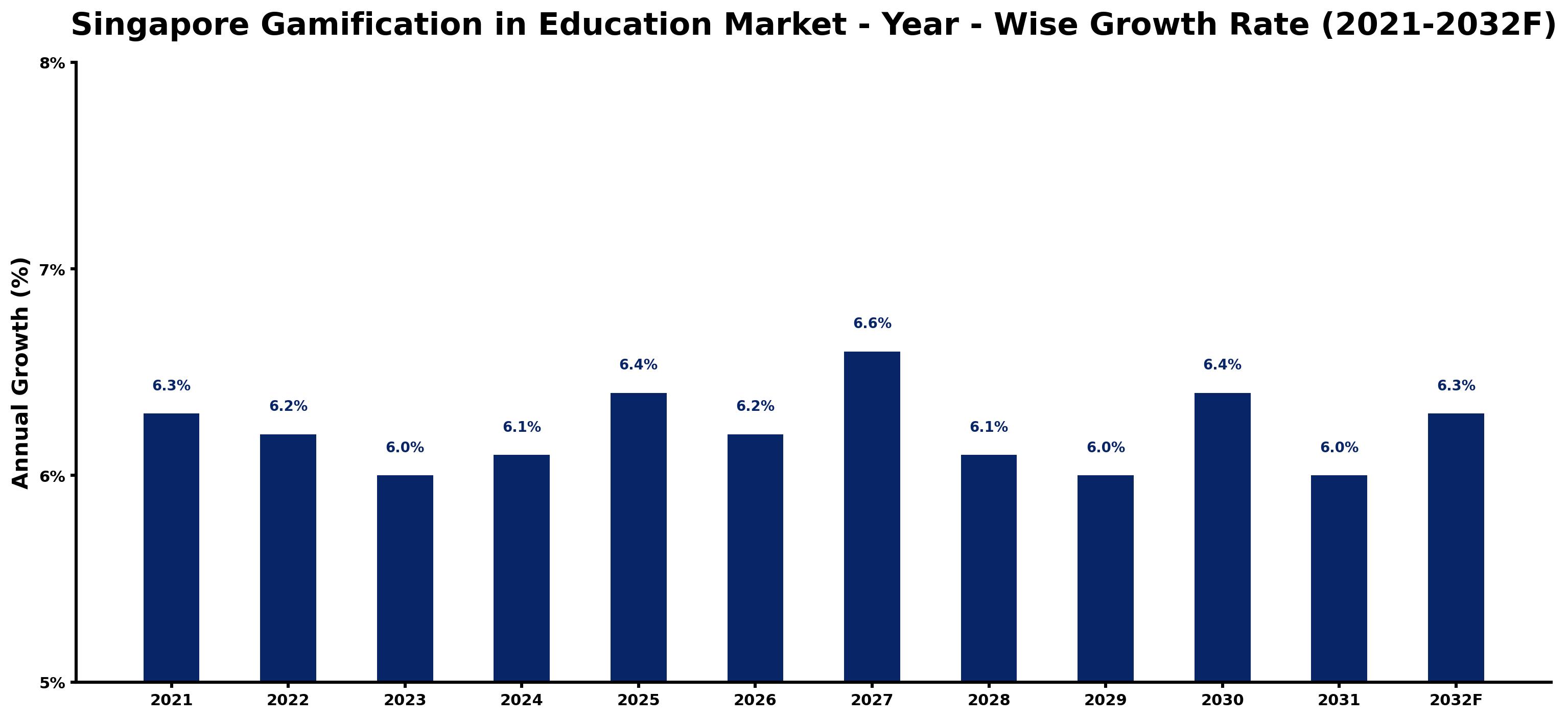
The table below presents the year‑wise growth rates along with the key drivers influencing the market
| Year | Growth Rate | Major Drivers |
| 2021 | 6.3% | Government grants support innovative educational technology adoption. |
| 2022 | 6.2% | Rising student engagement drives gamified learning integration. |
| 2023 | 6.0% | Ministry of Education promotes digital tools for effective learning. |
| 2024 | 6.1% | Emerging EdTech startups enhance gamification in local curriculum. |
| 2025 | 6.4% | Strong internet penetration boosts access to gamified education. |
| 2026 | 6.2% | Educational reforms highlight fun learning methodologies in schools. |
| 2027 | 6.6% | Increased parental interest in gamified learning solutions. |
| 2028 | 6.1% | Collaborations with game developers enrich educational content offerings. |
| 2029 | 6.0% | Corporate sponsorships fund gamification projects in schools. |
| 2030 | 6.4% | Rising awareness of gamification benefits among educators grows. |
| 2031 | 6.0% | Partnerships with tech firms enhance gamified learning experiences. |
| 2032 | 6.3% | Online platforms expand gamified options for remote learners. |
Note: Market size estimations and growth projections presented in this report are based on 6Wresearch's proprietary forecasting methodology, utilizing the latest available industry data, government publications, and primary research inputs.
Singapore Gamification in Education Market Key Takeaways
Below are some of the specific key takeaways from the market, including:
- Gamification strategies are enhancing student engagement and improving learning outcomes in Singapore.
- The shift to digital platforms has accelerated the adoption of gamified educational tools.
- Challenges remain in aligning gamification with curriculum objectives and quality standards.
- Key players are continuously innovating to create immersive and interactive learning experiences.
- Government initiatives are supporting the integration of gamification into educational frameworks.
Evaluation of Restraints in Singapore Gamification in Education Market
Despite the promising growth of gamification in education, several constraints are hindering its full potential. One primary issue is the difficulty in seamlessly incorporating gamification techniques into existing curricula. Educators often struggle to ensure that gamified elements genuinely enhance learning rather than distract from educational goals. Additionally, concerns about excessive screen time for students and the varying quality of gamified content further complicate the integration process. These factors necessitate careful consideration as stakeholders work to optimize gamification in educational settings.
Singapore Gamification in Education Market Trends
Recent trends reveal a strong shift towards personalized and adaptive learning experiences driven by gamification. Educational institutions are increasingly utilizing data analytics to tailor gamified content to individual student needs, thus enhancing motivation and retention. on top of that, the rise of mobile learning applications is facilitating on-the-go access to gamified educational resources, allowing students to engage with material anytime and anywhere.
Singapore Gamification in Education Market Opportunities
The landscape is rife with opportunities for growth and investment, particularly in the development of innovative gamified platforms that cater to diverse learning styles. There’s a notable demand for solutions that can integrate artificial intelligence to provide real-time feedback and adapt to student progress. Additionally, partnerships between educational institutions and technology firms could lead to the creation of more sophisticated gamification tools, enhancing the overall educational experience.
Government Initiatives in the Singapore Gamification in Education Market
Government policy is playing a crucial role in shaping the Gamification in Education Market in Singapore. With a strong focus on digital transformation in education, public sector initiatives are aimed at promoting the use of technology to enhance learning outcomes. The government is prioritizing investments in digital infrastructure, which is essential for the successful implementation of gamified educational solutions.
- A national digital infrastructure upgrade programme launched in early 2025 aims to improve connectivity in schools.
- Current efforts are underway to develop a regulatory framework that supports the integration of gamification into national educational standards.
- A public-private partnership initiative, expected to begin in mid-2026, will fund innovative gamification projects in local schools.
- Recently completed workshops focused on training educators in effective gamification techniques were held in Q3 2025.
- Upcoming initiatives include a national awareness campaign promoting gamification as a means to enhance student engagement.
Future Insights of the Singapore Gamification in Education Market
As we look toward 2026-2032, the Singapore Gamification in Education Market is expected to flourish. The increasing integration of immersive technologies, such as virtual and augmented reality, will further enhance gamified learning experiences. Additionally, as educational institutions continue to adapt to the demands of a digital-first world, the push for innovative teaching methods will solidify gamification's role in shaping the future of education in Singapore.
Singapore Gamification in Education Market Latest Developments
Over the past 12-14 months, the Singapore Gamification in Education Market has seen a surge in activity, driven by technological advancements and a growing recognition of the importance of student engagement. Educational institutions are rapidly adopting new tools and strategies to incorporate gamification into their curricula.
- A major technology vendor announced an expansion of its gamified learning platform in early 2025, enhancing user interactivity features.
- Currently ongoing is a collaborative project between several schools and a regional education tech firm focused on developing customized gamified content.
- A recent product launch in Q2 2025 introduced an innovative gamification tool designed to facilitate real-time feedback for students.
- A planned initiative set to begin in late 2026 aims to integrate artificial intelligence into existing gamified educational frameworks.
Singapore Gamification in Education Market - Key Attractiveness of the Report
- 10 Years of Market Numbers
- Historical Data Starting from 2022 to 2025
- Base Year: 2025
- Forecast Data until 2032
- Key Performance Indicators Impacting the Market
- Major Upcoming Developments and Projects
Key Highlights of the Report:
- Singapore Gamification in Education Market Outlook
- Market Size of Singapore Gamification in Education Market, 2025
- Forecast of Singapore Gamification in Education Market, 2032
- Historical Data and Forecast of Singapore Gamification in Education Revenues & Volume for the Period 2022-2032F
- Singapore Gamification in Education Market Trend Evolution
- Singapore Gamification in Education Market Drivers and Challenges
- Singapore Gamification in Education Price Trends
- Singapore Gamification in Education Porter's Five Forces
- Singapore Gamification in Education Industry Life Cycle
- Historical Data and Forecast of Singapore Gamification in Education Market Revenues & Volume By Offering for the Period 2022-2032F
- Historical Data and Forecast of Singapore Gamification in Education Market Revenues & Volume By Software for the Period 2022-2032F
- Historical Data and Forecast of Singapore Gamification in Education Market Revenues & Volume By Services for the Period 2022-2032F
- Historical Data and Forecast of Singapore Gamification in Education Market Revenues & Volume By End User for the Period 2022-2032F
- Historical Data and Forecast of Singapore Gamification in Education Market Revenues & Volume By Academic for the Period 2022-2032F
- Historical Data and Forecast of Singapore Gamification in Education Market Revenues & Volume By Corporate Training for the Period 2022-2032F
- Historical Data and Forecast of Singapore Gamification in Education Market Revenues & Volume By Deployment Mode for the Period 2022-2032F
- Historical Data and Forecast of Singapore Gamification in Education Market Revenues & Volume By Cloud for the Period 2022-2032F
- Historical Data and Forecast of Singapore Gamification in Education Market Revenues & Volume By On-Premises for the Period 2022-2032F
- Singapore Gamification in Education Import Export Trade Statistics
- Market Opportunity Assessment By Offering
- Market Opportunity Assessment By End User
- Market Opportunity Assessment By Deployment Mode
- Singapore Gamification in Education Top Companies Market Share
- Singapore Gamification in Education Competitive Benchmarking By Technical and Operational Parameters
- Singapore Gamification in Education Company Profiles
- Singapore Gamification in Education Key Strategic Recommendations






































