Singapore Gas Chromatography Systems Market Size, Share & Growth Rate
The Singapore Gas Chromatography Systems Market was estimated at USD 1117 Million in 2025 and is projected to reach USD 1605 Million by 2032, growing at a CAGR of 5.3% from 2026 to 2032. This growth trajectory is underpinned by the increasing demand for advanced analytical instruments across various sectors, particularly in chemical analysis and environmental monitoring. With Singapore's commitment to enhancing its research capabilities and quality control measures, the market is poised for steady expansion in the coming years.
Singapore Gas Chromatography Systems Market Year-wise Growth Rate and Key Drivers
This graph highlights how the Singapore Gas Chromatography Systems Market has steadily grown over the years, supported by major growth factors.
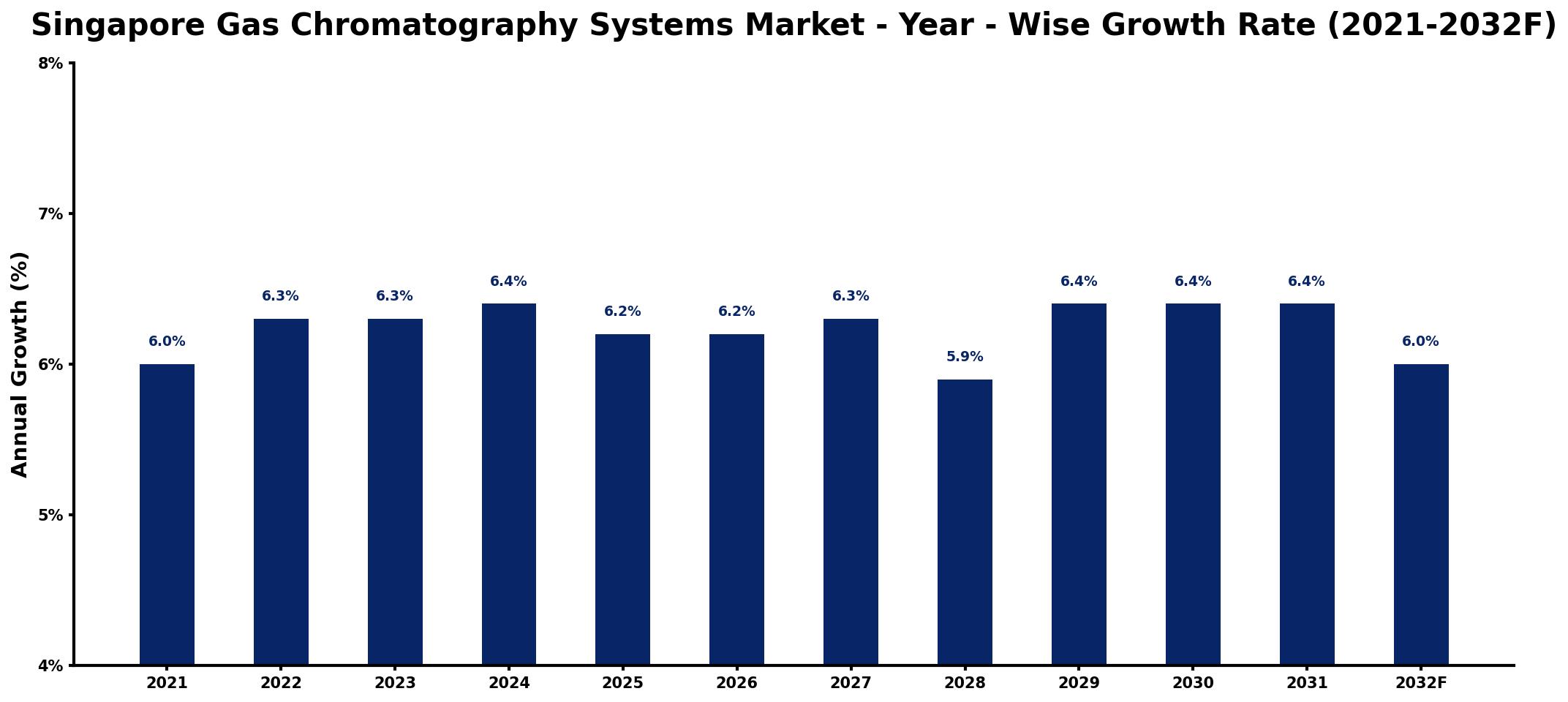
The table below presents the year‑wise growth rates along with the key drivers influencing the market
| Year | Growth Rate | Major Drivers |
| 2021 | 6.0% | Rising demand in pharmaceuticals sector |
| 2022 | 6.3% | Increased investment in research facilities |
| 2023 | 6.3% | Growth in environmental testing applications |
| 2024 | 6.4% | Expansion of food safety regulations |
| 2025 | 6.2% | Surge in petrochemical industry needs |
| 2026 | 6.2% | Boost in academic research initiatives |
| 2027 | 6.3% | Growing focus on quality control |
| 2028 | 5.9% | Emerging biotechnology industry investments |
| 2029 | 6.4% | Increased healthcare sector utilization |
| 2030 | 6.4% | Demand from academic institutions rising |
| 2031 | 6.4% | Strengthened regulations on product safety |
| 2032 | 6.0% | Growing interest in forensic analysis |
Note: Market size estimations and growth projections presented in this report are based on 6Wresearch's proprietary forecasting methodology, utilizing the latest available industry data, government publications, and primary research inputs.
Singapore Gas Chromatography Systems Market Synopsis
Recently, the Singapore gas chromatography systems market has experienced significant momentum, driven by the ongoing evolution of research methodologies and quality assurance practices. However, as the sector moves forward, the need for innovative, user-friendly analytical solutions is becoming more pressing, indicating a dynamic shift in market expectations.
Looking ahead, the demand for gas chromatography systems is set to be fueled by advancements in both technology and regulatory standards. Laboratories are increasingly prioritizing precision and accuracy, prompting a shift toward more sophisticated chromatographic solutions capable of meeting the stringent requirements of modern research and industrial applications.
Singapore Gas Chromatography Systems Market Key Takeaways
- Robust growth is driven by the demand for precision in chemical analysis and environmental monitoring.
- Innovation in chromatography technology is critical to meet evolving laboratory needs.
- Advanced training programs for laboratory personnel are essential to maximize system capabilities.
- Continued governmental focus on scientific research supports market expansion.
- The COVID-19 pandemic highlighted the flexibility and adaptability of manufacturers in the industry.
Evaluation of Restraints in Singapore Gas Chromatography Systems Market
Despite the promising outlook, the Singapore gas chromatography systems market faces certain constraints. A key challenge lies in the rapid pace of technological advancements, which necessitates constant upgrades and investments from manufacturers to keep their product offerings relevant. Furthermore, the high cost associated with advanced analytical equipment can deter smaller laboratories from investing in these essential tools. Thus, there exists a pressing need for companies to balance cutting-edge innovation with affordability to widen market access.
Singapore Gas Chromatography Systems Market Trends
The landscape of the gas chromatography systems market is increasingly influenced by trends that prioritize automation and integration. The rising adoption of cloud-based technologies is enabling real-time data analysis, which enhances productivity and decision-making in laboratories. Additionally, environmental regulations are pushing for more sophisticated analytical capabilities, leading to an uptick in demand for systems that can effectively analyze complex mixtures with higher accuracy and speed.
Singapore Gas Chromatography Systems Market Opportunities
Opportunities abound in the Singapore gas chromatography systems market, especially for players willing to innovate. Developing tailored solutions that cater to specific industries, such as pharmaceuticals or environmental sciences, can help capture niche markets. Moreover, enhancing partnerships with academic institutions and research organizations may facilitate product testing and feedback, ultimately driving further advancements in technology and usability.
Government Initiatives in the Singapore Gas Chromatography Systems Market
The Singapore government has been actively promoting scientific research and technological advancement through various initiatives and funding programs. Investments in research institutions and laboratories not only bolster the demand for gas chromatography systems but also foster collaborations that can lead to innovative applications. Public spending in R&D underscores the commitment to elevating Singapore's status as a global research hub, thereby enhancing market opportunities for analytical equipment providers.
Future Insights of the Singapore Gas Chromatography Systems Market
From 2026 to 2032, the Singapore gas chromatography systems market is expected to experience a paradigm shift characterized by greater emphasis on sustainability and efficiency. As environmental concerns become more prevalent, the demand for gas chromatography systems that can effectively monitor pollutants and ensure compliance with regulations will grow. Furthermore, the integration of artificial intelligence in analytical processes is anticipated to streamline operations and improve accuracy, paving the way for innovative applications in various sectors.
Singapore Gas Chromatography Systems Market Latest Developments (2025 - 2026)
During the past year, the industry has seen significant movements toward enhancing the capabilities of gas chromatography systems, with a focus on sustainability and efficiency. Manufacturers have been responding to the growing demand for automation by introducing more advanced and user-friendly systems that simplify the analytical process. Furthermore, collaborations between research institutions and industry players have started to yield innovative technologies aimed at improving data analysis and interpretation.
Singapore Gas Chromatography Systems Market - Key Attractiveness of the Report
- 10 Years of Market Numbers
- Historical Data Starting from 2022 to 2025
- Base Year: 2025
- Forecast Data until 2032
- Key Performance Indicators Impacting the Market
- Major Upcoming Developments and Projects
Key Highlights of the Report:
- Singapore Gas Chromatography Systems Market Outlook
- Market Size of Singapore Gas Chromatography Systems Market, 2025
- Forecast of Singapore Gas Chromatography Systems Market, 2032
- Historical Data and Forecast of Singapore Gas Chromatography Systems Revenues & Volume for the Period 2022-2032F
- Singapore Gas Chromatography Systems Market Trend Evolution
- Singapore Gas Chromatography Systems Market Drivers and Challenges
- Singapore Gas Chromatography Systems Price Trends
- Singapore Gas Chromatography Systems Porter's Five Forces
- Singapore Gas Chromatography Systems Industry Life Cycle
- Historical Data and Forecast of Singapore Gas Chromatography Systems Market Revenues & Volume By Product for the Period 2022-2032F
- Historical Data and Forecast of Singapore Gas Chromatography Systems Market Revenues & Volume By Systems for the Period 2022-2032F
- Historical Data and Forecast of Singapore Gas Chromatography Systems Market Revenues & Volume By Detectors for the Period 2022-2032F
- Historical Data and Forecast of Singapore Gas Chromatography Systems Market Revenues & Volume By Auto-samplers for the Period 2022-2032F
- Historical Data and Forecast of Singapore Gas Chromatography Systems Market Revenues & Volume By Fraction Collectors for the Period 2022-2032F
- Historical Data and Forecast of Singapore Gas Chromatography Systems Market Revenues & Volume By Other Products for the Period 2022-2032F
- Historical Data and Forecast of Singapore Gas Chromatography Systems Market Revenues & Volume By End User for the Period 2022-2032F
- Historical Data and Forecast of Singapore Gas Chromatography Systems Market Revenues & Volume By Pharmaceutical and Bioindustries for the Period 2022-2032F
- Historical Data and Forecast of Singapore Gas Chromatography Systems Market Revenues & Volume By Academic Research Institutes for the Period 2022-2032F
- Historical Data and Forecast of Singapore Gas Chromatography Systems Market Revenues & Volume By Other End Users for the Period 2022-2032F
- Singapore Gas Chromatography Systems Import Export Trade Statistics
- Market Opportunity Assessment By Product
- Market Opportunity Assessment By End User
- Singapore Gas Chromatography Systems Top Companies Market Share
- Singapore Gas Chromatography Systems Competitive Benchmarking By Technical and Operational Parameters
- Singapore Gas Chromatography Systems Company Profiles
- Singapore Gas Chromatography Systems Key Strategic Recommendations






































