Singapore Gift Retailing Market Summary
The singapore gift retailing market was estimated at USD 826 Million in 2025 and is projected to reach USD 1377 Million by 2032, growing at a CAGR of 8.7% from 2026 to 2032.
Singapore Gift Retailing Market Year-wise Growth Rate and Key Drivers
This graph highlights how the Singapore Gift Retailing Market has steadily grown over the past five years, supported by major growth factors.
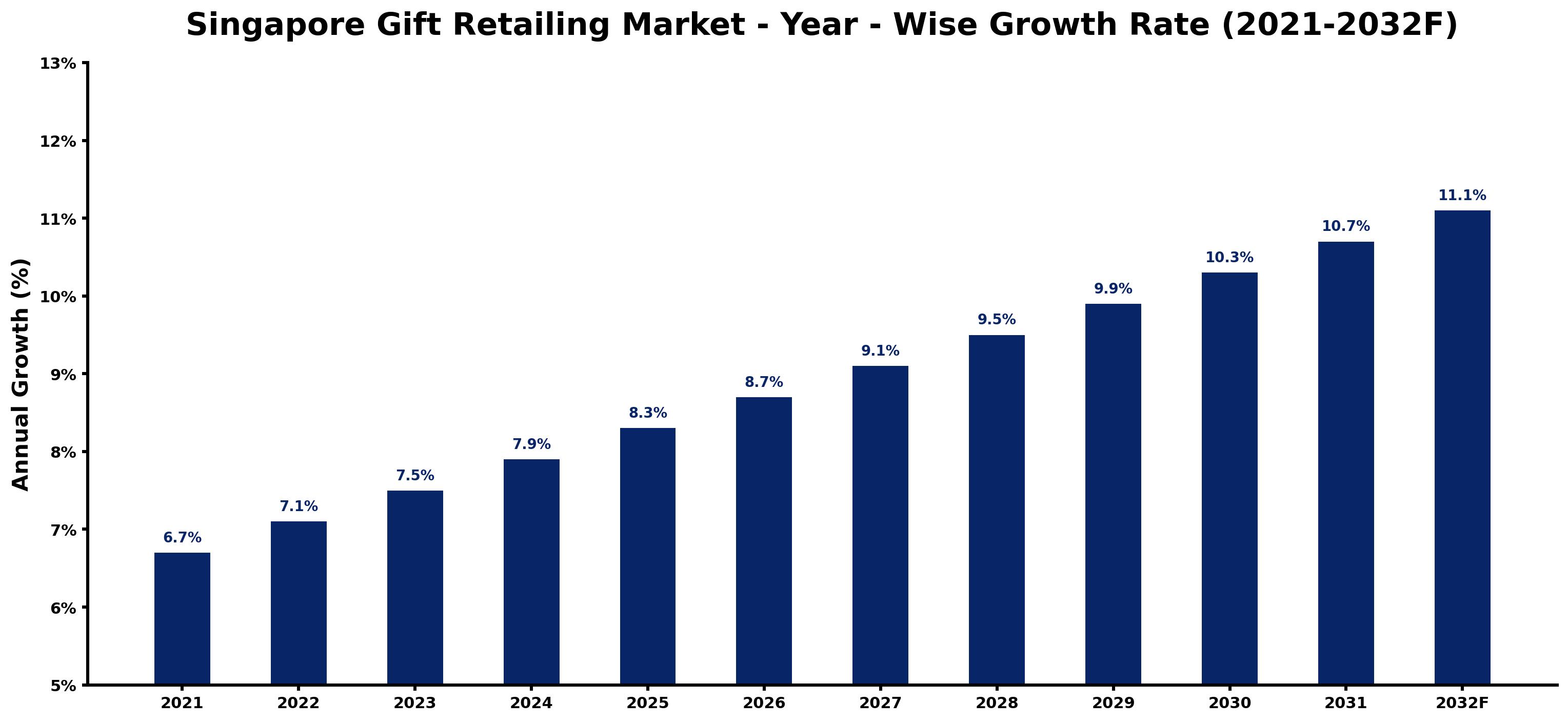
The table below presents the year wise growth rates along with the key drivers influencing the market
| Year | Growth Rate | Major Drivers |
| 2021 | 6.7% | Local artisans and brands gained prominence as consumers sought unique gifts. |
| 2022 | 7.1% | Online shopping provided convenience, reshaping how consumers buy gifts in Singapore. |
| 2023 | 7.5% | Corporate gifting trends highlighted the importance of personalized and sustainable options. |
| 2024 | 7.9% | Millennials and Gen Z's increasing purchasing power shifted market dynamics significantly. |
| 2025 | 8.3% | Seasonal celebrations and events led to spikes in demand for specialized gift items. |
| 2026 | 8.7% | Sustainability-focused brands tapped into conscious consumerism for market growth opportunities. |
| 2027 | 9.1% | Technological innovations enhanced the online shopping experience for local gift retailers. |
| 2028 | 9.5% | Collaborations between brands and local artists fostered unique, limited-edition products. |
| 2029 | 9.9% | Social media campaigns significantly influenced gifting trends and consumer choices. |
| 2030 | 10.3% | The rise of experiential gifts reflected changing preferences towards memorable experiences. |
| 2031 | 10.7% | Emerging gifting occasions expanded the market beyond traditional celebrations and holidays. |
| 2032 | 11.1% | Cross-border e-commerce allowed local retailers to access international markets seamlessly. |
Note - Market size estimations and growth projections presented in this report are based on 6Wresearch's advanced forecasting approach, validated with industry datasets as of June 2026.
Singapore Gift Retailing Market Synopsis
The Singapore Gift Retailing Market is projected to reach 8.7% and witness significant growth during the forecast period (2026-2032). This growth trajectory is primarily driven by the increasing demand for luxury gifting options and the rising prevalence of online shopping. As consumer preferences shift towards personalized and unique gifting solutions, the market is adapting to satisfy these evolving needs.
Singapore Gift Retailing Market Growth Drivers
Several factors are propelling the Singapore Gift Retailing Market forward. One of the most notable growth drivers is the escalating demand for premium and luxury gifts, which has been encouraged by higher disposable incomes among the populace. As consumers exhibit a growing inclination towards luxury goods, the market has seen a parallel increase in sales of high-end gifting items.
- Rising disposable incomes have allowed consumers to invest in luxury items, such as leather goods and artisanal products, resulting in heightened sales volumes.
- The proliferation of e-commerce platforms has made it easier for consumers to access luxury gifts, thereby expanding market reach.
- Consumer awareness regarding product quality and brand reputation has shifted purchasing behavior towards premium products.
- Innovations in product design and marketing have enhanced the appeal of unique gifting options, thereby driving sales.
- Seasonal events and celebrations have fostered increased expenditure in the gifting sector, particularly during festivals and special occasions.
Singapore Gift Retailing Market Trends and Opportunities
The Singapore Gift Retailing Market is witnessing several evolving trends that present lucrative opportunities for growth. The younger generations are increasingly inclined towards gifting items that reflect personal connection and uniqueness, propelling demand for customized products.
- Social media platforms play a crucial role in shaping consumer preferences and trends, particularly among millennials who are seeking personalized gifting solutions.
- The trend towards sustainable and eco-friendly gifts is gaining traction, driving retailers to offer products that align with ethical consumption criteria.
- Technological advancements are enhancing the shopping experience, with augmented reality (AR) and virtual reality (VR) influencing how consumers engage with products.
- Collaborations between brands and artists are leading to exclusive product lines, attracting consumers looking for unique gifting options.
- Gift subscription services are emerging, providing customers with curated gift selections tailored to their preferences, thus simplifying the shopping process.
Singapore Gift Retailing Market Challenges and Restraints
Despite its anticipated growth, the Singapore Gift Retailing Market faces several challenges. The competition from unorganized retailers continues to pose a significant threat to established market players.
- The presence of local unorganized retailers, who often offer lower prices, can undermine the pricing strategies of organized players.
- Market saturation in certain segments leads to intense competition, making differentiation crucial for sustaining market share.
- Fluctuations in consumer spending, particularly during economic downturns, can adversely affect the gifting industry.
- The pandemic-induced shift in consumer behavior has created a permanent change in how gifts are purchased, challenging traditional retail strategies.
- Supply chain disruptions can affect product availability and pricing, impacting overall sales performance in the market.
Singapore Gift Retailing Market Government Investment and Initiatives
The Singapore government recognizes the importance of the retail sector, including the gift retailing market, in driving economic growth and employment. Policymakers have implemented various initiatives to support the industry, aimed at enhancing innovation and resilience.
- Investment in digital infrastructure has been a priority, encouraging retailers to transition online and capitalize on e-commerce growth.
- Government grants and incentives are available for businesses that adopt technology to improve their operations and customer engagement.
- Training programs are promoted to enhance the skill sets of retail employees, focusing on customer service excellence and digital marketing strategies.
- Public campaigns aimed at promoting local products are designed to encourage consumer spending within the domestic market.
- Collaborative efforts between the government and industry stakeholders seek to establish Singapore as a regional retail hub, facilitating cross-border trade opportunities.
Singapore Gift Retailing Market Latest Developments (May 2025 - June 2026)
Recent developments within the Singapore Gift Retailing Market from May 2025 to June 2026 indicate a dynamic shift toward digitalization and personalization. Retailers are increasingly leveraging technology to enhance customer experiences and streamline operations.
- The introduction of AI-powered chatbots and personalized shopping experiences are revolutionizing customer interaction in the retail space.
- Partnerships between tech companies and retailers are fostering innovation in product offerings and marketing strategies.
- The rise of social commerce is leading to integration of e-commerce platforms with social media, allowing for seamless purchasing experiences.
- Growing awareness around health and well-being has resulted in an increase in demand for wellness-related gift products.
- Retailers are focusing on omnichannel strategies to provide consumers with a cohesive shopping experience across online and offline platforms.
Singapore Gift Retailing Market - Key Attractiveness of the Report
- 10 Years of Market Numbers
- Historical Data Starting from 2022 to 2025
- Base Year: 2025
- Forecast Data until 2032
- Key Performance Indicators Impacting the Market
- Major Upcoming Developments and Projects
Key Highlights of the Report:
- Singapore Gift Retailing Market Outlook
- Market Size of Singapore Gift Retailing Market, 2025
- Forecast of Singapore Gift Retailing Market, 2032F
- Historical Data and Forecast of Singapore Gift Retailing Revenues & Volume for the Period 2022-2032F
- Singapore Gift Retailing Market Trend Evolution
- Singapore Gift Retailing Market Drivers and Challenges
- Singapore Gift Retailing Price Trends
- Singapore Gift Retailing Porter's Five Forces
- Singapore Gift Retailing Industry Life Cycle
- Historical Data and Forecast of Singapore Gift Retailing Market Revenues & Volume By Product Type for the Period 2022-2032F
- Historical Data and Forecast of Singapore Gift Retailing Market Revenues & Volume By Souvenirs and Novelty Items for the Period 2022-2032F
- Historical Data and Forecast of Singapore Gift Retailing Market Revenues & Volume By Seasonal Decorations for the Period 2022-2032F
- Historical Data and Forecast of Singapore Gift Retailing Market Revenues & Volume By Greeting Cards for the Period 2022-2032F
- Historical Data and Forecast of Singapore Gift Retailing Market Revenues & Volume By Giftware? for the Period 2022-2032F
- Historical Data and Forecast of Singapore Gift Retailing Market Revenues & Volume By Other? for the Period 2022-2032F
- Historical Data and Forecast of Singapore Gift Retailing Market Revenues & Volume By Distribution Channel for the Period 2022-2032F
- Historical Data and Forecast of Singapore Gift Retailing Market Revenues & Volume By Online for the Period 2022-2032F
- Historical Data and Forecast of Singapore Gift Retailing Market Revenues & Volume By Offline for the Period 2022-2032F
- Singapore Gift Retailing Import Export Trade Statistics
- Market Opportunity Assessment By Product Type
- Market Opportunity Assessment By Distribution Channel
- Singapore Gift Retailing Top Companies Market Share
- Singapore Gift Retailing Competitive Benchmarking By Technical and Operational Parameters
- Singapore Gift Retailing Company Profiles
- Singapore Gift Retailing Key Strategic Recommendations






































