Singapore Glass Market: Import Trend Analysis
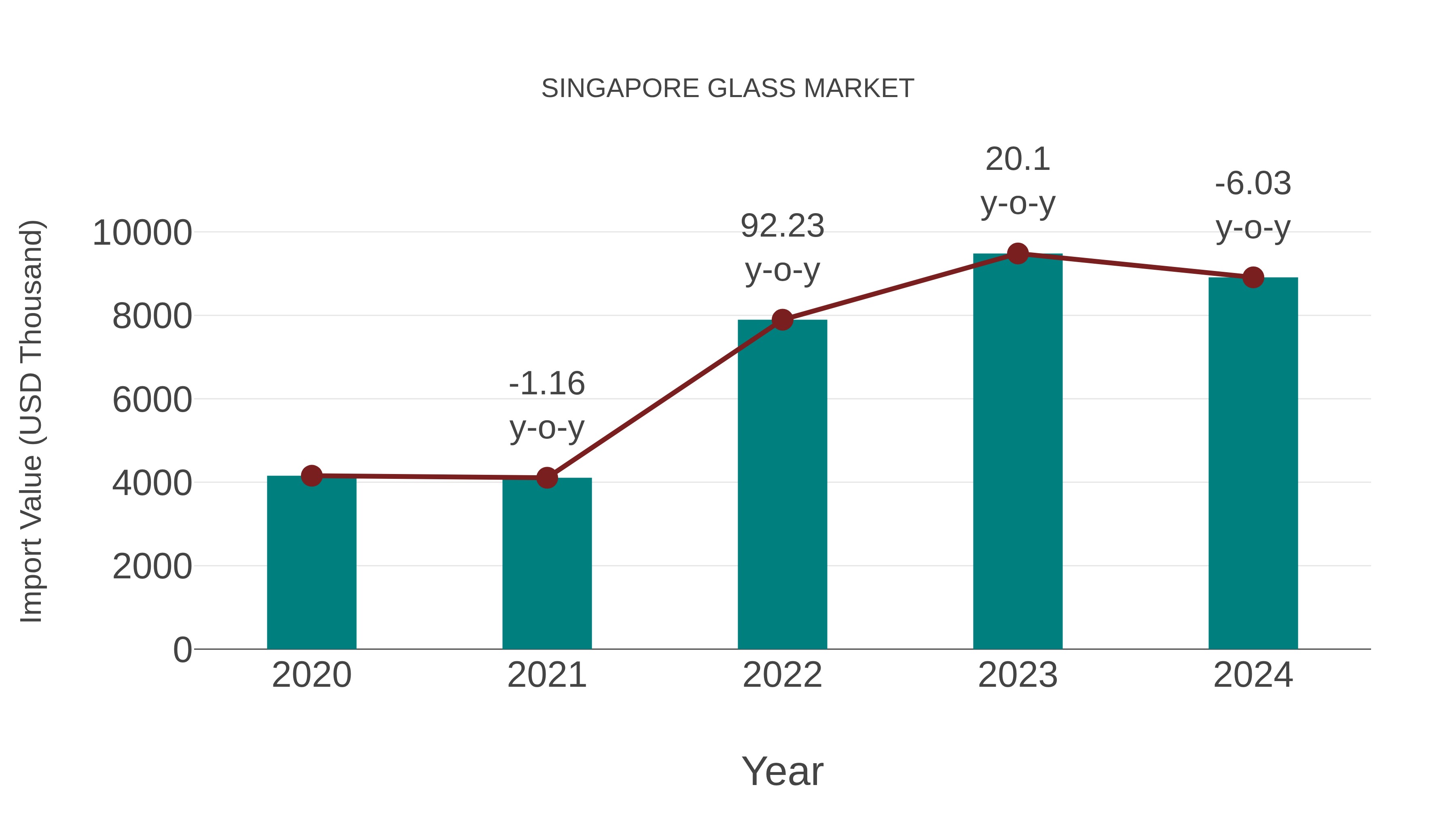
In 2024, Singapore`s glass market witnessed a -6.03% decline in import growth compared to the previous year. However, the compound annual growth rate (CAGR) between 2020 and 2024 stood at a healthy 21.01%. This decline in import momentum in 2024 could be attributed to shifting consumer preferences or changes in trade policies impacting market stability.
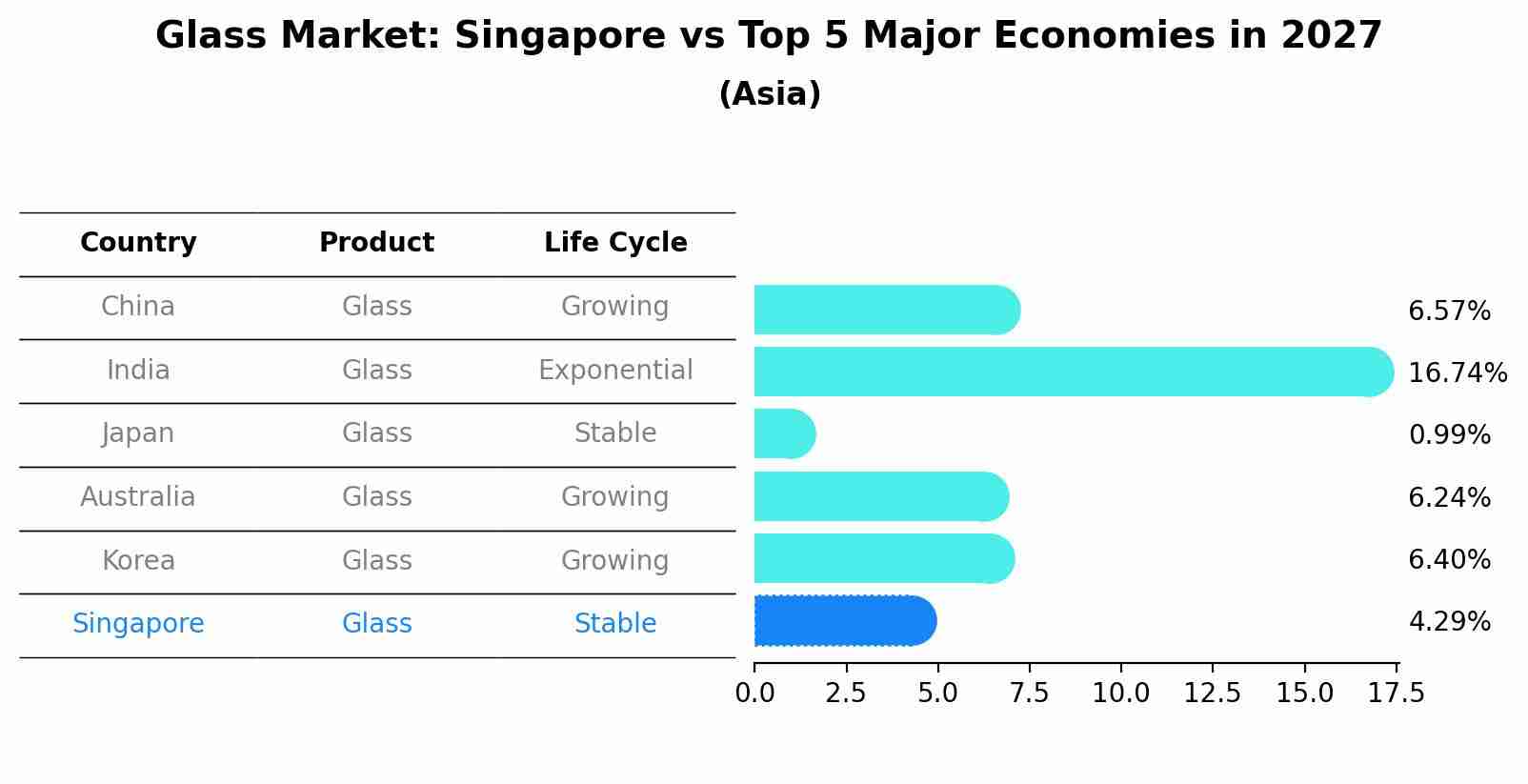
Glass Market: Singapore vs Top 5 Major Economies in 2027 (Asia)
By 2027, Singapore's Glass market is forecasted to achieve a stable growth rate of 4.29%, with China leading the Asia region, followed by India, Japan, Australia and South Korea.
singapore glass market Synopsis
The Singapore glass market was valued at USD 1.12 billion in 2020 and is estimated to reach USD 1.51 billion by 2026, growing at a CAGR of 4.9% during the forecast period from 2021 to 2026. The increasing demand for glass products such as toughened and laminated glasses across various end-use industries has driven the growth of the market in Singapore over recent years. Moreover, rising construction activities in the country are also aiding to propel the growth of this particular industry segment. Furthermore, technological advancements have led manufacturers to introduce highly efficient safety glasses that will attract consumer attention and encourage product adoption over the coming years which is anticipated to drive further market opportunities for players operating within this sector during 2021?2026 timeframe.
Key Highlights of the Report:
- Singapore Glass Market Outlook
- Market Size of Singapore Glass Market, 2019
- Forecast of Singapore Glass Market, 2026
- Historical Data and Forecast of Singapore Glass Revenues & Volume for the Period 2016 - 2026
- Singapore Glass Market Trend Evolution
- Singapore Glass Market Drivers and Challenges
- Singapore Glass Price Trends
- Singapore Glass Porter's Five Forces
- Singapore Glass Industry Life Cycle
- Historical Data and Forecast of Singapore Glass Market Revenues & Volume By Product Types for the Period 2016 - 2026
- Historical Data and Forecast of Singapore Glass Market Revenues & Volume By Basic for the Period 2016 - 2026
- Historical Data and Forecast of Singapore Glass Market Revenues & Volume By Tempered for the Period 2016 - 2026
- Historical Data and Forecast of Singapore Glass Market Revenues & Volume By Laminated for the Period 2016 - 2026
- Historical Data and Forecast of Singapore Glass Market Revenues & Volume By Insulated for the Period 2016 - 2026
- Historical Data and Forecast of Singapore Glass Market Revenues & Volume By Others for the Period 2016 - 2026
- Historical Data and Forecast of Singapore Glass Market Revenues & Volume By Applications for the Period 2016 - 2026
- Historical Data and Forecast of Singapore Glass Market Revenues & Volume By Architectural for the Period 2016 - 2026
- Historical Data and Forecast of Singapore Glass Market Revenues & Volume By Automotive & transportation for the Period 2016 - 2026
- Historical Data and Forecast of Singapore Glass Market Revenues & Volume By Others for the Period 2016 - 2026
- Historical Data and Forecast of Singapore Glass Market Revenues & Volume By Technology Types for the Period 2016 - 2026
- Historical Data and Forecast of Singapore Glass Market Revenues & Volume By Float for the Period 2016 - 2026
- Historical Data and Forecast of Singapore Glass Market Revenues & Volume By Rolled for the Period 2016 - 2026
- Historical Data and Forecast of Singapore Glass Market Revenues & Volume By Sheet for the Period 2016 - 2026
- Singapore Glass Import Export Trade Statistics
- Market Opportunity Assessment By Product Types
- Market Opportunity Assessment By Applications
- Market Opportunity Assessment By Technology Types
- Singapore Glass Top Companies Market Share
- Singapore Glass Competitive Benchmarking By Technical and Operational Parameters
- Singapore Glass Company Profiles
- Singapore Glass Key Strategic Recommendations






































