Singapore Gold Bullion Market: Import Trend Analysis
The Singapore gold bullion market witnessed a notable import trend from 2023 to 2024, with a growth rate of 35.74%. The compound annual growth rate (CAGR) for the period 2020-2024 stood at 14.9%. This surge in imports can be attributed to a significant shift in investor demand towards safe-haven assets amidst global economic uncertainties during this period.
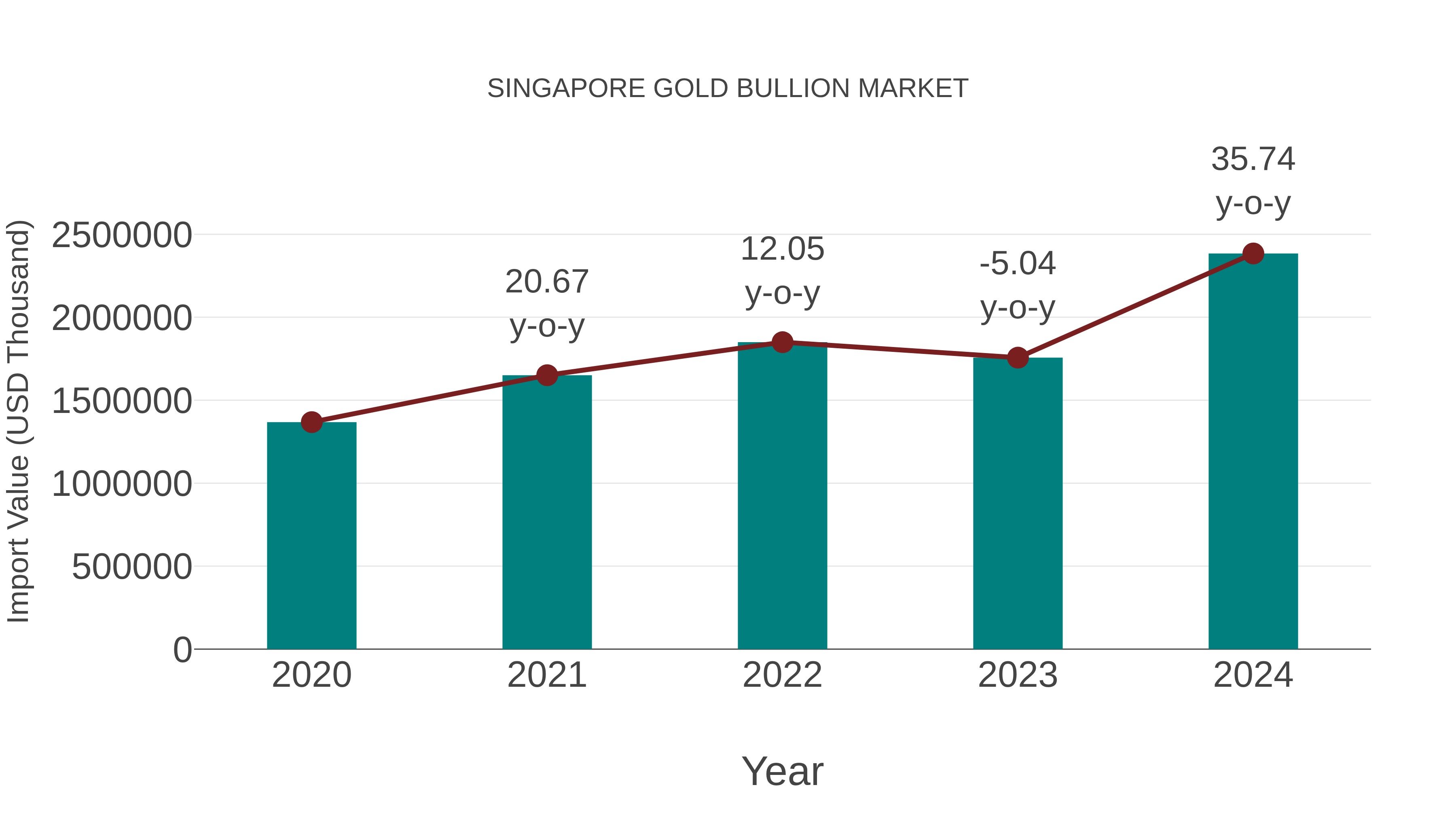
Singapore Gold Bullion Market Growth Rate
According to 6Wresearch internal database and industry insights, the Singapore Gold Bullion Market is projected to grow at a compound annual growth rate (CAGR) of 12.5% during the forecast period 2026–2032.
Topics Covered in the Singapore Gold Bullion Market Report
The Singapore Gold Bullion Market report thoroughly covers the market by type, and distribution channel. It provides an unbiased and detailed analysis of ongoing market trends, opportunities, challenges, and market drivers, helping stakeholders align their strategies with current and future market dynamics.
Singapore Gold Bullion Market Highlights
| Report Name | Singapore Gold Bullion Market |
| Forecast period | 2026-2032 |
| CAGR | 12.5% |
| Growing Sector |
Precious Metal Investments |
Singapore Gold Bullion Market Synopsis
The Singapore Gold Bullion Market is expected to experience significant expansion; This is mainly proliferated by its status as a major financial hub in Asia. Through the growing importance of gold as a hedge against economic uncertainty, the requirement for gold is spurring and Singapore is becoming a major centre for the trading and storage of gold owing to its solid financial infrastructure. The Singapore Gold Bullion Market Growth is proliferating owing to the rising participation of high-net-worth individuals.
Evaluation of Growth Drivers in the Singapore Gold Bullion Market
Below mentioned are some prominent drivers and their influence on the Singapore Gold Bullion Market dynamics:
| Drivers | Primary Segment Affected | Why It Matters (Evidence) |
| Government Support for Gold Investment | Distribution Channel, End-User | Singapore's financial regulations and initiatives, such as the establishment of gold-backed ETFs and tax incentives, are fostering a favorable investment environment. |
| Rising Demand for Hedging Against Inflation | Type, End-User | To safeguard their wealth from inflation more investors are turning to gold bullion as a reliable store of value. |
| Expansion of Digital Gold Platforms | Distribution Channel, Type | The growth in digital platforms for purchasing and selling gold is making it more attainable to retail investors. |
| Growing Awareness of Diversification | Distribution Channel, End-User | Investors are increasingly recognizing gold as an essential component of a diversified investment portfolio, leading to more demand for bullion. |
The Singapore Gold Bullion Market is projected to grow at a CAGR of 12.5% from 2026 to 2032. Growth is proliferated by robust requirement from both institutional investors and retail buyers wanting gold as a safe-haven investment. Market is expanding quickly owing to government support for gold-backed investment instruments and a favourable regulatory environment. Rising allocation of money for the advantages of gold as a diversified investment option is accelerating demand, making it a highly appealing asset in the financial market.
Evaluation of Restraints in the Singapore Gold Bullion Market
Below mentioned are some major restraints and their influence on the Singapore Gold Bullion Market dynamics:
| Restraints | Primary Segment Affected | What This Means (Evidence) |
| Fluctuating Gold Prices | All Segments | Gold prices are subject to fluctuations, which may affect investor confidence and lead to market instability. |
| Regulatory Challenges | Distribution Channel, Type | The evolving regulatory landscape could introduce uncertainties that affect the growth of the gold bullion market. |
| High Transaction Costs | All Segments | Few investors can get put off owing to the transaction costs linked with purchasing, storing, and insuring gold. |
| Competition from Other Investment Assets | End-User | Investors may choose other asset classes, like stocks and bonds, over gold bullion. |
Singapore Gold Bullion Market Challenges
The Singapore Gold Bullion Industry go through challenges like changing gold prices, which may deter some potential investors. Market expansion can get restricted owing to regulatory hurdles, particularly regarding taxation and compliance and there are also increased transaction prices linked with buying, storing, and insuring gold, which might affect retail investors. The competition from other investment assets, such as stocks and cryptocurrencies, could also impact the demand for gold bullion and market growth can slow down owing to the volatility of global economic conditions.
Singapore Gold Bullion Market Trends
Several notable trends are shaping the Singapore Gold Bullion Market dynamics:
- Rise of Digital Gold Platforms: Gold has become attainable to a wider audience owing to the advancement of online platforms for buying, selling, and trading gold.
- Gold ETFs Gaining Popularity: Institutional investors seeking exposure to gold without directly purchasing physical bullion is spurring via exchange-traded funds (ETFs).
- Increase in Sustainable Gold Investments: The need for responsible mining practices is spurring owing to investors showcasing a rising inclination towards in sustainably sourced gold.
- Gold as an Inflation Hedge: As worldwide inflationary pressures increases; investors are highly turning to gold as a protection against currency depreciation.
Investment Opportunities in the Singapore Gold Bullion Industry
Some notable investment opportunities in the Singapore Gold Bullion Market include:
- Investment in Digital Gold Platforms: There are various prospects there to allocate money in companies giving digital gold trading platforms owing to digital gold becoming more attainable.
- Gold ETFs and Funds: To get exposure to gold without owning physical bullion is happing owing to investors can capitalize on the rising popularity of gold ETFs, which give an easy way.
- Sustainable Gold Investments: With rising requirement for ethically sourced gold, allocation of money in sustainable mining practices and products are expected to appeal major interest from investors.
Top 5 Leading Players in the Singapore Gold Bullion Market
Below is the list of prominent companies leading in the Singapore Gold Bullion Market:
1. BullionStar
| Company Name | BullionStar |
|---|---|
| Established Year | 2013 |
| Headquarters | Singapore |
| Official Website | Click Here |
BullionStar is a leading precious metals dealer in Singapore offering a wide range of gold, silver, and other bullion products. Known for its transparent pricing and secure storage solutions, it provides both retail and institutional investors.
2. Silver Bullion
| Company Name | Silver Bullion |
|---|---|
| Established Year | 2008 |
| Headquarters | Singapore |
| Official Website | Click Here |
Silver Bullion specializes in providing a diverse selection of precious metals, including gold and silver bullion products. With secure storage services and a strong reputation in the Singapore market, it provides to investors seeking physical ownership of precious metals.
3. Global Precious Metals
| Company Name | Global Precious Metals |
|---|---|
| Established Year | 2012 |
| Headquarters | Singapore |
| Official Website | - |
Global Precious Metals is a major bullion distributor and dealer in Singapore, providing a range of gold bars, coins, and investment products.
4. Gold Silver Central
| Company Name | Gold Silver Central |
|---|---|
| Established Year | 2008 |
| Headquarters | Singapore |
| Official Website | - |
Gold Silver Central is a leading precious metals retailer and storage provider in Singapore, offering gold and silver bullion products. It concentrates on reliability, customer service, and secure storage solutions, making it a trusted name in the market.
5. Indigo Precious Metals
| Company Name | Indigo Precious Metals |
|---|---|
| Established Year | 2016 |
| Headquarters | Singapore |
| Official Website | Click Here |
Indigo Precious Metals is a bullion dealer giving a variety of gold and silver products, with services tailored toward both new and experienced investors. It emphasizes education and transparent pricing to support investor decisions.
Government Regulations Introduced in the Singapore Gold Bullion Market
According to Singapore's government data, various initiatives that make a favourable environment for gold bullion investment has been introduced by the government. Initiatives are present to make certain the transparency and safety of bullion transactions like the advancement of gold-backed ETFs and to sustain Singapore's position as a world-wide gold trading hub by continually enhancing regulatory standards there is active work happing by the government for it. The Monetary Authority of Singapore (MAS) makes sure the smooth functioning of gold trading, giving a secure environment for both institutional and retail investors.
Future Insights of the Singapore Gold Bullion Market
The Singapore Gold Bullion Market is poised for steady growth, it is proliferated by the city-state's strategic location as a financial hub and its robust infrastructure for trading and storing precious metals. The growing requirement for gold as an investment asset and a hedge against inflation will persist to proliferate the Singapore Gold Bullion Market Growth. The growing popularity of gold-backed financial instruments, like ETFs and digital gold, is predicted to make gold more attainable to a broader range of investors, further proliferating its market potential.
Market Segmentation Analysis
The report offers a comprehensive study of the following market segments and their leading categories:
By Type – Gold Bar to dominate the market:
Gold bars are expected to lead the Singapore Gold Bullion Market Share owing to their higher value and appeal among institutional investors and high-net-worth individuals looking for larger investments.
By Distribution Channel – Online to dominate the market:
According to Mansi Ahuja, Senior Research Analyst at 6Wresearch, Online distribution channels are projected to lead the market as they give convenience, accessibility, and lower transaction costs, creating gold bullion more accessible to retail investors.
Key Attractiveness of the Report
- 10 Years of Market Numbers
- Historical Data Starting from 2022 to 2025
- Base Year: 2025
- Forecast Data until 2032
- Key Performance Indicators Impacting the Market
- Major Upcoming Developments and Projects
Key Highlights of the Report:
- Singapore Gold Bullion Market Outlook
- Market Size of Singapore Gold Bullion Market, 2025
- Forecast of Singapore Gold Bullion Market, 2032
- Historical Data and Forecast of Singapore Gold Bullion Revenues & Volume for the Period 2022-2032
- Singapore Gold Bullion Market Trend Evolution
- Singapore Gold Bullion Market Drivers and Challenges
- Singapore Gold Bullion Price Trends
- Singapore Gold Bullion Porter's Five Forces
- Singapore Gold Bullion Industry Life Cycle
- Historical Data and Forecast of Singapore Gold Bullion Market Revenues & Volume By Type for the Period 2022-2032
- Historical Data and Forecast of Singapore Gold Bullion Market Revenues & Volume By Distribution Channel for the Period 2022-2032
- Singapore Gold Bullion Import-Export Trade Statistics
- Market Opportunity Assessment By Type
- Market Opportunity Assessment By Distribution Channel
- Singapore Gold Bullion Top Companies Market Share
- Singapore Gold Bullion Competitive Benchmarking By Technical and Operational Parameters
- Singapore Gold Bullion Key Strategic Recommendations
Market Covered
The report offers a comprehensive study of the subsequent market segments:
By Type:
- Gold Bar
- Gold Coin
By Distribution Channel:
- Online
- Offline






































