Singapore Graph Database Market Size & Growth Rate (2026-2032)
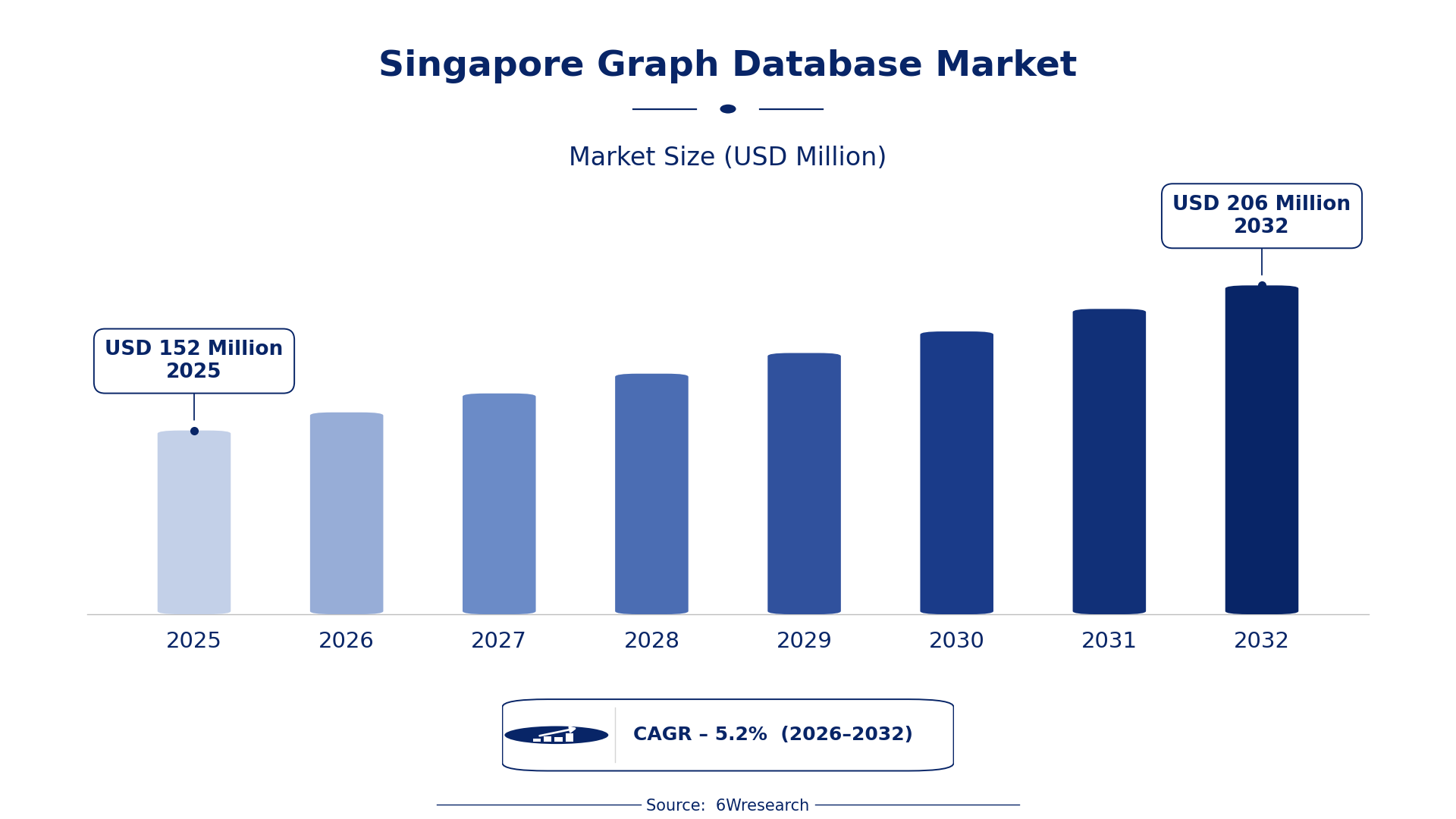
The Singapore Graph Database Market was estimated at USD 152 Million in 2025 and is projected to reach USD 206 Million by 2032, growing at a CAGR of 5.2% from 2026 to 2032.
Singapore Graph Database Market Synopsis
The Singapore Graph Database Market is currently experiencing a notable surge, driven by organizations’ growing needs to manage intricate data relationships. As businesses increasingly adopt data-centric strategies, graph databases emerge as essential tools for unlocking complex insights, especially in sectors such as finance and e-commerce.
Looking ahead, the trajectory for this market suggests continued growth as companies become more sophisticated in their data analysis approaches. The shift towards interconnected data systems is set to define future investments, pushing organizations to integrate advanced graph technologies into their operations.
Singapore Graph Database Market Year-wise Growth Rate and Key Drivers
This graph illustrates the annual growth rates of the Singapore Graph Database Market from 2021 to 2032, highlighting a steady upward trajectory and projected expansion over the forecast period.
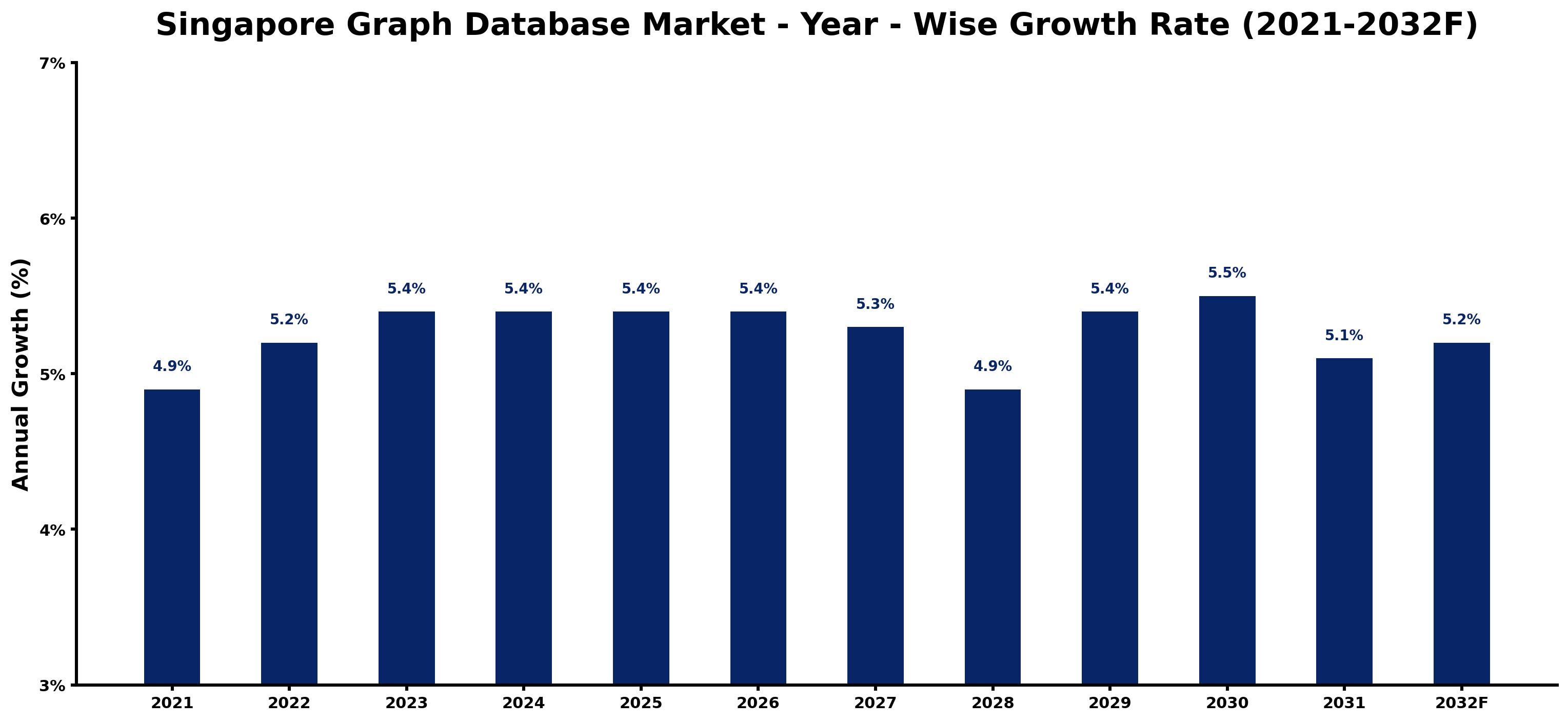
The table below presents the year‑wise growth rates along with the key drivers influencing the market
| Year | Growth Rate | Major Drivers |
| 2021 | 4.9% | Increased adoption of AI-driven data management solutions. |
| 2022 | 5.2% | Government push for smart nation initiatives enhances data integration. |
| 2023 | 5.4% | Growth in FinTech drives demand for real-time data analytics. |
| 2024 | 5.4% | Regulatory focus on data governance boosts graph database usage. |
| 2025 | 5.4% | Surge in e-commerce necessitates complex data relationship management. |
| 2026 | 5.4% | Rising need for personalized customer experiences fuels graph databases. |
| 2027 | 5.3% | Emergence of startups boosts competitive data management solutions. |
| 2028 | 4.9% | Increased investments in data infrastructure support innovation. |
| 2029 | 5.4% | Growing emphasis on data-driven decision making in enterprises. |
| 2030 | 5.5% | Continued investments in cloud solutions enhance graph database adoption. |
| 2031 | 5.1% | Demand for advanced analytics solutions increases among SMEs. |
| 2032 | 5.2% | Integration of IoT data sources drives graph technology growth. |
Note: Market size estimations and growth projections presented in this report are based on 6Wresearch's proprietary forecasting methodology, utilizing the latest available industry data, government publications, and primary research inputs.
Singapore Graph Database Market Key Takeaways
Below are some of the specific key takeaways from the market, including:
- The market is driven by the need for efficient data representation and analysis.
- Applications in fraud detection and recommendation systems are gaining traction.
- Data security and compliance remain pressing concerns for organizations.
- The COVID-19 pandemic accelerated the adoption of graph databases in critical sectors.
- Leading global providers are actively enhancing their offerings to meet local demands.
Evaluation of Restraints in Singapore Graph Database Market
Despite the upward momentum, several constraints impede the full potential of the Singapore Graph Database Market. Organizations often struggle with the complexities of integrating graph databases into existing infrastructures. Performance and scalability challenges arise as data volumes grow, requiring substantial investment in technology upgrades. Compliance with stringent data protection regulations also poses a barrier, as firms must ensure data consistency and security while managing complex relationships.
Singapore Graph Database Market Trends
Several trends are shaping the demand for graph databases in Singapore. The rise of artificial intelligence and machine learning applications is enhancing the utility of graph databases, enabling more sophisticated analytics. on top of that, businesses are increasingly focusing on real-time data processing, which is critical for applications like social media analytics and fraud detection. Collaborative efforts among companies to develop customized solutions are also on the rise, driving innovation in this space.
Singapore Graph Database Market Opportunities
There are numerous opportunities for growth within the Singapore Graph Database Market. As industries such as healthcare and logistics seek to optimize their operations through data-driven decision-making, graph databases can provide valuable insights into complex data relationships. Additionally, the ongoing digital transformation initiatives across sectors create a fertile ground for investment in graph technologies. The potential for partnerships between local firms and global technology providers also stands to enhance the capabilities and reach of graph databases in Singapore.
Government Initiatives in the Singapore Graph Database Market
The Singapore government is actively shaping the Graph Database Market through various initiatives aimed at enhancing data management and analytics capabilities. Regulatory frameworks and funding programs are being introduced to encourage businesses to adopt advanced technologies. The government's commitment to digitalization is crucial in fostering a conducive environment for graph databases to thrive.
- A recently launched initiative focuses on establishing a national data strategy to support innovative data usage across industries.
- Current efforts are underway to develop a public-private partnership aimed at enhancing data infrastructure for better analytics capabilities.
- Planned regulations expected to roll out in 2026 will mandate compliance standards that encourage the use of graph databases for data management.
- A digital literacy program aimed at upskilling professionals in data analytics is currently being implemented.
- The introduction of funding schemes in 2025 will support startups focused on developing graph database solutions.
Future Insights of the Singapore Graph Database Market
Looking forward to 2026-2032, the Singapore Graph Database Market is set to expand significantly. The increasing complexity of data and the demand for real-time analytics will drive further adoption of graph database technologies. Companies will increasingly invest in scalable solutions that not only manage large volumes of interconnected data but also enhance decision-making processes. As organizations seek competitive advantages, graph databases will play an integral role in shaping their data strategies.
Singapore Graph Database Market Latest Developments
In the last 12-14 months, the Singapore Graph Database Market has seen considerable activity, with organizations focusing on enhancing their data analytics capabilities. The demand for robust solutions has prompted technology providers to innovate and adapt their offerings to meet local needs.
- A leading technology vendor launched a new graph database solution in early 2025, designed to support real-time data processing for financial services.
- An ongoing collaboration between several local universities and industry partners aims to develop specialized graph database applications for healthcare analytics.
- A major technology firm announced plans for a comprehensive service upgrade expected to begin in Q3 2025, enhancing its graph database functionalities.
- A pilot project focusing on integrating graph databases with IoT systems is currently underway, testing the potential for smarter city solutions.
- Upcoming regulatory changes are anticipated to be introduced by mid-2026, promoting the adoption of graph database technologies across various sectors.
Singapore Graph Database Market - Key Attractiveness of the Report
- 10 Years of Market Numbers
- Historical Data Starting from 2022 to 2025
- Base Year: 2025
- Forecast Data until 2032
- Key Performance Indicators Impacting the Market
- Major Upcoming Developments and Projects
Key Highlights of the Report:
- Singapore Graph Database Market Outlook
- Market Size of Singapore Graph Database Market, 2025
- Forecast of Singapore Graph Database Market, 2032
- Historical Data and Forecast of Singapore Graph Database Revenues & Volume for the Period 2022-2032F
- Singapore Graph Database Market Trend Evolution
- Singapore Graph Database Market Drivers and Challenges
- Singapore Graph Database Price Trends
- Singapore Graph Database Porter's Five Forces
- Singapore Graph Database Industry Life Cycle
- Historical Data and Forecast of Singapore Graph Database Market Revenues & Volume By Component for the Period 2022-2032F
- Historical Data and Forecast of Singapore Graph Database Market Revenues & Volume By Software for the Period 2022-2032F
- Historical Data and Forecast of Singapore Graph Database Market Revenues & Volume By Services for the Period 2022-2032F
- Historical Data and Forecast of Singapore Graph Database Market Revenues & Volume By Organization Size for the Period 2022-2032F
- Historical Data and Forecast of Singapore Graph Database Market Revenues & Volume By Large enterprises for the Period 2022-2032F
- Historical Data and Forecast of Singapore Graph Database Market Revenues & Volume By Small and medium-sized enterprises (SMEs) for the Period 2022-2032F
- Historical Data and Forecast of Singapore Graph Database Market Revenues & Volume By Application for the Period 2022-2032F
- Historical Data and Forecast of Singapore Graph Database Market Revenues & Volume By Customer Analytics for the Period 2022-2032F
- Historical Data and Forecast of Singapore Graph Database Market Revenues & Volume By Risk, Compliance and Reporting Management for the Period 2022-2032F
- Historical Data and Forecast of Singapore Graph Database Market Revenues & Volume By Recommendation Engines for the Period 2022-2032F
- Historical Data and Forecast of Singapore Graph Database Market Revenues & Volume By Fraud Detection and Prevention for the Period 2022-2032F
- Historical Data and Forecast of Singapore Graph Database Market Revenues & Volume By Supply Chain Management for the Period 2022-2032F
- Historical Data and Forecast of Singapore Graph Database Market Revenues & Volume By Operations Management and Asset Management for the Period 2022-2032F
- Historical Data and Forecast of Singapore Graph Database Market Revenues & Volume By Infrastructure Management, IoT, Industry 4.0 for the Period 2022-2032F
- Historical Data and Forecast of Singapore Graph Database Market Revenues & Volume By Knowledge Management for the Period 2022-2032F
- Historical Data and Forecast of Singapore Graph Database Market Revenues & Volume By Deployment Mode for the Period 2022-2032F
- Historical Data and Forecast of Singapore Graph Database Market Revenues & Volume By Cloud for the Period 2022-2032F
- Historical Data and Forecast of Singapore Graph Database Market Revenues & Volume By On-premises for the Period 2022-2032F
- Historical Data and Forecast of Singapore Graph Database Market Revenues & Volume By Vertical for the Period 2022-2032F
- Historical Data and Forecast of Singapore Graph Database Market Revenues & Volume By BFSI for the Period 2022-2032F
- Historical Data and Forecast of Singapore Graph Database Market Revenues & Volume By Retail and eCommerce for the Period 2022-2032F
- Historical Data and Forecast of Singapore Graph Database Market Revenues & Volume By Telecom and IT for the Period 2022-2032F
- Historical Data and Forecast of Singapore Graph Database Market Revenues & Volume By Healthcare, Pharmaceuticals, and Life Sciences for the Period 2022-2032F
- Historical Data and Forecast of Singapore Graph Database Market Revenues & Volume By Government and Public Sector for the Period 2022-2032F
- Historical Data and Forecast of Singapore Graph Database Market Revenues & Volume By Manufacturing and Automotive for the Period 2022-2032F
- Historical Data and Forecast of Singapore Graph Database Market Revenues & Volume By Media and Entertainment for the Period 2022-2032F
- Historical Data and Forecast of Singapore Graph Database Market Revenues & Volume By Energy and Utilities for the Period 2022-2032F
- Historical Data and Forecast of Singapore Graph Database Market Revenues & Volume By Type for the Period 2022-2032F
- Historical Data and Forecast of Singapore Graph Database Market Revenues & Volume By RDF for the Period 2022-2032F
- Historical Data and Forecast of Singapore Graph Database Market Revenues & Volume By Labeled Property Graph for the Period 2022-2032F
- Singapore Graph Database Import Export Trade Statistics
- Market Opportunity Assessment By Component
- Market Opportunity Assessment By Organization Size
- Market Opportunity Assessment By Application
- Market Opportunity Assessment By Deployment Mode
- Market Opportunity Assessment By Vertical
- Market Opportunity Assessment By Type
- Singapore Graph Database Top Companies Market Share
- Singapore Graph Database Competitive Benchmarking By Technical and Operational Parameters
- Singapore Graph Database Company Profiles
- Singapore Graph Database Key Strategic Recommendations






































