Singapore Greasy Wool Market Size, Share & Growth Rate
The Singapore Greasy Wool Market was estimated at USD 188 Million in 2025 and is projected to reach USD 257 Million by 2032, growing at a CAGR of 4.6% from 2026 to 2032. This positive trajectory is supported by increasing global demand for natural fibers and a growing emphasis on sustainability within the textile industry. As Singapore continues to position itself as a regional hub for textile innovation, the demand for high-quality greasy wool is expected to rise, further enhancing market opportunities.
Singapore Greasy Wool Market Year-wise Growth Rate and Key Drivers
This graph highlights how the Singapore Greasy Wool Market has steadily grown over the years, supported by major growth factors.
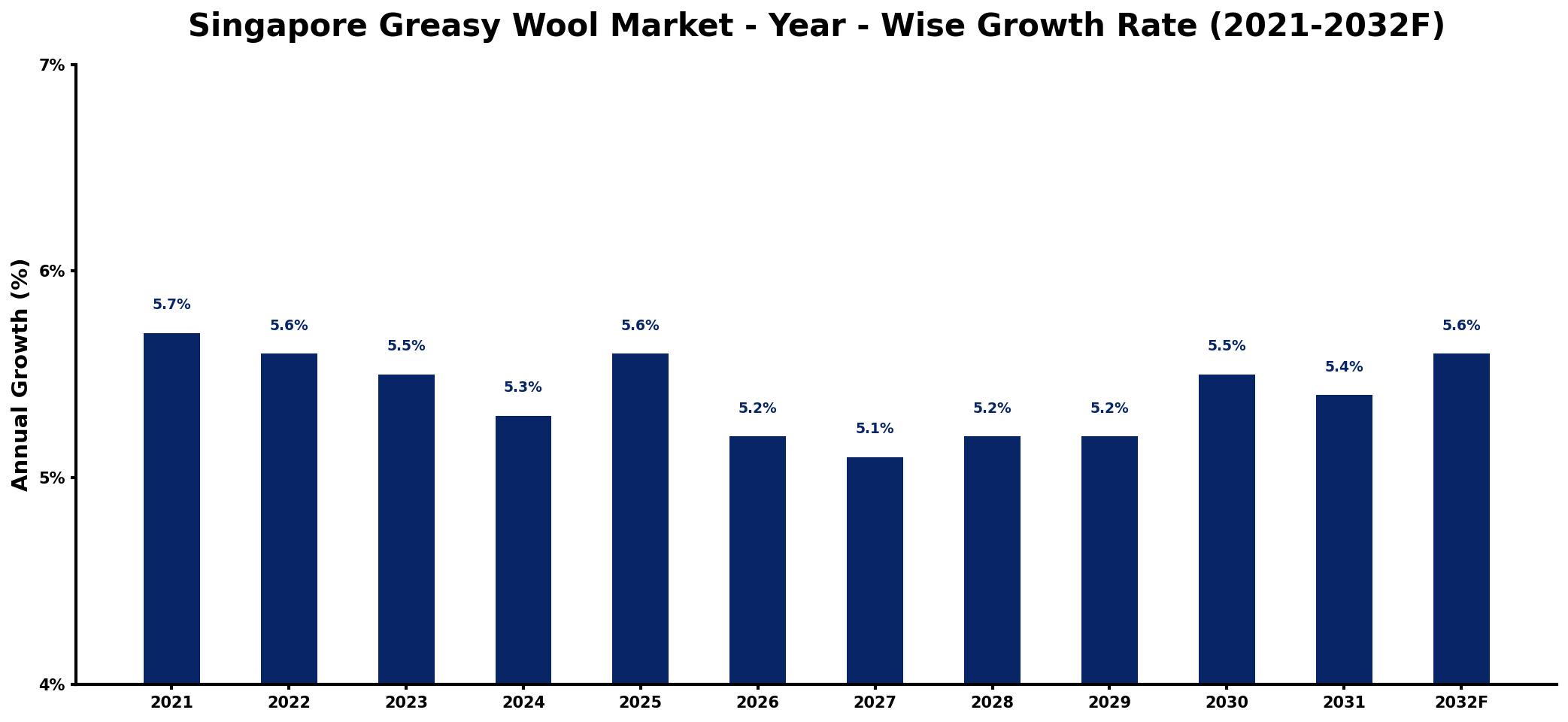
The table below presents the year‑wise growth rates along with the key drivers influencing the market
| Year | Growth Rate | Major Drivers |
| 2021 | 5.7% | Rising consumer demand for textiles |
| 2022 | 5.6% | Increased investment in processing facilities |
| 2023 | 5.5% | Expansion of export markets globally |
| 2024 | 5.3% | Growth in sustainable fashion trends |
| 2025 | 5.6% | Higher production capacity achieved |
| 2026 | 5.2% | Technological advancements in production |
| 2027 | 5.1% | Strengthened partnerships with manufacturers |
| 2028 | 5.2% | Emerging markets show increasing interest |
| 2029 | 5.2% | Enhanced quality standards implemented |
| 2030 | 5.5% | Growing focus on eco-friendly materials |
| 2031 | 5.4% | Increased collaboration with retailers |
| 2032 | 5.6% | Diversification of product applications |
Note: Market size estimations and growth projections presented in this report are based on 6Wresearch's proprietary forecasting methodology, utilizing the latest available industry data, government publications, and primary research inputs.
Singapore Greasy Wool Market Synopsis
The Singapore greasy wool market has recently witnessed significant momentum, driven by the resurgence in textile manufacturing and an upsurge in environmentally conscious consumer preferences. However, the market is now at a pivotal juncture, with the focus shifting towards sustainable sourcing and innovative processing techniques.
As the industry evolves, the quality and traceability of greasy wool have emerged as critical factors influencing purchasing decisions. Singapore's strategic location in the Asia-Pacific region presents unique opportunities for both import and export dynamics, emphasizing the importance of quality standards and supply chain resilience in ensuring long-term market growth.
Singapore Greasy Wool Market Key Takeaways
- Growing demand for natural fibers is driving the expansion of the greasy wool market in Singapore.
- The emphasis on sustainability in the textile industry is becoming a key factor for market players.
- High-quality sourcing remains essential amid growing competition from alternative materials.
- Resilience in supply chains has become a priority following disruptions experienced during the pandemic.
- Singapore's positioning as a textile innovation hub offers significant market opportunities.
Evaluation of Restraints in Singapore Greasy Wool Market
Despite the favorable growth prospects, the Singapore greasy wool market encounters several restraints that could hinder its potential. The sourcing of high-quality greasy wool is often complicated by geographical limitations and inconsistent global supply chains. Additionally, sustainability issues are increasingly scrutinized by consumers and regulatory bodies alike, necessitating stringent compliance measures. These challenges compel market participants to innovate and enhance their operational efficiencies, which may require substantial investment and strategic planning.
Singapore Greasy Wool Market Trends
Current trends indicate a robust shift towards more sustainable and ethical production practices. As consumers become more environmentally aware, they gravitate towards brands that prioritize responsible sourcing. Moreover, technological advancements in textile processing are enabling the introduction of novel applications for greasy wool, such as biodegradable textiles. The growing popularity of luxury and artisanal wool products in the region also plays a significant role in shaping demand.
Singapore Greasy Wool Market Opportunities
The Singapore greasy wool market presents numerous growth opportunities, particularly in enhancing local processing capabilities and fostering international partnerships. With Singapore's strategic location, the market could benefit from increased export activities to neighboring regions. Additionally, innovations in wool processing technology could open up new product lines and applications, further driving market expansion. By prioritizing quality and sustainability, businesses can tap into the premium segment of the market, catering to discerning consumers.
Government Initiatives in the Singapore Greasy Wool Market
The Singaporean government actively promotes sustainability within the textile sector through various initiatives aimed at enhancing the industry's competitiveness. Public spending on innovation and green technology is being directed to support local businesses in their transition towards sustainable practices. Moreover, partnerships with international organizations are being encouraged to improve sourcing standards and market access for greasy wool producers. These initiatives not only bolster the domestic market but also align with global sustainability goals.
Future Insights of the Singapore Greasy Wool Market
Looking ahead to 2026-2032, the Singapore greasy wool market is expected to evolve significantly, characterized by an increasing integration of sustainability into business models. As consumers demand greater transparency in sourcing, companies that invest in traceability and ethical practices will likely gain a competitive edge. The market is also anticipated to benefit from advancements in wool processing technologies, enabling the creation of innovative products tailored to emerging consumer trends, thus ensuring continued growth.
Singapore Greasy Wool Market Latest Developments (2025 - 2026)
Recent developments in the Singapore greasy wool market have underscored a focused commitment to quality assurance amid changing global dynamics. As suppliers navigate post-pandemic recovery, efforts are being made to strengthen local processing capabilities. Emerging collaborations within the industry signal a shift towards enhanced sustainability practices and innovation. These developments collectively position the market for a positive trajectory in the coming years, reflecting adaptability in a rapidly evolving landscape.
Singapore Greasy Wool Market - Key Attractiveness of the Report
- 10 Years of Market Numbers
- Historical Data Starting from 2022 to 2025
- Base Year: 2025
- Forecast Data until 2032
- Key Performance Indicators Impacting the Market
- Major Upcoming Developments and Projects
Key Highlights of the Report:
- Singapore Greasy Wool Market Outlook
- Market Size of Singapore Greasy Wool Market, 2025
- Forecast of Singapore Greasy Wool Market, 2032
- Historical Data and Forecast of Singapore Greasy Wool Revenues & Volume for the Period 2022-2032F
- Singapore Greasy Wool Market Trend Evolution
- Singapore Greasy Wool Market Drivers and Challenges
- Singapore Greasy Wool Price Trends
- Singapore Greasy Wool Porter's Five Forces
- Singapore Greasy Wool Industry Life Cycle
- Historical Data and Forecast of Singapore Greasy Wool Market Revenues & Volume By Application for the Period 2022-2032F
- Historical Data and Forecast of Singapore Greasy Wool Market Revenues & Volume By Apparel for the Period 2022-2032F
- Historical Data and Forecast of Singapore Greasy Wool Market Revenues & Volume By Sports for the Period 2022-2032F
- Historical Data and Forecast of Singapore Greasy Wool Market Revenues & Volume By Blazers for the Period 2022-2032F
- Historical Data and Forecast of Singapore Greasy Wool Market Revenues & Volume By Jacketing for the Period 2022-2032F
- Historical Data and Forecast of Singapore Greasy Wool Market Revenues & Volume By Others for the Period 2022-2032F
- Historical Data and Forecast of Singapore Greasy Wool Market Revenues & Volume By Upholstery Fabrics for the Period 2022-2032F
- Historical Data and Forecast of Singapore Greasy Wool Market Revenues & Volume By Blankets for the Period 2022-2032F
- Historical Data and Forecast of Singapore Apparel Greasy Wool Market Revenues & Volume By Flooring for the Period 2022-2032F
- Singapore Greasy Wool Import Export Trade Statistics
- Market Opportunity Assessment By Application
- Singapore Greasy Wool Top Companies Market Share
- Singapore Greasy Wool Competitive Benchmarking By Technical and Operational Parameters
- Singapore Greasy Wool Company Profiles
- Singapore Greasy Wool Key Strategic Recommendations






































