Singapore Hand Carts & Trolleys Market Summary
The singapore hand carts & trolleys market was estimated at USD 381 Million in 2025 and is projected to reach USD 557 Million by 2032, growing at a CAGR of 6.4% from 2026 to 2032.
Singapore Hand Carts & Trolleys Market Year-wise Growth Rate and Key Drivers
This graph highlights how the Singapore Hand Carts & Trolleys Market has steadily grown over the past five years, supported by major growth factors.
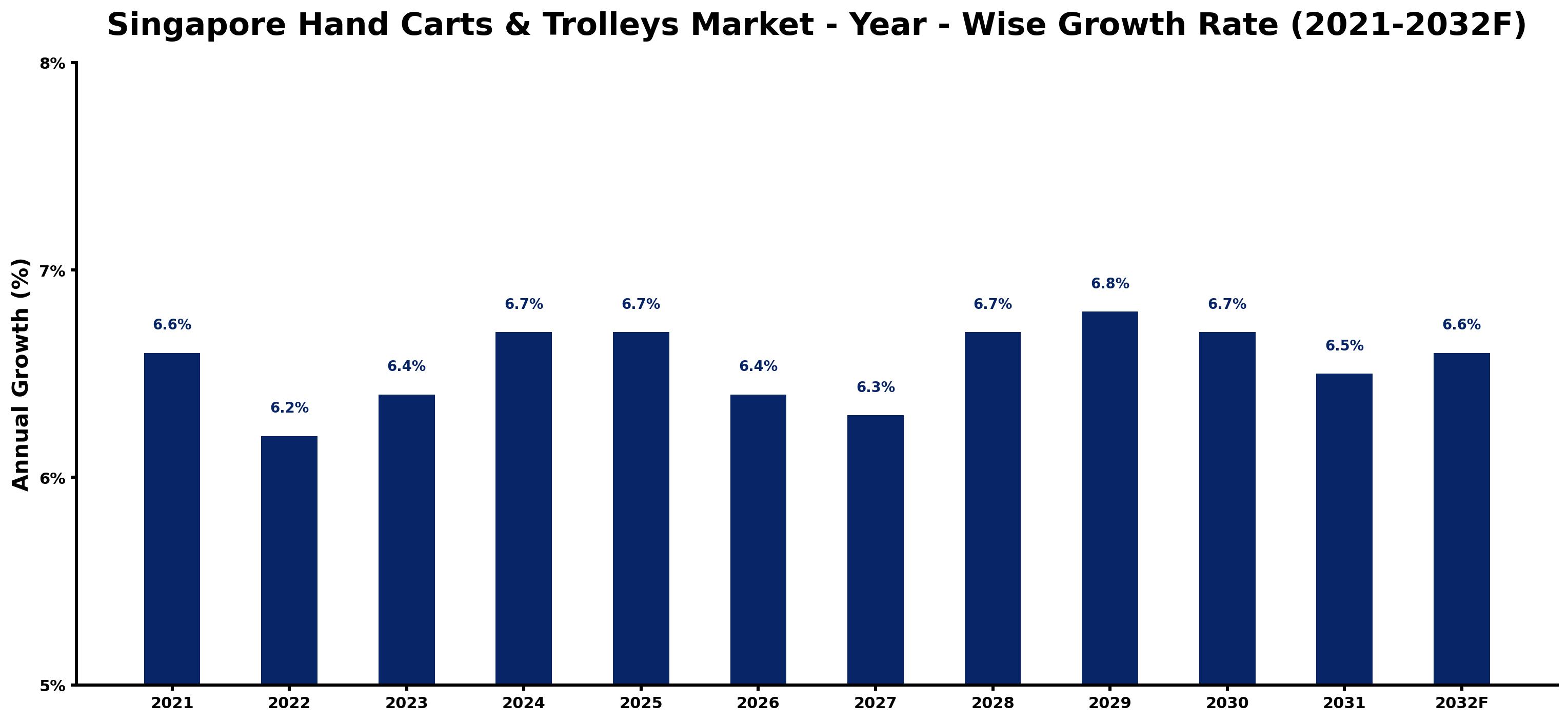
The table below presents the year wise growth rates along with the key drivers influencing the market
| Year | Growth Rate | Major Drivers |
| 2021 | 6.6% | Post-lockdown retail projects initiated a resurgence in hand cart demand across industries. |
| 2022 | 6.2% | E-commerce growth necessitated efficient logistics, boosting trolley markets significantly in Singapore. |
| 2023 | 6.4% | Construction activities surged, increasing the need for durable hand carts on job sites. |
| 2024 | 6.7% | Sustainability trends influenced consumer preferences toward eco-friendly trolley options this year. |
| 2025 | 6.7% | Emerging delivery services expanded market opportunities for compact and versatile hand trolleys. |
| 2026 | 6.4% | Rising urbanization led to heightened demand for efficient mobility solutions in crowded areas. |
| 2027 | 6.3% | Technological advancements integrated into trolleys improved functionality and attracted new users. |
| 2028 | 6.7% | Corporate budgets prioritized logistics optimization, reinforcing the hand cart market's growth trajectory. |
| 2029 | 6.8% | Innovative designs captured the attention of both consumers and businesses driving sales up. |
| 2030 | 6.7% | Sustainability regulations encouraged manufacturers to incorporate greener materials into their products. |
| 2031 | 6.5% | Increased focus on health and safety spurred demand for ergonomic and safe trolley designs. |
| 2032 | 6.6% | Economic stability and rising disposable incomes continued to support consumer spending on trolleys. |
Note - Market size estimations and growth projections presented in this report are based on 6Wresearch's advanced forecasting approach, validated with industry datasets as of June 2026.
Singapore Hand Carts & Trolleys Market Synopsis
The Singapore Hand Carts Trolleys Market is projected to reach 6.4% and witness significant growth during the forecast period (2026-2032). This robust expansion can be attributed to several factors including an increase in industrial demand, heightened adoption of automated material handling solutions, and a surge in construction activities across the region. The ongoing investments in infrastructure development and the rapid pace of urbanization further amplify the necessity for efficient transportation solutions, particularly in the tourism sector where ease of luggage handling becomes paramount.
Singapore Hand Carts & Trolleys Market Growth Drivers
A multitude of factors is driving the growth of the Singapore Hand Carts & Trolleys Market. These include:
- The demand from various industries, particularly logistics and retail, is burgeoning as companies seek to improve operational efficiency through effective material handling solutions.
- Growing adoption of automated equipment is reshaping traditional methods of transporting goods, promoting the usage of hand carts and trolleys that complement automation.
- The rising number of construction projects requires effective transport solutions on-site, creating a favorable environment for the hand carts and trolleys market.
- Increased investment in infrastructure development, such as transport networks and commercial facilities, is driving the demand for hand carts and trolleys to facilitate easier movement of materials and luggage.
- Rapid urbanization contributes to a significant influx of tourists, necessitating efficient systems for managing luggage and goods in high-traffic areas such as airports, hotels, and attractions.
Singapore Hand Carts & Trolleys Market Challenges and Restraints
Despite the promising growth, the Singapore Hand Carts & Trolleys Market faces several challenges that could hinder its trajectory:
- Availability and accessibility issues can arise from logistical challenges that impact the supply chain, leading to inconsistencies in product availability.
- The high cost associated with quality hand carts and trolleys may deter some businesses from investing, particularly SMEs that are cost-sensitive.
- Limited durability and poor quality of certain products can negatively affect customer satisfaction and result in a reluctance to invest in these solutions.
- Environmental regulations may impose additional costs and considerations for manufacturers, particularly as sustainability becomes a focal point of industry operations.
- Economic fluctuations can impact consumer spending and investment levels, creating uncertainty in the market for hand carts and trolleys.
Singapore Hand Carts & Trolleys Market Government Investment and Initiatives
The Singaporean government has been proactive in bolstering the infrastructure landscape, influencing the Hand Carts & Trolleys Market positively. Various development plans aim to enhance the capabilities of the tourism and transport sectors, leading to higher demand for material handling solutions. Investments in public transport infrastructure, including enhancements to the airport and rail systems, are crucial for improving logistics capabilities. Government incentives for companies adopting automation and environmentally friendly materials also contribute to the market expansion by promoting the use of advanced hand carts and trolleys across industries.
Singapore Hand Carts & Trolleys Market Latest Developments (May 2025 - June 2026)
In the period from May 2025 to June 2026, the Singapore Hand Carts & Trolleys Market saw several developments that reflect the evolving industry landscape. An increase in partnerships between technology providers and manufacturers has led to the introduction of smart hand carts equipped with tracking and automation features, enhancing operational efficiency. Additionally, industry stakeholders have focused on sustainability, with manufacturers exploring eco-friendly materials for production to align with global trends. Regulatory bodies have also ramped up efforts to ensure quality and safety standards in manufacturing, fostering consumer confidence in the market. Furthermore, demand recovery post-COVID-19 has gained momentum, although challenges in logistics continue to manifest, impacting supply timelines.
Singapore Hand Carts & Trolleys Market - Key Attractiveness of the Report
- 10 Years of Market Numbers
- Historical Data Starting from 2022 to 2025
- Base Year: 2025
- Forecast Data until 2032
- Key Performance Indicators Impacting the Market
- Major Upcoming Developments and Projects
Key Highlights of the Report:
- Singapore Hand Carts & Trolleys Market Outlook
- Market Size of Singapore Hand Carts & Trolleys Market, 2025
- Forecast of Singapore Hand Carts & Trolleys Market, 2032F
- Historical Data and Forecast of Singapore Hand Carts & Trolleys Revenues & Volume for the Period 2022-2032F
- Singapore Hand Carts & Trolleys Market Trend Evolution
- Singapore Hand Carts & Trolleys Market Drivers and Challenges
- Singapore Hand Carts & Trolleys Price Trends
- Singapore Hand Carts & Trolleys Porter's Five Forces
- Singapore Hand Carts & Trolleys Industry Life Cycle
- Historical Data and Forecast of Singapore Hand Carts & Trolleys Market Revenues & Volume By Types for the Period 2022-2032F
- Historical Data and Forecast of Singapore Hand Carts & Trolleys Market Revenues & Volume By Steel Hand Truck for the Period 2022-2032F
- Historical Data and Forecast of Singapore Hand Carts & Trolleys Market Revenues & Volume By Aluminium Hand Truck for the Period 2022-2032F
- Historical Data and Forecast of Singapore Hand Carts & Trolleys Market Revenues & Volume By Applications for the Period 2022-2032F
- Historical Data and Forecast of Singapore Hand Carts & Trolleys Market Revenues & Volume By Online Sales for the Period 2022-2032F
- Historical Data and Forecast of Singapore Hand Carts & Trolleys Market Revenues & Volume By Offline Sales for the Period 2022-2032F
- Singapore Hand Carts & Trolleys Import Export Trade Statistics
- Market Opportunity Assessment By Types
- Market Opportunity Assessment By Applications
- Singapore Hand Carts & Trolleys Top Companies Market Share
- Singapore Hand Carts & Trolleys Competitive Benchmarking By Technical and Operational Parameters
- Singapore Hand Carts & Trolleys Company Profiles
- Singapore Hand Carts & Trolleys Key Strategic Recommendations






































