Singapore Hay Making Machinery Market Size, Share & Growth Rate
The Singapore Hay Making Machinery Market was estimated at USD 334 Million in 2025 and is projected to reach USD 438 Million by 2032, growing at a CAGR of 3.9% from 2026 to 2032. This trajectory is driven primarily by the increasing need for high-quality animal feed within the nation's livestock industry and the growing emphasis on maintaining green spaces across urban landscapes. As Singapore progresses towards enhanced agricultural efficiency and sustainability, the demand for advanced hay making equipment continues to gain momentum.
Singapore Hay Making Machinery Market Year-wise Growth Rate and Key Drivers
This graph highlights how the Singapore Hay Making Machinery Market has steadily grown over the years, supported by major growth factors.
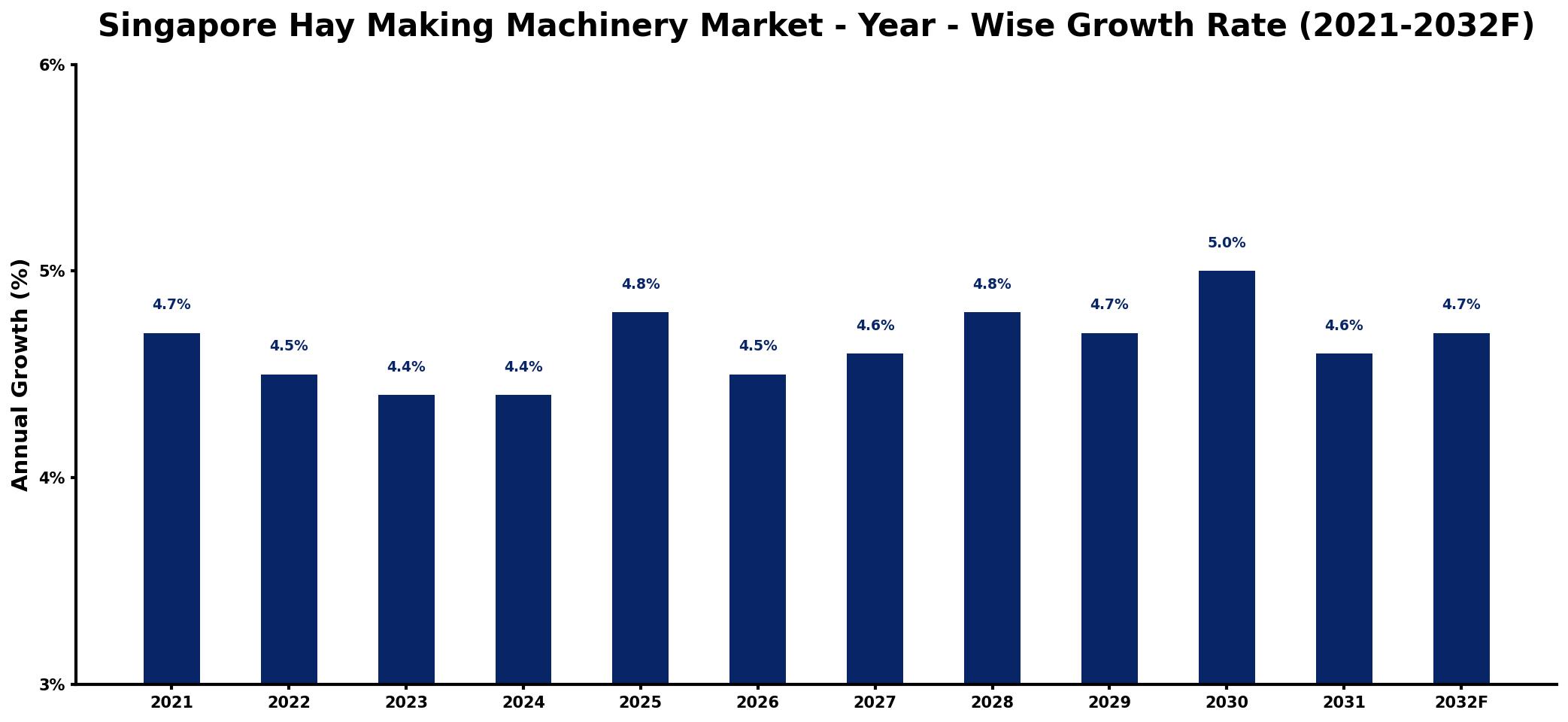
The table below presents the year‑wise growth rates along with the key drivers influencing the market
| Year | Growth Rate | Major Drivers |
| 2021 | 4.7% | Rising demand for agricultural efficiency |
| 2022 | 4.5% | Increased investment in automation technology |
| 2023 | 4.4% | Growth in organic farming practices |
| 2024 | 4.4% | Expansion of agricultural export markets |
| 2025 | 4.8% | Technological advancements in farming processes |
| 2026 | 4.5% | Higher focus on sustainable practices |
| 2027 | 4.6% | Increase in precision agriculture adoption |
| 2028 | 4.8% | Demand for cost-effective farming solutions |
| 2029 | 4.7% | improved raw material availability |
| 2030 | 5.0% | Surge in climate-resilient farming techniques |
| 2031 | 4.6% | Enhanced government support for agriculture |
| 2032 | 4.7% | stronger distribution network expansion |
Note: Market size estimations and growth projections presented in this report are based on 6Wresearch's proprietary forecasting methodology, utilizing the latest available industry data, government publications, and primary research inputs.
Singapore Hay Making Machinery Market Synopsis
In Singapore, where agricultural land is at a premium, the hay making machinery market plays a crucial role in supporting the livestock sector. The machinery is indispensable for livestock farms and recreational parks, ensuring the availability of quality hay, which remains a staple in animal husbandry practices. This specialized market is vital for enhancing productivity and promoting sustainable farming practices.
The sector encompasses a diverse range of equipment, such as balers, mowers, and tedders, each designed to optimize hay harvesting and processing. Given Singapore's focus on sustainability, innovations aimed at reducing the environmental impact of these machines are increasingly influencing market dynamics. As the demand for efficient and eco-friendly solutions rises, market players are adapting to provide cutting-edge technology in hay making machinery.
Singapore Hay Making Machinery Market Key Takeaways
- The Singapore hay making machinery market is integral to the country's agricultural strategy, particularly in supporting livestock and maintaining urban green spaces.
- Efforts toward self-sufficiency in food production are driving demand for modern hay making equipment.
- Sustainability and resource efficiency are critical factors influencing innovation within the market.
- Despite geographical constraints, the market is poised for steady growth through 2032.
- The increasing popularity of sustainable agricultural practices is encouraging investments in advanced machinery.
Evaluation of Restraints in Singapore Hay Making Machinery Market
The Singapore hay making machinery market faces significant restraints stemming from the limited agricultural land and rapid urbanization that characterize the region. These constraints result in a narrower customer base and restrict the scale of hay production. Weather variability further complicates the situation, leading to unpredictable demand for machinery based on seasonal cycles. Additionally, manufacturers must contend with the complexities of designing durable equipment capable of enduring local outdoor conditions, which can inflate production costs and impact pricing strategies. The presence of imported hay products and alternative feed sources also poses competitive challenges for domestic machinery sales.
Singapore Hay Making Machinery Market Trends
Current trends in the Singapore hay making machinery market indicate a growing emphasis on automation and digital solutions. As labor shortages persist, operators are increasingly looking towards machinery that reduces manual intervention while enhancing efficiency. Moreover, the rise in eco-conscious farming practices has led to a demand for machines that prioritize sustainability, including those that use less energy or produce fewer emissions. The integration of smart technology in hay making equipment is also emerging, enabling real-time monitoring and data analytics to optimize performance and yield.
Singapore Hay Making Machinery Market Opportunities
Opportunities for growth within the Singapore hay making machinery market are abundant, particularly in the realm of innovative product development. There is a burgeoning demand for machines that offer precision in hay processing, which can cater to the specific needs of local farms and parks. Furthermore, partnerships with regional agricultural cooperatives could enhance distribution channels and broaden the customer base. As the government continues to support sustainable agricultural practices, investment in new technologies that enhance productivity and reduce environmental impact is likely to find favorable market reception.
Government Initiatives in the Singapore Hay Making Machinery Market
The Singaporean government has launched various initiatives aimed at promoting sustainable agriculture, which directly benefits the hay making machinery market. Public spending is directed toward enhancing agricultural efficiency and supporting the adoption of modern farming technologies. Furthermore, various programs encourage investment in sustainable equipment, providing incentives for farmers and agricultural businesses to upgrade their machinery. These supportive policies create a conducive environment for growth and innovation in the market.
Future Insights of the Singapore Hay Making Machinery Market
Looking ahead to 2026-2032, the Singapore hay making machinery market is likely to witness further consolidation around sustainability and efficiency. As local agricultural practices adapt to contemporary demands, there will be a heightened focus on machinery that can deliver high productivity while minimizing ecological footprints. Additionally, advancements in technology are set to redefine operational capabilities, making hay production not just more efficient, but also more aligned with Singapore's vision of a greener future.
Singapore Hay Making Machinery Market Latest Developments (2025 - 2026)
Recent industry developments indicate a shift towards greater automation in hay making machinery, responding to labor market challenges. Local manufacturers are increasingly investing in smart technologies that facilitate enhanced monitoring and control of machinery performance. Additionally, innovations focused on energy efficiency and reduced emissions are becoming more prominent, aligning with global trends toward sustainability. The market is also experiencing collaborative efforts to improve supply chain resilience and adaptation in the wake of ongoing disruptions.
Singapore Hay Making Machinery Market - Key Attractiveness of the Report
- 10 Years of Market Numbers
- Historical Data Starting from 2022 to 2025
- Base Year: 2025
- Forecast Data until 2032
- Key Performance Indicators Impacting the Market
- Major Upcoming Developments and Projects
Key Highlights of the Report:
- Singapore Hay Making Machinery Market Outlook
- Market Size of Singapore Hay Making Machinery Market, 2025
- Forecast of Singapore Hay Making Machinery Market, 2032
- Historical Data and Forecast of Singapore Hay Making Machinery Revenues & Volume for the Period 2022-2032F
- Singapore Hay Making Machinery Market Trend Evolution
- Singapore Hay Making Machinery Market Drivers and Challenges
- Singapore Hay Making Machinery Price Trends
- Singapore Hay Making Machinery Porter's Five Forces
- Singapore Hay Making Machinery Industry Life Cycle
- Historical Data and Forecast of Singapore Hay Making Machinery Market Revenues & Volume By Type for the Period 2022-2032F
- Historical Data and Forecast of Singapore Hay Making Machinery Market Revenues & Volume By Mower for the Period 2022-2032F
- Historical Data and Forecast of Singapore Hay Making Machinery Market Revenues & Volume By Balers for the Period 2022-2032F
- Historical Data and Forecast of Singapore Hay Making Machinery Market Revenues & Volume By Tedder for the Period 2022-2032F
- Historical Data and Forecast of Singapore Hay Making Machinery Market Revenues & Volume By Rakes for the Period 2022-2032F
- Singapore Hay Making Machinery Import Export Trade Statistics
- Market Opportunity Assessment By Type
- Singapore Hay Making Machinery Top Companies Market Share
- Singapore Hay Making Machinery Competitive Benchmarking By Technical and Operational Parameters
- Singapore Hay Making Machinery Company Profiles
- Singapore Hay Making Machinery Key Strategic Recommendations






































