Singapore Hormone Market Size, Share & Growth Rate
The Singapore Hormone Market was estimated at USD 246 Million in 2025 and is projected to reach USD 344 Million by 2032, growing at a CAGR of 4.9% from 2026 to 2032. This growth trajectory is propelled by increasing demand for hormone-based therapies driven by an aging population seeking solutions for various hormonal imbalances and conditions. Additionally, advancements in healthcare technologies are enhancing the efficacy and safety of hormone treatments, further propelling market expansion.
Singapore Hormone Market Year-wise Growth Rate and Key Drivers
This graph highlights how the Singapore Hormone Market has steadily grown over the years, supported by major growth factors.
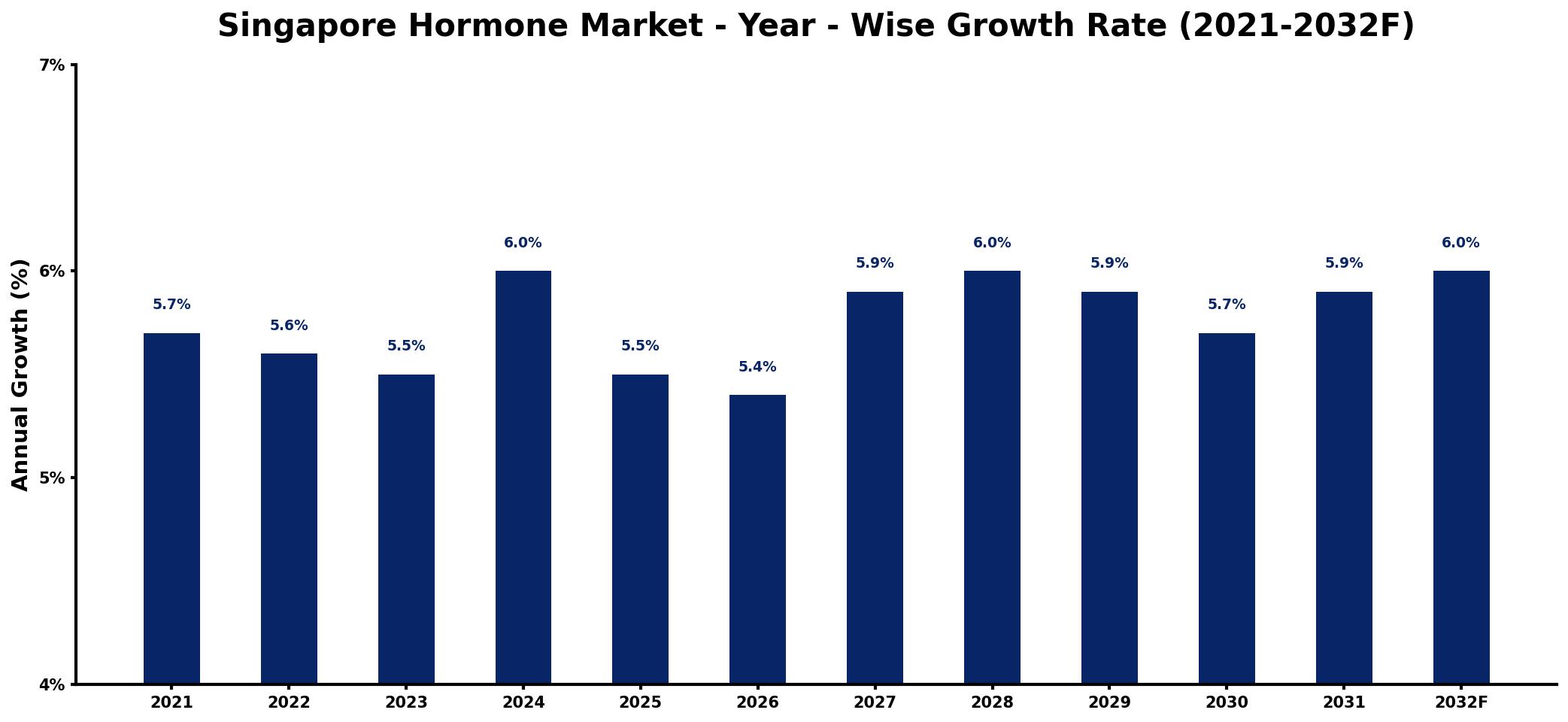
The table below presents the year‑wise growth rates along with the key drivers influencing the market
| Year | Growth Rate | Major Drivers |
| 2021 | 5.7% | Rising health awareness among consumers |
| 2022 | 5.6% | Increased investment in biotechnology |
| 2023 | 5.5% | Growing aging population demands services |
| 2024 | 6.0% | Technological advancements in healthcare |
| 2025 | 5.5% | Expanding research in therapeutic applications |
| 2026 | 5.4% | Higher disposable incomes drive spending |
| 2027 | 5.9% | Emergence of personalized medicine trends |
| 2028 | 6.0% | Strengthened regulatory frameworks enhance trust |
| 2029 | 5.9% | Collaborations between firms and universities |
| 2030 | 5.7% | stronger distribution network expansion |
| 2031 | 5.9% | Increased focus on preventive healthcare |
| 2032 | 6.0% | Broadening access to innovative treatments |
Note: Market size estimations and growth projections presented in this report are based on 6Wresearch's proprietary forecasting methodology, utilizing the latest available industry data, government publications, and primary research inputs.
Singapore Hormone Market Synopsis
The Singapore hormone market is a vital component of the healthcare ecosystem, providing essential hormone therapies that address a range of medical conditions. As healthcare providers increasingly recognize the importance of hormonal balance, the market is experiencing a surge in demand for innovative treatment options.
Regulatory standards and product quality remain pivotal in shaping the market, with stakeholders emphasizing safety and efficacy to meet patient needs. As the healthcare landscape evolves, the hormone market is adapting to various challenges while exploring new opportunities for growth and development.
Singapore Hormone Market Key Takeaways
- The market is fueled by rising demand for hormone replacement therapies and fertility treatments.
- Regulatory compliance and product quality are critical to maintaining market viability.
- Healthcare advancements are driving innovation in hormone therapies, impacting patient care.
- The ongoing shift towards personalized medicine is reshaping treatment paradigms in the hormone sector.
- Collaboration between pharmaceutical companies and healthcare providers is essential for market growth.
Evaluation of Restraints in Singapore Hormone Market
Despite its potential, the Singapore hormone market is not without its challenges. The complexity of pharmaceutical research and the rigorous clinical trial processes can slow down the introduction of new hormone therapies. Additionally, regulatory approval pathways can be lengthy and intricate, creating barriers for innovation. As healthcare needs evolve, the market must remain agile in addressing these obstacles to sustain growth.
Singapore Hormone Market Trends
Several key trends are currently shaping the Singapore hormone market. There is a noticeable increase in the adoption of personalized medicine, with therapies tailored to individual patient profiles gaining traction. Moreover, advancements in biotechnology are leading to more effective and targeted hormone treatments. A growing awareness of hormonal health among patients is also encouraging more individuals to seek therapeutic interventions, thereby boosting demand.
Singapore Hormone Market Opportunities
The Singapore hormone market presents numerous growth opportunities for stakeholders. As the population ages, there is an escalating demand for hormone replacement therapies that address age-related hormonal changes. Additionally, ongoing research and development initiatives focusing on novel hormone formulations and delivery systems could open new avenues for market entrants. Increased collaboration with healthcare professionals to enhance patient education about hormonal health may further drive market expansion.
Government Initiatives in the Singapore Hormone Market
The Singapore government is actively investing in healthcare modernization, including initiatives aimed at enhancing access to hormone therapies. Public spending on healthcare infrastructure and programs that support clinical research contribute to a more robust hormone market. Furthermore, regulatory bodies are continually reviewing policies to streamline approval processes, fostering an environment conducive to innovation and development.
Future Insights of the Singapore Hormone Market
Looking ahead to 2026-2032, the Singapore hormone market is poised for significant transformation. With an increasing focus on patient-centric care, stakeholders will need to align their strategies with emerging trends in healthcare. The integration of technology in treatment approaches, coupled with greater awareness of hormonal health, will drive demand for more sophisticated hormone therapies. As market dynamics evolve, proactive adaptation will be crucial for stakeholders aiming to capitalize on future growth opportunities.
Singapore Hormone Market Latest Developments (2025 - 2026)
In the recent period, the Singapore hormone market has seen notable shifts in strategy among suppliers, focusing on enhancing product quality and compliance with regulatory standards. Developments in clinical research have also gained momentum, with several studies underway to assess the effectiveness of new hormone therapies. The ongoing discussions around patient education and awareness initiatives are contributing to an environment that supports growth and innovation in hormone treatment.
Singapore Hormone Market - Key Attractiveness of the Report
- 10 Years of Market Numbers
- Historical Data Starting from 2022 to 2025
- Base Year: 2025
- Forecast Data until 2032
- Key Performance Indicators Impacting the Market
- Major Upcoming Developments and Projects
Key Highlights of the Report:
- Singapore Hormone Market Outlook
- Market Size of Singapore Hormone Market, 2025
- Forecast of Singapore Hormone Market, 2032
- Historical Data and Forecast of Singapore Hormone Revenues & Volume for the Period 2022-2032F
- Singapore Hormone Market Trend Evolution
- Singapore Hormone Market Drivers and Challenges
- Singapore Hormone Price Trends
- Singapore Hormone Porter's Five Forces
- Singapore Hormone Industry Life Cycle
- Historical Data and Forecast of Singapore Hormone Market Revenues & Volume By Product Type for the Period 2022-2032F
- Historical Data and Forecast of Singapore Hormone Market Revenues & Volume By Powder for the Period 2022-2032F
- Historical Data and Forecast of Singapore Hormone Market Revenues & Volume By Solvent for the Period 2022-2032F
- Historical Data and Forecast of Singapore Hormone Market Revenues & Volume By Application for the Period 2022-2032F
- Historical Data and Forecast of Singapore Hormone Market Revenues & Volume By Growth Hormone Deficiency for the Period 2022-2032F
- Historical Data and Forecast of Singapore Hormone Market Revenues & Volume By Idiopathic Short Stature for the Period 2022-2032F
- Historical Data and Forecast of Singapore Hormone Market Revenues & Volume By Turner Syndrome for the Period 2022-2032F
- Historical Data and Forecast of Singapore Hormone Market Revenues & Volume By Small For Gestational Age for the Period 2022-2032F
- Historical Data and Forecast of Singapore Hormone Market Revenues & Volume By Prader-Willi Syndrome for the Period 2022-2032F
- Historical Data and Forecast of Singapore Hormone Market Revenues & Volume By Others for the Period 2022-2032F
- Historical Data and Forecast of Singapore Hormone Market Revenues & Volume By Distribution Channel for the Period 2022-2032F
- Historical Data and Forecast of Singapore Hormone Market Revenues & Volume By Hospital Pharmacy for the Period 2022-2032F
- Historical Data and Forecast of Singapore Hormone Market Revenues & Volume By Retail Pharmacy for the Period 2022-2032F
- Historical Data and Forecast of Singapore Hormone Market Revenues & Volume By Online Medstores for the Period 2022-2032F
- Singapore Hormone Import Export Trade Statistics
- Market Opportunity Assessment By Product Type
- Market Opportunity Assessment By Application
- Market Opportunity Assessment By Distribution Channel
- Singapore Hormone Top Companies Market Share
- Singapore Hormone Competitive Benchmarking By Technical and Operational Parameters
- Singapore Hormone Company Profiles
- Singapore Hormone Key Strategic Recommendations






































