Singapore Hydrochloric Acid Market: Import Trend Analysis
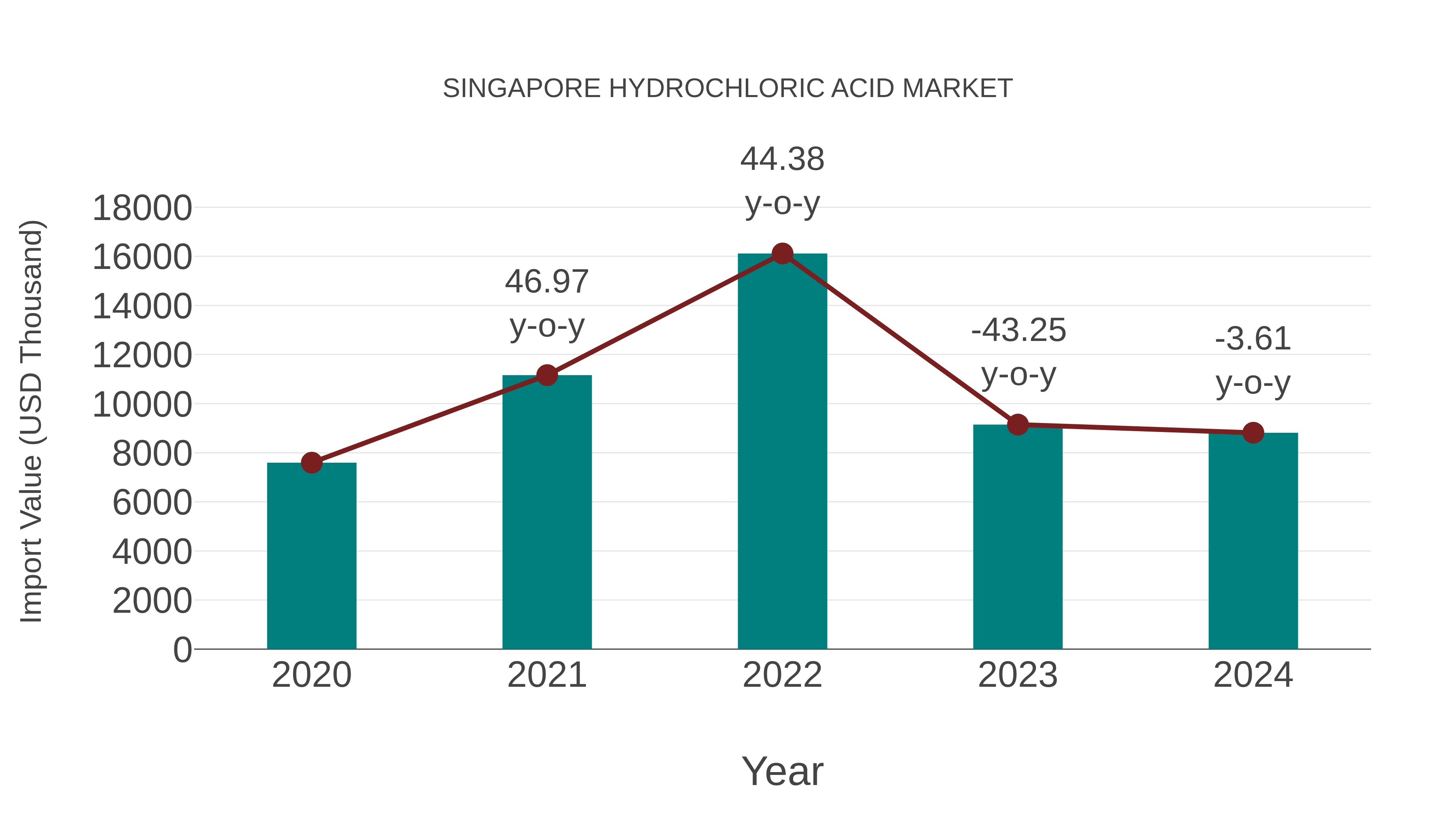
In the Singapore hydrochloric acid market, the import trend showed a decline from 2023 to 2024, with a growth rate of -3.61%. However, the compound annual growth rate (CAGR) for the period 2020-2024 stood at 3.8%. This downward momentum in imports could be attributed to shifting demand dynamics or changes in trade policies impacting market stability.
Hydrochloric Acid Market: Singapore vs Top 5 Major Economies in 2027 (Asia)
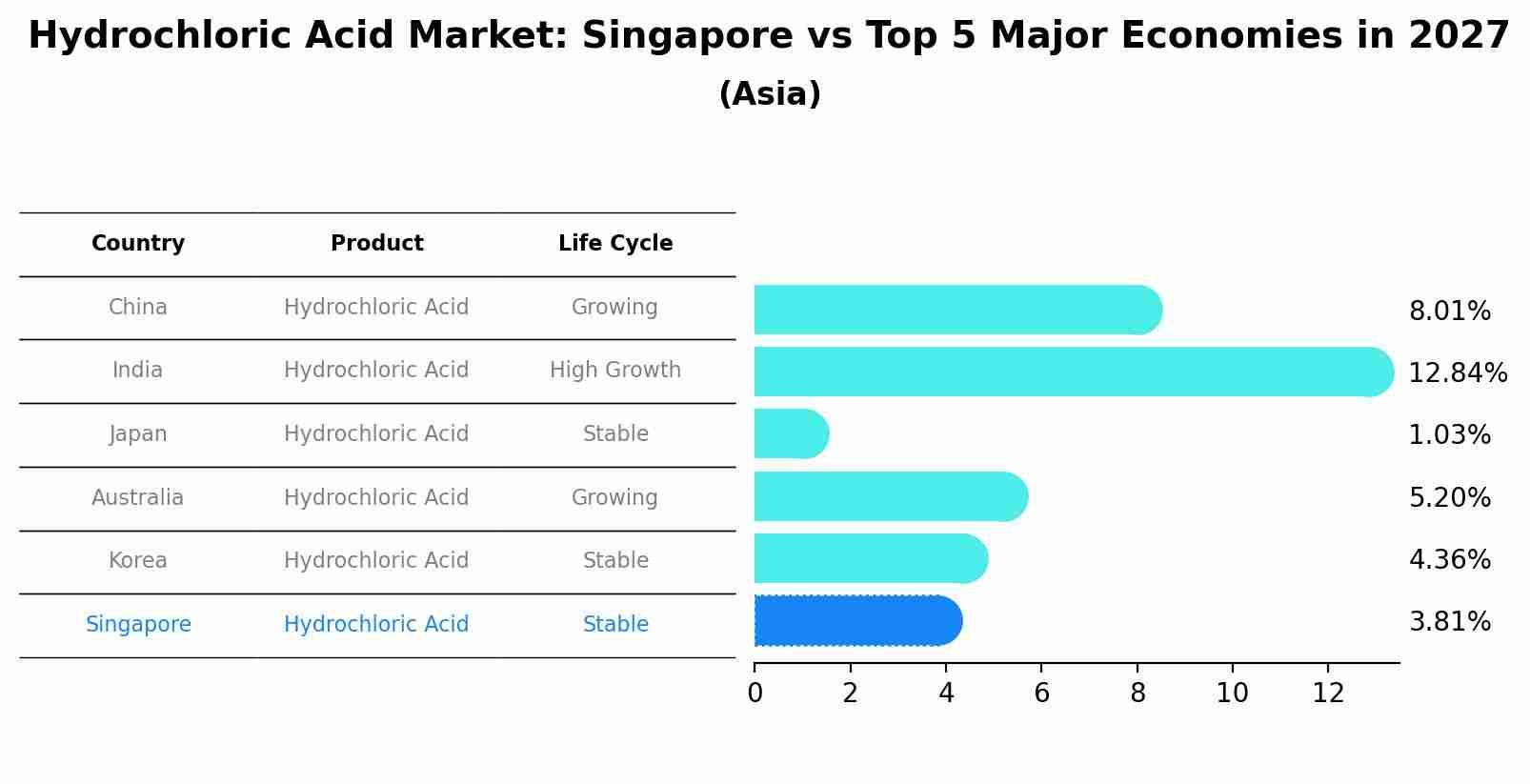
In the Asia region, the Hydrochloric Acid market in Singapore is projected to expand at a stable growth rate of 3.81% by 2027. The largest economy is China, followed by India, Japan, Australia and South Korea.
Singapore Hydrochloric Acid Market Synopsis
The Singapore hydrochloric acid market is expected to exhibit stable demand, primarily from the chemical and industrial sectors. Hydrochloric acid is a versatile chemical used in various processes, including pickling, metal cleaning, and pH control. Market growth will depend on factors such as industrial production and manufacturing activities in Singapore and the region.
Drivers of the Market
The hydrochloric acid market in Singapore is poised for growth due to its crucial role in various industries, including chemicals, pharmaceuticals, and metallurgy. Hydrochloric acid is used in chemical synthesis, pH control, and metal cleaning and processing. With the diversification of the chemical and pharmaceutical sectors in Singapore, the demand for hydrochloric acid is expected to rise. Additionally, its applications in wastewater treatment and construction further contribute to market expansion.
Challenges of the Market
The hydrochloric acid market in Singapore is driven by its use in various industrial processes. Challenges include the need for proper storage and handling of this corrosive chemical, as well as environmental concerns related to emissions and disposal of hydrochloric acid waste. Regulatory compliance and safety measures are paramount in this market, along with competition from alternative chemicals for specific applications.
COVID-19 Impact on the Market
The Singapore hydrochloric acid market faced disruptions during the COVID-19 pandemic, driven by reduced industrial activity and logistics challenges. As industries resume operations and demand for chemical products increases, the market is expected to recover. Sustainable and efficient hydrochloric acid production methods will likely gain prominence in line with environmental regulations. Singapore established chemical infrastructure positions it as a key player in the regional hydrochloric acid market.
Key Players in the Market
The Singapore hydrochloric acid market is expected to witness growth due to its widespread use in industrial processes. Prominent chemical companies like Dow Inc., INEOS, and Olin Corporation are key players in providing high-quality hydrochloric acid for various industrial applications.
Key Highlights of the Report:
- Singapore Hydrochloric Acid Market Outlook
- Market Size of Singapore Hydrochloric Acid Market, 2025
- Forecast of Singapore Hydrochloric Acid Market, 2032
- Historical Data and Forecast of Singapore Hydrochloric Acid Revenues & Volume for the Period 2022-2032F
- Singapore Hydrochloric Acid Market Trend Evolution
- Singapore Hydrochloric Acid Market Drivers and Challenges
- Singapore Hydrochloric Acid Price Trends
- Singapore Hydrochloric Acid Porter's Five Forces
- Singapore Hydrochloric Acid Industry Life Cycle
- Historical Data and Forecast of Singapore Hydrochloric Acid Market Revenues & Volume By End-user Industry for the Period 2022-2032F
- Historical Data and Forecast of Singapore Hydrochloric Acid Market Revenues & Volume By Food and Beverage for the Period 2022-2032F
- Historical Data and Forecast of Singapore Hydrochloric Acid Market Revenues & Volume By Steel for the Period 2022-2032F
- Historical Data and Forecast of Singapore Hydrochloric Acid Market Revenues & Volume By Oil and Gas for the Period 2022-2032F
- Historical Data and Forecast of Singapore Hydrochloric Acid Market Revenues & Volume By Chemical for the Period 2022-2032F
- Historical Data and Forecast of Singapore Hydrochloric Acid Market Revenues & Volume By Textile for the Period 2022-2032F
- Historical Data and Forecast of Singapore Hydrochloric Acid Market Revenues & Volume By Other End-user Industries (Leather, Rubber, etc.) for the Period 2022-2032F
- Singapore Hydrochloric Acid Import Export Trade Statistics
- Market Opportunity Assessment By End-user Industry
- Singapore Hydrochloric Acid Top Companies Market Share
- Singapore Hydrochloric Acid Competitive Benchmarking By Technical and Operational Parameters
- Singapore Hydrochloric Acid Company Profiles
- Singapore Hydrochloric Acid Key Strategic Recommendations






































