Singapore Hydrophobic and Superhydrophobic Materials Market Size, Share & Growth Rate
The Singapore Hydrophobic and Superhydrophobic Materials Market was estimated at USD 266 Million in 2025 and is projected to reach USD 369 Million by 2032, growing at a CAGR of 4.8% from 2026 to 2032. This growth is primarily driven by increasing industrial applications where water resistance is essential for equipment longevity and operational efficiency. Additionally, the rising demand for consumer electronics with enhanced durability and protection is further propelling the adoption of these advanced materials.
Singapore Hydrophobic and Superhydrophobic Materials Market Year-wise Growth Rate and Key Drivers
This graph highlights how the Singapore Hydrophobic and Superhydrophobic Materials Market has steadily grown over the years, supported by major growth factors.
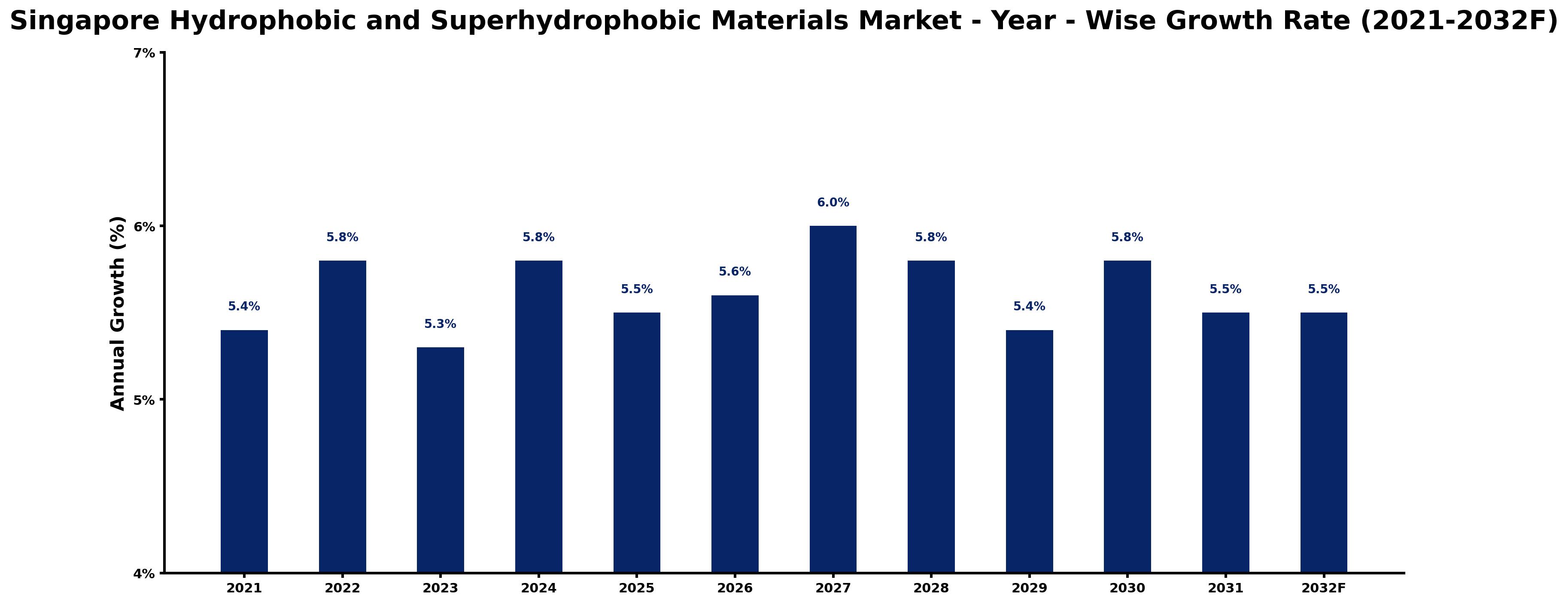
The table below presents the year‑wise growth rates along with the key drivers influencing the market
| Year | Growth Rate | Major Drivers |
| 2021 | 5.4% | Increasing industrial automation investments |
| 2022 | 5.8% | Rapid growth in telecom and data center sectors |
| 2023 | 5.3% | Increasing industrial infrastructure investments |
| 2024 | 5.8% | Growing urbanization and commercial development |
| 2025 | 5.5% | Increasing adoption of advanced technologies |
| 2026 | 5.6% | Government infrastructure modernization initiatives |
| 2027 | 6.0% | Rising electricity demand across industries |
| 2028 | 5.8% | Government infrastructure modernization initiatives |
| 2029 | 5.4% | Increasing adoption of advanced technologies |
| 2030 | 5.8% | Rapid growth in telecom and data center sectors |
| 2031 | 5.5% | Expansion of transportation and logistics networks |
| 2032 | 5.5% | Increasing smart city development projects |
Note - Market size estimations and growth projections presented in this report are based on 6Wresearch’s advanced forecasting approach, validated with industry datasets as of June 2026.
Singapore Hydrophobic and Superhydrophobic Materials Market Synopsis
The strongest force shaping the Singapore Hydrophobic and Superhydrophobic Materials Market is the relentless push for surface protection across various industries. As companies strive to extend the life of their products and machinery, the need for effective water-repelling coatings has become paramount.
Moreover, the ongoing trend towards innovation in the electronics and textiles sectors significantly influences market dynamics. As end-users increasingly prioritize functionality and durability, manufacturers are keen to incorporate hydrophobic and superhydrophobic treatments to meet these expectations.
Singapore Hydrophobic and Superhydrophobic Materials Market Key Takeaways
- Hydrophobic and superhydrophobic materials are increasingly crucial in protecting equipment across diverse industrial sectors.
- The electronics industry is a major driver for innovative coatings due to heightened demand for water-resistant devices.
- Textile applications are expanding, particularly in outdoor gear and apparel, fostering growth opportunities.
- Sustainability concerns are pushing for the development of eco-friendly alternatives to traditional hydrophobic coatings.
- The COVID-19 pandemic has accelerated the need for easy-to-clean surfaces in healthcare and hygiene-focused applications.
Evaluation of Restraints in Singapore Hydrophobic and Superhydrophobic Materials Market
Despite its growth, the Singapore Hydrophobic and Superhydrophobic Materials Market faces several restraints. One significant challenge is the durability of these coatings, particularly in harsh environments. Frequent wear and tear can lead to diminished effectiveness, which is a concern for many end-users. Additionally, the cost associated with the production and application of these advanced materials often exceeds that of traditional coatings, presenting a barrier for broader adoption, especially among price-sensitive industries. Environmental concerns surrounding the chemicals used in some hydrophobic coatings are also prompting a shift towards more sustainable alternatives.
Singapore Hydrophobic and Superhydrophobic Materials Market Trends
Emerging trends in the Singapore Hydrophobic and Superhydrophobic Materials Market include a growing emphasis on sustainability, driving manufacturers to innovate eco-friendly coating solutions. Moreover, advancements in nanotechnology are enhancing the performance and applicability of these materials across multiple sectors. The integration of smart technologies into hydrophobic coatings, allowing for self-cleaning and additional functionalities, is also gaining traction. Such trends are expected to shape the future landscape of the market significantly.
Singapore Hydrophobic and Superhydrophobic Materials Market Opportunities
Genuine growth opportunities in the Singapore Hydrophobic and Superhydrophobic Materials Market lie in the burgeoning demand for water-resistant applications in construction and automotive sectors. The shift towards smart textiles presents another promising avenue, with applications in high-performance clothing and outdoor gear. Additionally, the healthcare industry is increasingly recognizing the value of these materials in minimizing contamination risks, opening doors for innovative product development and investment.
Government Initiatives in the Singapore Hydrophobic and Superhydrophobic Materials Market
The Singapore government has been proactive in promoting research and development in advanced materials, including hydrophobic coatings. Initiatives aimed at enhancing industrial resilience and fostering innovation in manufacturing have been launched, encouraging local companies to invest in these technologies. Public spending on infrastructure improvements also indirectly supports the demand for durable materials, driving growth in the hydrophobic and superhydrophobic sectors.
Future Insights of the Singapore Hydrophobic and Superhydrophobic Materials Market
Looking ahead to 2026-2032, the Singapore Hydrophobic and Superhydrophobic Materials Market is poised for significant growth. As industries continue to prioritize durability and sustainability, the demand for advanced water-repelling coatings will likely increase. Innovations in material science, combined with favorable government policies, will foster an environment ripe for development. Furthermore, the increasing awareness of hygiene in public spaces post-pandemic will continue to fuel the market's expansion.
Singapore Hydrophobic and Superhydrophobic Materials Market Latest Developments (May 2025 - June 2026)
Recent developments in the Singapore Hydrophobic and Superhydrophobic Materials Market indicate a heightened focus on enhancing the environmental sustainability of products. Manufacturers are prioritizing the creation of coatings that minimize ecological impact while maintaining high performance. Additionally, collaborations between industry players and research institutions are driving innovation, leading to breakthroughs in application techniques and formulation. These advancements are positioning the market for a robust trajectory in the coming years.
Singapore Hydrophobic and Superhydrophobic Materials Market - Key Attractiveness of the Report
- 10 Years of Market Numbers
- Historical Data Starting from 2022 to 2025
- Base Year: 2025
- Forecast Data until 2032
- Key Performance Indicators Impacting the Market
- Major Upcoming Developments and Projects
Key Highlights of the Report:
- Singapore Hydrophobic and Superhydrophobic Materials Market Outlook
- Market Size of Singapore Hydrophobic and Superhydrophobic Materials Market, 2025
- Forecast of Singapore Hydrophobic and Superhydrophobic Materials Market, 2032F
- Historical Data and Forecast of Singapore Hydrophobic and Superhydrophobic Materials Revenues & Volume for the Period 2022-2032F
- Singapore Hydrophobic and Superhydrophobic Materials Market Trend Evolution
- Singapore Hydrophobic and Superhydrophobic Materials Market Drivers and Challenges
- Singapore Hydrophobic and Superhydrophobic Materials Price Trends
- Singapore Hydrophobic and Superhydrophobic Materials Porter's Five Forces
- Singapore Hydrophobic and Superhydrophobic Materials Industry Life Cycle
- Historical Data and Forecast of Singapore Hydrophobic and Superhydrophobic Materials Market Revenues & Volume By Product for the Period 2022-2032F
- Historical Data and Forecast of Singapore Hydrophobic and Superhydrophobic Materials Market Revenues & Volume By Anti-corrosion for the Period 2022-2032F
- Historical Data and Forecast of Singapore Hydrophobic and Superhydrophobic Materials Market Revenues & Volume By Anti-wetting for the Period 2022-2032F
- Historical Data and Forecast of Singapore Hydrophobic and Superhydrophobic Materials Market Revenues & Volume By Anti-icing for the Period 2022-2032F
- Historical Data and Forecast of Singapore Hydrophobic and Superhydrophobic Materials Market Revenues & Volume By Self-cleaning for the Period 2022-2032F
- Historical Data and Forecast of Singapore Hydrophobic and Superhydrophobic Materials Market Revenues & Volume By End user for the Period 2022-2032F
- Historical Data and Forecast of Singapore Hydrophobic and Superhydrophobic Materials Market Revenues & Volume By Steel & Metal for the Period 2022-2032F
- Historical Data and Forecast of Singapore Hydrophobic and Superhydrophobic Materials Market Revenues & Volume By Building & Construction for the Period 2022-2032F
- Historical Data and Forecast of Singapore Hydrophobic and Superhydrophobic Materials Market Revenues & Volume By Automotive for the Period 2022-2032F
- Historical Data and Forecast of Singapore Hydrophobic and Superhydrophobic Materials Market Revenues & Volume By Textile & Fabric for the Period 2022-2032F
- Historical Data and Forecast of Singapore Hydrophobic and Superhydrophobic Materials Market Revenues & Volume By Others for the Period 2022-2032F
- Singapore Hydrophobic and Superhydrophobic Materials Import Export Trade Statistics
- Market Opportunity Assessment By Product
- Market Opportunity Assessment By End user
- Singapore Hydrophobic and Superhydrophobic Materials Top Companies Market Share
- Singapore Hydrophobic and Superhydrophobic Materials Competitive Benchmarking By Technical and Operational Parameters
- Singapore Hydrophobic and Superhydrophobic Materials Company Profiles
- Singapore Hydrophobic and Superhydrophobic Materials Key Strategic Recommendations






































