Singapore Hyperscale Data Center Market Size & Growth Rate (2026-2032)
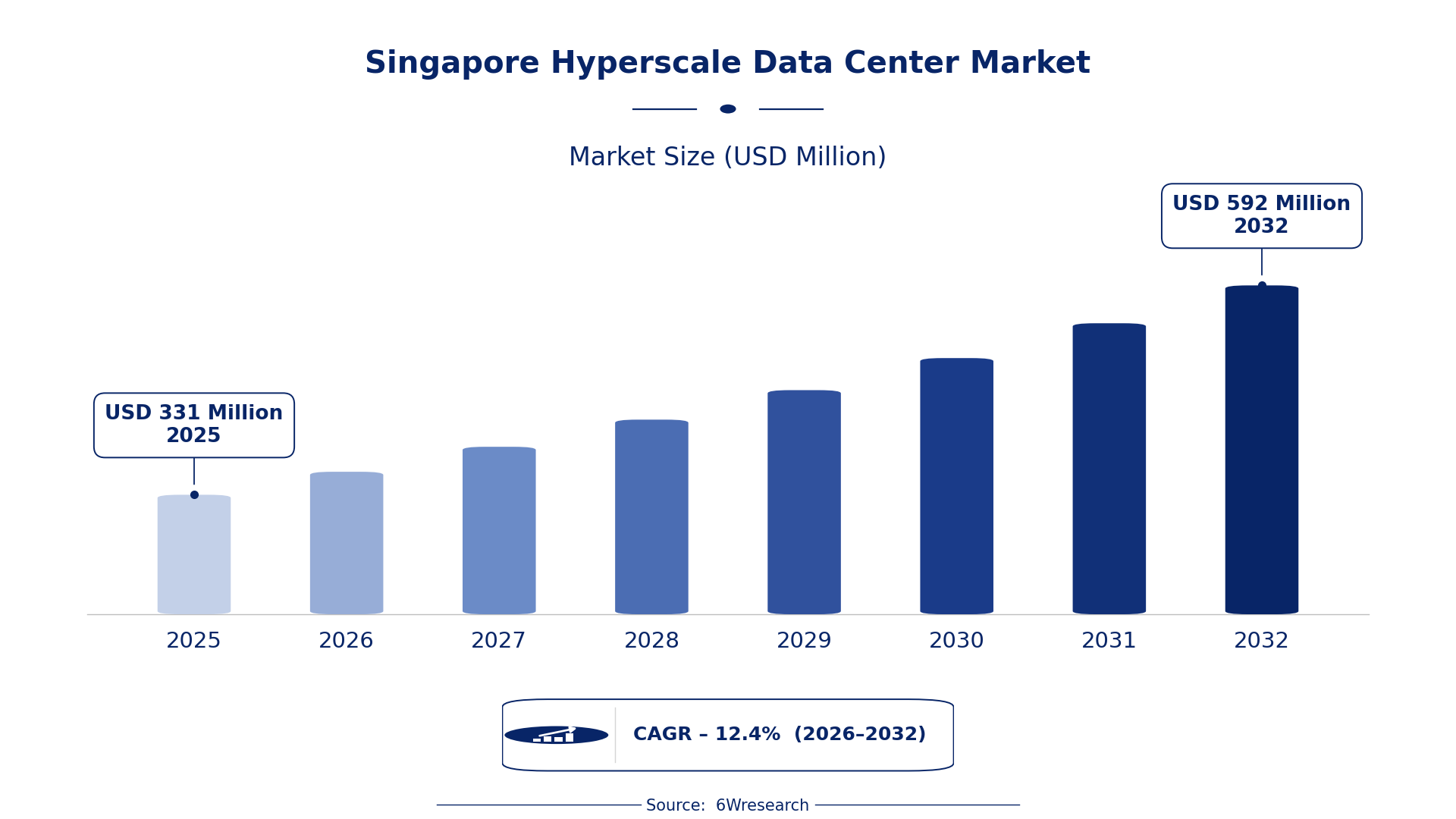
The Singapore Hyperscale Data Center Market was estimated at USD 331 Million in 2025 and is projected to reach USD 592 Million by 2032, growing at a CAGR of 12.4% from 2026 to 2032.
Singapore Hyperscale Data Center Market Synopsis
The hyperscale data center market in Singapore is currently experiencing unprecedented growth, largely fueled by the demand for cloud services and the surge in digital business operations. Positioned as a key data hub in the Asia-Pacific region, Singapore's data centers are critical to the infrastructure supporting various sectors, including finance, technology, and e-commerce.
As businesses increasingly transition to digital platforms, hyperscale data centers are becoming indispensable. Their ability to provide vast scalability and efficiency is attracting investments and innovations aimed at meeting the rising data demands and processing requirements that define today's economy.
Singapore Hyperscale Data Center Market Year-wise Growth Rate and Key Drivers
This graph illustrates the annual growth rates of the Singapore Hyperscale Data Center Market from 2021 to 2032, highlighting a steady upward trajectory and projected expansion over the forecast period.
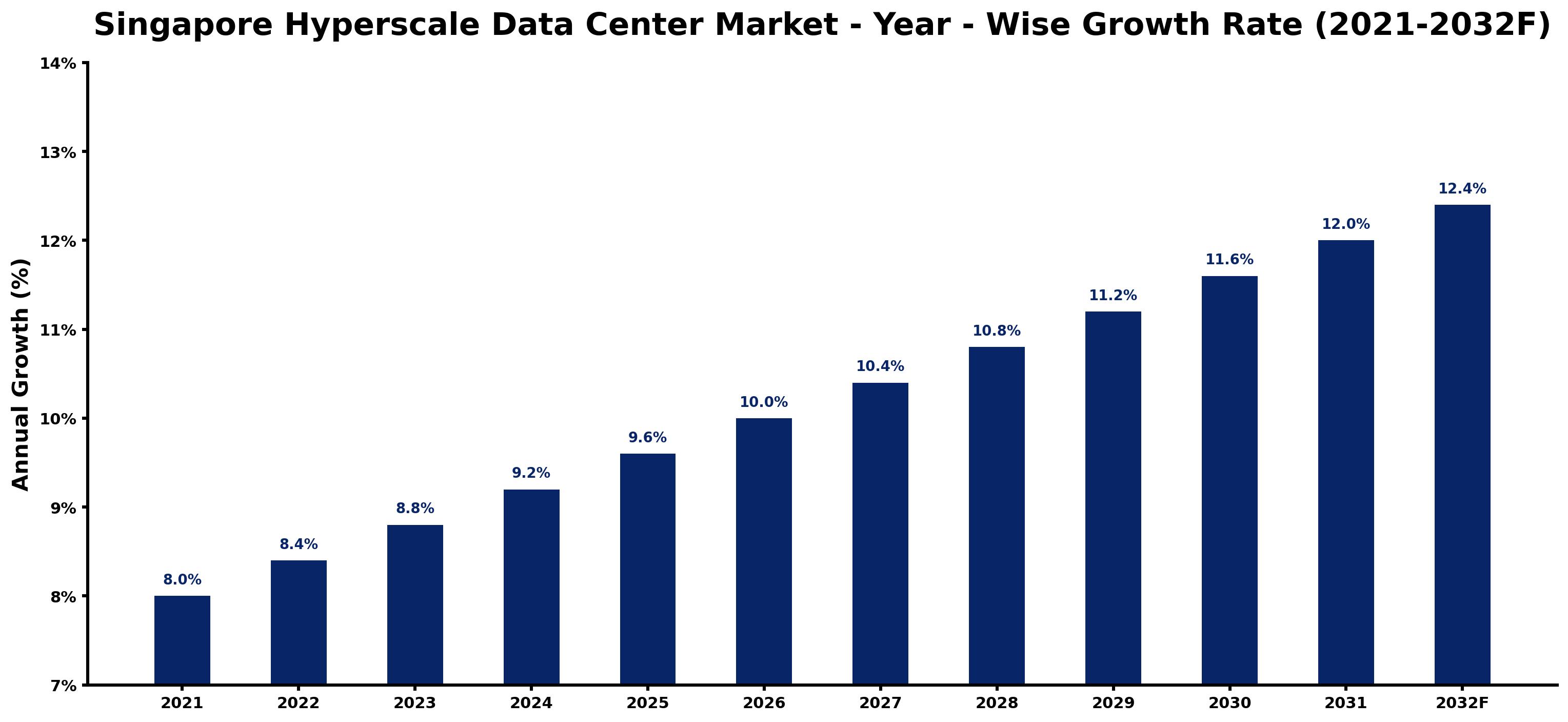
The table below presents the year‑wise growth rates along with the key drivers influencing the market
| Year | Growth Rate | Major Drivers |
| 2021 | 8.0% | Government's data center sustainability initiatives attracting investments. |
| 2022 | 8.4% | Continued growth in regional e-commerce platforms boosting capacity. |
| 2023 | 8.8% | Singapore's position as a digital gateway for Southeast Asia. |
| 2024 | 9.2% | Implementation of stricter data privacy laws driving data center needs. |
| 2025 | 9.6% | Increase in localized cloud service providers expanding infrastructure. |
| 2026 | 10.0% | Boost in 5G deployment enhancing data transmission capabilities. |
| 2027 | 10.4% | Partnerships with global tech firms for localized data solutions. |
| 2028 | 10.8% | Growing fintech sector demands robust data security services. |
| 2029 | 11.2% | Increased government spending on digital economy transformations. |
| 2030 | 11.6% | Focus on digital identity frameworks enhancing data center relevance. |
| 2031 | 12.0% | Rising urbanization trends necessitating more centralized data facilities. |
| 2032 | 12.4% | Emerging trends in blockchain technology requiring enhanced data centers. |
Note: Market size estimations and growth projections presented in this report are based on 6Wresearch's proprietary forecasting methodology, utilizing the latest available industry data, government publications, and primary research inputs.
Singapore Hyperscale Data Center Market Key Takeaways
Below are some of the specific key takeaways from the market, including:
- Singapore serves as a crucial regional hub for hyperscale data centers, driven by robust cloud adoption.
- Demand for extensive computing and storage capabilities is pushing the development of new facilities.
- Energy efficiency and sustainability are becoming key focal points amid growing environmental concerns.
- Government initiatives are increasingly supporting infrastructure development and investment in the sector.
- The COVID-19 pandemic has accelerated the growth trajectory of the hyperscale data center market.
Evaluation of Restraints in Singapore Hyperscale Data Center Market
Despite its rapid growth, the Singapore hyperscale data center market faces several constraints. Chief among these is the challenge of scaling operations in a sustainable manner, especially given the significant energy demands of these facilities. As the market expands, ensuring energy efficiency while managing vast data loads remains a formidable task. on top of that, regulatory compliance and cybersecurity concerns are paramount, necessitating continuous investment in infrastructure and technology to safeguard sensitive data. Environmental impact also looms large, pushing operators to adopt more sustainable practices to mitigate their carbon footprint.
Singapore Hyperscale Data Center Market Trends
Several trends are shaping the Singapore hyperscale data center market. A notable shift towards green technologies is evident, with operators investing in renewable energy sources to power their facilities. There is also a rising demand for edge computing solutions, as businesses look to minimize latency and optimize data processing closer to end-users. The integration of artificial intelligence and machine learning technologies is becoming more prevalent, enhancing operational efficiencies and predictive maintenance. Lastly, the collaboration between public and private sectors to enhance digital infrastructure is gaining momentum, reflecting a concerted effort to bolster the region's technological capabilities.
Singapore Hyperscale Data Center Market Opportunities
Growth opportunities abound in the Singapore hyperscale data center market. The increasing reliance on cloud services presents substantial potential for new data center developments. Companies focusing on hybrid cloud solutions are likely to see increased investment as businesses seek to balance on-premises and cloud-based infrastructure. Additionally, partnerships aimed at sustainability innovations can attract funding and enhance operational efficiencies. The growing adoption of 5G technology will also drive demand for data centers that can accommodate higher data throughput and lower latency requirements.
Government Initiatives in the Singapore Hyperscale Data Center Market
The Singapore government plays a crucial role in shaping the hyperscale data center market through supportive policies and strategic initiatives. With a clear focus on enhancing digital infrastructure, the government is prioritizing sustainable development while ensuring robust cybersecurity measures are in place. These initiatives are essential to maintaining Singapore's competitive edge in the global digital economy.
- A national digital infrastructure upgrade programme was completed in early 2023, enhancing connectivity and data management capabilities.
- The government is currently rolling out a regulatory framework aimed at improving energy efficiency standards for new data center developments.
- A public-private initiative is in the planning stages, set to enhance the integration of renewable energy sources in data center operations by 2026.
- Ongoing assessments of cybersecurity measures are being conducted to ensure compliance with international standards.
- A recent initiative launched in late 2022 focuses on funding for research and development in sustainable data center technologies.
Future Insights of the Singapore Hyperscale Data Center Market
Looking ahead to 2026-2032, the Singapore hyperscale data center market is expected to flourish. The convergence of technological advancements and increased data consumption will propel the market forward. Investments in green technologies and sustainable practices will not only address environmental concerns but also attract environmentally conscious clients. As the demand for cloud services continues to rise, hyperscale data centers will remain a linchpin in Singapore's digital infrastructure, facilitating the growth of various sectors and enhancing the region's status as a technological hub.
Singapore Hyperscale Data Center Market Latest Developments
In the past year, the Singapore hyperscale data center market has seen dynamic developments that reflect the growing urgency for enhanced digital infrastructure. Companies are increasingly focusing on energy efficiency and sustainability as core components of their operational strategies. This shift is indicative of a broader trend towards environmentally responsible practices that are becoming essential for future growth.
- A major technology vendor announced the launch of a new data center facility in Q3 2023, emphasizing energy-efficient design and renewable energy usage.
- Construction of an advanced data center facility began in early 2023 and is expected to focus on high-density server deployment.
- A partnership between two leading firms was formed in late 2022 to develop AI-driven data management solutions, with initial implementations expected by mid-2024.
- Current upgrades to existing facilities are underway, focusing on improving cooling technologies to enhance energy efficiency.
- A rollout of a new data processing solution is planned for late 2024, aimed at addressing the increasing demand for low-latency services.
Singapore Hyperscale Data Center Market - Key Attractiveness of the Report
- 10 Years of Market Numbers
- Historical Data Starting from 2022 to 2025
- Base Year: 2025
- Forecast Data until 2032
- Key Performance Indicators Impacting the Market
- Major Upcoming Developments and Projects
Key Highlights of the Report:
- Singapore Hyperscale Data Center Market Outlook
- Market Size of Singapore Hyperscale Data Center Market, 2025
- Forecast of Singapore Hyperscale Data Center Market, 2032
- Historical Data and Forecast of Singapore Hyperscale Data Center Revenues & Volume for the Period 2022-2032F
- Singapore Hyperscale Data Center Market Trend Evolution
- Singapore Hyperscale Data Center Market Drivers and Challenges
- Singapore Hyperscale Data Center Price Trends
- Singapore Hyperscale Data Center Porter's Five Forces
- Singapore Hyperscale Data Center Industry Life Cycle
- Historical Data and Forecast of Singapore Hyperscale Data Center Market Revenues & Volume By Solution for the Period 2022-2032F
- Historical Data and Forecast of Singapore Hyperscale Data Center Market Revenues & Volume By Server for the Period 2022-2032F
- Historical Data and Forecast of Singapore Hyperscale Data Center Market Revenues & Volume By Storage for the Period 2022-2032F
- Historical Data and Forecast of Singapore Hyperscale Data Center Market Revenues & Volume By Networking for the Period 2022-2032F
- Historical Data and Forecast of Singapore Hyperscale Data Center Market Revenues & Volume By Software for the Period 2022-2032F
- Historical Data and Forecast of Singapore Hyperscale Data Center Market Revenues & Volume By Service for the Period 2022-2032F
- Historical Data and Forecast of Singapore Hyperscale Data Center Market Revenues & Volume By Consulting for the Period 2022-2032F
- Historical Data and Forecast of Singapore Hyperscale Data Center Market Revenues & Volume By Installation and deployment for the Period 2022-2032F
- Historical Data and Forecast of Singapore Hyperscale Data Center Market Revenues & Volume By Maintenance and support for the Period 2022-2032F
- Historical Data and Forecast of Singapore Hyperscale Data Center Market Revenues & Volume By End-User for the Period 2022-2032F
- Historical Data and Forecast of Singapore Hyperscale Data Center Market Revenues & Volume By Cloud providers for the Period 2022-2032F
- Historical Data and Forecast of Singapore Hyperscale Data Center Market Revenues & Volume By Colocation providers for the Period 2022-2032F
- Historical Data and Forecast of Singapore Hyperscale Data Center Market Revenues & Volume By Enterprises for the Period 2022-2032F
- Historical Data and Forecast of Singapore Hyperscale Data Center Market Revenues & Volume By Data Center Size for the Period 2022-2032F
- Historical Data and Forecast of Singapore Hyperscale Data Center Market Revenues & Volume By Small and medium-sized data centers for the Period 2022-2032F
- Historical Data and Forecast of Singapore Hyperscale Data Center Market Revenues & Volume By Large data centers for the Period 2022-2032F
- Historical Data and Forecast of Singapore Hyperscale Data Center Market Revenues & Volume By Industry for the Period 2022-2032F
- Historical Data and Forecast of Singapore Hyperscale Data Center Market Revenues & Volume By Banking, Financial Services, and Insurance (BFSI) for the Period 2022-2032F
- Historical Data and Forecast of Singapore Hyperscale Data Center Market Revenues & Volume By IT and telecom for the Period 2022-2032F
- Historical Data and Forecast of Singapore Hyperscale Data Center Market Revenues & Volume By Research and academics for the Period 2022-2032F
- Historical Data and Forecast of Singapore Hyperscale Data Center Market Revenues & Volume By Government and defense for the Period 2022-2032F
- Historical Data and Forecast of Singapore Hyperscale Data Center Market Revenues & Volume By Retail for the Period 2022-2032F
- Historical Data and Forecast of Singapore Hyperscale Data Center Market Revenues & Volume By Manufacturing for the Period 2022-2032F
- Historical Data and Forecast of Singapore Hyperscale Data Center Market Revenues & Volume By Healthcare for the Period 2022-2032F
- Historical Data and Forecast of Singapore Hyperscale Data Center Market Revenues & Volume By Media and entertainment for the Period 2022-2032F
- Singapore Hyperscale Data Center Import Export Trade Statistics
- Market Opportunity Assessment By Solution
- Market Opportunity Assessment By Service
- Market Opportunity Assessment By End-User
- Market Opportunity Assessment By Data Center Size
- Market Opportunity Assessment By Industry
- Singapore Hyperscale Data Center Top Companies Market Share
- Singapore Hyperscale Data Center Competitive Benchmarking By Technical and Operational Parameters
- Singapore Hyperscale Data Center Company Profiles
- Singapore Hyperscale Data Center Key Strategic Recommendations






































