Singapore Ice cream Market Size Growth Rate
The Singapore Ice cream Market is projected to witness mixed growth rate patterns during 2025 to 2029. Starting at 3.57% in 2025, the market peaks at 3.82% in 2027, and settles at 3.37% by 2029.
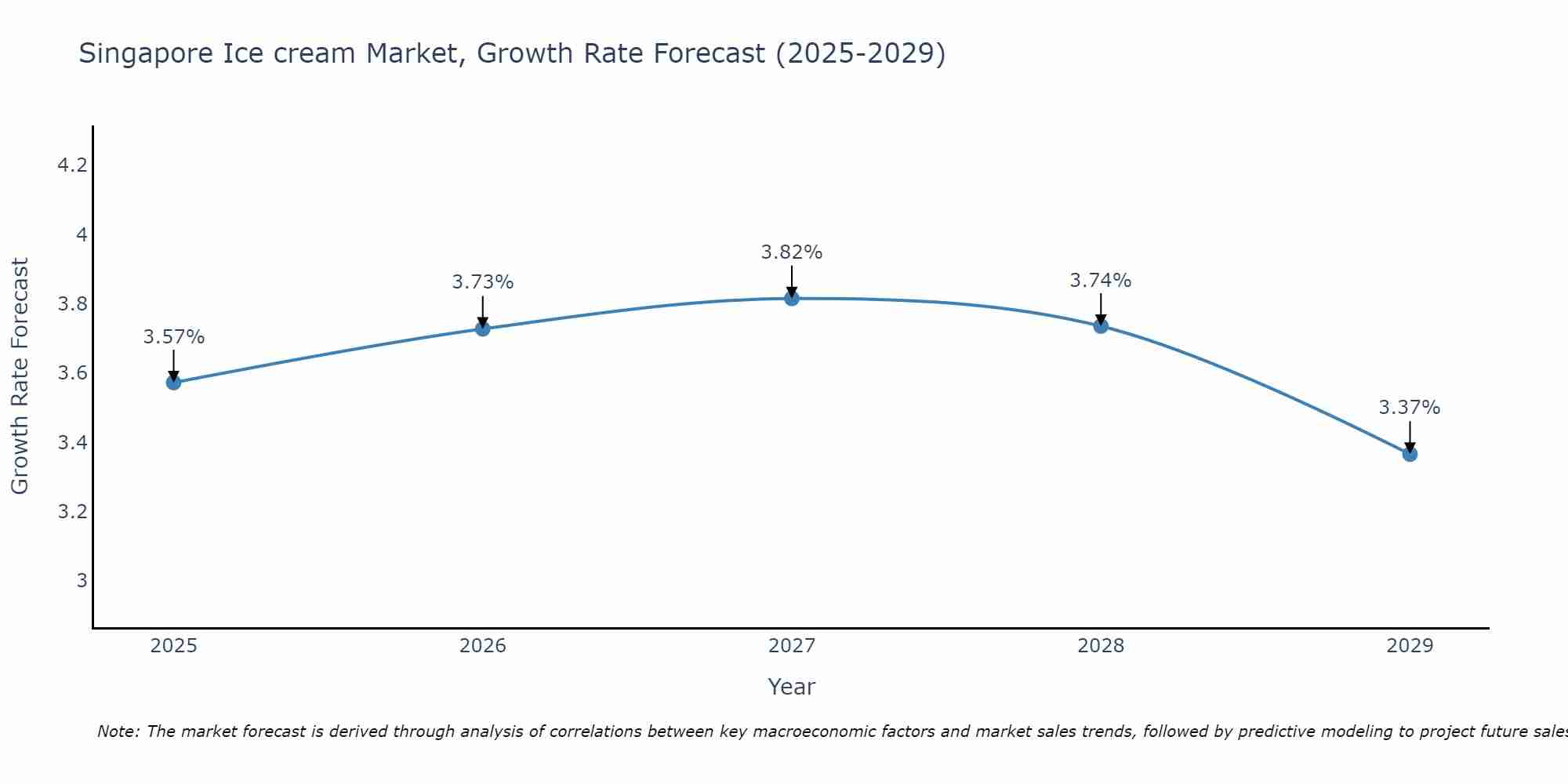
Singapore Ice Cream Market Growth Rate
According to 6Wresearch internal database and industry insights, the Singapore Ice Cream Market is projected to grow at a compound annual growth rate (CAGR) of 5.8% during the forecast period (2026-2032).
Topics Covered in the Singapore Ice Cream Market Report
The Singapore Ice Cream Market report thoroughly covers the market by sales type and distribution channel type. The market report provides an unbiased and detailed analysis of ongoing market trends, opportunities/high growth areas, and market drivers, which help stakeholders devise and align their market strategies according to the current and future market dynamics.
Singapore Ice Cream Market Highlights
| Report Name | Singapore Ice Cream Market |
| Forecast period | 2026-2032 |
| CAGR | 5.8% |
| Growing Sector | Take-home Ice Cream & Modern Retail Channels |
Singapore Ice Cream Market Synopsis
Singapore Ice Cream Market is expected to witness stead growth due to increase in disposable income alongside the quest for premium desserts and the change in consumer lifestyle. People living in urban areas, on the other hand, are exhibiting a significant preference for creative flavors, products with less sugar, and premium items made by local artisans. In addition to that, the growth of supermarkets, convenience stores, and online grocery platforms has made it much easier for consumers to get products nationwide. The rising tourism and a robust cafe culture are also helping to increase spontaneous purchases. Besides that, the entry of international brands and constant product innovation is creating a competitive environment and thereby pushing the market growth overall.
Evaluation of Growth Drivers in the Singapore Ice Cream Market
Below mentioned are some prominent drivers and their influence on the market dynamics:
| Drivers | Primary Segments Affected | Why it Matters (Evidence) |
| Rising Disposable Income | Premium & Take-home; Supermarkets | Higher spending capacity increases demand for premium and value-added products. |
| Expansion of Modern Retail | Take-home; Supermarkets & Convenience Stores | Increased shelf space improves product availability and visibility, supporting higher sales. |
| Growing Demand for Innovative Flavors | Artisanal & Impulse; Parlours | Unique and premium flavor offerings attract younger and higher-income consumers. |
| Growth of Online Grocery Platforms | Take-home; Online | Home delivery and bulk purchase options enhance convenience and drive volume sales. |
| Strong Tourism & Café Culture | Impulse & Artisanal; Parlours | Tourist spending and social dining trends boost impulse purchases and premium consumption. |
Singapore Ice Cream Market is expected to grow at the CAGR of 5.8% during the forecast period of 2026-2032. The growth is backed by increased consumer inclination towards indulgent and premium dessert products, and also more product availability through both physical and digital retail channels. Likewise, the trend of healthier formulations like low, fat, plant, based, and reduced, sugar variants is broadening the consumer base. Moreover, vigorous brand competition, regular product launches, and marketing innovations are facilitating trial and repeat purchasing. Furthermore, increasing tourism activities and changing urban lifestyles will be additional factors to a steady demand growth across various sales formats.
Evaluation of Restraints in the Singapore Ice Cream Market
Below mentioned are some major restraints and their influence on the market dynamics:
| Restraints | Primary Segments Affected | What This Means (Evidence) |
| High Storage and Logistics Costs | All Types; Retail Channels | Cold chain requirements significantly increase transportation, storage, and operational expenses. |
| Health Concerns Over Sugar Content | Impulse; Mass Products | Health-conscious consumers tend to reduce consumption, limiting demand for high-sugar products. |
| Premium Pricing Pressure | Artisanal; Parlours | Higher prices restrict purchases among price-sensitive consumers. |
| Limited Shelf Space Competition | Take-home; Supermarkets | Intense competition for shelf space reduces product visibility, especially for smaller brands. |
| Dependence on Imported Ingredients | Premium & Artisanal; All Channels | Import costs and supply fluctuations directly impact product pricing and profit margins. |
Singapore Ice Cream Industry Challenges
The Singapore Ice Cream Industry is expected to grow positively, however, there are still some operational and market, related challenges that hinder the industry’s High rental costs and operational expenses make it difficult for smaller artisanal brands and specialty parlours to sustain profitability. Moreover, rigorous cold chain requirements escalate the logistics and storage costs throughout the supply chain. The market also comes under intense competition from well, known international brands, which results in pressure on pricing and product differentiation. Besides, increased consumer awareness of health and nutrition is causing manufacturers to reformulate their products, thereby raising production complexity. Limited retail shelf space and heavy reliance on imported raw materials are the two additional factors contributing to operational challenges.
Singapore Ice Cream Market Trends
Key trends shaping the Singapore Ice Cream Market Growth include:
- Premiumization and Gourmet Offerings: Consumers are more and more turning to premium, small, batch, and gourmet ice cream products. This trend is leading brands to concentrate on using high, quality ingredients, creating unique textures, and bringing worldwide flavor concepts.
- Growth of Plant-Based and Health-Focused Variants: Health, conscious consumers are progressively looking for dairy, free, low, sugar, and functional ice cream variants. To meet the changing dietary preferences of consumers, manufacturers are introducing new products based on plant, based milk and natural sweeteners.
- Rise of Experiential Ice Cream Parlours: Artisanal parlours are concentrating on the customer experience in, store and social media friendly presentation of the products. This combination of tactics helps to enhance the brand engagement and get impulse purchases from younger consumers.
- Expansion of E-commerce and Quick Delivery: Online grocery platforms and rapid delivery services are becoming major outlets for sales. Home delivery of take, home ice cream packs is a convenience that allows for the purchases of larger quantities.
- Seasonal and Limited-Edition Product Launches: Brand owners are inventing holiday, themed and limited, time tastes to stir up the crowd and to create a need to buy quickly. These initiations sustain the customer's attraction and provide a way of the brand's differentiation from competitors.
Investment Opportunities in the Singapore Ice Cream Market
Key investment opportunities emerging in the Singapore Ice Cream Market include:
- Development of Premium and Artisanal Brands – More people are ready to spend extra on quality and uniqueness, thus the premium niche becomes available. Investors might focus on specialty concepts and unique flavor portfolios.
- Expansion of Cold Chain Infrastructure – Proper storage and transportation facilities are indispensible to maintain product quality. A step ahead in cold logistics will back up retail expansion and reduce operational losses.
- Plant-Based Ice Cream Manufacturing – The growing vegan and health-conscious population is increasing demand for dairy alternatives. Establishing local production facilities can reduce import dependency and improve margins.
- Digital and Direct-to-Consumer Channels – Online subscriptions and brand-owned delivery platforms are gaining popularity. Investment in digital sales models can enhance customer loyalty and recurring revenue.
- Franchise-Based Parlour Expansion – Branded ice cream outlets in malls and tourist areas offer strong growth potential. Franchise models allow rapid expansion with controlled operational costs.
Top 5 Leading Players in the Singapore Ice Cream Market
Some leading players operating in the Singapore Ice Cream Market include:
1. Unilever PLC
| Company Name | Unilever PLC |
| Established Year | 1929 |
| Headquarters | London, United Kingdom |
| Official Website | Click Here |
Unilever operates major ice cream brands such as Magnum, Wall’s, and Ben & Jerry’s in Singapore. The company focuses on premium innovation, strong retail distribution, and sustainable sourcing while expanding its presence across modern trade and convenience channels.
2. Nestlé S.A.
| Company Name | Nestlé S.A. |
| Established Year | 1866 |
| Headquarters | Vevey, Switzerland |
| Official Website | Click Here |
Nestlé offers a wide range of impulse and take-home ice cream products under well-known brands. The company emphasizes product innovation, portion control formats, and strong cold chain distribution to meet evolving consumer preferences across Singapore’s retail network.
3. General Mills Inc.
| Company Name | General Mills Inc. |
| Established Year | 1928 |
| Headquarters | Minnesota, USA |
| Official Website | Click Here |
General Mills markets premium ice cream through its Häagen-Dazs brand, which has strong recognition in Singapore. The company focuses on indulgent flavors, high-quality ingredients, and expanding its presence through supermarkets and branded retail outlets.
4. F&N Foods Pte Ltd
| Company Name | F&N Foods Pte Ltd |
| Established Year | 1883 |
| Headquarters | Singapore |
| Official Website | Click Here |
F&N Foods produces and distributes a range of dairy and frozen dessert products tailored to local tastes. The company leverages strong regional distribution networks and focuses on affordability, quality, and product accessibility across retail channels.
5. Udders Ice Cream
| Company Name | Udders Ice Cream |
| Established Year | 2007 |
| Headquarters | Singapore |
| Official Website | Click Here |
Udders is a well-known local artisanal brand offering unique, locally inspired flavors and premium handcrafted products. The company emphasizes experiential retail, strong brand identity, and expansion through parlours and modern retail partnerships.
Government Regulations Introduced in the Singapore Ice Cream Market
According to Singapore’s Government data, food safety and quality standards are strictly regulated by the Singapore Food Agency (SFA), which oversees the production, import, storage, and distribution of ice cream products. Manufacturers and distributors must comply with stringent hygiene requirements, cold chain standards, and accurate product labeling to ensure consumer safety. In addition, the government is encouraging the consumption of healthier food through different programs such as the Healthier Choice Symbol, which is an incentive for companies to produce reduced, sugar and lower, fat products. At the same time, support for local food innovation through the Singapore Food Story initiative is providing a great opportunity for product development, strengthening local manufacturing capabilities, and raising overall frozen dessert sector quality standards.
Future Insights of the Singapore Ice Cream Market
Singapore Ice Cream Market is expected to demonstrate steady growth in the coming years, supported by evolving consumer preferences, premium product demand, and expanding retail accessibility. The increasing focus on healthier indulgence, including plant-based and low-sugar formulations, will drive innovation among manufacturers. Growth of e-commerce, quick commerce, and direct-to-consumer delivery models is also expected to reshape distribution strategies. In addition, rising tourism activity and the expansion of experiential dessert outlets will support impulse consumption. With continued product innovation, strong brand competition, and supportive food safety regulations, the market is likely to offer stable and attractive opportunities for both local and international players.
Market Segmentation Analysis
The report offers a comprehensive study of the subsequent market segments and their leading categories.
Take-home Ice Cream to Dominate the Market – By Sales Type
According to Mohit, Senior Research Analyst, 6Wresearch, the Take-home ice cream category holds the largest market segment in the Singapore Ice Cream Market Share. This dominance is further supported by the extensive presence of family packs and multipacks in supermarkets, hypermarkets, and online grocery platforms. To freeze desserts at home is becoming more and more a home convenience and value benefit thus consumer preference trend is toward freezing desserts at home. The demand is gaining more strength result of the at, home entertainment trend and family, oriented consumption pattern. Moreover, the bulk purchases are being encouraged by regular promotional discounts, flavor variety, and cold chain infrastructure thus take, home formats are leading in overall market revenue segment.
Key Attractiveness of the Report
- 10 Years of Market Numbers.
- Historical Data Starting from 2022 to 2025.
- Base Year: 2025.
- Forecast Data until 2032.
- Key Performance Indicators Impacting the Market.
- Major Upcoming Developments and Projects.
Key Highlights of the Report:
- Singapore Ice Cream Market Outlook
- Market Size of Singapore Ice Cream Market, 2025
- Forecast of Singapore Ice Cream Market, 2032
- Historical Data and Forecast of Singapore Ice Cream Revenues & Volume for the Period 2022-2032
- Singapore Ice Cream Market Trend Evolution
- Singapore Ice Cream Market Drivers and Challenges
- Singapore Ice Cream Price Trends
- Singapore Ice Cream Porter's Five Forces
- Singapore Ice Cream Industry Life Cycle
- Historical Data and Forecast of Singapore Ice Cream Market Revenues & Volume By Type for the Period 2022-2032
- Historical Data and Forecast of Singapore Ice Cream Market Revenues & Volume By Impulse Ice Cream for the Period 2022-2032
- Historical Data and Forecast of Singapore Ice Cream Market Revenues & Volume By Take-home Ice Cream for the Period 2022-2032
- Historical Data and Forecast of Singapore Ice Cream Market Revenues & Volume By Artisanal Ice Cream for the Period 2022-2032
- Historical Data and Forecast of Singapore Ice Cream Market Revenues & Volume By Category for the Period 2022-2032
- Historical Data and Forecast of Singapore Ice Cream Market Revenues & Volume By Dairy for the Period 2022-2032
- Historical Data and Forecast of Singapore Ice Cream Market Revenues & Volume By Non-dairy for the Period 2022-2032
- Historical Data and Forecast of Singapore Ice Cream Market Revenues & Volume By Distribution Channel for the Period 2022-2032
- Historical Data and Forecast of Singapore Ice Cream Market Revenues & Volume By On-trade for the Period 2022-2032
- Historical Data and Forecast of Singapore Ice Cream Market Revenues & Volume By Off-trade for the Period 2022-2032
- Historical Data and Forecast of Singapore Ice Cream Market Revenues & Volume By Supermarkets/Hypermarkets for the Period 2022-2032
- Historical Data and Forecast of Singapore Ice Cream Market Revenues & Volume By Convenience Stores for the Period 2022-2032
- Historical Data and Forecast of Singapore Ice Cream Market Revenues & Volume By Specialist Stores for the Period 2022-2032
- Historical Data and Forecast of Singapore Ice Cream Market Revenues & Volume By Other Distribution Channels for the Period 2022-2032
- Singapore Ice Cream Import Export Trade Statistics
- Market Opportunity Assessment By Type
- Market Opportunity Assessment By Category
- Market Opportunity Assessment By Distribution Channel
- Singapore Ice Cream Top Companies Market Share
- Singapore Ice Cream Competitive Benchmarking By Technical and Operational Parameters
- Singapore Ice Cream Company Profiles
- Singapore Ice Cream Key Strategic Recommendations
Market Segmentation
The Market report covers a detailed analysis of the following market segments:
By Sales Types:
- Impulse Ice Cream
- Take-home Ice Cream
- Artisanal Ice Cream
By Distribution Channel Type:
- Supermarket / Hypermarket
- Convenience Stores
- Ice Cream Parlour
- Online
- Others






































